This is Planet Money from NPR.
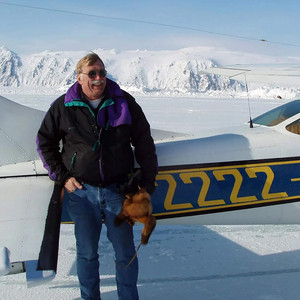
For many years, Ken Jopie ran his own little air taxi service up in Fairbanks, Alaska.
He called it Ken Air.
Most of the villages, the mining camps are totally remote.
The only way to get there is by air.
So...
You know, everything that can be transported gets flown in.
Ken is a bush pilot.
He used to skim over the Alaskan wilderness in his Cessna Skywagon, which is those little single propeller airplanes with just six seats.
The colors that I liked were blue and yellow.
The blue and yellow goes good together, so I had a blue and yellow stripe on it, my name up on the tail, big cargo doors in the back and oversized tires so you can land on rough surfaces.
Pretty much anything you can imagine.
Ken has probably tried to jam it in the back of that Cessna at some point.
We're talking drums full of gasoline, a partially disassembled ATV, a moose from a hunting trip.
Once he had a whole team of sled dogs, like seven or eight of them just loose in the back.
And these were white dogs.
And when they're nervous or shed, there was so much hair in that airplane.
I thought every dog was bald by the time we got where we were going.
But Ken hasn't flown that Cessna with his name up on the tail for a while now.
In fact, Ken Ayer went out of business several years ago.
And the main reason for that has to do with this incident that happened on an April morning in 2012.
Yeah.
That day, Ken had a bunch of jobs lined up.
He was going to deliver a casket for a funeral.
Later, he was going to haul some parts and equipment for a mining outfit.
But first, he had a quick job for one of his regulars, a woman named Helen.
I'm there, you know, getting the airplane ready, getting the covers off the wings and putting gas in.
And Helen the gal and her sister pulled up in a Suburban.
Helen was going to visit her husband who lived in a little village called Beaver, along the banks of the Yukon River.
They were going to celebrate her birthday.
Helen had brought along a bunch of supplies and Ken helped her load those bags and boxes of supplies into the back of his plane.
It was groceries, cardboard box full of groceries.
And she had like 12 packs of Coke and things like that.
So nothing unusual.
Ken says he wasn't really in the business of rifling through his customer stuff.
So he closes the cargo doors, climbs into the pilot seat, the propeller spinning, the engines roaring away, and just as he's about to pull out onto the runway, he sees this guy running up to him.
It's an Alaska state trooper asking him to get out of the plane.
You know, it's like, what?
You know, what's going on?
You know, I had no idea.
So I turned the engine off and got out.
The trooper tells Ken they have a warrant to search his plane.
A couple officers go in the back and start going through Helen's stuff, dumping it on the tarmac.
And that is when Ken spots the problem.
There, among Helen's groceries, Helen had brought along a six-pack of Budweiser.
And the moment you see that beer, what's going through your mind?
Oh, well, uh-oh.
Yeah, the village of Beaver, where Ken and Helen were headed to, it is a dry town.
The few dozen people who live there voted in 2004 to ban all alcohol.
A lot of towns in Alaska have banned alcohol because alcohol abuse has been that big of a problem.
So Helen was in trouble for bootlegging.
The state troopers end up finding a couple of cases of beer in her luggage.
But Ken, Ken was also in trouble for bootlegging.
Prosecutors accused him of knowingly helping Helen smuggle beer.
Yeah, the police had been going after bush pilots like Ken.
Some of them had a reputation for not asking their passengers too many questions about what was in their luggage.
Ken had gotten caught once before, when one of his passengers brought alcohol onto his plane, though that was only a misdemeanor.
This time, Ken was in trouble for a much bigger crime. bootlegging is a felony.
His case goes to trial and the jury is like okay, maybe Ken didn't know about all those you know hidden cases of beer, but that six pack, that six pack of Budweiser in a clear plastic bag yeah, Ken should have known about.
So the jury finds Ken guilty.
When the jury came out and read the verdict, I glanced up at the judge and he was stunned.
He was absolutely stunned to hear that verdict.
That's not what he was expecting.
The judge sentences Ken to the minimum punishment under Alaska law.
Ken gets three days in jail and a $1,500 fine.
But there's another part of Ken's punishment.
Because Ken has been convicted of bootlegging, the judge has no choice but to take away Ken's plane.
You see, under Alaska law, any plane involved in bootlegging becomes property of the state.
So for the crime of helping Helen load a six-pack of Budweiser onto his plane, the state orders Ken to forfeit his Cessna.
And ever since then, for the past dozen years, Ken has been fighting for that plane.
Because, come on, a $95,000 Cessna taken away over a six-pack?
How in the world can this be fair?
Right?
Hello and welcome to Planet Money.
I'm Jeff Guo.
And I'm Sarah Gonzalez.
A few weeks ago, Ken's case and the controversial question at the heart of it caught the attention of the US.
Supreme Court.
It's a question so many courts in the United States right now are struggling with.
And the answers could change criminal punishment forever.
Today on the show.
What are the limits when the government tries to take away your money or your property or your plane over a crime?
What does the Constitution have to say about these economic punishments?
Like, does the fine have to fit the crime?
Ken Jopie has been fighting with the state of Alaska for the last 12 years about his Cessna Skywagon the plane they're trying to take away over a six-pack of beer.
And Ken's lawyers, they are trying to make this very interesting argument.
It has to do with one kind of mysterious line in the U.S.
Constitution.
It's actually just a couple of words.
And one of our nation's experts on those couple of words is Michael O'Hare.
Okay, well, I've got the text of the Eighth Amendment right here.
I'm ready to read this.
Michael is a law professor at Marquette University, where he teaches about crime and punishment.
This is the Eighth Amendment.
It's one of the shortest provisions of the Constitution.
It reads, Now, most people have probably heard of that cruel and unusual punishment part.
Even my kids tell me I can't deprive my kids of access to their iPhones because that would be cruel and unusual punishment.
But very few people are familiar with the other two parts of the Eighth Amendment.
He's talking about the parts of the Eighth Amendment that say excessive bail shall not be required, nor excessive fines imposed.
And that last part is known as the excessive fines clause.
And for most of the past century people weren't really paying much attention to the excessive fines clause, in part because courts weren't really handing out a lot of huge fines.
This was like an obscure part of the Constitution.
When you were in law school, did you guys learn about the excessive fines clause?
Absolutely not.
I don't think I heard those words uttered while I was a law student in the 1990s.
Michael says what changed everything.
What made the excessive fines clause way more relevant?
Started with the war on drugs.
In the 1970s and 1980s, federal and state governments began to really crack down on drug crimes.
They passed laws that forced courts to hand out much harsher prison sentences and much harsher economic punishments to bigger fines.
And also a special kind of penalty called a forfeiture, where the government would confiscate property just for being related to a crime.
That's what happened to Ken, right?
The state of Alaska took his plane in a criminal forfeiture.
So if there is a boat or a private airplane used to carry drugs across the border, those could be seized.
If your house was being used for anything having to do with drug trafficking, the house can be taken.
Cars.
If you are using your car to transport even a small amount of drugs to a drug transaction, the car can be seized.
The goal of these forfeiture laws was to punish drug dealers, to make it so that crime didn't pay.
But these forfeitures were also a way to fund the war on drugs.
Like the police might confiscate a helicopter and turn it into a police helicopter.
Or more likely, they would auction it off and use that cash.
These forfeiture laws led to some pretty extreme situations.
Like, in one case, police found a joint on a yacht.
And so they took the whole yacht.
And the defense lawyers, you know, initially, they weren't sure what to do, right?
Like, what part of the Constitution do we use? to fight these asset forfeitures.
And there are a number of different theories that are advanced, but it turned out that the thing that stuck was the excess of fines clause.
Yeah, those couple of words in the Constitution that say that economic punishments can't be excessive.
And what really put the excessive fines clause on the map was this one Supreme Court case from 1998.
This case was about a guy named Josep Bajikajian.
Bajikajian and his family were flying out of LAX one day.
Now, whenever you leave the country with more than 10000 in cash, you were supposed to report it to the government and fill out this official form.
Hosep Bajikajian and his family, they were carrying a lot of cash and they had not reported it.
But at the airport that day, there was a cash-sniffing dog. who found that cash in their luggage.
They were about to leave the country with more than $300,000.
And under federal law, they had to forfeit all of that money to the U.S. government.
At the Supreme Court, his lawyers argued that this was an excessive fine, because this cash reporting law was created as part of the war on drugs.
It was intended to catch drug dealers and cartel money launderers.
Bajikajian says, but hey, wait a minute.
I'm actually not a drug dealer.
OK, but why does he have all this cash?
He says he was repaying a loan.
And he proves that this $300,000 is legitimate money.
It has no connection to drugs whatsoever.
And the only reason he didn't declare this money was because he says he was scared.
He says where he grew up in Syria, there were a lot of problems with government corruption.
He comes from a foreign country where, if the authorities found out you were traveling with a large amount of cash, the authorities might do a little shakedown.
So Bajikajian says, that's why I didn't want to report the cash.
I didn't trust the authorities.
Well, ironically, it sounds like he did end up getting shaken down.
In a sense.
In a sense.
So here is the argument that Josep's lawyers made.
It boils down to...
Come on, guys.
Clearly there is something wrong here.
Look at the Eighth Amendment.
It says that fines can't be excessive.
And here we are talking about a $300,000 punishment over not filling out a form.
Like, how?
How can this be constitutional?
And at the time a lot of people didn't think that Hosea Bajikajian had any shot in this case, because people had already tried to challenge the other harsh laws that were part of the war on drugs, like the laws that imposed long mandatory prison terms.
People were getting sentenced to decades in prison for pretty low-level crimes like selling a tiny amount of coke, or decades in prison for having just a little bit of marijuana on them if it was their third offense.
And back in the 1980s defense lawyers had tried to argue that some of these prison sentences seemed pretty extreme, pretty cruel and unusual, possibly unconstitutional.
But the Supreme Court was like nope.
In general, we're going to be OK with these super harsh prison sentences.
So basically the Supreme Court.
Before it even got into the whole business of dealing with excessive fines, the Supreme Court had already made pretty clear that the sky is almost the limit when it comes to prison terms.
So that is the context when, in 1998, Hosep's case gets to the Supreme Court.
He's asking the court to put a constitutional limit on fines and forfeitures.
But if the Supreme Court isn't putting real limits on prison terms, why would it put limits on economic types of punishment?
Yeah.
Except that the Supreme Court actually sided with Josep.
The Supreme Court said that what happened to him was unconstitutional, that taking away his 300000 in cash over not filling out a form, that was an unconstitutionally excessive fine.
You know, it's not often you see the birth of a new kind of constitutional argument.
But in 1998, that's basically what happened.
There is a limit to those kinds of economic punishments, a constitutional limit.
The fine has to fit the crime.
Yeah, but what does that actually mean?
Like what makes something an excessive fine versus an okay fine?
Michael says the Supreme Court kind of left that question open.
Yeah, so what the majority said was actually kind of mysterious.
The majority said it's okay if a fine is a little bit disproportionate to the severity of the offense.
It just can't be grossly disproportionate.
OK, what does that mean?
But then the court didn't really explain.
Sounds like the Supreme Court.
It really does.
And OK, some of this vagueness was kind of on purpose.
The Supreme Court wanted to see how the lower courts would apply the excessive fines clause.
You know, give them a chance to come up with their own ways of balancing the fine against the crime.
And at first, defense lawyers were pretty excited about this.
They were like this could be a powerful new tool in our constitutional tool belts to fight back against unfair fines and forfeitures.
There was definitely some optimism.
What ends up happening to all that optimism?
The optimism runs into the reality of lower courts that are not very receptive.
The lower courts are just like rejecting what the Supreme Court says.
Well, the Supreme Court's decision had a lot of wiggle room in it.
After the break, how courts have actually been interpreting the excessive fines clause and how Ken Jopie's case could change it all.
It's now been almost three decades since the Supreme Court said that there is a constitutional limit on economic punishment, that fines and forfeitures generally have to fit the crime.
But that has not stopped state and local governments from issuing a lot of fines and doing a lot of these extreme-sounding forfeitures.
Like in Ken Jopie's case, where in 2012, he basically lost his 95000 airplane over a six-pack of Budweiser.
For the past decade his lawyers have been arguing that that was an unconstitutionally excessive fine.
And recently Ken's appeal reached the highest court in Alaska, the Alaska Supreme Court.
But the judges said, no, Ken's punishment was not excessive.
And almost immediately, that decision catches the attention of a lawyer named Sam Gedge.
I have an alert system where every day Westlaw, the big law database, automatically sends me a list of every case that's come down in the past day or two with the phrase excessive fines in it.
Because you are like the excessive fines guy.
Yeah.
Yeah.
I mean, I get really, really jazzed about the excessive fines clause.
I can't get enough of it.
Sam is a lawyer at the Institute for Justice.
It's this nonprofit law firm that focuses on kind of libertarian issues like private property and free speech.
And for years Sam has been fighting state and local governments trying to stop the kinds of forfeitures we've been talking about, where the police are taking away people's cars over joints of marijuana.
Sam is a big believer in the excessive fines clause.
A couple years ago, he and his colleagues actually won a big case at the U.S.
Supreme Court, where the court said that the excessive fines clause doesn't just apply to the federal government.
It also applies to every state and local government too.
But Sam says, one thing he's noticed in his years doing this work is that, unlike him, a lot of judges were not that jazzed about the excessive fines clause.
They weren't really throwing out fines for being unconstitutionally excessive.
You didn't really see them scrutinizing fines and forfeitures all that closely.
You know, a lot of the lower courts were kind of viewing it as something of a rubber stamp for the government.
So they weren't even like applying the excessive fines clause in the Constitution very harshly.
That's exactly right.
Yeah.
Or we're not really applying it at all.
And when Sam starts reading the decision in Ken Jobe's case, he's like this is one of the most outrageous examples I've seen of a court not taking this excessive fines clause protection seriously.
So, Sam? gives Ken a call, and pretty soon he's on a flight out to meet him.
He's like, Ken, we got to appeal your case to the U.S.
Supreme Court.
Right now, the Supreme Court is deciding whether to take Ken's case.
And here are the stakes.
Sam says, when it comes to the excessive fines clause, there are basically two ends of the spectrum right now, two different ways courts are analyzing whether the fine fits the crime.
On one end of the spectrum, some judges have interpreted the excessive fines clause as a really strong protection.
They ask questions like how bad was the crime that you had to take away this person's car or home or plane?
And does that punishment make sense in this circumstance?
So there are courts that are really kind of grappling seriously with this, that have really kind of gotten their hands dirty and tried to think through what the standard should really look like.
For instance, in Seattle Washington there was a case involving a man who was living out of his truck.
The man had parked his truck for too long in a city lot, so the city towed it away.
They told him that in order to get it back, he had to pay a $500 towing fee.
This case went up to the highest court in Washington state, which said, hold on, for this man...
That fine is unconstitutionally excessive.
This man doesn't have a home.
He can't afford 500 and you can't take away his only shelter, the only means to get to work over a simple parking violation.
Sam says more courts need to be doing that kind of analysis, actually looking at economic punishments on a case-by-case basis, asking if this particular fine fits this particular crime and this particular person.
If we're talking about a drug crime, for example, are they on the Pablo Escobar end of the spectrum or are they on the just low-level addict end of the spectrum?
Sure.
How bad was the crime?
How big is the fine?
Seems like that's...
Pretty simple.
That's exactly right.
Now, where some courts are going wrong is that they're just kind of zooming out and saying well, we don't really care about the facts of this particular case.
It's really enough for them to say, well, the crime as a general matter is a serious crime.
Yeah, so that's the other end of the spectrum.
A lot of courts are more hands-off.
They're not really zooming in on the facts of any particular case, which means they're not finding that many fines or forfeitures to be unconstitutionally excessive.
Michael O'Hare, our expert on crime and punishment, he actually did a study on this recently.
He looked at hundreds of cases from state and federal courts to see how they were interpreting the excessive fines clause.
Mostly the lower courts have said, no, thank you.
We'd rather not enter the brave new world of a robust excessive fines clause.
Michael says there are basically three reasons why a lot of courts have been so reluctant to get involved with the excessive fines clause.
First, they're just like the practical concerns.
If the excessive fines clause means that judges now need to get into the nitty gritty detail of every defendant's specific crime and their life circumstances and all of that, every case would take forever.
And there would be so many more cases, so many more appeals if people started making a constitutional matter out of every parking ticket.
The second reason is that courts are trying to respect the intent behind some of these harsh laws with mandatory punishments.
That's something that the Alaska Supreme Court was thinking about a lot in Ken's case.
The court was like we know that taking away Ken's Plane sounds a little extreme, but this bootlegging law exists for a good reason.
Our state has a really long and troubled history with alcohol.
Villages in Alaska have struggled with alcohol abuse.
So no, we don't think it's excessive to have a law where the state will take your plane if they catch you bootlegging.
The idea here is that this bootlegging law is harsh on purpose.
It's supposed to deter people from breaking the law.
If you bring any amount of alcohol into a village that doesn't want it in Alaska, you're going to lose your plane period.
It's a mandatory penalty.
I can't try to weasel my way out of the punishment.
There's no argument I can make.
There's no sob story I can tell the court.
And so I'm not going to do the crime because it's an automatic punishment.
Very severe punishment.
Now the final reason why courts might be so reluctant to call a fine unconstitutionally excessive has to do with the bigger picture of the whole justice system.
Over the past 20 years, a lot of police departments and prisons, and even court systems themselves, have started to rely on the money coming in all the fines they get people to pay and all the cars and planes and homes that they confiscate and auction off.
That's become a big part of the economic model for how criminal justice operates in a lot of places these days.
If judges really leaned into enforcing the excessive fines clause, they could undermine all of that, the whole economic model.
But...
Maybe we should be rethinking that economic model.
You know, when it comes to the excessive fines clause, there's always been this puzzle.
And one argument is that the incentives here are kind of warped.
Because when the government puts people in prison, that costs the government money.
But fines and forfeitures generate money for the government.
So there's an incentive for governments to impose more and more fines.
Ken and his lawyers say that is what's really at stake in this case.
They want the Supreme Court to step in and set some real rules to push back against this economic model that relies on more fines and more forfeitures.
It's a tricky debate and they're hoping in the next few months to find out if the Supreme Court wants to weigh in.
Also, Planet Money has written a book.
Wow, wow, wow, wow, wow.
If you want to preorder it, please do.
You can go to planetmoneybook.com.
Today's episode of Planet Money.
The show was produced by James Sneed and Sam Yellow Horse Kessler with help from Luis Gallo.
It was edited by Jess Chang, fact-checked by Sierra Juarez and engineered by Ko Takasugi Chernovan with help from Robert Rodriguez.
Our executive producer is Alex Goldmark.
A special thanks to Justin Wilson, Michael Greenberg, and Donald Soderstrom.
I'm Jeff Guo.
And I'm Sarah Gonzalez.
You take it.
No, you say it.
You say it.
No, you say it.
No, you have to say it.
We always do this.
You have to say it.
This is NPR.
Thanks for listening.