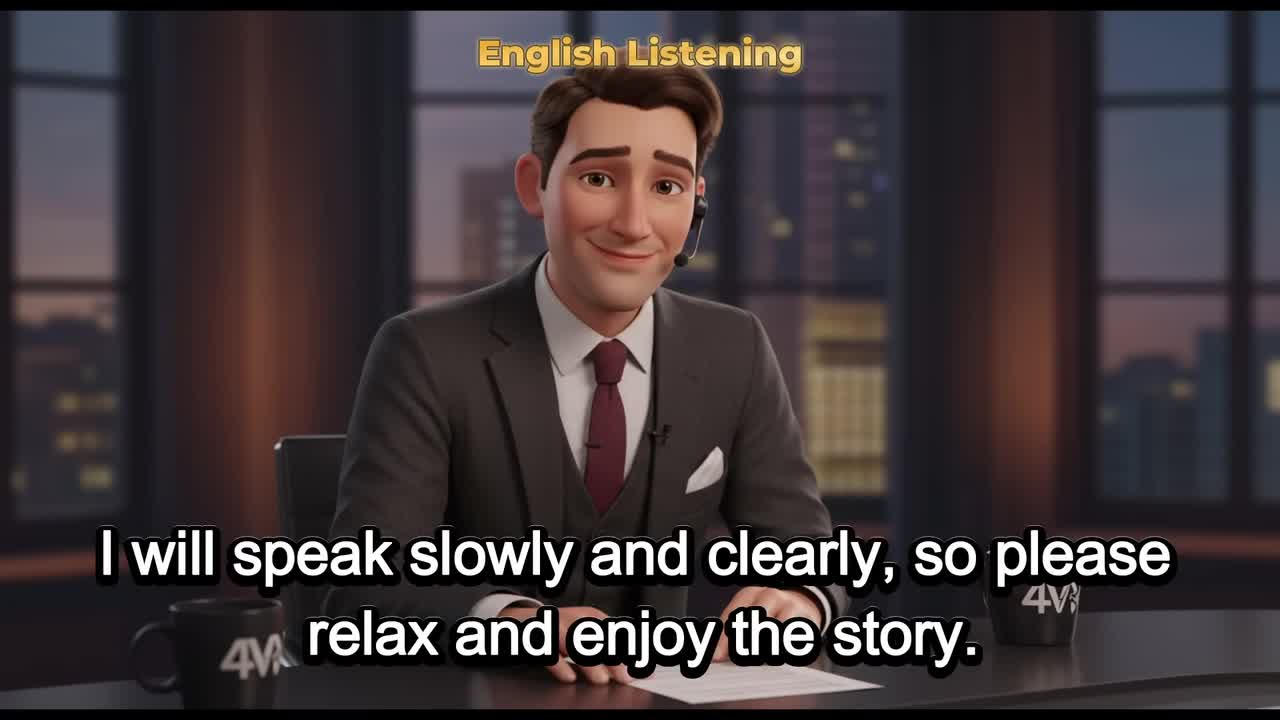
Welcome to English Listening Channel.
Hello everyone.
Today's title is Shopping Center Vocabulary.
In this video, you will follow a simple and fun story about Sam and Mina at a shopping center.
Don't worry, I will speak slowly and clearly, so please relax and enjoy the story.
Before we begin, I have a small question for you.
Please listen carefully to find the answer.
This will help you understand English more deeply.
So here is today's question.
What does slow music make people do?
The answer is mentioned in the conversation.
If you find the answer, please write it in the comments section.
By writing your answer in English, you can improve your English skills even more effectively.
All right, are you ready?
Okay, let's begin.
Hey, Mina, we're here.
Wow, this place is so big.
I can't believe how big it is.
This is my first time here.
Really welcome.
This is a shopping center.
Some people call it a mall.
A shopping mall, shopping center mall both are okay.
You can use either one shopping center mall okay, i'll remember both.
There are so many stores here, you can find almost anything.
So what do you want to buy today?
I want to buy some new shoes and clothes.
Me too.
I want to look for some new clothes.
Great.
Let's go shopping together.
Okay.
Let's go in.
Look, this is the entrance.
The entrance is where you go in.
Entrance.
Okay.
Oh, the doors opened by themselves.
Yes, those are automatic doors.
Automatic doors, they open by themselves.
You don't need to push them or pull them.
Automatic doors.
That's very convenient.
I like that.
Okay, first let's find a floor map.
We can see where all the stores are.
Let's go.
Okay, here we are.
Look, this is the floor map.
Oh, I see it.
This is helpful.
Yes.
Some people also call this a directory.
A directory is like a big guide that shows where all the stores are.
Floor map and directory are similar.
Both help you find stores in the mall.
Directory.
Okay, I'll remember that.
And if you need help, you can also look for the information desk.
The information desk has staff who can help you.
Good to know.
So, what do you want to find?
I want to find a shoe store and a clothing store.
Okay, let me look at the map.
The shoe store is on the second floor on the right side and the clothing store is on the first floor on the left side.
First floor, second floor.
Right.
First floor, second floor, third floor.
This mall has three floors.
You can also say level.
Level one, level two, level three.
Level.
Got it.
So the clothing store is near us.
Yes, it's on this floor on the left, not far from here.
The shoe store is far.
It's on the second floor.
We need to go upstairs later.
We can take the escalator or the elevator.
Upstairs means the floor above us?
Yes, upstairs means the floor above.
Downstairs means the floor below.
Upstairs, downstairs.
Got it.
You know, I think many shopping centers look similar.
They all look the same to me.
Yes, you're right.
That's because the stores are placed like a circle.
A circle?
What do you mean?
The stores are on both sides, and you walk around in a big circle.
You walk around and around and you come back to the same place, so you see all the stores.
That's why the stores are placed in a circle.
Oh, that's why I always see the same stores again and again.
Exactly.
That's how the mall is designed.
Okay, the clothing store is on the left on this floor.
Let's walk that way.
Let's go.
Here it is.
Let's go into this clothing store.
Okay.
Oh look, there is a sale.
I can see the big sign.
Yes, a sale.
That means the prices are lower than usual.
Sale means a discount.
Things are cheaper than before.
Discount everything looks so cheap.
I want to buy everything.
Wait, wait.
Let me tell you something important.
First, always check the price tag.
Price tag yes, the price tag is the small paper on the clothes.
It shows the price.
Okay, I see the price tag here.
Good,
Now look at the original price.
That is the price before the sale.
The original price.
And then look at the new price.
The price now.
Hmm.
The original price is very high, but the new price looks cheap.
Right, but is it really cheap?
Sometimes the original price is not the real regular price.
They make the original price very high, so the sale price looks very cheap.
But it's not really that cheap.
Oh, I see.
That's a little tricky.
Yes, it is a little tricky.
So always check.
Is it really a good discount?
Is it really cheap?
Compare the original price and the sale price.
Look at both prices and think carefully.
That's a good tip.
I'll be more careful from now on.
Oh, but I really like this jacket.
It's on sale, too.
Nice.
The color is great, and the price looks good too.
Let me check the price tag for you.
Yes, the original price was high, but the sale price is fair.
This is a real discount.
But I want to try it on first.
Can I try it on here?
Try it on means you wear it to see if it fits.
Yes, and I think I need a different size.
This one looks too big for me.
Okay, let's ask the store clerk.
You can talk to her.
Okay, I'll ask.
Excuse me.
Hi, how can I help you?
I like this jacket, but this one is too big for me.
Do you have this in medium?
Let me check for you.
We have small, medium, and large.
Yes, we have medium.
Here you go.
Thank you.
Oh, and one more thing.
Do you have this jacket in black?
In black?
Let me look.
Yes, we do.
Here is the black one in medium.
Oh, that's perfect.
I like this color much better.
Can I try this on?
Of course.
The fitting room is right over there, on the right side.
I'll show you the way.
The fitting room.
Okay, thank you so much.
I'll go try it on now.
Sure.
Take your time.
Let me know if you need anything.
I'm back.
I really like it.
It fits perfectly.
It's not too big and not too small.
The size is just right, and the color is beautiful.
I'll take this one, please.
Wonderful.
Great choice.
Let's go to the checkout over here.
Okay, let's go to the checkout.
How much is it?
It's $35.
It was $50 before the sale.
Oh, that's a nice discount.
Yes.
Cash or card?
I'll pay with my credit card, please.
Sure.
Please tap or insert your card here.
Okay, done.
Great.
Here is your receipt.
Please keep it if you need to return the item.
Receipt.
Okay, I'll keep it.
Thank you.
And here is your shopping bag.
Thank you for coming.
Thank you so much.
Have a nice day.
You too.
Have a nice day.
Nice jacket, Mina.
It looks great on you.
Thank you.
I really love it.
I'm getting hungry now.
Are you hungry?
Yes, I'm very hungry.
Let's eat something.
Good idea.
Let's eat something before we go home.
Where should we eat?
Let's go to the food court.
The food court has many different restaurants in one place.
You can choose what you want.
Chinese food, burgers, pizza, anything.
It's on the third floor.
Let's go upstairs.
Okay, let's go.
Here we are.
This is the food court.
Wow, it's so crowded.
So many people are here.
Yes, it's a weekend, so it's always crowded like this.
I can't find an empty seat anywhere.
Okay, here's a tip.
Let's save a seat first.
Save a seat means we keep a table for ourselves before we go buy food.
Oh, I see.
So one person saves a seat and the other person goes to buy food.
Exactly.
On weekends, this is very important.
The food court gets very busy.
If you don't save a seat first, someone else will take it.
Oh, look, I see an empty table over there.
Let's go quickly.
Great.
We got a seat.
Oh, Sam, before I go buy food, where is the restroom?
The restroom?
There is one near the food court, but it's probably very crowded right now.
I have a tip for you.
The restroom upstairs is often less crowded.
Also, restrooms farther from the food court are often empty.
Farther means a longer distance from here.
So, the restroom that is far away from here is probably empty.
Yes, that's right.
Oh, that's really good to know.
I'll go upstairs then.
Okay.
After that, you can go buy food for us.
I'll save the seat here.
Sounds good.
What do you want me to buy for you?
Just get me the same thing you get.
Anything is fine.
Okay.
I'll go to that counter over there.
Hi.
Hi.
Welcome.
What would you like to order?
Let me look at the menu first.
Okay.
I would like this one, please.
The chicken burger.
The chicken burger.
Good choice.
Actually, can I have two of those, please?
One is for my friend.
Two chicken burgers.
Sure.
Would you like the combo?
The combo comes with fries and a drink.
A combo?
It comes with a drink?
That sounds good.
A combo is cheaper than buying everything separately, right?
That's right.
The combo is a better deal.
So two combos?
Yes.
Two combos, please.
Great.
What drinks would you like?
We have water, cola, and orange juice.
One cola and one water, please.
Okay, so that's two chicken burger combos, one cola and one water.
Yes, that's right.
Your total is $15.
Cash or card?
Card, please.
Okay, please top your card here.
Done.
Thank you.
Here is your tray with everything on it.
That's the flat thing I carry the food on, right?
That's right.
Be careful.
It's a little hot.
Okay.
Thank you so much.
You're welcome.
Have a nice day.
Thank you.
Have a nice day.
That was so delicious.
Yes, it was really good.
I'm full now.
Okay, let's go home now let's walk to the exit.
The exit is on the first floor okay oh, i like this background music.
It's nice and slow, very relaxing.
You know, shopping centers choose their music very carefully.
Really, why is that?
Slow music makes people walk slowly?
When people walk slowly, they stay in the mall longer.
And when they stay longer, they see more stores and they buy more things.
Oh, that's so interesting.
And can you smell that?
Hmm, I can smell something sweet.
Is that popcorn?
Yes, popcorn.
And can you also smell the bakery near the entrance?
Oh yes, the bakery.
It smells so good i want to buy something just because of the smell.
Yes, that's why they do it.
The smell is there for a reason.
The smell makes people hungry, and when you're hungry, you want to buy food.
That's so clever.
And look at those shopping carts over there.
Do you see how big they are?
Yes, the carts are very big.
That's also for a reason.
A big cart feels empty, even when you have some items in it.
When the cart feels empty, people want to put more things in it, so people buy more.
So that's why the carts are always so big.
Exactly.
And one more thing.
Look near the register over there.
The register?
That's where you pay, right?
Yes, the register is where you pay.
Do you see those small items near it?
Candy gum, small snacks?
Oh yes, i always see those near the register.
People buy those small items while they are waiting in line to pay small items near the register.
It's a very smart trick.
Shopping centers are really really smart.
They really are.
So, Mina, you learned many new words today.
Yes, let me think.
I learned entrance, automatic door, directory, fitting room, and discount.
Oh, and price tag, checkout, receipt, food court, combo, and tray.
Wow, that's amazing.
You remembered so many words.
I want to come back again soon.
Me too.
Let's come back again soon and go to more stores.
Yes.
Today was really fun.
Thank you, Sam.
Thank you too, Mina.
See you next time.
See you next time.
How was it?
I hope this video helped you improve your English.
Now let me ask the question from the beginning one more time.
What does slow music make people do?
Did you find it?
If you did, please write your answer in the comments section.
By practicing English output like this, you can improve your English skills more efficiently.
On this channel I share slow and easy English stories with useful vocabulary and practical tips for real life.
I will keep uploading videos like this, so if you enjoyed it, please subscribe to the channel.
And don't forget to like the video and leave a comment.
Alright, that's all for today.
I hope to see you in the next video.
See you next time.