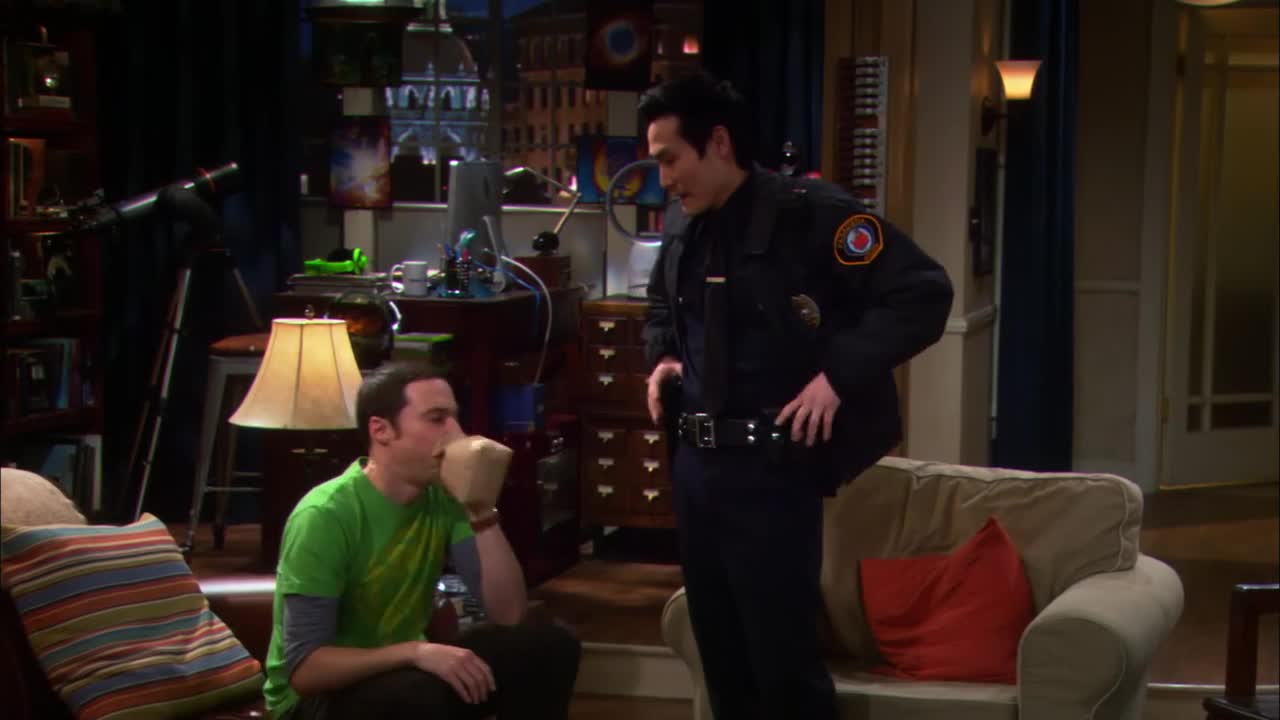
Here, read into this bag.
What's going on?
They stole everything, Leonard.
Everything.
Are you the roommate?
Yeah, Leonard Hofstadter.
What happened?
Your friend here called 911 to report a robbery.
Oh, my God.
What did they get?
What didn't they get?
I got my enchanted weapons, my vicious gladiator armor, my wand of untainted power, and all my gold.
You called the police because someone hacked your World of Warcraft account?
What choice did I have?
The mighty Sheldor, level 85 blood elf hero of the Eastern Kingdoms, has been picked clean like a carcass in the desert sun.
Plus the FBI hung up on me.
Into the bag.
They took my battle ostrich.
Oh no, not glenn.
Yes glenn, only bird i ever loved.
Good luck, fellas.
Thank you, officer.
Wait a minute, you're not going to do anything, mr cooper.
There's nothing, dr cooper, seriously not the kind with access to drugs.
Fun, Dr Cooper, I'm sorry for your loss, but the Pasadena Police Department doesn't have jurisdiction in Pandora.
That's from Avatar.
World of Warcraft takes place in Azeroth.
Goodness gracious, how are you allowed to carry a gun?
Hey, look, Amazing Spider-Man 183.
Got it.
Remember this one?
Spider-Man loses a big fight and his girlfriend breaks up with him.
Want me to get it for you?
It'll help take your mind off things.
Hey, guys, what's going on?
We need to kill a couple hours till the next showing of Time Bandits.
Oh, well, no problem.
I was thinking of closing early and going home, but let's face it, that's just a slightly smaller, lonely room filled with comic books.
Thanks, Stuart.
Let me ask you something.
Do you think it's okay for Penny to have an ex-boyfriend sleep on her couch?
No, I mean, she's obviously way out of line.
Thank you.
But if she dumps you, she'll have a new boyfriend by tomorrow morning and you'll have a new girlfriend when you figure out how to build one.
So the only question is, how long until you fold?
I am not going to fold.
Excuse me, I don't think Penny's out of line at all.
You don't own her.
It's like my girl Beyonce says, if you like it, you should have put a ring on it.
Come on.
At the very least, when she found out Leonard was upset about it, she should have backed off.
You mean like when a guy's upset because his friend agreed to take a cooking class with him and then doesn't show up because he's doing a juice fast with his mother.
I didn't know you were upset about that.
Really?
Did you miss all the subtle indicators, like me saying, Howard, I am upset?
Okay, sorry.
Maybe it means something different in this country.
Back in India, it means you're upset with a guy named Howard.
I said I'm sorry.
Sorry doesn't make up for the fact that I had to make chicken and rice with this vegan guy.
Do you know what vegan chicken and rice is?
Rice.
You think I was having fun sitting around all night listening to my mother say have you ever peed so much in your life?
Oh, my God.
You are such a mama's boy.
Hey, don't bring my mother into this.
You brought your mother into this.
Stop it, both of you.
All this fighting.
I might as well be back with my parents.
Damn it, George.
I told you if you didn't quit drinking, I'd leave you.
Well, I guess that makes you a liar because I'm drunk as hell and you're still here.
Stop.
Stop yelling!
You're making Sheldon cry!
I'll tell you what's making Sheldon cry!
That I let you name him Sheldon!
Boy, what got him so upset?
No, sure, you can tell when Sheldon's upset.
Uh, that's my water.
What?
My water.
You're drinking it.
Dear Lord!
Have you been drinking it?
Yes, it's my water.
Well, that's it then.
I'm dead.
Here we go.
I'm sorry.
Do I really need to connect the dots for you?
The backwash into this glass is every pathogen that calls your mouth home sweet home.
Not to mention the visitors who arrive on the dancing tongue of your subtropical girlfriend.
Hey, that's my sister and my country you're talking about.
Leonard may have defiled one, but I won't have you talking smack about the other.
You guys ready to order?
Yes, I'd like a seven-day course of penicillin, some syrup of Ipecac to induce vomiting, and a mint.
I don't understand.
He drank from Leonard's glass.
He drank from Leonard's glass.
Words they'll be carving into my tombstone.
That's actually my napkin.
Oh!
Where are you going?
To the bar to sterilize my mouth with alcohol.
Gangway!
Dead man walking!
I just want to make sure that we're all clear.
Standard robotic fighting league rules apply.
Are you crazy?
This is a street fight.
The street has no rules.
He's right, Leonard.
The paradigm is to the death.
I will however, give you the opportunity to concede my superiority now and offer me your robot as the spoils of war.
Never.
I'd rather see Monty dead than in your hands.
That could be easily arranged.
Ready, set, go?
Do it.
All right, then.
Ready, set, go.
Come on, Sheldon, you got this.
Indeed.
We are prepared for anything he can throw at us.
That's new.
Don't hurt us!
Don't hurt us!
Don't hurt us!
What are you doing?
Eating, reading, watching television, listening to the radio.
What is the lamb doing?
Asparagus?
I thought you hate asparagus.
I thought so too, but I also thought super asymmetry was a good idea, so what else am I wrong about?
Oh, so now you're reevaluating every opinion you've ever had?
Yes.
I am following the example of 17th century philosopher René Descartes.
He subjected all his beliefs to radical doubt so that he could build a bedrock belief and build his cognitive life back up on firm principles.
Oh, deliaki, deliaki.
Sheldon, I know you're upset about the paper, okay?
I'm upset too.
I mean, I was so sure we were right.
Every fiber of my being felt like this was it.
This was the one.
How can I trust my instincts anymore?
Well, just because our theory was wrong, that doesn't mean you're wrong about everything.
Doesn't it?
You know, I've always thought I hated jazz.
Maybe I was wrong.
Maybe it's great to hear all the notes at once.
I'm trying.
I'm really trying.
How's your family?
It was the worst trip.
Everyone got sick over the weekend.
Sick?
Here we go.
What kind of sick?
The flu, I guess.
I don't need you to guess.
I need you to know.
Now, when did the symptoms first appear?
Maybe Friday?
Friday.
Was that morning or afternoon?
I don't... Think woman who blew their nose and when.
Sheldon, relax.
She doesn't have any symptoms.
I'm sure she's not contagious.
Oh, please.
If influenza was only contagious after symptoms appear, it would have died out thousands of years ago.
Somewhere between tool using and cave painting.
Homo habilis would have figured out to kill the guy with the runny nose.
Penny, you'll have to excuse Sheldon.
He's a bit of a germaphobe.
Oh, it's okay.
I understand.
Thanks for your consideration.
Now, please leave.
You'd better go before he starts spraying you with Lysol.
Okay.
Well, thank you for getting my mail.
No problem.
Welcome home.
What?
What the hell are you doing?
I'm making petri dishes to grow throat cultures.
With lime jello?
I need a growth medium and someone polished off the apricot yogurt.
Here, swab my throat.
I don't think so.
Leonard, if I'm going to get ahead of this thing, I need to find out what's growing in my throat.
Sheldon, you are not sick.
This is, but you are not.
We have no idea what pathogen typhoid penny is introduced into our environment.
And having never been to Nebraska, I'm fairly certain that I have no corn husking antibodies.
So don't you think you're overreacting?
When I'm lying comatose in a hospital, relying on inferior minds to cure me.
These jello cultures and my accompanying notes will give them a fighting chance.
I'm going back to bed.
Wait, put this in the bathroom.
What for?
I need to measure my fluid intake and output to make sure my kidneys aren't shutting down.
I mixed pancake batter in this.
No, that measuring cup has always been for urine.
You had time to make a label for everything in this apartment, including the label maker, but you didn't have 10 seconds to make one that said urine cup right here on the bottom.
Huh.
I guess I owe the Betty Crocker company a letter of apology.
Oh.
Stuart.
You're not going to answer it?
He wants to talk about Penny.
I don't want to talk about Penny.
You're making an assumption.
Perhaps the comic book store is on fire.
He needs your assistance.
Why would he call me?
We don't know.
And if you don't answer the phone, we can't know.
I'm not answering the phone, Sheldon.
Answer the phone, Leonard.
No!
There, it went to voicemail.
Aren't you going to check your messages?
No.
You have to check your messages, Leonard.
The leaving of a message is one half of a social contract, which is completed by the checking of the message.
If that contract breaks down, then all social contracts break down and we descend into anarchy.
It must be hell inside your head.
At times.
Obviously I care about Leonard.
I'm going to spend the rest of my life with him.
And I'm not?
It's an earthquake.
I knew it.
Sheldon, it was just a little tremor.
A little tremor that turns routine sinus surgery into a frontal lobotomy.
Oh, I don't care for this at all.
I need to see he's okay.
Sheldon, you can't go back there.
Try and stop me.
Are you okay?
Why didn't you stop me?
Come on, smile.
This is going to be my Christmas card.
Oh, Leonard, there you are.
I'm ready to go home.
I just got here.
Good.
Perfect timing.
I told you I only have access to the free electron laser at night.
I can't drive you for the next few weeks.
No, you said you couldn't drive me to work.
This is from work.
Howard, help me out here.
No, just for the fun of it, I'm going to take his side.
Now, how do you propose I get home?
How did you get here in the first place?
Penny.
But I sense that's no longer an option.
Look, I need to get to the laser lab.
You're just going to have to find someone else to take you home.
Oh, damn, I picked the wrong side.
Oh, God, not Euclid Avenue!
Good morning, gentlemen.
Hey.
Good morning.
There's some new kind of casual Friday I don't know about?
No, he lives here now.
Really?
Why?
Well, since he won't take the bus and he's too evolved to drive, he decided it would be easier to just sleep in his office and shower in the radiation lab until I'm finished with my experiment.
But you finished your experiment a week ago.
Yep.
You saw nothing.
By the time I was born, Voyager 1's mission was supposed to be over.
It had seen Jupiter and Saturn and all their moons, but it kept going.
When I left India for America, I was never more scared in my life.
I had no idea what lay ahead.
Whenever I feel that way, I think about how Voyager is still out there somewhere beyond our solar system.
Don't leave!
You can do this!
Sheldon, is everything okay?
It's too late for Cuthrop-Hawley!
Let's go!
Eleven minutes.
That's longer than I thought.
Leonard?
Leonard?
Leonard?
I need to speak to you.
It's 2 o'clock in the morning.
It's important.
I highly doubt that.
Go away.
Are you still out there?
Yes.
What?
You're right.
It can wait until morning.
What, what, what, what?
Never mind.
I clearly woke you up in the middle of a REM cycle.
You're in no state of mind to talk.
Sheldon, what is it?
I'm uncomfortable having been included in your lie to Penny.
What was I supposed to say?
You could have told her the truth.
That would have hurt her feelings.
Is that a relevant factor?
Yes.
Then I suppose you could have agreed to go.
And what would I have said afterwards?
I would suggest something to the effect of singing is neither an appropriate vocation nor avocation for you.
And if you disagree, I'd recommend you have a CAT scan to look for a tumor pressing on the cognitive processing centers of your brain.
I couldn't say that.
I would have to say, you were terrific and I can't wait to hear you sing again.
Why?
It's the social protocol.
It's what you do when you have a friend who's proud of something they really suck at.
I was not aware of that.
Well, now you are.
Oh.
All right.
Leonard?
Yes?
When we played chess earlier, you were terrific, and I can't wait to play you again.
Good night.
Leonard.
Leonard.
Leonard.
It would be so much easier if I were a violent sociopath.
Leonard.
Leonard.
What?
I was analyzing our lie, and I believe we're in danger of Penny seeing through the ruse.
Simple.
If she were to log on to wwwsocalfysicsgrouporg.
Forward slash activities.
Forward slash other.
Click on upcoming events, scroll down to seminars, download the PDF schedule and look for the seminar on molecular positronium.
Well then bippity, boppity boo, our pants are metaphorically on fire.
Well sir, my trousers will not be igniting today.
Oh, hey, Leonard, is the podcast too loud?
I didn't hear a podcast.
I told you no one could hear it.
Actually, I need to talk to both of you about your paper.
Oh, right.
How are the citations coming?
Well, Raj and I were chasing them down, like you asked us to, and we came across a Russian paper that seems to disprove super asymmetry.
Are you sure?
Yeah.
Howard translated it.
So sorry.
Sheldon, are you all right?
Oh, yes, of course.
Thank you for telling us, Leonard.
I'm sure that wasn't easy.
I guess we don't need this anymore.
So what are you listening to, This American Life?
We'll just play one-on-one until he gets back.
One-on-one?
We don't play one-on-one.
We play teams, not one-on-one.
One-on-one.
Well, the only way we can play teams at this point is if we cut Raj in half.
Oh, sure.
Cut the foreigner in half.
There's a billion more where he came from.
Hey, if you guys need a fourth, I'll play.
Great idea.
Uh, no.
The wheel was a great idea.
Relativity was a great idea.
This is a notion and a rather sucky one at that.
Why?
Why?
Oh, penny, penny, penny.
Oh, what, what, what?
This is a complex battle simulation with a steep learning curve.
There are myriad weapons, vehicles and strategies to master, not to mention an extremely intricate backstory.
Oh, cool.
Whose head did I just blow off?
Mine.
Okay, I got this.
Lock and load, boys.
It's the only way we can play teams.
Yes, but whoever's her partner will be hamstrung by her lack of experience, and not to mention the fact that she Ah, there goes your hat again.
Okay, this isn't all good sportsmanship to shoot somebody who's just respawned.
You need to give them a chance to... Now, come on.
Raj, Raj, cover me.
Cover this sucker.
Betty, you are on fire.
Yeah, so is Sheldon.
Okay, that's it.
I don't know how, but she is cheating.
No one can be that attractive and this skilled at a video game.
Wait, wait, Sheldon, come back.
You forgot something.
What?
This plasma grenade.
Look, it's raining you.
You laugh now.
You just wait until you need tech support.
Here we go.
Oh, look how cute you were.
Amy, please, of course I was cute.
Look how I turned out.
Hello, Sheldon.
Hello, Sheldon.
If you're watching this, I assume something bad has happened.
Something unfortunate and unforeseen.
Something that's making you question everything.
I'm so smart.
Now just make sure it's really you watching this, not an imposter.
What am I thinking of?
On the count of three.
One, two, three.
Robot Monkey Butler.
Okay, good.
Should I leave you two alone?
No, this is going to be inspiring.
You should watch.
Sheldon, never forget, no matter how bad things seem, You can all... What?
What?
No.
No.
My dad taped over at one of his stupid high school football games.
Sorry.
You know, it doesn't matter.
Nothing matters.
Is there anything I can do?
Yes.
You can build me a time machine so I can go back and tell my younger self to give up because nothing's going to work out the way he wants, thinking a nice cup of leaf soup.
As I said, the entire point of emulating Spock was to rise above human emotion, which I've spent a lifetime mastering.
Oh, pfft.
Excuse me?
I'm sorry, I'm not here.
No, you went pfft.
What does pfft mean?
Um... You did go pfft.
Okay, fine.
Well, Sheldon, I'm no expert, but aren't you completely missing the point of Spock?
I mean, he liked to act like he had no emotions, but he was still half human.
Just like you.
I'm just saying, you pretend you don't, but you have feelings just like everybody else.
Not true.
No, look at me.
I had an engagement ring to give a girl, and instead she rejected me.
And am I emotional about that?
No.
No, I am sitting here on a couch talking about my favorite TV character like nothing happened.
Because I am just like him.
All logical.
All the time.
Sweetie, you're yelling.
Because when I speak at a regular volume, no one seems to believe me that I put this Amy nonsense behind me.
This documentary is going to be awesome.
So what do you think, Howard?
It's not that bad, right?
Oh, no.
A little electrical tape, some solder.
Are you insane?
I've seen space probes that crashed into the desert that were in better shape than this.
You're right.
Monty's gone.
We'll bury him in the morning.
It's a simple ceremony.
I'll speak.
Leonard, you'll play your cello.
Sheldon, honey, aren't you getting a little carried away?
I mean, it's just a toy robot.
Just a toy robot?
Penny.
I know, I got it.
Sheldon!
I'm sorry.
And how does it feel to be married to a Nobel Prize winner?
You tell me.
Amy-centric, what a fun way to look at it.
I think so.
You would, that makes sense.
Aw, it's a congratulations text from my Meemaw.
Oh, and there's one from my mom.
And my sister.
And my brother.
And my brother's ex-wife.
And my brother's other ex-wife.
Boy, they don't tell you when you win a Nobel.
It chews up your phone battery.
Oh, that's me.
It's CVS.
My prescription's ready.
Oh, and also my dad.
He says congratulations and he loves me.
Nothing about me?
Oh.
Oh, it's your dad.
I'm good.
You know, when you think about it, now that we're Nobel Prize winners, our names will be linked together forever.
We're married.
Our names are already linked together forever.
No, please.
That's just a piece of paper.
This is a piece of paper and a medal.
It's weird.
I don't really feel different, but I guess our lives will never be the same.
I don't know.
We're going to work like always.
I still put my pants on both legs at a time.
One day that's going to end very badly.
Oh!
Doctor!
Congratulations.
How does it feel?
We're happy to answer your questions just one at a time, please.
Is Dr. Cooper coming back?
No.
Next question.
Sheldon, you're sick.
Go back to bed.
I am fine.
Here, eat your toast.
Sorry.
It's okay.
Now I don't need butter.
Well, perhaps I am a little under the weather.
There's only a little cold medicine and tea can't fix.
You need sleep.
What I need is to get to work.
Well, I don't want your germs around me.
You hold my hand, you kiss my mouth, but you draw the line at 102 fever?
What happened to our love?
Sheldon, are you okay?
What's going on?
How'd I get here?
I don't know.
We came home from work and we found you.
Home from work?
What time is it?
It's 9 o'clock.
9 o'clock?
What happened to 8 and 7 and all the other clocks?
You don't remember?
Well...
I remember waking up in the morning, Amy rubbing Vicks on my chest, and her hands were like two frozen chunks of tundra.
I took some cold medicine to... I took cold medicine.
You did seem a little loopy when you showed up at the lab.
At the lab?
Why am I naked from the waist down?
I don't know where your pants are, but we did find you underwear in a pot on the stove.
My pants are missing.
I don't remember anything.
Penny, this is your youth.
What do I do?
I don't know.
Check your body for tattoos.
Lynyrd, would you be a lamb?
Wait, wait.
Where's my bag?
My phone and my wallet are in my bag.
It's right here.
Where's my notebook?
My notebook's gone.
Oh, no.
Hey, it's just a notebook.
What's the big deal?
What's the big deal?
It's full of classified information about the Air Force project.
How could you lose that?
It's okay.
I'm sure we'll find it.
Look, it's got to be around here somewhere.
Maybe it's wherever your pants are.
Nope.
Pants in the microwave.
No notebook.
The notebook isn't in the bathroom.
I can't find it either.
How can he not remember a day?
Well, people who are abducted by aliens lose time.
I mean, maybe it happens to the aliens, too.
It's not across the hall.
That's it.
I'm in breach of my security clearance.
I'm going to prison.
You know what happens to people like me in prison.
Be forced to be some large man's tutor.
You're not going to prison.
Oh, boy, it is funny to think about.
You really can't remember anything?
I'm trying.
Wait a minute.
Hey, let me see your phone.
Why?
It's possible it was tracking everywhere you went.
Phones can do that?
Yeah, depends on the privacy settings.
Oh, that's so cool.
How do you turn that thing off?
Relax.
I know when you go for a run, you stop for a donut.
I don't even run there.
I drive.
Hang on.
I can see every place you went.
What does it say?
You were in the building.
You were at the university.
Then you were somewhere on Colorado Boulevard.
Where?
Wait, hang on.
Did you go to a cowboy bar?
No!
That is preposterous.
Ow!
Maybe.
I swear.
Not to tell anyone.
Not to tell anyone.
The top secret military information I'm about to tell you.
The top secret military information I'm about to tell you.
Hey, I just ran into Penny.
She seemed upset about something.
I think it's her time of the month.
I marked the calendar for future reference.
What's with the fish?
It's an experiment.
What happened to your scrambled egg research?
Oh, that was a dead end.
Scrambled eggs are as good as they're ever going to be.
So, fish?
I read an article about Japanese scientists who inserted DNA from luminous jellyfish into other animals and I thought hey fish, night lights.
Fish nightlight.
It's a billion dollar idea.
Shhh.
Mum's the word.
Sheldon, are you sure you don't want to just apologize to Gabelhauser and get your job back?
Oh, no, no, no.
Oh, I have too much to do.
Like luminous fish?
Shhh.
I'm sorry.
That's just the beginning.
I also have an idea for a bulk mail-order feminine hygiene company.
Oh, glow-in-the-dark tampons.
Leonard, we're gonna be rich.
Thanks for coming on such short notice.
You did the right thing, Colin.
I didn't know what else to do.
He's lost all focus.
Every day he's got a new obsession.
This is a particularly disturbing one.
Mommy?
Hi, baby.
Oh, you got yourself a loom?
How nice.
Thank you.
Honey, why'd you get a loom?
I was working with luminous fish and I thought, hey, loom.
Hey, what's with all the yelling?
Leonard disproved my element.
Now all the attention is going to go away.
Oh, that's great.
You must be thrilled.
That's it.
I'm down to seven friends.
He's counting hobbits and superheroes, right?
When I thought the element was real, I didn't want it.
But now that Leonard made it not exist, I want it more than anything in the world.
The element never existed.
I didn't take it away.
Science took it away.
Be mad at science.
Don't you dare use science against me.
Science is my best friend.
Oh, good.
I'm back up to eight.
Will you tell him he's out of his mind?
Actually, I get what he's saying.
Yes!
Nine!
Welcome back, buddy.
It's like if you're dating someone you're not that into and then they break up with you, and then you want them more than ever.
I have no idea what she's talking about, but we're ganging up on you, so I agree.
Okay, Sheldon, what do you want me to do?
Hide the information?
If I don't publish it, it's just a matter of time before someone else does.
No, no, of course you have to publish.
That's your responsibility as a scientist.
Doing otherwise would be unethical.
You have no choice.
Fine, I'll publish.
Can you believe this guy?
Come on, Sheldon, Star Wars.
I'm pushing plate.
I mean it.
Yeah, if we don't start soon, George Lucas is gonna change it again.
This would go a lot faster if you put your trade school diploma to work and help me set up this high-frequency tone generator.
I have a master's degree from MIT.
Yeah, but you got a can-do attitude, and that's what's important.
I really don't get your problem with birds.
The question you should be asking is what is their problem with me?
My first memory, a hummingbird dive bombing my stroller to get at the apple juice in my sippy cup.
Hummingbirds are pretty.
Hummingbirds are the vampires of the flower world.
Still my first choice for an ankle tattoo.
Or a dolphin, I go back and forth.
Age seven, a bloodthirsty chicken chases me up a tree.
Age 12, a magpie tries to steal the retainer out of my mouth.
Age 16, a parrot in a pet store calls me fat ass.
Need I go on?
Yes, please.
This is way better than the movie.
All right, Sheldon, your bird death ray is ready.
It's not a death ray.
It's just a little ultrasonic blast to scare him off.
Trust me, if I had a death ray, I wouldn't be living here.
I'd be in my lair enjoying the money the people of Earth gave me for not using my death ray.
All right, and in three, two, one.
That is one tough birdie.
One, two, three.
Go!
Bird in the apartment!
Bird in the apartment!
No!
And Sheldon, he's not going to hurt you.
He looks friendly.
I think he might be someone's pet.
No, Bernadette, don't be a hero.
Aw, he's a sweetie.
Yes, he's very sweet.
Now, slowly and carefully, flush him down the toilet.
Sheldon, the only way to get past this fear is to interact with it, just like you did with the mailman.
Every year, tens of people around the world are killed by birds.
I'm not going to be another statistic.
Look how sweet he is.
Come over and say hi.
Come on.
You can do it.
Don't be scared.
Oh, just pet the bird, you big baby.
I did it.
I actually did it.
Okay, now flush him.
It's remarkable.
All that time spent in fear.
For what?
He's magnificent.
Oh dear, I just realized I haven't offered you a beverage.
It's just like my grandma with her parrot.
And after she lost her marbles with her remote control.
We're gonna have so much fun together.
You can carry messages to all my enemies.
I can tie a string to your leg and fly you like a kite.
If you're keeping him, I've got a cage you can borrow.
One of the test monkeys slipped on a banana peel and broke his neck.
It was both tragic and hysterical.
Nonsense!
No, Lovey Dovey doesn't sleep in a cage.
No, Lovey Dovey sleeps in his very own nest, which I'm going to get off the windowsill and put in my room.
Isn't that right, LD?
Where are you going?
Come back, lovey-dovey.
This is your home now.
I already ordered 20 pounds of bird feed off of Amazon.
He's gone.
I'm sorry, Sheldon.
How could he do this to me?
Get back here, you stupid bird, so I can love you!
Excuse me.
Is it at all possible that you're knitting a pair of pants?
Oh, no, you're understandably terrified.
You don't allow me to explain.
45 days ago, I embarked on a railroad journey of healing because my university was making me do string theory.
My favorite comic book store burned down.
And when my roommate got engaged, my girlfriend wanted to move in with me, which was no doubt a ploy just to see my well, excuse my language, but my bathing suit parts.
Sir, may I use your phone?
I don't think so.
I understand that I'm half naked, but there is a reasonable explanation.
While I slept in my sleeper car, all my possessions were stolen.
Now.
Typically I wear pajamas, but I recently adopted a hobo lifestyle and pajamas are the sleep pants of the man.
I'll have you know, Mahatma Gandhi wore no pants and a nation rallied behind him.
My good man now, before you walk away.
I know that I may appear deranged, but I am in fact a world-renowned physicist.
Ask me the difference between a boson and a fermion.
Go ahead, ask.
Bosons have integer spin.
Fermions have half-integer spin.
My legs are getting cold.
Why won't anybody help me?