BBC Sounds.
Music, radio, podcasts.
Sheen has many fashion fans.
These black boots are simply amazing, on trend and so comfy.
But the European Union's not wearing it.
This is actually quite telling about the serious damage that a platform like Sheen can potentially pose to our consumers.
It's World Business Report from the BBC World Service.
This is Andrew Peach.
On the way.
The European Commission shares its concerns with us and will examine how retailers like Sheen are changing the market.
Also today, the German drugs giant Bayer proposes to pay more than 10 billion to settle claims that its weed killer Roundup caused cancer.
And Iran closes the Strait of Hormuz for military drills.
But how will that affect global oil prices?
Going to start though, with your online shopping haul.
I did a big fall basics haul from Shein, and I'm so excited to show you what I got.
These black boots are simply amazing, on trend and so comfy.
This sports set here.
I got in a different color, since I loved it so much, and I got these great pants for fall, along with this blouse and these three t-shirts for every day.
Check out my latest Shein haul.
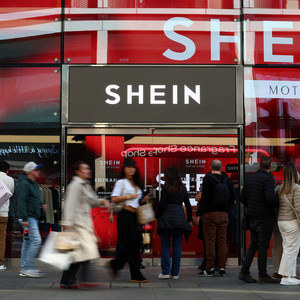
The European Union has opened a formal investigation into the Chinese online retailer Sheen.
This is partly over illegal products like weapons and childlike sex dolls, which have been removed from the site.
But it's also looking at whether the site is too addictive, overwhelming users with suggestions of things to buy.
To find out more, I've been talking to Thomas Renier from the European Commission.
Three main grievances that we will be investigating now.
The first one is the so-called addictive design of the platform.
It's the gamification of the service, the rewards program for our consumers.
So this is highly addictive.
The second grievance is the recommender systems.
We fear that there is a lack of transparency around recommender systems and products being pushed towards consumers.
And the third grievance is the sale of illegal products on the e-commerce platform.
And here we're talking, for example, about weapons or, for example, tied like sex dolls.
Let's talk about that first, because it feels like the most serious of the three accusations.
Tell me a bit more about the illegal products you're talking about.
You mentioned weapons.
Yes, indeed.
We have found many problematic issues on sheen service.
So first, for example, when you take a mystery shopping of 27 toys that are sold on the platform for kids under three years old, all of them, the 27 toys were actually in breach of EU law.
So this is actually quite telling about the serious damage that a platform like Shein can potentially pose to our consumers.
Then indeed there is also the sale of weapons, of childlike images and, for example, childlike pornography or potentially childlike sex dolls.
So these are real concerns for our consumers that we're tackling with this investigation.
Right.
So when you say they don't meet EU standards, can you give me a sense of what the sort of breaches might be, so we get a sense of the scale of them?
Yes.
So you have two different potential breaches here.
I mean.
The first is illegal products, not because we define them as illegal, because they're simply defined as illegal in national law, in European law or in international law.
I mean here the sale of weapon is forbidden and you cannot sell weapons to consumers in the EU like on an e-commerce platform.
This is we cannot tolerate this in Europe.
Childlike sex dolls, of course, are illegal.
Again, defined in European law, national law, international law.
But then you have certain products that do simply not meet European standards.
For example, cosmetics, clothes.
And these are also tackled by the investigation, because actually we have to put the responsibility back where it belongs.
It's on online platforms.
And a platform like SHEIN when it reaches 145 million users in Europe this is around a third of our population needs to properly assess the risks its platform is posing to our consumers.
And I understand that talking about weapons and childlike sex dolls is headline grabbing.
But when you say that all 27 products you tested, marketed at young children failed, that must be failing on technicalities, on things that aren't allowed in the EU but would be allowed elsewhere in the world.
Exactly.
I mean here you are confronted to an Asian platform and we obviously don't always have the same standards on different types of products.
So what is required from an e-commerce platform, like for real shop selling products in the European Union?
Your product has to be compliant with EU law.
Likewise, when European platforms offer their services elsewhere around the globe, they will have to meet the threshold and the standards of the countries where they're selling their products.
So we expect the same basically, of what is expected in real life, the same in the online world and on an e-commerce platform like Shein.
And what do you say to consumers listening to us in European countries who might be really happy with the products they're getting from Shein, because they're probably getting them at a really good price?
Yes.
And we don't want to change this, but they should also be able to rely on these platforms to have a certain level of trust when they buy products there.
So everything is not only about the cheapest price.
And of course, we don't want to change this for our consumers.
We don't say that Shein is a bad platform to use.
We simply say that Shein has a major role to play in designing a service that is safe for our citizens in Europe.
So it's not about blaming a a platform like Shein.
We have ongoing investigations, for example, already against Teemu or against AliExpress.
It's really making sure that these platforms meet EU standards.
People might be suspicious that what you really don't like is that the middleman has been cut out, that consumers can deal directly with platforms based in China selling products that they want at a price they're perfectly happy with.
That's absolutely not the case.
Our focus is not on individuals.
It's not even on the country of origin of the platform.
Our focus is on the systems and the systems that platforms the risk that these systems may pose in Europe.
I mean here when it's about an addictive design.
There is no way you design your service in such an addictive way towards kids, towards minors, be it 13, 14 years old, who can be on that platform.
They should not be targeted by a highly addictive design.
Recommender systems, they need to be transparent.
Our consumers should have the rights to determine what they see and what is being pushed towards them.
And then again, there is no way our consumers should be able to buy weapons online.
That's Thomas Renier from the European Commission.
Here's what Sheen is saying today.
They told us, we take our obligations under the Digital Services Act seriously and have always cooperated fully with the European Commission, as we'll continue to do in this process.
It says, measures put in place to include enhanced protections for younger users and ongoing work to design our services.
Live now to Priya Raj, freelance fashion journalist in London.
Priya, give me your take on Sheen.
Where does it sit in the market?
Yeah.
Hi, Andrew.
Shein is pretty much as fast fashion as it gets.
I mean, the items on the site are sold for as low as a couple of pounds, sometimes even less.
So it doesn't take a genius or a fashion journalist like me to figure out where things might be made and in what conditions.
And it's been around for a while as well.
I remember Shein being around when I was in my early teens and since has gone on to become one of the biggest fast fashion brands in the world and unfortunately also one of the biggest polluters too.
I mean, it hasn't been without its controversies over the years for the items that have been sold through the site, and obviously the list continues to grow.
It's certainly popular.
I live in a house with a teenage girl in it.
And what it enables her to do is to have more clothes, right?
You can buy more outfits, which is fun, without breaking the bank, without spending money you can't afford.
Well, exactly.
And this is exactly how they grew as well, by targeting teenagers and young people with ultra cheap clothes, constantly changing.
Of course, as we also heard, this is driven by social media and influencers too.
Obviously, if you take to TikTok, you'll find hundreds of videos of creators doing shopping hauls.
So it's not surprising that they've really managed to capture this part of the market.
And it feels a bit like the European Commission is sort of protecting us from ourselves because in the end the growth and the popularity of sheen is down to us as consumers.
Well, exactly.
And I will say it is partly because of sheen as well.
As mentioned, it's popular because it's cheap and it's addictive.
I mean, if you go on the website, the app or the website, it is designed to keep you safe, scrolling and buying.
There's new drops every day, there are flash sales, there are rewards for shoppers to spend more sort of creating a sense of urgency, and obviously that addictive design is now part of what the European Commission is investigating.
Isn't that just retailers being retailers, though?
It is, however, these features, as we're seeing, could have a negative impact on consumers.
And considering that it is also pushing fast fashion, I think it is definitely a bigger issue that we need to look at.
I mean when items are being sold for as low as £5.
We really have to think about how much someone may be getting paid to make that item, what their working conditions might look like.
That really is the true cost of buying fast fashion.
So however, and why ever the investigation might be taking place, I do think it is a good time for us to look at why we might be purchasing Shein products and think about otherwise.
Very good to talk it through with you.
Thank you very much.
Priya Raj, freelance fashion journalist on World Business Report.
Now, Iran has closed the Strait of Hormuz on Tuesday.
It isn't really clear whether it's fully reopened.
Iranian state media said the closure was a precaution while Iran's Revolutionary Guards carried out military drills.
.
.
.
.
.
.
So the real story here is that millions of barrels of oil are transported through the Strait of Hormuz every day, and any disruption to it could have an instant impact on global oil prices.
Lorianne Oroco is global supply chain reporter at CNBC.
Lorianne, thank you for being with us.
What's the latest we've got on this?
Is the Strait now open again?
I mean, your guess is as good as mine.
I mean, when you're looking at the flow of trade right now, you could still see that holding pattern, based on what I'm looking at through Kepler, which is marine traffic.
They actually track the vessels, if you will.
But this was supposed to be a partial and temporary closure.
So there were currently 390 tankers in the Midwest Gulf in that region.
And so that's why when you were looking at it today, the price of oil really didn't skyrocket.
And there really wasn't a lot of concern with the analysts that I spoke with.
But they are keeping very close tabs, because if it closes completely, that's when you're going to see that immediate reaction.
But as of right now, things are, you know, people are just kind of watching to see what happens.
OK, slightly dodgy connection to you, Laurie-Anne, but let me ask you this.
Oh, sorry.
Don't worry.
Is this, there obviously are talks going on between Iran and the US right now.
Is this Iran flexing a bit of muscle to try and influence that process?
I think they definitely are.
I mean, when you're looking at what they can control, right?
What is their strength?
It's the Strait of Hormuz.
And so if they want to make a if they want to send a message, it's by impeding the flow of trade.
You know, when you look at the amount of vessels that go through that area, you're looking at 13 million barrels of crude a day that go through there.
And that's roughly 31% of the global crude trade.
So, you know, if you shut that off, it is not going to be pretty.
And analysts have told me... could actually rise $20 to $30 per barrel.
And so you also have to look at yourself, but also the Saudis think if this gets shut down.
Kuwait, you know, there are a lot of players in that region.
And so yes, they could flex their muscles.
But also, what pressure and expense from their nearby countries.
Laurie-Anne, thank you very much indeed for that.
That's Laurie-Anne La Rocco from CNBC.
This is World Business Report with Andrew Peach on the BBC World Service.
I'm now to Jennifer Snyder, financial advisor at Brighton Securities in Rochester, New York.
Thanks for being with us, Jennifer.
Let's start with a story about Bayer offering huge money more than 10 billion to settle claims about a weed killer called Roundup and the possibility of cancer being caused by it.
Talk us through that.
Sure.
And just so familiar with Roundup.
Grew up with it myself, and I believe I even used it at one point.
Not part of the lawsuit.
However, the price did surge.
This was actually good news for investors as much as 84 in Frankfurt, marking its biggest one-day gain since December.
And U.S. listed ADRs rose 6%, hitting a new 52-week high at $14.85.
So this was actually good for the markets.
And some analysts from big firms have issued a buy.
Now, this is a historic story because the ingredient that's of concern in Roundup goes back to it being owned by Monsanto, a completely different firm.
Yes, and that seems to have been the downfall of Bayer taking that company on.
And they did put aside some serious cash for it the 11 billion and what I'm seeing is a 725 billion roundup settlement.
We're hearing $10 billion.
That's the comfort to investors, though, is that there is money set aside for this litigation to go on for the next 20 years or so.
And so the investors are really relieved by the prospect of closure that this has weighed on this company for years.
So that's why we're seeing share prices rise, because it looks like there's a plan.
Correct.
And that's all the markets come down to.
We just want to know that there's a plan.
It's the uncertainty that drives volatility.
And when we see something is in place that we're moving in a direction, markets react instantaneously.
Let's talk about gold prices, which are down today.
Why?
So gold, the big picture gold is the barometer.
2% drop typically signals that there's less fear, higher yields.
We have a stronger dollar and markets are recalibrating the rate expectations.
So we're seeing obviously good news with the stocks across the board.
But gold is taking a little bit of a backseat.
And there was no movement from the feds back in January.
And that also affected the drop.
Okay.
And finally, I just want a word about defence stocks, because there's all this talk about increased spending on defence, particularly off the back of the Munich Security Conference over the weekend.
What impact is all that talk having?
Absolutely.
Yep.
Accelerating the defence spending timeline is good for the markets and it suggests that the UK may increase military spending sooner than they had previously planned, moving faster toward or above that NATO's 2 of the GDP.
So I know that's something that we've been focusing on quite a bit, and that is the aerospace and defense globally, and we have seen rises in all of those indexes.
Jennifer, stay with us.
Thank you for now.
Now to China, which has installed more solar and wind power in the last 12 months than the rest of the world combined.
The speed of this so-called renewable revolution is unprecedented.
The country is still the world's biggest polluter, but for the first time, President Xi Jinping has pledged that China will reduce greenhouse gas emissions.
Our China correspondent Laura Bicker has been to see how people are adapting to this dramatic shift.
China has created a desert that no longer just reflects the sun, it captures it.
As we travel through Inner Mongolia, miles of solar panels stretch in front of us across the golden dunes.
On the Ordos plateau, 58-year-old Xin Guiyi is feeding his small flock of sheep, while inside the house two lambs sit in a cardboard box by the fire keeping warm.
His friend Fan Yong laughs at our idea of what is cold.
In the past, we used sheepskin and fur to make trousers and hats so we can survive in winter.
Otherwise, our ears would get frostbite.
The snowfall used to be so heavy that we couldn't even open our door.
Farmers here believe in climate change.
They see winters becoming warmer and wetter.
And Mr. Xin and others welcome China's push to become a renewable superpower.
Wind and solar energy are a natural resource abundant in Inner Mongolia.
We can contribute to our country.
But it's not welcomed by all.
We're on a single track road, twisting through the hills of southern Yunnan, heading to a tea farm where a farmer has told us that he's been ordered to replace his crop with solar panels.
We have arrived and we can see the installation of the solar panels ahead.
Actually, they're using drones to take materials up onto the hill.
My heart aches.
I can't sleep at night thinking about this.
Look at this land.
It was a great green tea farm, and now it's like this.
My heart feels anxious.
I don't understand why my local government wants to introduce this.
Farmer Duan Tiansong waives a contract which he'd refused to sign.
It says the tea company has rented out the land for another use.
He had no idea his tea plants would be ripped out and replaced by solar panels.
The BBC's questions to the company went unanswered.
Local governments are eager to show they're doing what they can to fulfil Beijing's renewables push.
China is in a hurry.
The country's factories built more solar panels in the first half of last year than the rest of the world combined.
Some analysts believe China is so far ahead in renewable technology that it could take other countries decades to catch up.
In other words, China's not just powering its own future.
It has the potential to power all our futures.
Li Shou is from the Asia Society's Climate Hub.
It's a resounding victory of China.
Their lead is so significant and so systematic so that it is irreversible at this point in time.
This country is running two races at once.
It's trying to keep the lights on and its factories working alongside its shift towards renewables.
How it manages this race in the next decade has the potential to affect us all.
Our correspondent Laura Bicker in China.
So who will be the next owner of Warner Brothers?
The story continues to buzz.
Negotiations have been going on for weeks.
Now Paramount have been given seven days to make their best and final offer.
Paramount is seeking to take over the whole media network.
Netflix, also part of the story.
They want control of the studios and HBO with shows like Game of Thrones and Succession.
Tom Noonan is a former American media executive and Oscar-winning film and TV producer.
He's with us live from Los Angeles.
When Warner Brothers seemed so keen on the Netflix deal, how did Paramount get it on the action, Tom?
It's kind of a funny story.
Apparently, a friend of a board member let that board member know Paramount wants to up its offer.
So it was very informal, very casual, but they have to take it very seriously.
So as a producer, first of all, what do you think of these two deals?
Netflix just want part of Warner.
Paramount wants the whole thing.
Candidly.
I'm in favor of the Netflix acquisition because it doesn't require so much consolidation and job loss.
It's an added value acquisition.
Paramount, if it succeeds, will have two networks.
They're going to have to reduce it down to one.
Two studios will have to reduce it down to one.
Two theatrical organizations will have to reduce it down to one.
It doesn't make a lot of sense on the Paramount side of the ledger.
Netflix seems to make a lot more sense.
In terms of leaving things more as they are now, in other words.
And possibly even growing them.
As much as people are skeptical about Netflix supporting theatrical releases, I think they're eager to show that they can play ball and are willing not to terrify locals in Hollywood who think the whole thing is getting consolidated down to nothing.
Stay there, Tom.
Jennifer Snyder still with us, financial advisor at Brighton Securities in Rochester.
Jennifer, what's the impact of all this on the various companies involved and their performance?
Well, we're seeing an uptick in the stocks.
Netflix has been struggling for a bit, but this is all good news.
Again, circling back to let's have a plan.
And I think, at the end of the day, whether Netflix or Paramount wins, the result is a hybrid beast that this industry hasn't seen before.
Pretty interesting that if Netflix does win, they would own the big three pillars of prestige right.
HBO brand, DC Universe, massive theatrical film division.
And it forces competitors like Disney and Apple to decide, are they tech companies or movie studios?
And Netflix is choosing to be both.
It's super futuristic of what's next.
Isn't the fact that it's happening at all evidence that the sort of consolidation that Tom's talking about people in Hollywood theory might be necessary?
I agree.
I definitely think that the way that we view movies is shifting going to the theaters, things of that nature.
It's the same as the demise of going shopping and online shopping becoming a thing.
Comfort in your own home is what we seek.
And this also cuts back on cost in every way imaginable from the producer to the viewer.
So it is the future and it's just how are we going to work with it in our lives, creating more space time, all the things that we want.
And it's upon us.
What do you think, Tom?
This consolidation is happening, whether people in the industry like it or not.
Everyone views it as inevitable.
I think that what we're all looking at here in Hollywood is who are the best partners?
Who has the best vision for the future?
Netflix has a very proven track record when it comes to streaming.
And Skydance and the Ellisons have barely taken over Paramount, and now they want to take over another giant legacy studio.
Let's give them a little bit more time.
Can't help feeling that the Trump administration is part of this story as well, that we haven't touched on yet.
Do you think the US administration has a view, Tom, about what it wants to happen?
Well, it seemed pretty clear that the Ellisons were courting the Trump administration by the way that they've operated paramount so far by installing a much more conservative voice over CBS News and overall just making sure that Trump is comfortable with all of their moves, including the effort to acquire Warner Brothers.
So I believe that there's a feeling inside that the Ellison's think that they're going to prevail with Trump.
But Trump's extremely unpredictable.
And it's I don't think anything is a given.
Give me your take on that, Jennifer.
Yes.
I'm sorry.
You're back to me on the Trump administration.
Apologies.
Yes, certainly.
Echoing what Tom is sharing and also some sort of overreach of ensuring that what we're putting on, we have some kind of say in it.
I would think that there would be some influence of that as well, if that be the case.
Interesting.
Thank you, Jennifer.
Thank you, Tom, as well, for being with us.
Tom Noonan live from Los Angeles.
And that's World Business Report.
You'll find more on the stories we've been covering.
Particularly the story that's developing today about Bayer and the several billion dollars being offered to try and settle the problems around the weed killer roundup.
By going to our website, bbccom slash news.
From me.
Andrew Peach and the whole team on the programme though, thanks for being with us on the BBC World Service.