Grownups, Wondery Plus subscribers can listen to Wow in the World early and ad-free right now.
Join Wondery Plus in the Wondery app or Wondery Kids Plus on Apple Podcasts.
Hey, Wowzer fans, Mindy here.
And before we start the show, I gotta let you know that this November, with a special new episode featuring our friends at Circle Round and Terrestrials on Radiolab for Kids,
And don't miss when Elmo from Sesame Street stops by Wow in the World to make us all belly laugh on November 24th.
Oh, but that's not all, Reg.
On December 1st, we are sharing our 250th episode of Wow in the World with all of you.
We think this one is going to be music to your ears.
Literally.
Did I mention it's a musical?
And if you're a member of the World Organization of Wowzers...
Oh boy, do I have a surprise for you.
You can listen to our 250th episode early with me and other members from around the world on Saturday, November 22nd, at 7 pm.
Eastern.
That's right, we are throwing another listening party.
Join us as we dance along to our new songs.
React to the episode with other members in the chat and more.
Grownups.
If you want your wowzer to join this members-only listening party, you can sign up to become a member today at Tinkercastcom.
Slash wow.
Already a member?
Well, you can find the link and password to join the event when you sign in at Tinkercastcom.
Slash wow.
That's it.
It's going to be a November to remember.
But for now, let's get on with the show.
Woo!
Welcome, everyone, to my very first inaugural class called Stretching with Sandy.
Thank you.
No woo-hooing, please.
Thank you.
Stretching with Sandy!
Sorry, I'm just so excited.
I've never been to a Stretching with Sandy class before.
I mean, I keep seeing her commercials on TV, and I just can't believe how flexible she is.
Are you that flexible?
How long have you been coming here?
Sandy!
What?
Now let's begin.
Everyone take a deep breath in.
And exhale.
Let it out.
Thomas Fingerling?
He said, excuse me, grubs.
Grandma G-Force, keep your voice down.
Yeah, everyone be quiet.
You shush.
Okay, getting back to it.
Now to loosen up our bodies.
Our first stretch is going to be a free stretch, meaning that you can stretch however you'd like.
Oh, oh, excuse me.
I'd like to go first.
Sorry, I'd like to go first.
No, no.
A free stretch means that I call this stretch the sloppy spaghetti, because I make my body all floppy and flexible like an overcooked spaghetti noodle.
Here, watch.
She ain't got no bones.
Okay, yes, very nice.
Now, if you'll all just quietly stretch on your own.
Oh, I've got to stretch.
May I go next?
Okay, sure.
Why not?
If the chakras call you.
Go ahead, Guy Raz.
Yeah, go Guy Raz.
Okay, okay.
I call this stretch the Guy in the Sky.
And in this stretch, I lift my entire body and reach my hands up for the sky like this.
We're going to catch a bird someday.
Thank you.
Very, very nice.
Now, if you'll all please quiet down.
And go back to your mats, we can... Okay, Dennis' turn.
Excuse me stretching with Sandy.
May I use your mat here as I address the class?
What?
No.
All right, just going to scooch in here.
Hello, class.
My stretch is called Dennis' Super Snooper Stretch.
Sounds super.
It is.
Snooping requires a lot of flexibility.
Let's see the stretch, Dennis.
Okay, for this stretch, first you're going to elongate your neck...
Like this.
And then you're going to rotate your head a full 360 degrees like this.
Ah, no, no, no, no, no, no.
No one do that.
That is extremely unsafe.
Is Dennis' neck made of rubber?
I don't know.
It might be.
Please, Mr. Dennis, un-rubber your neck.
OK.
I can't believe you can do that!
Thank you!
Thank you!
Okay, okay.
Now let's move on with the class.
Okay, fine.
I'll go next.
What?
No!
Sir, please.
This isn't show and tell.
Excuse me, Cindy.
Oh, my heavens.
Now, this is a mysterious ancient stretch.
It's called... Yes?
Yes?
It's called... Yes?
You're spinning out, fingerling.
It's not called anything.
It's just a stretch.
Aw.
Okay, here goes.
Ow!
I just got hit in the face with a bone.
Sir, sir, please stop.
Your bones are falling out of your body.
Oh, it's okay.
Happens all the time.
Here it is.
Wow, you are super-duper not flexible, Thomas Fingerling.
Mr. Fingerling, are you okay?
Oh, yeah.
Come here, Bones.
Ew!
Tommy!
Well, I always knew your body was just a skeleton made out of dried-up old twigs and branches.
What?
My bones ain't twigs.
Oh, what do you know?
This one is a twig.
How'd you get in there?
Ew!
Fingerling, you and your bones, get out of the way.
Grandma G-Force is gonna show everybody the Thrasher.
The Thrasher?
Yeah.
Is this one of your old wrestling moves or something?
No.
Oh, I've seen the Thrasher stretch before.
It's a multi-stepper.
You kids might want to step back for this one.
I'm sorry.
Uh...
Yoo-hoo!
It's me, Sandy, the actual teacher of this class, and we need to... Shh!
Sandy!
Don't interrupt, Sandy!
Excuse me?
Show us what you've got, Grandma G-Force.
Yeah, show us the thrasher stretch.
Okay, everyone, now pay attention.
This is serious business.
Ooh!
Step number one.
I lock eyes on my prey like this.
Your prey?
You mean us?
Gee, Flores, quit looking at us like that.
Step number dos.
I lower my head like this.
Wow, that head is real low.
Yeah, that's actually terrible for her posture.
Step number three.
The full body flex.
Look at those muscles.
What?
Where?
You talking about those lumps of potatoes bulging from her arms?
I think those are biceps.
Biceps?
What is that?
French for potato?
Step number four.
I flap my tail over my head Like a whip.
Her tail?
Oh, she means her butt.
Oh.
And... Fire!
Whoa!
Wow!
Did you see that guy run?
I don't know how she did that.
That was amazing.
Step number five.
After you thwap your plate, you're gonna...
What just happened?
Yeah, how did Grandma G-Force thrash her body like that?
Wait a minute, wait a minute.
What did she call me? stretch, Dennis?
Um, the Thrasher.
The Thrasher.
The Thrasher.
The... I got it!
Oh, no, Mindy.
You're not going to try to eat us too, are you?
What?
No!
Oh, whew!
What I mean is I know where I've heard of Grandma G-Force's Thrasher technique.
Where?
From the Thrasher Shark.
The Thrasher Shark?
No, the Thrasher Shark.
Oh!
Thrasher Shark.
What is it?
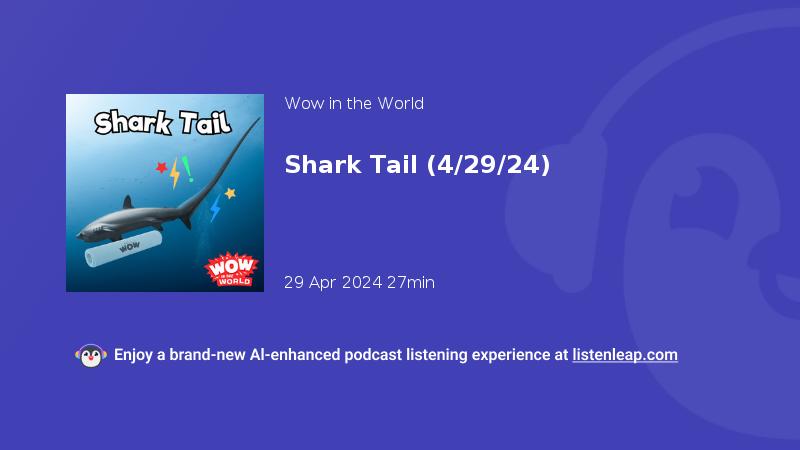
So the thresher shark is a long, big-eyed mackerel shark that lives in temperate and tropical ocean waters.
Okay.
But what really sets this shark apart from other sharks is its tail.
What about its tail, Mindy?
Well, I'm so glad you asked.
You see, the thresher shark has an extra long, extra flexible whip-like tail.
That not only helps it to be a super speedy ocean swimmer, but it can flex, bend and stretch super far.
The thresher shark hunts by herding whole schools of little fishy prey into a small area and then snap.
It whips its tail and snaps the little fishy prey.
Ah, so then the stunned fish can't move.
Exactoritos.
And that's when the thresher shark moves in and gobbles up its fishy prey in a single gulp.
Wow.
So let me get this straight, Mindy.
The thresher shark doesn't just use its powerful jaws to attack.
Well, why would you when you have the fastest whip-cracking tail in the entire ocean?
G-Force, would you quit chasing me?
I'm hurting you with my flexible tail.
And now I'm gonna... I'm stunned.
Wow, you're right, Mindy.
Grandma G-Force's Thrasher Stretch looks just like how you described the Thresher Shark.
Well, that's on account of...
I was trained by one.
You were trained by a thresher shark?
Yeah.
But they're super rare and rarely ever seen in the wild.
Yeah.
And the thresher sharks that are out there have to be protected or they could go extinct.
Yeah.
And the human spine isn't supposed to be able to stretch that way.
Well, I have my way too.
I'm already stunned.
Okay.
Hi.
Excuse me.
I'm very curious how you know so much about this thresher shark.
Oh well, it's because I just read this fascinating new study on them in the journal Royal Society of Open Science.
Oh.
Science.
No complaining about science stretching with Sandy.
Dennis, you complain about science all the time.
What?
No, I don't.
I love when you two talk about boring old science.
Dennis!
Oh, look, I just found this study on my guy phone here.
This is fascinating.
Well, I am curious about how this thresher shark is so flexible.
Oh, you're not alone stretching with Sandy.
See in this study.
A team of biologists from Florida Atlantic University, led by Dr Mary Ann Porter, had the same curiosity.
They wanted to find out what made the backbone and the tail of the thresher shark so wow.
Oh, wow.
And it says here that the researchers got their hands on 10 different specimens or samples from thresher sharks that had been stranded on shore.
And these sample specimens ranged from teeny tiny embryos or unborn baby thresher sharks to faeces.
Full-grown threshers the length of a medium-sized car.
Wow, this is so interesting.
I agree, it is.
Don't interrupt, Sandy.
What happened next, Guy Raz?
Well, from there, they examined the skeletons of these sharks by taking lots of X-ray photos and creating 3D, digital or computer models of their vertebrae.
Wait, wait, wait, wait, wait.
Time out.
Uh, yes, Dennis.
What are vertebrae?
Oh, vertebrae are the bones that make up the spine or backbone of something.
We can even feel our own vertebrae by reaching to the center of our backs and feeling those bumpy little bones that run down the middle of it.
Ooh, I want to feel.
Oh, I can feel my vertebrae.
Anyone else want to feel them?
No.
No.
Uh, yeah, I'll pass.
Fine, suit yourselves.
Oh, G-Force, come here.
I want to see your weird vertebrae.
Oh, my.
Anywho, when Dr Porter and her team studied the thresher shark's vertebrae or backbone, they discovered these bony plates that spread out evenly, like the spokes on a bike wheel.
Huh, I wonder if Granny G has similar vertebrae.
That's exactly what I was thinking.
Quit talking about me.
So the scientists continued to study these plates and found that the plates started out long in the body of the shark and got shorter and shorter as they reached the top of the tail.
And they wondered how the different lengths and structure of these bony plates or vertebrae work together to help these sharks move the way they do.
Tee hee!
Scientists are such little snoops.
Well, yeah, kind of.
I mean, these scientists knew that these bony plates held all the secrets to the thresher shark's amazing flexibility.
That's right.
And it says here that, as they studied the bones of these sharks, they looked for clues, Clues that could help explain how the thresher shark could be so flexible or how it's able to move the way it does.
Or how it's able to swing its body from side to side to help it speed swim.
Or how it's able to thrash and thwap its whip-crackin' fish-snappin' tail.
Fascinating.
So, what secrets were revealed to the snooping... Sorry, Sandy.
I was just going to say, what secrets were revealed to the snooping scientist, Mindy?
Really, Dennis?
Well, I'll tell you, but first... Excuse me, Miss Stretchin' with Sandy?
You can just call me Sandy.
No, that's okay.
Miss Stretchin' with Sandy, can you turn on your meditation music, please?
Oh, sure.
Okay.
Okay.
Now I want you to close your eyes and imagine a shark.
Oh, I see it!
Very good, Dennis.
Now, imagine you have X-ray vision and can see the vertebrae or backbone of this shark.
Okay.
Now, imagine the vertebrae looking like a bridge.
A bridge of bones connecting the body of the shark to the tail of the shark.
Okay.
Now imagine yourself standing on the end of the bridge at the body of the shark, its belly and back.
The bridge here is strong, steady, and stable.
Like a firm, sturdy foundation planted on solid ground.
I agree.
Solid ground.
But as you fall, follow that strong and steady bridge out to the tail.
Things start getting more flexible.
Suddenly, the bridge is able to twist and turn in unexpected and exciting ways.
Ah!
So tell me, what happens to the vertebrae when it reaches the tail?
Well basically, That vertebrae or backbone gets stronger and stronger throughout the length of the shark.
And once it reaches the tail, the vertebrae is so strong that the tail is able to act almost like a catapult, giving the shark the power to launch its tail over its head.
So, in other words, the thresher shark is able to move in the same ways that Grandma G-Force did in the stretching class, because of the way its vertebrae or backbone is structured or connected in its body.
That's right.
The structure of the vertebrae in the thresher shark's main body gives it stability, while the structure of the vertebrae in the tail gives it the power and flexibility to whip its tail over its head.
Cool, dude!
And what's really wow about this is that the more scientists understand about these sharks, they understand about how all shark backbones work.
And who knows, maybe this new discovery could lead to new inventions modeled after the way the Thresher shark's backbone is built.
Well, you could have just taken me apart to see for yourselves.
Or maybe...
I could invent a new Stretchin' with Sandy class, modeled after the Thresher shark and your grandma G-Force here.
And maybe we can turn your classroom into an aquarium.
And maybe we can all dress up like sharks in shark costumes.
Or maybe we should all call it a day and just go home before things get even more out of hand.
No way, dude.
Say, Grandma G-Force.
Yeah?
You think you could help me lead the class in your Thresher Shark-inspired flexibility stretch?
Well, don't mind if I do.
Yay!
Yes!
Okay, first you gotta approach this bowl of fish.
You mean the class.
Sure, whatever.
And then you gotta flex your body like this.
Very nice.
Very nice.
And then you gotta take your tail.
He means your butt.
And whip.
Smack your tail.
Stun your prey.
Quit it, G-Force.
And then you gotta gobble them up like this.
Go.
What just happened?
I don't know.
I guess class is dismissed?
Sure seems like it.
Come on, Mindy.
Let's get out of here.
Good idea, Guy Raz.
Wow in the World will be right back.
Grown-ups, this message is for you.
Hey, grown-ups.
It's Mindy and Guy Raz here from Wow in the World.
Mindy and I have some Wow in the World toys out in the world just in time for the holidays.
Made for the kids who love science and for the ones who don't yet.
From our 100 experiments, that wow kit to the telescope and astronomy kit.
Our Wow in the World toys help your wowzer learn about their world through play.
Play?
You can hear exclusive audio content from me and Guy Raz to help your wowzer discover even more wows.
Grownups.
Give the gift of wow and wonder this holiday season with our latest Wow in the World toys designed with your curious wowzer in mind.
You can shop our Wow in the World toys at Tinkercast.com slash toys.
That's Tinkercast.com slash toys.
Hi, thanks for calling Wow in the World.
After the beep, get ready to record.
Hi, Mindy and Gary.
My name is Lucy and my Wow in the World is that the biggest mammal living on Earth is the blue whale.
And Dennis, I have an important message for you. knows that you're Spongy Man.
Floods and rain don't stand a chance against Spongy Man!
Hi, I'm Indian Guy Rod.
My name is Kinsey, and I live in Bellbrook, Ohio.
My wow is that the first computer mounted when they have was.
Bye!
Hi, my name is Oliver, and my wow in the world is And, Dennis, I know you're static, man.
Hi, Mindy and Guy Ross.
My name's Claire, and I'm from Texas.
And my wow in the world is that scientists have discovered signs of water on Mars, so they're trying to figure out how to get humans to live on Mars.
I love you, Joe.
Say hi to Reggie.
G-Force.
Oh, yeah.
And Mr. Fingerling for me.
Ooh, what are you doing on that?
Bye.
Hi, Mindy and Guy Ross.
I'm Declan, and I'm Seth from Vancouver, Canada.
My wow in the world is that the first airplane flight was only 12 seconds long.
Say hi to Mindy Guy Ross, Dennis Sniff and Seek Robot, Baby Dennis Bucky, Thomas Fingerling, Grandma G-Force and the flight cast.
Greetings.
What is up?
Delise are jumping.
Bye.
And our wow is that when a seagull steps in from a wormhole, it stomps its feet, so the worms think it's raining.
And when the worms come out, the seagull is in for a tasty feast.
Say hi to Reggie, Grandma G-Force.
Oh, no, you didn't.
And the very, very, very, very, very, very, very, very, very annoying Dennis.
End of messages in the world is written by mindy thomas and tom van kalken, with help from me, guy roz.
Original sound design and music editing is done by our senior production director, jed anderson, and audio producer, tyler thull.
You can also hear jed anderson in the voices of dennis thomas fingerling, reggie and many of the other silly characters that you hear on our show.
Lizzie Freilich can also be heard as some of the silly characters on our show.
Jessica Bode keeps our facts straight as our fact checker.
And Meredith Halpern-Ranzer powers the wow at Tinkercast.
Our theme song was composed and performed by three-time Grammy nominees, the Pop-Ups.
Find them at thepopups.com.
Special thanks to Kit Ballinger, Rebecca Caban, Dr Natasha Crandall, Kenny Curtis, Kristen Yang Twee Mack, Erica Medina, Henry Moskal, Jodi Nussbaum, Ali Paksima, Linda Rothenberg, Steph Sosa, Joanna Weber, Anna Zagorski and all of the other tinkerers at Tinkercast HQ.
And to keep the WOW rolling after you finish this episode, visit us at Tinkercast.com.
There you can become a member of the World Organization of Wowzers to get year-round mailings and weekly activities.
Shop our WOW shop, get tickets for upcoming events and Find our best-selling books and learn about some of the other amazing podcasts from Tinkercast.
Grownups, you can follow Wow in the World on Facebook, Instagram, and Twitter at Wow in the World.
And our email address is hello at Tinkercast.com.
And if you're a kid with a big wow to share with us...
Call us at 1-888-7WOW-WOW for a chance to be featured at the end of our show or an upcoming episode of Two.
What's in a Wow?
Thanks again for listening.
We're here every Monday or you can check out Two What's in a Wow every Friday right here in the Wow in the World podcast feed.
And don't forget, we wow on the weekend with Dennis Saturday and Sunday.
Keep on wowing! the world was made by Tinkercast and sent to you by Wondery.