Grownups, Wondery Plus subscribers can listen to Wow in the World early and ad-free right now.
Join Wondery Plus in the Wondery app or Wondery Kids Plus on Apple Podcasts.
Hey, Wowzer fans, Mindy here.
And before we start the show, I got to let you know that this November, with a special new episode featuring our friends at Circle Round and Terrestrials on Radiolab for Kids,
And don't miss when Elmo from Sesame Street stops by Wow in the World to make us all belly laugh on November 24th.
Oh, but that's not all, Reg.
On December 1st, we are sharing our 250th episode of Wow in the World with all of you.
We think this one is going to be music to your ears.
Literally.
Did I mention it's a musical?
And if you're a member of the World Organization of Wowzers...
Oh boy, do I have a surprise for you.
You can listen to our 250th episode early with me and other members from around the world on Saturday, November 22nd, at 7 pm.
Eastern.
That's right, we are throwing another listening party.
Join us as we dance along to our new songs.
React to the episode with other members in the chat and more.
Grownups.
If you want your wowzer to join this members-only listening party, you can sign up to become a member today at Tinkercastcom.
Slash wow.
Already a member?
Well, you can find the link and password to join the event when you sign in at Tinkercastcom.
Slash wow.
That's it.
It's going to be a November to remember.
But for now, let's get on with the show.
Woo!
We'll be right back.
No, G-Force, it's my boo-boo beanie bopper.
No, it's my boo-boo beanie bopper, Fingerline.
It's my boo-boo beanie bopper.
It's my boo-boo beanie bopper.
It's mine.
No, it's mine.
No, it's mine.
OK, OK, we are just going to stop this right now.
Boo-boo beanie boppers are tearing this neighborhood apart.
But I had it first.
It's just a big-eyed toy animal stuffed with beans.
It was a gift.
She gave it to me.
And when somebody gives you a gift, you give it back.
Nope, that's not how it works.
Now, I think we all just need to calm down, find a way to resolve this once and for all.
Uh, I know.
Here, Thomas Fingerling.
Yeah?
I would like you to say one nice thing about Grandma G-Force.
Oh, okay.
Let's see here.
Just one nice thing?
One nice thing.
Like a compliment.
Okay, let me think.
I'm waiting.
Um, G-Force, my favorite thing about you is that you'll always be older than me.
Say what?
Okay well, that was more of an observation of fact than a compliment.
Um Oh, you think I'm older than you fingerling.
Oh, I'm sorry, G-Force.
What I meant to say was, you're so old, your telephone number is one.
Oh, snap!
Okay, that is the opposite of a compliment.
Um, why don't you try this again?
Maybe say something about how lovely she is.
Oh, sure, uh... I'm waiting.
G-Force, when...
I think of you, I think of the wonderful smell of burnt popcorn.
What?
Uh, you know, why don't we try this the other way around?
Grandma G-Force, I would like you to say one nice thing about Thomas Fingerling.
Okay.
Now watch and learn, Fingerling.
Okay, whenever you're ready.
Fingerling, your knuckles are so loud.
They shut off the ding-dang tornado sirens.
And I'm proud of it.
No, no, no, Fingerling.
False alarm!
False alarm, everyone!
Thomas Fingerling was just in a... Mindy, what's going on out here?
Hey, Guy Raz.
I was just practicing my mediation skills.
Your mediation skills.
Yeah, you know, getting in the middle of an argument between two people to try to help them resolve it.
J-Force, you're so old, your birth certificate says expired.
Yeah, well, you're so old, Fingerling, that when you were in school, you had to write a diary.
And how's it going?
Um, great!
I guess I just don't understand why you'd want to even get involved with that, Mindy.
I mean, they've been acting this way with each other forever.
For what, a hundred years?
Eh, give or take.
I just want them to understand that they are the same species, you know?
Team Homo sapiens.
And instead, they're acting like a couple of slow lorises.
Uh, what's a loris?
A slow loris, Guy Raz.
Uh-huh.
It's a primate.
A primate?
Yeah, you know, like lemurs, monkeys, apes.
Us?
Um, excuse me.
Yes, hello?
Over here.
It's me, Dennis.
Dennis?
I couldn't help but overhear your conversation while using my long-range audio recorder.
Dennis!
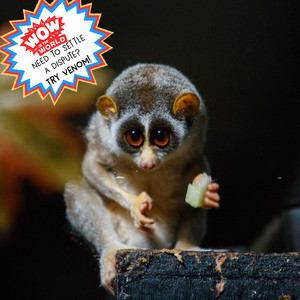
A slow loris is a small primate that lives in South Asia and is generally considered to be very cute.
In fact, the boo-boo beanie bopper that Grandma G-Force and Mr Fingerling are fighting over is a slow loris.
Boo-bop beanies?
What is anyone here talking about?
Boo-boo beanie poppers, Guy.
It was a whole craze.
Just wait.
I'll go get some of my collection and bring them over.
What in the?
What Dennis is trying to tell you, Guy Raz, is that slow lorises are considered by some to be the cutest animal in the whole animal kingdom.
So cute, in fact, that they look like animals. stuffed animals.
Like this boo-boo beanie bopper?
My!
Get out of here, fingerling git.
Oh.
Well, how am I to see one of these slow lorises for myself, then?
Well, just go ahead and zoodle them up on your guy phone 12.
OK.
S-L-O-W-L-O-R-I-S's.
Mindy!
Their little, round, furry heads.
Their pudgy, melon-shaped bodies.
Their big, round eyes.
Their teeny, tiny mouths and button noses.
Here, take it away.
I can't keep looking.
Okay, I'm back.
Here you go, guy.
Boo, boo, beanie poppers.
What in the... What? to them, Dennis.
Oh well, they gave me severe, cute aggression, so I may have ripped the heads off a few of them in a joy-filled rage.
What?
Dennis, those could have been worth a lot of money, millions even.
Every collector of boo-boo beanie boppers knows that.
I'm well aware, Mindy.
I just couldn't help it.
Look how cute they are.
We're... I guess I'll never retire now.
Retire?
Do you even have a job, Dennis?
Of course I have a job.
I'm static ma- I mean, I'm an unpaid intern for an internet company called Static Management.
Yeah, Static Management.
Uh-huh.
And I have to go now, suddenly, because I have a work meeting thing with my supervisor, Chad.
Uh... Hi!
Anywho, as I was saying, slow lorises are cute enough to bring on some major cute aggression.
But that's nothing compared to the aggression they have for each other.
Aggression?
How could something so adorable be aggressive?
Oh, well, I could tell you... Yes?
But I'd rather show you.
Uh-oh.
Hey, Reg!
Over here!
Think you could give us a ride to Indonesia?
Indonesia?
Yeah, it's a country located off the coast of Southeast Asia.
I know what Indonesia is.
That's right, Reggie.
It's right there in the Indian and Pacific oceans.
Think you could give us a ride?
For a price?
You only accept boo-boo beanie boppers as payment?
Wow, these things are really bringing out the bonker balls in everyone these days.
Okay, here's a bag of headless, boopy-dupe animals.
We'll pay you the rest later.
Can we go now?
Yes!
I knew we could count on you, Reg.
I'm just going to hop on here first.
There we go.
Okay, Roz, I'm going to pull you up on the count of three.
Ready?
Okay.
Three!
Ah!
And here we go!
Baby!
I think that was a gum tree we just smashed.
Thanks for the ride, Reggie.
Okay, now it's pretty dark out here in the wild.
I think we're going to need some night vision goggles.
Let me just check my adventure tool kit here.
Stick of butter and new spare tires.
Maybe later.
Let's see here.
Mindy, please, no cats.
What?
I don't have cats in my adventure tool kit, Guy Raz.
But I've got this boo boo beanie bopper kitten with karate scratch action.
Look. kisses when you boop its nose.
What?
Here they are.
Night vision goggles.
A pair for you, Guy Raz, and a pair for you, Reggie, and a pair for me, Mindy.
Now, just put them on and power them up.
Mindy, turn around.
You're blinding me.
Oops.
There.
Now we can all see in the dark.
These aren't night vision goggles, Mindy.
These are halogen... strapped to our faces.
I know.
Aren't they great?
I invented them myself.
And I used the dimming knobs from your formal dining room in your micro house.
They help to control the intensity.
What?
Mindy, you stole my light switches?
No.
I borrowed your dimming knobs, Skyroz.
And if the glasses are a little too bright, you can just use the knobs to turn them down a little.
Okay, but when we get back, if we ever make it back you have to promise to reinstall these dimmers in my micro house, okay.
Uh-huh.
Now, first things first.
I want everyone to creep very quietly as we go and search for the slow lorises in this forest.
We should be able to find some up in the trees.
Hey, slow lorises! think they're all sleeping, Mindy?
Oh, definitely not.
Slow lorises are actually nocturnal.
Oh, which means they sleep all day.
And party all night.
Aw, yeah.
Slap me a wing, Reg.
Give me five.
Thank you.
We also want to be careful not to spook them as they've got it pretty rough already.
You know, they are a super endangered species.
Endangered species?
Meaning that they're at risk of going extinct?
You know it, Guy Raz.
When it comes to slow lorises, it turns out that they've got two big enemies.
The first one being humans who capture them and then sell them to other humans for pets.
Super against the law, by the way.
You mean people who want to own a real, live, bloopity, beany, boopin' all or whatever?
Yeah, something like that.
But their other enemies is the one that has had scientists majorly perplexed for years.
And that enemy is slow lorises themselves.
What was that?
You see, Guy Raz, this primate conservationist named Anna Nicaris gathered her team of researchers from Oxford Brookes University in the UK and set out to solve a slowloris scientific mystery.
The mystery of how an animal species could be its own worst enemy?
Precisely.
How one of the most adorable animals in the entire animal kingdom could possibly turn on its own.
Does this involve cute aggression, Mindy?
Well, it involves aggression, all right, but I wouldn't...
Over there.
Look where.
Over there.
Do you see what I see?
Not unless I'm wearing your glasses.
Here, let me put them on for a sec.
Stop.
Leave my glasses on my face.
You can see the same things I can see without them.
Guy Raz!
It's a slow loris.
I know it's a slow loris.
That's what I've been trying to show you.
And look.
Pudgy little fuzzy body.
Tiny button nose. giant flying saucer eyes, sharp venomous fangs.
What?
Come on, let's creep closer.
Creep, creep, creep, creep, creep.
Did you say venomous fangs, Mindy?
Oh yeah, did I forget to mention that?
I think I would have remembered if you told me we were going off in search of a venomous.
Wait this slow.
Loras is a, And primates are mammals, and mammals are not exactly known as venomous creatures.
Well, that's mostly true, but there are exceptions to the rule.
Of course, you're right.
Vampire bats are mammals, and they're famous for their venomous bite.
Yep, and the platypus also has venomous abilities.
So do two types of shrew and those insectivorous mammals, the selenodon and, of course, the slow loris.
So you're saying that there are only six species of mammal that are venomous, and one of them looks like the living stuffed animal that's staring at us right now.
Uh-huh.
Look, look, Mindy.
He's got your bamboozled, bopping, boo-boo kidney.
It must have fallen out of your adventure toolkit.
Hey!
We come in peace.
We are just here to watch you do your thing.
So just pretend like we're not even here, okay?
So, uh, Mindy, exactly how venomous is his bite?
Oh, well, uh, on a scale of 1 to 10, 10 being the worst, I'd say, uh, 50?
What?
I mean...
According to the researchers, the slow loris's venomous bite is extremely toxic, incredibly painful and ghastly enough to cause its victim to lose an eye, part of its scalp or even half its face.
But look how cute he is.
Mindy, are you saying?
Yeah, this little buddy's got a flesh-eating bite.
Don't you, little pal?
But why?
Especially since it primarily only uses it on other slow lorises.
Well, that's what Dr. Nicaris and her team wanted to find out.
So they conducted a short eight-year experiment.
I don't know if I'd call eight years a short experiment.
And for this experiment starting in 2012, they temporarily captured 82 slow lorises, gave them all tracking collars and then released them back into the wild in a two-square-mile patch of forest.
Okay.
And then they studied them for 7,000 hours over eight years.
Sheesh.
Anything for science.
And during that time period, they would occasionally recapture them for closer health examinations.
Sort of like an annual checkup with the doctor.
Exactoritos!
Huh.
And what did they find?
Well, at the end of the eight years, when Dr Nicaris looked back on all of their yearly health checkups, she found that out of the 82 slow lorises, 20 or around 16 of them had fresh open bite marks.
Ooh, ow.
And some of those bite marks, you don't even want to know.
You're right.
I really don't think I want to know.
You can spare me the details.
Okay, fine.
I'll tell you.
Some of the bite wounds were so bad that the venom caused the slow loris to lose ears toes, other body parts.
I said I did not need the details.
Ooh.
The researchers also found that the males were bitten more often than the females.
Well, that's interesting.
And how do we know these bites weren't the result of another predator, like a snake or an orangutan?
Oh.
So, according to the researchers, only one slow loris during this whole eight-year time period was lost to a predator.
And that predator was a feral dog.
So if the slow lorises weren't fighting off predators...
Yep, they were fighting off each other.
The researchers concluded that slow lorises are extremely territorial, especially when there's not enough of the thing they want.
Huh.
So if another slow loris treads on the wrong turf or competes for the wrong mate well, I guess that's when the venomous fangs come out.
Shh!
And the slow lorises use that venom to settle their arguments.
Uh-huh.
A pretty extreme way to get what you want.
So what about when one slow loris wants another slow loris' bippity boppity bean boozy?
What?
Because I'm seeing another slow loris creeping in on the first one we saw and he's got his eyes on that toy.
You thought that argument back home between Grandma G-Force and Thomas Fingerling was bad?
Wait till you see what happens when these two go at it.
Okay, well, the first little loris is raising his cute little arms above his cute little head.
Yeah, and watch what he does next.
Okay, with his arms above his head, he's now licking his cute little armpits?
Well, it might look like he's just licking his cute little armpits, but what he's really doing is licking his cute little venomous oil-secreting glands on his upper arms.
And now he seems to be licking his cute little teeth.
Oh, yeah, he's coating those razor-sharp fangs or canine teeth with fresh venom.
I can't look, I can't look, I can't look, I can't look, I can't look!
Guy Raz, he's about to... Ah!
Reggie, get us out of here!
What?
And here we go!
Oh, I think we both know what was going to happen next.
Nope, no idea.
And now I guess I'll never know how two venomous mammals solve a fight.
Plus, I'm down one boo-boo beanie bopper, and that was a rare one, too.
Well, if you want to watch some non-venomous mammals solve an argument, I think I found a couple of interesting human species for you to study.
Wrangling!
You're so clever, you put airbags on your computer in case it crashes.
Well, that's true.
My computer hasn't crashed since 1988.
Oh.
And, G-Force, you're so spicy, you make jalapenos cry.
Oh.
Isn't that nice?
Yeah, you know what?
Maybe you should take the boo-boo beanie bopper.
You first.
No, you take the boo-boo beanie bopper.
No.
Hey, it looks like my argument mediation from earlier worked.
Uh, sort of.
You take it.
You take it.
No, you take it.
I don't want it.
I'm giving it to you.
It's yours.
No, you take the boo-boo beanie bopper.
We'll be right back.
Grownups, this message is for you.
Hey, grownups.
It's Mindy and Guy Raz here from Wow in the World.
Mindy and I have some brand new Wow in the World toys out in the world just in time for the holidays.
Made for the kids who love science and for the ones who don't yet.
From our 100 experiments, that Wow kit to the telescope and astronomy kit.
Our Wow in the World toys help your wowzer learn about their world through play.
Plus, you can hear exclusive audio content from me and Guy Raz to help your wowzer discover even more wows.
Grownups.
Give the gift of wow and wonder this holiday season with our latest Wow in the World toys designed with your curious wowzer in mind.
You can shop our Wow in the World toys at Tinkercast.com slash toys.
That's Tinkercast.com slash toys.
Hi, Mindy and Guy Raz.
I'm Callie from Highland and my wow in my world is that sharks have been on Earth longer than any tree.
Say hi to Reggie and Dennis for me.
Hi.
Don't forget Grandma G-Force.
Oh, isn't that nice?
Bye.
Hi, Mindy and Guy Raz.
My name is Zelda.
I live in Brooklyn, New York, and my wow in the world is that if you fell into a black hole, you'd get stretched out like spaghetti.
Say hi to Reggie for me.
And Grandma G-Force.
Oh, snap!
Bye!
Hi, I'm Oliver, and I live in Lethbridge, Alberta.
And my well in the world is that some killer whales eat great white sharks.
I'm Dusty, and I'm from North Vancouver, Canada.
And my well in the world is that giant spider crab... live for longer than humans.
I'm Indian Garbaz.
My name is Mauricio and I live in Austin, Texas.
My world in the world is that people in the Netherlands used to be obsessed with tulips, and some tulips even cost more than a whole house.
Isn't that bonker balls?
Also, say hi to Reggie for me.
Hi, we're Harrison and Liam and we live in Washington, D.C.
And our wow is that if you're on the moon and drop a hammer in the feather, they will both land on the same time.
Bye.
I'm Cynthia from Shitton, Antonio, Texas.
My wow of the week is why leaves change color.
In the fall, leaves lose chorizo, which is a chemical that makes leaves green.
Since they lose this chemical, they lose their green color as well.
Hi, Indian guys.
My name's Mac, and I'm six years old.
I live in New Jersey, and my vow is that the naked mole rat is the longest living rodent.
It can live up to 32 years.
Say hi to everybody.
Howdy.
Oh, yeah.
Pop, pop, pop, pop, pop, pop.
Get out of here.
Bye.
End of messages.
Wow in the World is written by Mindy Thomas and Tom Van Kalken with help from me, Guy Raz.
Original sound design and music editing is done by our senior producer, Jed Anderson and Tyler Tholtz.
You can also hear Jed Anderson in the voices of Dennis Thomas Fingerling, Reggie and many of the other silly characters you hear on our show.
Jessica Bode keeps our facts straight as our fact checker and Meredith Halpern-Ranzer powers the wow at Tinkercast.
Our theme song was composed and performed by three-time Grammy nominees, The Pop-Ups.
Find them at thepopups.com.
Special thanks to the rest of our team of tinkerers, including Anna Zagorski, Rebecca Caban, Kit Ballinger and Henry Moskal.
To keep the wows rolling, visit us at tinkercast.com.
There you can learn more about becoming an official member of the World Organization of Wowsers.
Learn more about upcoming events.
Shop our shop and pick up a copy of our new number one New York Times bestselling book, The How and Wow of the Human Body.
Grownups, you can follow Wow in the World on Facebook, Instagram, and Twitter at wowintheworld.
And our email address is hello at tinkercast.com.
And if you're a kid with a big wow to share with us, call us at 1-888-7-WOW-WOW for a chance to be featured at the end of our show or an upcoming episode of Two What's and a Wow.
Thanks again for listening, and until next time... Be fun wowing!
Wow! was made by Tinkercast and sent to you by Wondery.