
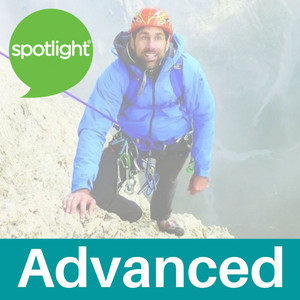
[Seeing Clearly: The Extraordinary Journey of Eric Weihenmayer]-[Seeing Clearly: The Erik Weihenmayer Story (Advanced Program)]
📋 Summary
The Unseen Ascent: Redefining Human Potential
The Challenge of Darkness
Imagine a world defined not by sight, but by sensation—the biting cold of mountain winds, the thin, suffocating air at high altitudes, and the physical exhaustion of trekking through ice and snow. For Eric Weihenmayer, this is not a hypothetical scenario but his lived reality. Diagnosed with juvenile retinoschisis at age four, Weihenmayer faced a slow loss of his field of vision, becoming completely blind by the age of 14. Initially, he confessed, "I was afraid that I was not going to be able to do much in life." However, his journey from this fear to becoming a world-renowned mountaineer serves as a profound testament to the human spirit's ability to transcend physical limitations.
From Wrestling to Rock Climbing
Weihenmayer’s path to resilience began with school wrestling, a sport that required him to physically "grab" his opponents and engage in direct, tactile competition. This foundational confidence led him to discover rock climbing. Unlike sighted climbers who rely on visual scanning, Weihenmayer learned to "use his hands... the way others used their eyes." By searching for "cracks in the mountain," he mapped his ascent through touch. This sensory adaptation allowed him to bypass the traditional visual planning of a route, forcing him to "focus on what he could feel and touch in front of him."
Conquering the Death Zone
Weihenmayer’s ambition soon expanded beyond local cliffs to the world’s most formidable peaks. After successfully climbing mountains on three continents, he set his sights on Mount Everest. Experts were skeptical, citing the "death zone" above 8,000 meters—a region where low oxygen levels compromise brain and lung function. Coupled with his blindness, many believed the feat was impossible. Yet, supported by an experienced team and the National Federation of the Blind, Weihenmayer summited Everest in 2001. He eventually completed the "Seven Summits," becoming the only blind person to conquer the tallest mountains on every continent.
Beyond the Mountains: The 'No Barriers' Philosophy
Weihenmayer’s thirst for adventure did not end at the mountain peak. He later undertook the daunting task of kayaking 442 kilometers through the dangerous rapids of the Colorado River in the Grand Canyon. His motivation was never merely about physical prowess; as he stated, "I do not care whether people climb mountains or kayak, but we are hoping people look within themselves."
To formalize this mission, he founded the nonprofit organization "No Barriers," which is dedicated to helping others "overcome problems and obstacles in their lives." Fellow climber Chris Morris aptly summarized Weihenmayer’s impact, noting that he is "mentally one of the strongest guys you will ever meet."
Conclusion: A Vision for Life
Eric Weihenmayer’s life is defined by his refusal to accept limits. Through his books, documentaries, and humanitarian work, he challenges us to ask, "What are we capable of doing?" By viewing his blindness not as a barrier but as a different way to engage with the world, he transforms the concept of sight into a metaphor for clarity of purpose. Whether on a river or a mountain, Weihenmayer proves that the most significant adventures are those that encourage us to break through our own perceived boundaries.
Deep Learning with ListenLeap


