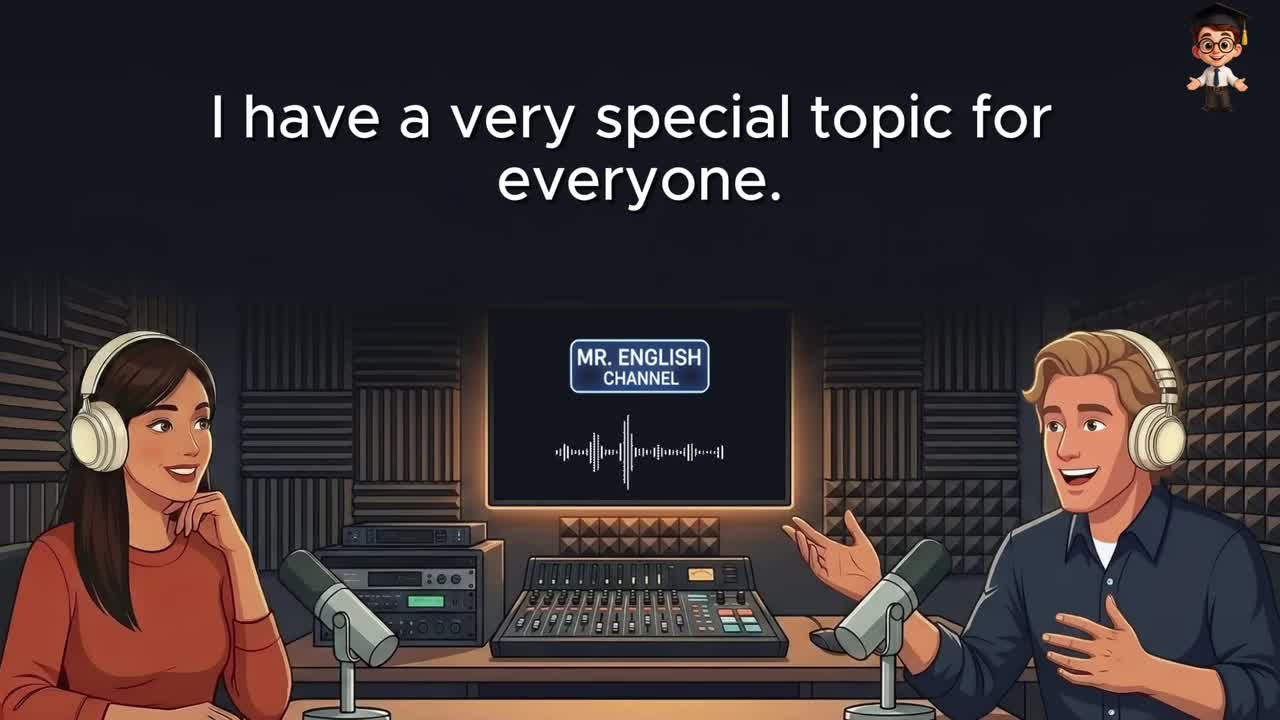
Hello everyone and welcome back to Mr. English channel where learning English is easy and fun.
I'm Emily.
Hi Emily and hello to all our friends listening at home or maybe in the car or at work.
It is so good to be here with you today.
I am so happy today, Paul.
I have a very special topic for everyone.
It is something many students ask about.
Oh, let me guess.
Is it about grammar or maybe how to use get in 50 different ways?
No, not today.
Today we are talking about something even more important.
We are talking about how to train your brain to think in English.
Wow, that is a big one, Emily.
Many people tell me, Paul, I always translate in my head and it makes me so slow.
Exactly.
It is like having a little translator in your brain who is always tired.
We want to say goodbye to that translator.
I like that.
Goodbye, Mr. Translator.
I used to have that problem when I was learning my second language.
It felt like my brain was a very old computer.
Yes.
And later in the episode, I want to share a very small secret with you.
It is a trick I used that changed everything for me.
It only takes two minutes.
A two-minute secret?
Now I am curious.
I will remind you at the end of the episode to tell us.
It's a deal.
But first, let's talk about why we translate.
Paul, why do you think we do it?
Well, I think we feel safe when we use our first language.
It's like a warm blanket.
We're afraid of making mistakes if we don't check the meaning first.
That's true, but translating is like walking with heavy shoes.
You can walk, but you cannot run.
Thinking in English is like taking those shoes off.
So how do we start?
Do we need to read a big dictionary?
Oh no, please don't do that.
That sounds very boring.
The first step is to start very, very small.
Small is my favorite way to start.
Do you mean like learning one word at a time?
Not exactly one word.
I mean narrating your life.
For example, when you are in the kitchen, don't just think about the food.
Talk to yourself.
My neighbors will think I am crazy.
Paul is talking to his toast again.
Let them think that.
You can say, I am making coffee.
The water is hot.
I need a spoon.
Just simple actions.
Ah, I see.
So I am connecting the English words directly to what I am doing.
I am not thinking of the word in my language first.
Exactly.
You are building a bridge between your eyes and your mouth.
No middleman allowed.
I tried that this morning while I was getting ready.
I said, where are my keys?
Ah, they are on the table.
It felt natural.
That's great, Paul.
Good job.
When you do that, your brain starts to see English as a tool for real life, not just a school subject.
It also helps with speed.
When I saw my keys, I didn't have to think of the word in my language.
The word keys just popped up.
That is the goal.
It's like a muscle.
You have to train it every day, even for just five minutes.
Hmm.
Five minutes is easy.
Everyone has five minutes.
What else can we do, Emily?
Well, another good trick is the what-if game.
I love this one because you can do it anywhere.
The what-if game?
How do you play that?
Is it a card game?
No.
Imagine you are waiting for the bus.
Look at the people around you and imagine a small conversation in English.
Oh, so I look at a man with a dog and think, what if I ask him about his dog?
Yes, you can think, the dog is very cute.
What is its name?
Is it a boy or a girl?
You are practicing a real situation in your head.
That's a very smart idea.
It's like a rehearsal for a play.
When you actually meet someone, you are already prepared.
Exactly.
You are teaching your brain to look for English words in your environment.
It becomes a game.
I like games.
They make learning feel less like work.
Speaking of work, I have a story about this.
Oh, tell us.
I love stories.
Well, yesterday at work, I was very busy.
I had so many things to do.
I started feeling stressed, stressed.
Oh no paul, that is not good for the brain, i know.
But then i stopped and said to myself in english okay paul relax, first finish this email, then have some water.
Wow, you used english to calm yourself down.
That is amazing.
It really worked.
Because I had to focus on the English words, I stopped focusing on the stress.
It was like a reset button.
That is a perfect example of thinking in English.
You were using the language to organize your thoughts.
Yes.
It wasn't about studying.
It was about living my day.
It made the English feel real.
I love that.
English as a reset button.
I might use that tomorrow.
Please do.
It's very helpful.
Hey, Emily, I just realized something.
What is it, Paul?
We are having such a great time talking.
If you are enjoying this conversation, don't forget to like the video and subscribe to the channel.
Oh yes, and share it with a friend who is learning English too.
It helps us so much.
And if you are still listening right now, comment the word thinking below.
We want to see who is training their brain with us.
Yes, I love reading the comments.
It makes me so happy to see people from all over the world practicing.
Okay, so we talked about talking to yourself and the what-if game.
What about things we use every day, like our phones?
Ah, the phone.
That is a huge one.
Most people look at their phones hundreds of times a day.
I know I do.
Too much, probably.
Well, here is a challenge for everyone.
Change your phone language to English.
Oh, that sounds scary, Emily.
What if I get lost and can't find my settings?
You won't get lost, Paul.
You already know where everything is.
You know where the Save button is by the icon.
That's true.
I don't really read the words anymore.
I just know the pictures.
Exactly.
But now your eyes will see the English words every time you use the phone.
Settings, messages, clock.
It's like a tiny English lesson every time I check my messages.
That is very efficient.
It really is.
It helps your brain accept English as your default language.
It's not foreign anymore.
It's just there.
I'm going to do that right after we finish recording.
I hope I can still find my camera.
You will be fine.
It's a great way to learn technical words without even trying.
You know, Emily, another thing I find hard is when I don't know a word.
My brain immediately goes back to my first language to find the translation.
That is very common.
But here's the secret.
Don't look for the translation.
Look for the description.
Description?
What do you mean?
Well, if you don't know the word for a refrigerator, don't look it up in your language.
Think the cold box in the kitchen for food.
Ah, so I use the English words I already know to explain the new word.
Yes, this is what native speakers do when they forget a word.
We don't translate, we just describe.
The thing for the, you know, the hair.
Like a hairbrush.
Exactly.
If you can describe it, you can communicate.
And communication is the most important part.
That makes me feel so much better.
I don't have to be a walking dictionary.
I just have to be creative.
Yes.
Be a conversation explorer.
Use what you have to get what you need.
I love that.
It takes the pressure away.
I don't need to be perfect.
I just need to be clear.
That's the spirit, Paul.
You are becoming a very confident English thinker.
Thank you, Emily.
I'm trying.
But sometimes when I'm tired at night, my English just disappears.
Oh, that happens to everyone, even to me sometimes.
When the brain is tired, it wants to go the easy way.
So what do we do then?
Do we just stop?
No, that is the perfect time for passive thinking.
Passive thinking?
That sounds like I can do it while I'm sleeping.
Almost.
It means listening to English songs or a podcast like this one while you are doing other things.
Oh, so I don't have to focus 100%.
I can just let the sounds wash over me.
Exactly.
Even if you don't understand every word, your brain is getting used to the rhythm and the music of the language.
I do that when I'm cooking dinner.
I put on the news in English.
I don't understand everything, but I recognize the tone.
That's perfect.
It helps your inner ear recognize the patterns.
It makes it easier to think in those patterns later.
It's like being a child again.
Children don't study.
They just listen until they start to understand.
Yes, we need to be more like children.
Less worry, more listening.
I agree.
Adults worry too much about grammar rules.
Children just want to play and talk.
Speaking of talking, I had a very funny moment yesterday while I was walking in the park.
Oh?
What happened?
Did you see a squirrel?
No, but I saw a man trying to read a map.
He looked very confused.
Did you help him?
I wanted to.
My brain immediately started thinking in English.
Should I help him?
Does he speak English?
He looks lost.
And did you say anything?
I walked up to him and said, Hello, are you looking for something?
And he smiled and said, Yes, the museum.
Wow.
And was he an English speaker?
No, he was from Italy, but we both used English to talk.
It was amazing.
That is the beauty of English.
It's a bridge between people from different places.
It really is.
And because I was already thinking in English before I spoke, the words came out very fast.
That's the key.
If you think in English, you are always ready for the world.
Exactly.
You don't have to switch your brain on.
It's already on.
I want my brain to be always on like yours, Emily.
You make it look so easy.
It just takes practice, Paul.
And remember, it's okay to have quiet days where it feels harder.
That's good to know.
Some days I feel like a genius, and other days I feel like I forgot how to say hello.
We all have those days.
Just be kind to your brain.
It's doing a lot of work.
You're right.
Learning a language is like a marathon, not a sprint.
We have to keep a steady pace.
Yes, and part of that pace is making English a fun part of your lifestyle, not a chore.
How can we make it more fun, though?
Sometimes studying feels like, well, studying.
Well, think about your hobbies.
What do you love doing, Paul?
I love cooking, as you know, and I love watching old movies.
Great!
So find a cooking blog in English, or watch your favorite movie with English subtitles.
I usually use subtitles in my own language.
Is that bad?
It's not bad, but it keeps your brain in your first language.
Try using English subtitles.
Oh, so I hear the English and I see the English at the same time.
Yes, it's a double hit for your brain.
It helps you connect the sounds to the spelling.
That sounds like a good challenge for my movie night this Friday.
Pepperoni pizza and English subtitles.
That sounds like a perfect Friday night.
I might do the same.
We should have a movie club.
We can watch the same movie and talk about it next time.
I love that idea.
It gives us a reason to think and talk in English.
Okay, Emily, we have talked a lot about different tips today.
I think I'm ready for your big secret now.
Oh, you remembered.
I almost forgot.
You promised a two-minute secret that changed everything for you.
I'm waiting.
Okay, okay.
Here it is.
It is called the morning ritual.
The morning ritual.
Do I need to buy special candles?
No candles.
It's much simpler.
Every morning, the very first thing you do when you wake up, think for two minutes in English.
The very first thing?
Before I even have my coffee?
Yes, before your brain wakes up in your first language.
Just lie in bed and think about your day in English.
Like, today is Wednesday.
I have a meeting at 10.
I want eggs for breakfast.
Exactly.
By doing this, you are setting your brain's operating system to English for the rest of the day.
Wow, so I am telling my brain, hey, today we're using English.
Yes, it's like warming up your car engine before you drive.
It makes everything smoother.
That is so simple.
Only two minutes?
I can definitely do that.
It really works.
When I started doing it, I noticed that I stopped translating much faster during the day.
It's like a reset for the whole day.
I love it.
I'm going to start tomorrow morning.
Let me know how it goes.
I want to hear if it helps you as much as it helped me.
I will.
I'll tell you all about it in our next chat.
Good.
Now, Paul, before we finish, should we review some of the things we talked about today?
That's a great idea.
We covered a lot of ground.
Okay, so step one, narrate your life.
Talk to yourself while you do things.
Step two, play the what if game.
Imagine conversations while you are out and about.
Step three, change your phone language.
It's a tiny lesson you see all day.
Step four, describe things instead of translating them.
Be a conversation explorer.
Step five, use passive thinking.
Listen to English music or podcasts in the background.
And the big secret, the morning ritual.
Two minutes of English thinking as soon as you wake up.
You have a great memory, Paul.
Good job.
Thank you, Emily.
I'm using my English brain to remember everything.
It's working.
I am very proud of you and I'm proud of all our listeners too.
Yes, learning to think in a new language is a big adventure.
Thank you for joining us today.
We really hope these tips help you feel more confident.
Remember, don't be afraid of small steps.
Even a small step is moving forward.
You are doing great!
Well, that is all for today.
But before you go, don't forget to subscribe to Mr. English channel.
And give this video a big like if it helped you today.
It really helps our channel grow.
And tell us in the comments, what is your favorite way to practice thinking in English?
Or what are you going to try first?
We can't wait to read your stories.
It's our favorite part of the week.
Thank you all so much for listening.
We will see you in the next episode.
Yes, see you soon.
Keep thinking in English.
Bye for now.
Bye-bye.