Nickelodeons got your preschoolers covered from sunrise to bedtime with four brand new podcasts.
Grab their backpack and go on a culinary quest with Dora's recipe for adventure.
Make game time great time with Let's Guess Who with Josh and Blue.
And tuck in for adventure with Nickelodeon's Good Night bedtime stories.
Plus, we've got a brand new season of Storytime with Josh and Blue.
Search Nickelodeon on your favorite podcast app to listen.
You're listening to Brains On, where we're serious about being curious.
Brains On is supported on part by a grant from the National Science Foundation.
Hey Ruby, want to play a game?
They don't call me Ruby loves a good game Guthrie for nothing Molly.
I've never heard anyone call you that.
Oh it's true, see? It's even printed on my driver's license.
And my birth certificate.
Huh, guess they really do call you that.
Well, this is perfect because I thought we could play a game of 20 questions.
I'll think of an animal and you get to ask me 20 questions to figure out which animal it is.
Let's do it! Okay, does the animal you're thinking of have a tail?
Yes, it has a long curly tail for grabbing onto stuff.
Ooh, ooh, okay, I know this.
It's a monkey. Good guess, but no.
Ugh, okay. Uh, does it have a pouch?
It does have a pouch. Okay, it has a long tail and a pouch.
Oh, it's got to be a kangaroo, right?
It's not a kangaroo. Cheese, a tail, a pouch.
My next question was going to be if it lives in the ocean, but that seems unlikely.
Uh, yes, it does live in the ocean and shallow habitats along the coast like coral reefs.
Wait, for real? Is it some kind of fish?
Yes, it is a fish. Hold on, Molly, are you pulling my leg?
What kind of fish has a pouch and a curly tail?
I'll give you a hint. Where?
Okay, a sea cowboy? Oh, a sea pony.
No, sea monkey. No, um, no, horses.
Horses, horses. Horses in the ocean.
No, I got it. It's a seahorse.
Yes, you got it, a seahorse.
Wait, a seahorse has a tail that can grab onto stuff and a pouch?
Yes, and that's not all.
They also have a spoiler alert, Molly.
Don't tell me. I'm just about to listen to this episode of Brains On about seahorses right now.
You're listening to Brains On from APM Studios.
I'm Molly Bloom and my co-host today is Noemi from Minneapolis, Minnesota.
Hi, Noemi. Hey, Molly. Today we're talking about one of the most incredible creatures in the ocean.
Sea Horses. We've gotten a lot of questions about seahorses over the years, like this one.
Oh, my name is Beth. Hi, my name is Sawyer.
We're from Salt Lake City, Utah.
And we want to know how to seahorses swim.
We're going to answer that question and more today, but first, Noemi, you've been interested in seahorses for a while, right?
Yes. Well, we have video proof of that because your mom shared a video of you talking about seahorses when you were three years old.
And you already knew a lot about them.
Amy. What? Can you tell me some stuff about seahorses?
They don't use your dorsophine.
They don't use a dorsophine.
What kind of tails do they have?
Pianosales. It's so stinking cute.
Oh my gosh. I don't think there's a lot of three-year-olds to know the word prehensal.
Yeah. I was definitely so into seahorses and animals when I was younger.
So do you remember how you found out all those faxia about seahorses?
No idea. And so back then, do you remember like being really into other animals to like what were some of your other faves?
I remember that I really like jaguarous and I really like the ring-tailed lemurs.
So are you still interested in animals today?
I mean, I definitely don't research them as much as I did when I was younger, but yeah, I still love animals.
How old are you now? Now I'm 11.
11. Okay, so that was eight long years ago.
What's your favorite animal these days?
I can't choose a favorite.
Too many wonderful animals.
So okay, let's have about top three.
Could you do that? Okay.
I guess I like hawk and cats and I guess like any species of bird.
So cool. Have you ever seen a seahorse in real life?
No, I don't think so. At least not that I can remember.
So back then, you were into the prehensal tails, the dorsal fins, the having babies.
Do you have any other things about seahorses that you love?
I love their camouflage.
Mm-hmm. Like, I love that there's sort of like octopuses in that way, you know?
Or like they can blend in with their surroundings.
So do you feel like you remember everything you knew about seahorses back then or have you forgotten some of it?
I've definitely forgotten most of it.
Excellent. So we're going to learn a lot today together.
Seahorses are strange and wonderful animals.
Technically, they're a type of fish, but they look really different from most other fishes.
Instead of scales, seahorse bodies are covered in hard, bony plates like armor.
They have long snouts and eyes that move independently in all directions, like a chameleon.
Since their eyes can move in different directions, that means one eye can be looking forward while the other is looking behind them at the same time.
Seahorses also have a special curly tail that they use to hold on to help, seagrass, and coral.
Like how a monkey or possums tail holds on to a branch.
Like Noami said earlier, those are called pre-hensal tails and seahorses are some of the only animals in the ocean that have them.
There are all different kinds of seahorses that live in oceans across the world.
You can find them along the rocky shores of Ireland, in Australia's Great Barrier Reef, or even in Kelp Forest on the California coast.
Some are as small as a grain of rice, while others are more than a foot long.
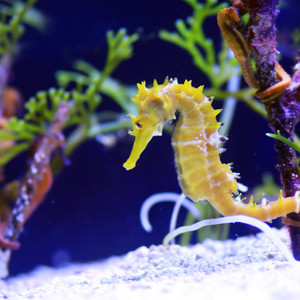
Seahorses come in all different colors too, from fiery red to bright yellow.
Some have long, spiky spines or bony knobs sticking off their bodies.
Others are covered in beautiful patterns, like black and white stripes and tiny dots.
So cool, and get this, they can even change colors.
Their skin can switch colors to help them blend in with their surroundings.
That's called camouflage.
Sometimes they're so good at hiding that it's really hard to find them in the wild.
We talked with Heather cold away about that.
She's a marine biologist who co-founded a group called Project Seahors, which works to protect seahorses in the wild.
Heather still remembers the first time she saw a wild seahorse.
She was snorkeling at night in the Philippines.
That first moment of seeing one in the wild was quite extraordinary, just because I appreciated how very, very difficult it was.
You paddle out over the reef, you drop into the water, which is sort of a mix of magical and spooky, because it's all very sort of dark and mysterious, but you get these flashes of plankton sort of glowing like sparkles, and it's like being surrounded by tinsel as you swim.
And then going through the water, you just have a flashlight under the water, and what you actually first see is their eyes moving.
Seahorses have to be really good at hiding, because lots of other creatures want to eat them, and they're not great at swimming away.
A seahorse holds its body straight up, with a Ted pointing toward the surface of the water, and its tail facing toward the sea floor.
When they swim in this upright position, it's pretty awkward.
It would be like if you tried to swim while standing upright.
Much slower than when you lay on your stomach and swim, with your hands in front of you and your feet behind you.
Seahorses have one fin on their back that moves them forward, like a propeller, and smaller fins on their head that help them steer.
The fins beat up to 70 times per second, about as fast as the hummingbirds' wings, but even so, their awkward swimming style makes them pretty slow.
So, if a predator comes along, seahorses probably won't be able to out swim it.
Instead, they hide or blend in with their surroundings.
And being camouflaged has another big advantage.
It helps seahorses catch their food.
You might not think of seahorses as expert hunters, but picture this.
A seahorse is hiding in a patch of seaweed, holding onto the plant with its grippy little tail, and it's waiting.
All different kinds of creatures pass by.
Fish, sea turtles, sharks, the seahorse waits and watches.
Suddenly, a tiny shrimp floats by in the water, right next to the seahorse, and...
it just sucks it in. Heather says a seahorse's mouth has a special defined, help it gop-food down really fast.
Basically, the mouth has become fused into a straw with a flap on the end.
So, as the little shrimp swims by, the flap opens, and the seahorse sucks really hard.
Now, if you think of drinking a bubble tea or something like that where it's got a lump in it, and you want to suck it really hard, then basically that's what that straw is doing.
It's sucking in that shrimp as it swims by.
So, seahorses are basically sucking up tiny sea creatures, just like they're sipping shrimp bubble tea.
Another cool thing about seahorses is that they can make sounds.
There's some really curious things, like seahorses make noises.
They click and they grunt, and we don't really understand much about how seahorses and why seahorses make noises.
With their color changing camouflage, fluttering fin propellers, and super fast sucking straw mouths, seahorses are some of the coolest animals in the ocean.
Most of the time, things are pretty chill for our horsey pals.
Yeah, they just draw on to some seaweed and slip up tiny shrimp.
But lately, seahorses have been under threat, in part because people like to catch them and collect them.
They sometimes get stuck in fishing nets, smitten for other animals, and their habitats are being destroyed, like coral reefs and kelp forests.
That's why Heather and her group, Project Seahorse, are trying to protect these little fishy friends.
You know, no Emmy, there's one more amazing thing about seahorses we haven't mentioned yet.
How they have their babies!
Exactly, and I know just the seahorse to talk about that.
How about we head over to the beach and see if we can find them?
I'm always up for a beach trip.
Before we go searching for seahorses, let's take a little break, because it's time for the...
Shhh, Mr. Seah! Are you ready, Noemi?
Yes. Wonderful. Here it is.
Hmm, what do you think? I think it could be like, someone typing or like, fluttering pages of a book or something.
Hmm, typing or fluttering pages do you want to hear it again?
Yeah. Okay, let's hear it.
Okay, what do you think now?
Okay, I still think it might be those two, but it could also be like, someone rattling something and something like, bumping around inside maybe.
Okay, what do you think the thing rattling could possibly be?
I don't know. What's that's why some history sound?
Because it's a mystery.
Well, we'll hear it again.
Get another chance to guess and hear the answer at the end of the show.
We're working with our friends at Radio Lab on an episode about naming objects in space, and it got us wondering about Earth's Moon.
Other planets in our solar system have moons with awesome names like, Ganymede and Narvee.
Why is Earth's Moon just called Moon?
So, we want to know if you had to give our moon a new name, what would it be?
Noemi, what would you name our Moon?
I know you read a lot, and a lot of times names come from like, you know, mythology or literature, so as they're like a favorite character from a book you'd want to name the moon after, or like a land from a book or something.
Oh, there is this character from this one book that I read.
It's called Voja. I feel like that might be a cool name.
That would be a cool name.
What is Voja like that makes you think Moon when it comes to her name?
I don't know. She's just like a really cool character, and I love her name so much.
And I feel like it would just be a really pretty name for a moon.
It is a pretty name for a moon.
I totally agree. Well, listeners, we want to hear from you too.
What do you think Earth's Moon should be named?
Record your Moon name. Tell us why you think it's cool, and send it to us at brainzon.org slash contact.
While you're there, send us your mystery sounds, drawings, and questions.
Like this one. My question is, is a whale shark bigger than a whale?
You could find answers to questions like these on the moment of on podcast.
Again, that's brainson.org.
So keep listening. MUSIC Brainson Universe is a family of podcasts for kids and their adults.
Since you're a fan of brainson, we know you'll love the other shows in our universe.
Come on, let's explore.
MUSIC And during brainson universe.
MUSIC To find my favorite podcasts.
MUSIC Brainson. Smash Boom Best.
Forever ago. Picking up signal.
Smash Boom Best. The Smart Funny debate show.
MUSIC Ski, skit, skit, skit, skitter.
Tail, tail, tail, turn.
Tail, skit, skit, skitter, skitter.
Skitter, tail, turn. Is that a rat noise I hear?
That is a rat noise. You know a classic rat noise.
Tail, tail, tail. Tail, tail, turn, turn, turn, skitter.
Zorp, where did the signal go?
Must find Smash Boom Best.
Now! Listen to Smash Boom Best.
Wherever you get your podcasts.
MUSIC BABABABABABABABABABABABABABABABABABABABABABABABABABABABABABABABABABABABABABABABABABABABABABABABABABABABABABABABABABABABABABABABABABABABABABABABABABABABABABABABABABABABABABABABABABABABABABABABABABABABABABABABABABABABABABABABABABABABABABABABABABABABABABABABABABABABABABABABABABABABABABABABABABABABABABABABABABABABABABABABABABABABABABABABABABABABABABABABABABABABABABABABABABABABABABABABABABABABABABABABABABABABABABABABABABABABABABABABABABABABAB
ABABABABABABABABABABABABABABABABABABABABABABABABABABABABABABABABABABABABABABABABABABABABABABABABABABABABABABABABABABABABABABABABABABABABABABABABABABABABABABABABABABABABABABABABABABABABABABABABABABABABABABABABABABABABABABABABABABABABABABABABABABABABABABABABABABABABABABABABABABABABABABABABABABABABABABABABABABABABABABABABABABABABABABABABABABABABABABABABABABABABABABABABABABABABABABABABABABABABABABABABABABABABABABABABABABABABABABABABABABABABAB
I think I see one. I know.
That's just seaweed. Did you hear something?
It sounded like an ant with a head cold.
Or the world's tiniest radio?
It's me. Hello. Hello. Is this thing on just kidding?
I don't have a microphone.
Only my sonorous powerful voice.
I see horse. You are really good at hiding.
I bet you're great at hiding.
Seek. Believe me. You're great.
You're definitely don't want to try that.
The last human who played hide and seek with me ended up looking for years.
Nice to see you again. We stop by because we wanted to talk about how sea horses have babies.
Oh everyone's always asking us sea horses about this.
Don't you want to hear about my encyclopedic knowledge of 1980s pro wrestlers?
Or how we just learned how to make donuts?
A secret ingredient is brine shrimp.
That sounds delicious.
First can we hear about the seahorse babies?
Okay, okay. Hold your seahorses.
You're in luck because not only am I an expert in shrimp donuts, I'm also an expert in baby seahorses.
Here's the thing. We seahorses do things a little differently than most other animals.
That's because the males are the ones who carry the babies around while they're growing.
In a little pouch, right?
Like a kangaroo? Exactly.
Except with kangaroos, it's the females who carry the baby.
See this pouch on my belly?
There are dozens of baby seahorses in there right this very moment.
Whoa, congratulations.
Oh my gosh, that's so excited.
Thank you. Thank you. It's very exciting.
But first, let me back up and explain how this happens.
First, a male seahorse like moi and a female do a special dance for each other.
Like ballroom dancing or tap dancing?
No, no, no. Not like the wild jumping around you humans do.
Like I was saying. Seahorse dancing looks like trees swaying in the wind.
Very elegant. Sometimes the two seahorses even intertwine their tails like their holding hands.
Oh, cute. After they're done dancing, the female seahorse puts her eggs inside the male's pouch where the male fertilizes them.
Eventually, those eggs will hatch into baby seahorses.
But even after they hatch, they stay safely tucked inside the male's pouch so they can keep growing for a bit.
Oh, so cozy. And not only do we provide a cozy place to grow, our bodies make special chemicals to feed the babies.
And we make sure the amount of saltwater in our pouches is just right.
Our female mate comes and checks on us every day and our bellies get bigger and bigger.
Then after a couple weeks, the baby seahorses pop out of the pouch.
They're called a fry. So cool.
Do other animals have babies like this?
Just us seahorses and our relatives pipe fish and sea dragons.
We're the only animals where the males incubate and carry the babies in their bodies.
And get this, some seahorses can have as many as 2,000 babies at a time.
That's so many babies. Sure is.
Good thing we don't have to change diapers.
Can you imagine? Speaking of which, it looks like it's time for these seahorse kiddos to greet the world.
All right, little buddies, come on out.
Hi there, baby. Super, baby.
Yeah, it's us. Oh my gosh, there are little miniature versions of you.
So tiny. They do have my stunning jawline, don't they?
Where are they going now?
They're all floating away.
That's just how it happens.
All the seahorse babies float away on ocean currents to start their lives.
Good luck out there, kids.
I'm proud of you. Oh, my dad, I'm gonna see you later, Bob.
Look at dad. Bye, dad. Whoa, that was pretty incredible.
It really was. Those three seconds of quality time before they float away makes it all worth it, you know?
Now, time for what you've really been waiting for.
More, baby seahorses? What?
No. A fresh batch of shrimp donuts.
I just pulled them out of the oven.
Okay, so the first thing you got to do when you're making these is collect a lot of brine shrimp with your mouth.
Like, we're talking hundreds of brines.
Seahorses are truly unique and wonderful sea creatures.
They have eyes that move in all directions like chameleons, special body plates like armor, and a grabby tail like a monkey.
Seahorses also are really good at camouflaging themselves.
Male seahorses are the ones who carry and protect the babies as they grow inside a special pouch.
And they're a part of the only group of animals in the world where the males are the ones that do this.
That's it for this episode of Brain Zon.
This episode was written by Shaila Farzon and edited by Sandin Totten.
Fact checking by Jess Miller.
We had engineering help from Jess Berg with sound design by Rachel Breeze, original theme music by Mark Sanchez.
We had production help from the Brain Zon Universe team.
Molly Bloom, Rosie DePont, Anna Goldfield, Mikko Gonzalez Whistler, Ruby Guthrie, Lauren Humbert, Joshua Ray, Mark Sanchez, Charlotte Traver, Anna Weigel, and Aron Woldesalassi.
Beth Proman is our executive producer and the executives in charge of APM Studios are Chandra Cavati and Joanne Griffith, special thanks to Hannah Miikakross, Jesse Ross, and Heather Koldaway.
Brain Zon is a non-profit public radio program.
There are lots of ways to support the show.
Subscribe to Brain Zon Universe on YouTube where you can watch animated versions of some of your favorite episodes or head to brainzon.org.
While you're there, you can send us mystery sounds, drawings, and questions.
Okay, no at me. Speaking of mystery sounds.
Ready to listen to that again?
Yeah, let's do it. Awesome.
What do you think? I still think it's like the keyboard.
Okay, I think that's a great guess.
Do you want to hear the answer?
Yeah. Here it is. Hello, my name is Zellan from Palsa Oklahoma and my mystery sound was the sound of fingers typing on a keyboard.
Oh yeah! Yeah! That's right!
Amazing ears. I can tell you've been a podcast fan for a long time because your ears are tuned in.
Thank you. Thank you. So good.
Now it's time for the Brain's honor role.
These are the incredible kids who keep the show going with their questions, ideas, mystery sounds, drawings, and high fives.
Marlow from Ann Arbor, Michigan, Henry and Mira from Richmond, Virginia, Ethan and Emmy from Malapan, New Jersey, Rory and Ila from Erie, Colorado, Vivian from Stanford, Vermont, James Michael from Chapel Hill, North Carolina, Harrison and Hayden from Somerset, Massachusetts, River from Chicago, Zola from Burlington, Washington, Nina from Louisiana,
Abigail from New Jersey, Frankie, Jamie, Benji and Tilly Joe from Eden, Perry, Minnesota, Emily and Gracie from Louisville, Colorado, Micah from Phoenix, Arizona, Prieta from Orlando, Florida, Sam from Toronto, Leah and Jack from Haram, Utah, Milo from Villanova, Pennsylvania, Jacob Luke, Kaylee, Kaitlyn and Mark from Chalamar, Florida, Chen Chen from Melbourne,
Australia, Rebecca, Judah and Jubilee from Mobile, Alabama, Laila from Multinkinatakit, Bryn from British Columbia, George and Samuel from Minneapolis, Kingsley from Bellyna, Washington, Savion, Jurner and Khalifa from Oakland, California, James from Placidas, New Mexico, Jack from Dumfries, Scotland, and from East Lake Ohio, Augustin, Maverick
from San Diego, California, Paulina from Savannah, Georgia, Harvey and Warren from Madison, Wisconsin, Milo and Ruby from San Marcos, Texas, Lucy from Zionsville, Indiana, Jones from Irvine, California, Devora from Airmont, New York, Gillian from Oysterbed, Prince Edward Island, Ezra from Cheltenham, United Kingdom, Virginia from Lexington, Massachusetts,
Anna from Colorado Springs, Mietra from Windsor, California, Clara from Canton, Michigan, Zoe from Lakewood, Ranch, Florida, Orion from Asheville, North Carolina, Brielle and Lorelai from Castle Rock, Colorado, Ethan from Sumamish, Washington, Elijah from Merrival, Tennessee, Marty Jack and Chuck from San Francisco, Sean from Blanginburg, Saskatchewan,
Evelyn from Elkhart, Indiana, Lockhe from Edinburgh, UK, and Maeve and Leyla from Solahul, UK.
We'll be back next week with an episode all about Aurora's Nature's Amazing Light Show in the Sky.
Thanks for listening! Hey friends, Molly here with Ruby and Ruby here with Molly.
Hello, we're just popping in to tell you about analog August.
It's a month of using screens less and getting out more.
Or as we like to put it, a chance to slow your scroll.
But before you log off, go to brainson.org and sign up for our newsletter.
We'll send you a list of cool, screen free activities and tips on resetting your relationship with your phone.
And parents, this is for you.
We've got a free virtual event coming up on August 15th, all about kids and phones.
When should kids get one?
What should the rules be?
And how do you handle social media?
The event is free and there'll be a panel of experts to answer your questions.
Sign up at brainson.org.
So this August, go analog and get more out of your summer.
Molly, isn't the webinar on a screen?
Well, we thought about doing this through a series of elaborate billboards across the country, but it just wasn't in FY25 budget.
Oh, have we considered passenger budgets?
Ruby, I think you're taking the screen free thing a little too far.
Oh, I know. Nomatic tubes.
We're just saying use your screens less.
You know, everything in moderation.
Chain letters. They have a Xerox machine at the library.
Ruby, like screens can be a tool.
They're fine. But Molly, what about skywriting?
It's just a webinar, okay?