Grownups, Wondery Plus subscribers can listen to Wow in the World early and ad-free right now.
Join Wondery Plus in the Wondery app or Wondery Kids Plus on Apple Podcasts.
Hey, Wowzer fans, Mindy here.
And before we start the show, I got to let you know that this November, with a special new episode featuring our friends at Circle Round and Terrestrials on Radiolab for Kids,
And don't miss when Elmo from Sesame Street stops by Wow in the World to make us all belly laugh on November 24th.
Oh, but that's not all, Reg.
On December 1st, we are sharing our 250th episode of Wow in the World with all of you.
We think this one is going to be music to your ears.
Literally.
Did I mention it's a musical?
And if you're a member of the World Organization of Wowzers...
Oh boy, do I have a surprise for you.
You can listen to our 250th episode early with me and other members from around the world on Saturday, November 22nd, at 7 pm.
Eastern.
That's right, we are throwing another listening party.
Join us as we dance along to our new songs.
React to the episode with other members in the chat and more.
Grownups.
If you want your wowzer to join this members-only listening party, you can sign up to become a member today at Tinkercastcom.
Slash wow.
Already a member?
Well, you can find the link and password to join the event when you sign in at Tinkercastcom.
Slash wow.
That's it.
It's going to be a November to remember.
But for now, let's get on with the show.
Woo!
Ah, okay.
Micro houses and all that.
My seed collection is all organized and I'm just going to fold myself up here so I can sit down, relax and log into Yulu to watch my favorite show.
Your favorite show is brought to you by Dekepikit.
Are you sick and tired of your old decrepit body?
Ugh, commercials?
I knew I should have paid the two extra dollars for commercial-free Yulu.
Yo, you love commercials.
What?
Uh, I said, is your body crawling with parasites?
No.
Don't you wish you could shed that annoying body sometimes and just grow a new one?
Again, no.
Ah, the freedom, the autonomy, the feeling of being a head rolling around on the table.
What is this?
Why, it's Decap-A-Kit.
Decappa Kit comes with everything you need to snap off your old body and snap into a new life.
A new life without those heavy appendages weighing you down.
Decappa Kit?
That's right.
Decappa Kit.
Say goodbye to arms, legs, torsos, elbows.
Hey, I'm Ozzie.
You in there?
Me?
Um, be right there.
You don't have to get up, Guy Raz.
Reggie and I just let ourselves in.
Oh, Reggie, be careful.
Your wing.
Wow, did your micro house shrink, Guy Raz?
Uh, no.
It probably just feels that way ever since you gave me this giant hot dog vending machine for my latest on birthday.
Well, I knew you'd love it, but I had no idea it would take up all the space in your home.
Uh, you got a dollar I can borrow?
You can have the hot dogs for free, Mindy.
Ooh, jackpot!
Inspired by the body-shedding nature of sea slugs, the Decappa Kit comes with everything you need to get rid of your old, parasitic body, but also keep your head alive while you grow a new one.
Watching in here, Guy Raz.
Oh, I just turned on Yulu and this strange commercial just popped up.
Something about a kit that helps you remove your head from your ailing body?
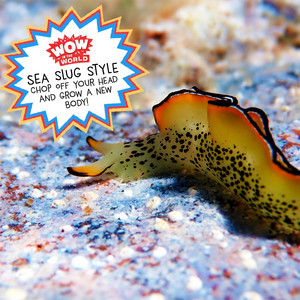
Oh, like the Elysia Marginata.
The what?
The Elysia Marginata.
It's this little green leafy looking sea slug and it's famous for losing its head.
I was just coming over here to tell you about it.
See, I just read this bonker ball's new study about it in the journal Current Biology.
To order your Decapikit, call 1-555-678-910-1112.
See this biology researcher named Sayaka Mito from Nara Women's University in Japan.
She was just hanging out in her laboratory of slugs one day when she noticed something freaky.
Freaky?
Freaky.
She found that one of the sea slugs in her lab had been... Had been what?
You know.
But don't take our word for it.
Let's see what some of our satisfied customers had to say about Decaficit.
One morning, I woke up with a Charlie horse in my leg.
And as a busy mom, I don't have time for my leg muscles to be cramping up.
So I use my Decappa Kit to chop off that old muscle crampy body.
And in three weeks, I'll have a whole new body.
Thanks, Decappa Kit.
Wait.
Wait, you were just about to say what freaky thing the researcher found.
Oh, right.
So she found that one of the sea slugs in the lab had been, um, decapitated.
Decapitated?
Yeah, decapitated.
You know, beheaded.
Off with its head.
Everything from the neck up just removed with a clean break.
Ooh.
But that's not even the freaky part.
It gets worse?
It gets weirder.
See, when Mito continued to examine the scene inside of the slug tank, a shiver of shock and surprise ran down her spine.
And the Decapa Kit is not just for removing heads from bodies.
Use it to sever unwanted limbs like weak arms, wobbly legs, stumped toes, and tails.
Oh, this thing? is really versatile.
You got a credit card I can borrow, Guy Raz?
Mindy, please continue with the story.
You can't leave me here in the suspense.
Oh, yeah.
Uh, where was I?
The biology researcher looked into the slug tank and saw something shocking.
Oh, right.
Okay, so she noticed... Yes?
That the decapitated head...
Yes?
Was waltzing around the tank with no body, eating algae like it was no big deal.
The severed head was moving and eating without the body attached?
Yep.
And where was the body?
Oh, the body was there too.
And of course it didn't have a head or a brain, but that didn't stop it from moving all around and acting like it had not just had its head cut off.
So who did it?
Who did what?
Who?
Cut the head off the sea slug?
Who would even do such a thing?
Oh, well, the slug did it.
What?
The sea slug.
It chopped its own head off.
Why pay top dollar to have your head separated from your body by a professional when you can just do it yourself in the comfort of your own tiny home?
Or slug tank?
Or electric-powered banana scooter?
Uh, Guy Razzi?
You okay?
Okay.
I mean, I know that there are certain members of the animal kingdom who remove body parts in order to survive.
Like some lizards and salamanders, for example.
Occasionally, they'll lose their own tails in order to escape from predators.
Oh, yeah.
Abandoning their wiggly tails to be eaten alive, while the rest of their bodies run off into the sunset.
Uh-huh.
And I think I remember seeing a video of a crayfish who amputated or cut off its own arm in order to escape being boiled alive.
Oh, yeah, that crayfish thing was cray-cray.
And how can we forget the African spiny mouse who's known to release its own skin when under attack?
Yep, one of the only mammals known to autonomize.
Autotomize?
Oh yeah, autotomize is the scientific word for get rid of your own body parts.
And you're saying that this sea slug gets rid of its own body?
Uh-huh.
And, as far as I know, it's the only known creature in the entire animal kingdom to ditch its whole body.
But don't worry, it grows a whole new one.
Phew!
Some of the time, at least.
And we know what you're thinking.
Uh, hey, Decapakid, once I cut my own head off, how long will it take to grow a new body?
Well, one-third of our clients grow new and improved bodies in just three short weeks.
Oh, yeah.
With Decapakid, my head began to sprout with a new body in only eight days.
My neighbors were all like, hey, where'd you get that awesome new body?
Where'd your old terrible one go?
When I told them, they couldn't believe it.
Now they all want the Kappa Kids.
Hey, I want to make my neighbors jealous.
Knock, knock, knock.
Mindy, Guy, you in here?
Oh, no.
Dennis!
Guy, you have a hot dog vending machine in here?
Can I borrow a dollar?
Dennis, there's really not enough room in here for Mindy and Reggie and you.
And Wait, why are you holding a in your hands?
Well, I was coming over to see if you could help me.
Help you with what, Dennis?
It's my new sea slugs.
I got them off a commercial I saw on Yulu, and they're all broken.
Broken?
You ordered sea slugs off a commercial you saw on TV?
Not just any sea slugs.
Elysia sea slugs.
They were on sale two for one.
Just gotta set this down.
Which makes sense now that I see that they're all broken.
Look.
These are them, Guy Raz.
These are the sea slugs we've been talking about.
You know, the ones that decapitate their own heads.
You sound just like the customer service representative I talked to.
Sea slugs don't decapitate themselves.
Now please, help me, Guy Raz.
You're my only hope.
I don't know.
Glue them back on or something.
Dennis, Guy Raz is not going to help you fix your broken slugs.
But why not?
Because there's a pretty good chance that they'll fix themselves.
Mindy, these aren't magician slugs.
They can't just wave their little magic wands and magically glue their own heads back on magically.
No magic is needed to repair these slugs, Dennis.
Guy Raz is right, Dennis.
All your slugs need is a little bit of science.
Well, where am I supposed to get science at this hour?
If you call Decapakit within the next four seconds and order seven Decapakits, we'll throw in a pack of science absolutely free.
Where's my phone?
1-555-678-910-1112.
Nope.
Don't even think about it, Dennis.
Listen, Mindy was just telling me about this new scientific study.
That was all about these sea slugs.
And according to this study, your sea slugs kind of broke their heads off on purpose.
What?
Why would they do that?
Well, a likely culprit could be parasites.
You know, tiny organisms living on or inside of other living organisms.
And since a parasite living in the body of one of these little slugs could be deadly, the sea slugs use their power of decapitation to get rid of their bodies altogether.
Okay, gross.
But look inside my aquarium.
The sea slug's little zombie bodies are wiggling around without heads.
And their severed heads are roaming around without bodies.
What is happening?
Well, according to the researchers on this study, the circle of this sea slug's life is happening Dennis.
Huh.
Go on.
See, first, the slug senses that something is wrong with its body...
Yes.
And then it decapitates its head in an effort to ditch its parasitic body.
Yes.
And then the headless body continues to wiggle around with its heart beating for a couple more months.
Okay.
And then the severed head enjoys its freedom by wiggling around and munching on all the algae it can find.
Uh-huh.
And finally, the headless body rots and dies.
Oh.
But a new body grows out of the severed head.
Yay!
About one third of the time.
Yay?
So, you know, anything for science.
Anything for science.
And what about the headless body, Mindy?
Yeah, you said the headless body rots and dies.
But is it possible that one of the bodies could grow a new head?
Well, that's one of the questions that these researchers had as they were studying these slugs.
Yeah, it's a pretty great question.
And they found that while the heads could regrow new bodies... Yeah?
The bodies never, ever grew new heads.
Oh, poo.
So in other words, the brain and teeth can't be replaced, but the heart and other important vital organs can.
That's right.
Mindy, Guy Raz, look!
Something's happening to one of my broken sea slugs.
Again, Dennis, it's not broken, it's... Let me see that, Dennis.
Yep, just like we talked about.
What's happening?
Whoa!
The head seems to be sprouting a new body.
And from what the researchers reported in their study, this sea slug should grow at least 80 of its new body within the next three weeks.
A whole new body in just three weeks?
Yeah.
According to this study, it takes about one day for the head wound to heal after the head's been, you know, lobbed off.
And then it takes about another week for the organs like the heart to begin to grow.
And then another couple of weeks for the rest of the body to catch up.
Amazing.
The sea slug gets a whole new body to make up for the one it dumped.
Huh.
So maybe I wasn't scammed by that commercial after all.
Maybe that's what it meant by two for one sea slugs.
Two bodies for one head.
And actually Dennis, you could be getting even more than that two heads on one body.
No, oh mindy, are you suggesting that some sea slugs go through this whole strange process more than once?
Oh yeah, and in this study, while some of the slugs did not chop their heads off at all, some managed to do it twice.
Wow, that's right.
The Decava Kit can be used over and over and over again.
Don't believe me?
Let's hear from yet another satisfied customer.
Oh, it's become like a party trick.
Now all my friends are like, do that thing where you pop your head off.
And I'm all, nah.
And they're all, do it, do it, come on.
So I do it.
And now I'm on my fourth new body.
Thanks, Decava Kit.
Dialing, dialing, dialing, dialing, dialing.
Yes, I would like seven Decapakits.
Guy, do you have a credit card I can borrow?
No.
Oh, hi, you still there?
Okay, cancel my order.
Now you might be thinking to yourselves wow, that must be a lot of work growing a whole new body and all
Yeah, is a severed head able to produce enough energy for this kind of massive regeneration or regrowth?
Well, yes, but...
But lucky for these sea slugs, they may have found a sneaky way of stealing energy, something called kleptoplasty.
Oh, I know about kleptoplasty.
It's the ability to steal chloroplasts from plants.
What in the... Chloroplasts help plants convert sunlight into energy through photosynthesis.
And photosynthesis... is how plants use sunlight to make their own food.
Wow, Dennis.
I'm not done.
The process requires sunlight, chlorophyll, water, and carbon dioxide.
Okay, now I'm done.
Wow, you sure know a lot about photosynthesis, Dennis.
Yeah, well, most of my friends are plants.
So, let me make sure I've got this right.
These researchers think that the sea slugs are essentially stealing energy from...
Well, basically, yes.
So the researchers found that these slugs, also known as solar-powered sea slugs, they seem to be stealing the teeny tiny sunlight-trapping energy engines called chloroplasts from plants.
And look, they're doing it right now.
My broken slug heads are stealing chloroplasts from the algae they're eating.
And look.
This is how they might be getting the extreme energy boost they need to regenerate or regrow their bodies.
I guess.
Mindy, does stealing chloroplasts from algae also help them to look like little green plants?
Well, yes.
Huh.
Well, I'll be.
I mean, take a look at all of your broken slugs in the aquarium, Dennis.
They basically look like little slimy green leaves.
Oh, yeah.
They do look like leaves.
Huh, I guess you are what you eat.
So Mindy, now that these researchers have this information, what do they plan to do with it?
Well, there's still a lot more to learn and discover about the strange beheading habits of these little slugs.
But Sayaka Mito and her fellow researcher Yoichi Yusa are hoping that what they're learning could help other scientists who are working to invent medicines that could regenerate or regrow parts of bodies for other living things as well.
The miracles of science.
What if we could discover how to grow like three sets of arms?
I could finally achieve my dream of becoming the world's greatest juggler slash pan flute player.
Reggie, don't yuck my yum.
So what are you waiting for?
Call now to order your Decapikit and start resetting, beheading, and body shedding today.
Does this commercial ever end?
It does now.
The end.
Mindy, turn that back on.
I need a Decapikit.
Well, what if one of us gets parasites?
Dennis!
What?
Loud in the World will be right Hey grownups, it's Mindy and Guy Raz here from Wow in the World.
Mindy and I have some brand new Wow in the World toys out in the world just in time for the holidays.
Made for the kids who love science and for the ones who don't.
From our 100 experiments, that wow kit to the telescope and astronomy kit.
Our wow in the world toys help your wowzer learn about their world through play.
Plus, you can hear exclusive audio content from me and Guy Raz to help your wowzer discover even more wows.
Grownups.
Give the gift of wow and wonder this holiday season with our latest wow in the world toys designed with your curiosity.
Wowzer in mind.
You can shop our Wow in the World toys at Tinkercast.com slash toys.
That's Tinkercast.com slash toys.
That's it.
Back to the show.
Wow in the World.
Hi.
Thanks for calling Wow in the World.
After the beep, get ready to record.
Hello, my name is Alec.
I come from England.
And my wow in the world is that polar bears have black skin under their fur.
Say hi to Reggie for me.
Bye.
Hi, I'm Indian Guy Roz.
My name is Benjamin, and I live in Westminster, Colorado.
And my wow is that a farmer from Massachusetts once paddled down a river in an 817-pound hollowed-out pumpkin.
Say hi to everybody for me.
What?
Bye.
Hi, my name is Jenny, and I live in Wilmette, Illinois.
My Round.
The World is at.
The world's largest chocolate bar was created in 2011 and weighed 12770 pounds 448 ounces.
That's nearly the weight of an adult male African elephant.
Say hello to Reggie.
Hello.
Grandma G-Force.
Oh, I'm sorry.
I couldn't hear that.
Thomas Fingerling.
What?
And the annoying dentist for me.
Howdy.
Hi, Mindy and Guy-Wa.
My name is Owen, and I live in Holceston, Delaware.
My wow in the world is that the sun is so big you can fit one million earths in it.
Say hi to Grandma G-Force.
Say what?
Thomas Fingerling.
What?
Hi, Wow in the World.
My name is Dov, and I am from London.
My Wow in the World is that baby seahorses are carried around in their father's pouch, not their mother's.
Say hi to Grandma Jeeple for me.
Oh, isn't that nice?
Hi, Mindy and Guy Raz.
My name is Paisley.
I'm eight years old and I live in Wyoming.
And my wow in the world is that tigers have striped skin and striped fur.
Also, say hi to Grandma D-Force for me.
Oh, snap!
Bye.
Hi, Mindy and Guy Ross.
My name is Felix.
My name's Harry.
And we are from Conway, Arkansas.
Our wow in the world is that Cuvier beak whale can hold their bus underwater for two hours.
Say hi to Dennis and Reggie for me.
Hi there.
Bye.
Love your show.
End of messages.
Hey, everyone.
Thanks so much for hanging out with us this week on Wow in the World.
And to keep the wow rolling, consider becoming a member of our World Organization of Wowzers.
Each membership includes episode-specific digital activities, science experiments, book lists and more.
Plus, you'll get a welcome box including a special edition members-only t-shirt and an autographed picture of us.
Find out more at Tinkercast.com.
There you can also find more info on our upcoming shows.
Shop our shop and find our New York Times best-selling book, the how and wow of the human body.
Wow in the World is written by Mindy Thomas and Tom Van Kalken with help from me, Guy Raz.
Our senior producer, Jed Anderson, brings our show to life with sound design and music editing and is also in charge of wrangling Dennis Thomas Fingerling, Reggie and many of the other silly characters you hear.
And Grandma G-Force wrangles Grandma G-Force.
Grandma G-Force gets Jessica Bode keeps our facts straight as our fact checker.
And Meredith Halpern-Ranzer powers the WOW at Tinkercast.
Our theme song was composed and performed by three-time Grammy nominees, the Pop-Ups.
Find their music at thepopups.com.
And special thanks to the rest of our WOW in the World team, including Anna Zagorski, Rebecca Caban, Kit Ballinger and Henry Moskal.
Grown-ups.
You can follow WOW in the World on Facebook, Instagram and Twitter at And if you're a kid with a big wow to share with us, call us at 1-888-7-WOW-WOW for a chance to be featured at the end of the show or on an upcoming new episode of Two.
What's in a Wow?
Also, be sure to subscribe to Wow in the World wherever you get your podcasts.
And you can also ask your smart speaker to play Wow in the World.
Thanks for listening.
And until next time, keep on wowing.
Wow in the world is made by Tinkercast.
Grownups, if you like Wow in the World, you can listen early and ad-free right now on Wondery Plus.
Join Wondery Plus in the Wondery app, or on Wondery Kids Plus on Apple Podcasts.
Prime members can listen ad-free on Amazon Music.
And before you go, tell us about yourself by filling out a short survey at wondery.com.