What's in your wallet?
Terms apply.
See CapitalOne.com slash bank for details.
Capital One N.A., member FDIC.
This is Planet Money from NPR.
This is a story of two groups of people doing life-saving work in totally different ways.
One group up close with their hands and the other with numbers at a desk.
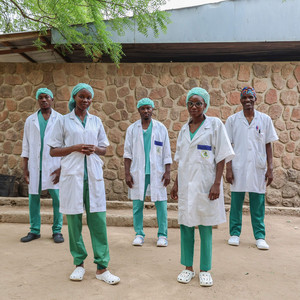
That first group provides basic health care and medical supplies in the far north region of Cameroon.
Their doctors and nurses give vaccines.
They monitor pregnancies, train patients to look out for signs of malnutrition with tools as simple as a little piece of tape, like a measuring tape, with red, yellow and green on it.
So a mom can wrap it around her kid's arm and measure whether her kid is malnourished.
So it's a very easy to use tool that we train the mothers to use on their children so that they get to identify malnutrition very early.
Madeleine Tronceau manages grants for the organization called ALIMA.
It's an acronym.
It stands for the Alliance for International Medical Action.
Last year in Cameroon, ALIMA treated almost 400,000 people.
ALIMA has been able to do this work by staying far out of the fray during an armed conflict that has been going on for years, by building trust and partnership, also by managing difficult logistics.
Sometimes there's no road you face.
Potential attacks.
It's scary.
It's dangerous.
To continue that work, Aleema's Cameroon program was supposed to get 19 million this year from USAID.
When the Trump administration announced it was gutting USAID, Madeleine had just gotten back from a visit to Aleema's doctors and nurses up in the mountains in an area called Mokolo.
They had malnourished children in the beds of the hospitals.
They knew that if we had to discharge all of these children, then they will not get treated.
So I just thought, oh my God, what if we have to stop all this?
Who's going to be able to take over?
And what was the answer?
Well, the answer is the health system is not able to take in all those patients.
And that means those patients just don't get care.
Yeah.
Alima's Cameroon Project is one of thousands of programs helping millions of people around the world that all of a sudden this year stopped having money.
Tens of billions of dollars gone.
An estimated 620,000 people have already died for lack of care.
So while people like Madeleine and Cameroon are triaging, choosing what clinics and what services to sustain across the world, there's a parallel triage at the desks of that other group doing life-saving work.
The other part of our story, the people with the numbers.
They are a philanthropic group.
They have money and have been trying to figure out if and how they can help.
But they have their own very particular way of doing things.
They have a lot of math to do, all while racing against the biggest worst, loudest ticking clock they could imagine.
Hello and welcome to Planet Money.
I'm Mary Childs.
Today on the show, we get to be a fly on the wall while one organization tries to fill in a tiny part of the enormous hole left by USAID.
The calculations they're making are ruthless.
If I'm adding up the deaths averted, it's like 650 averted in total.
Is that right?
Yes, I think so.
This group led us in as they tried to reconcile this chaotic and terrible moment with their particular procedures.
Sorry, where is the agenda?
I haven't spotted it yet.
So week after week... Oh yeah, did I not send it?
I'm sorry.
Okay.
We were able to watch up close as they wrestled through one decision whether to give their money to the project in Cameroon.
Boop, boop, boop.
There you go.
Boop graduate students learn to turn bold ideas into real-world impact, whether launching a startup or rethinking business as usual.
In Babson's MBA and specialized master's programs, you'll gain the skills and experience to lead change.
Ranked number one in entrepreneurship.
Babson is shaping leaders who don't just study the economy, they build it.
More at babson.edu slash grad school.
In the days after USAID got gutted, private philanthropy groups everywhere were in a kind of panic, trying to figure out how to help.
And a few recently unemployed USAID workers used their newfound spare time to compile a list of all the projects that had just lost funding, from water sanitation in Yemen to researching biofortified maize in Guatemala.
And that list landed on the desk of a philanthropic group called GiveWell.
GiveWell donates hundreds of millions of dollars every year, and they have this very explicit goal.
To make that money save or improve the most lives per dollar.
Through those ruthless calculations, through research and proof.
So GiveWell assigned a special team of researchers and advisors.
To start sorting through the list, including Rosie Bettle.
I was on our rapid response team, trying to hoover up. stuff between the cracks.
Givewell expected that they could spend about 50 million to try to fill in a little tiny part of that USAID hole.
So Rosie and the rapid response team start zeroing in on a few specific projects.
And one of them was Madeline and all those doctors and nurses in the mountains of Cameroon.
So now Givewell has to see is this project a better choice than our?
All of the other projects GiveWell could give their limited money to right now.
And way back then in March, I asked GiveWell if they would record themselves as they tried to sort that out.
So I wanted to start this meeting actually for Mary from Planet Money, because I know you'll be listening to this reporting.
That's Taryn Maddox, the director of research who, for my sake, starts the meeting, laying out what she sees as the challenge GiveWell is diving into.
The mismatch between GiveWell and their love of crispy, clear data and this project in Cameroon.
We're facing a steeper learning curve in understanding the context, because it's just terrain we don't know as well.
So in this first meeting?
GiveWell is mapping out what they will need to know.
Actually, I'm curious, Rosie, if you can talk me through, like, why this?
Why are we prioritizing this among the other opportunities that we looked at?
So it's this region which is heavily affected by conflict.
In many ways, this Cameroon program is emblematic of the kinds of things USAID had given money to.
Big, multi-pronged programs in areas where there's conflict and poverty and malnutrition, disease.
Or it funded programs promoting global stability for trade.
And historically, GiveWell has operated more at the margins, looking for specific programs, efficient and neglected projects so that they can prove with research and data, and preferably randomized controlled trials, that they are saving the most lives.
The canonical example is buying mosquito nets to prevent diseases like malaria.
The nets are super effective and super cheap.
So for this project in Cameroon, the GiveWell team is starting by trying to understand the most basic facts.
How many people are in the area and at What rate do they die?
Yeah, and these are populations that we think are just higher risk, higher mortality populations in general.
Yeah, that's definitely something I really want to get into through this investigation.
But like coming in my sense would be yes they, more than the vast majority of people on the planet really critically need like good health care.
They spend the rest of this first meeting on what they will need to find out that could convince them to fund this grant.
Or not.
Okay, we'll check in soon.
I'll look forward to seeing the investigation plan.
Taryn is Rosie's boss and when I spoke with her later I learned on this rapid response team it is her job to decide who gets money and who doesn't.
Well, I manage the teams that decide where the money goes.
I try to make sure that we're doing that, making those decisions in the highest quality way possible.
Yeah.
But you are kind of the buck stops.
The buck stops with me.
That's right.
What GiveWell is looking for is the least expensive way possible to save the most lives or improve the most lives.
In the unique language of GiveWell, they call it life-saved equivalent.
So we're taking all of the benefits like averting disability, improving somebody's income, improving someone's cognitive outcomes.
They assign precise numerical values to the benefits that a program provides, so that they can compare how effective one kind of intervention is versus the next.
We're putting that all into one measure and calling it like an equivalent life saved.
So that's a little bit of like nuance.
And this type of calculation is unique to a little group of nonprofits and philanthropic organizations like GiveWell.
They overlap with a philosophy called effective altruism, in which people try to quote do the most good based on the evidence.
This arose with our newfound ability to gather and crunch vast amounts of data, which enabled more rigorous research.
That transformed development economics.
Everybody started doing randomized controlled trials and this whole new way of thinking about aid was born.
That is the context in which GiveWell started in 2007.
And that's their promise to their donors who have handed their money to GiveWell, because they also believe in this idea of saving or improving the most lives per dollar.
But for all this to work, GiveWell has to have proof.
So a couple days later, GiveWell asked the people running the Cameroon project to meet them on Zoom.
We are recording this.
If anyone's uncomfortable sharing externally, that's fine.
Just shoot us a note.
First the GiveWell people want to know how urgent the needs are, and then they'll start to fill in the numbers they need.
Okay, so if it's good...
My first question is to get a sense of the current status of Aleema's work in Cameroon.
Like is everything still fully operational or are some parts of the program maybe not running like at the moment?
No, they are not running in 100 percent.
Joel Kambale-Kamete is in charge of the program in Cameroon.
And he says, yeah, we are already having to pull our doctors and nurses and staff.
Like in Makari, where they were in 14 health centers.
Now we have only four health centers and one hospital.
So it means from 14 health centers to four.
And in Mokolo, their other location under discussion.
They were in eight health facilities and now are down to just one.
Just the hospital.
In Mokolo, if there's no other funding coming... then we'll have to shut down the project.
Madeleine is in the meeting too, the one in charge of raising money for the Cameron Project.
And Rosie, the researcher from GiveWell, she asks Madeleine for more clarity on the demographics.
This figure will go into one of Rosie's GiveWellian calculations to get at the rate of lives being saved.
So it's a mix of internally displaced people, host communities, is that correct?
So I can give you the The population from Mokolo House District, that will be around 350,000 people.
After their first meeting with the Cameroon group, the GiveWell team spends several weeks trying to compile the answers to some ruthless-sounding questions.
Like, how many children under five generally die in that area?
And how many children will die without the Cameroon Project's work?
So the baseline mortality versus the counterfactual.
And during GiveWell's internal meetings, Rosie and Taryn are doing this sort of unnerving child mortality math.
When children die because of malnutrition, it's because it's usually because of a complication.
Right.
So we have like children that are very unwell because they're malnourished, and then they have.
They get pneumonia or they get a case of diarrhea.
And that just puts their little bodies like over the edge.
And so.
I wonder if we might be double counting, essentially.
These mortality figures are weirdly hard to come up with.
And it's a conflict zone.
So a lot of the patients are displaced people or refugees.
They're pretty mobile, so they don't come back for follow-up visits.
So GiveWell needs information that basically doesn't exist.
Throughout April, clock ticking, they keep trying to make sense of the numbers.
Like this one data point of how many kids under five die every year per 10,000 people.
Oh, so I'm just looking at this row 15.
730 total deaths per year.
And then if we're averting 650 of those.
I'm with you.
Taryn and Rosie are parsing this data point and asking...
Is that with the Cameroon Project's doctors and nurses?
Because that would mean without them.
Is that potentially like a little bit higher still, which would seem like really gutting right?
Okay, so is this on the list for us to just ask them about tomorrow?
I think it's not, and actually I think it should be.
In addition to not having all the numbers give well needs for this project...
There's another missing component so far that's just as important.
On the ground research.
Rosie told me later both are crucial.
If you're just like spreadsheet spreadsheet spreadsheet model model model without, of course, like really thinking like hey, what is happening on the ground?
You're liable to go equally astray in the opposite direction, right?
But where GiveWell might normally hire some trusted research firm to fly in and confirm the Cameroon project's numbers to say yes, this many people are there.
Looks like the hospital does indeed employ 54 people.
They cannot do that here.
Because the area is so unstable.
Like, two researchers were killed here a few years ago.
GiveWell talks a lot about this in their meetings, by themselves and with Aleema.
Like, should they commission a study here?
Is it safe in the area to run these types of surveys?
The hardest to reach area will be hard to cover, and that's usually where we have the worst figures.
A comprehensive study like the kind they want would take a year to get done.
All while that clock is still ticking.
On the other hand, the GiveWell team is thinking if we don't spend the time we need to complete on-the-ground research and our spreadsheet spreadsheet spreadsheet, How can we be sure we're backing the right project?
Taryn told me she's learned that sometimes real measured, evidence-based outcomes can be counterintuitive.
Like this one time when she first joined GiveWell in 2019.
I remember looking into two different interventions around the same time.
One was an intervention that was designed to reduce maternal mortality rates.
And the other was helping a government switch an HIV test for pregnant women to test for syphilis as well.
So which should they fund?
Preventing birthing mothers from dying?
Or testing for syphilis in addition to HIV?
When you do the math, maternal mortality is extremely rare.
And syphilis is... like not as rare if you find the right places.
And then the effects of having syphilis are lifelong and horrible.
And it came out like one program was like a thousand times more cost-effective than the other one.
Adding the syphilis test saved way, way, way more lives per dollar.
So they did the same cold calculations you hear in all these meetings and that is the project they funded.
That's like an illustrative moment, but that happens a lot, actually.
Like where you go in and you crunch the numbers and your strong intuitions end up being wrong.
I like having a framework that can discipline my compassion.
Are you ever like, oh, I can't, I'm going to do this like syphilis HIV switch that's like so high yielding.
Like, how do you not think about the mothers that you're not saving?
No, you think about them.
I mean, I don't.
Oops.
No, it's okay.
I'm sorry.
This is going to be bad audio.
You think about them.
And so I think that the best that we can do is say, we have this limited pot.
We're going to use this the best way we possibly can.
The GiveWell team goes into their next meeting with the Cameroon team hoping to sort out some of the data that's not making sense to them.
You can really hear these two groups trying to speak each other's languages.
Taryn from GiveWell is talking to Susan Shepard from Alima and the Cameroon Project.
We've heard about this, like, two children per 10,000 mortality.
Right.
Yeah.
I knew this was going to become a key point for you guys.
Is this the first time you guys are trying to do a project evaluation in a humanitarian context here?
A humanitarian context, meaning there's armed conflict, there are refugees and displaced people.
These are places where Doctors Without Borders work and, before this year, USAID.
And Susan explains there's a whole decades-long history of data crunching in regions like these.
Measuring mortality and trying to.
There are different ways of doing it and it causes us, you know, endless discussions.
Like she says, the demographic and health surveys that everyone uses across the industry.
Those measure by live births per year.
But... Humanitarian projects use number of deaths per 10,000 people per day.
I have never found a way to join those two to find out.
Yeah, I have never.
I just say, OK.
In another meeting, Taryn from GiveWell asks Susan a question that kind of goes to the heart of the difference in approach between the two groups.
Why is service provision kind of targeted at places with conflict as opposed to just really high rates of mortality?
Yeah, it's kind of the humanitarian including this Cameroon project is focused on reducing mortality, but not just that.
I think it's the idea that people who are the victims of all of these conflicts, they're forced to flee or they're forced to move, you know, trying to provide the services that allow them to maintain some level of dignity.
Gotcha.
Okay.
Thank you.
On the last day of April, The GiveWell team meets on its own again to go through their current back-of-the-envelope calculations, which they call BOTECs.
I would like to start with the mortality coverage one.
Yes.
Okay, so to give an overview, BOTEC, back-of-the-envelope calculation, relatively simple.
Rosie has fed all the information she's managed to collect into three different models, three ways of slicing the data to see how the Cameroon projects work.
Impacts mortality in the populations they serve.
One big thing they ask themselves, which I think of as very effective altruism, is do these Cameroon programs work better than just giving people money?
And Rosie tells Taryn that all three of her models are spitting out the same basic answer.
They all say yes. a fair amount better.
Which, Taryn says, is pretty surprising, I think, considering how different the approaches are.
Still for GiveWell to fund a project.
They usually want it to beat cash transfers by even more than what Rosie's calculations show so far.
But she is still doing her maths.
I've got, like, three Botex at the moment, but one is currently in my, like, problem child.
Her problem child.
Because it's hard to calculate how effective the Cameroon program is when they're doing so many different kinds of interventions at once, from prenatal care to pediatric medicine, to vaccines, sanitizing water.
So it's hard to attribute an outcome to any one given intervention.
For example, very often moms bring kids in to get those nutrient-dense packets of basically, peanut butter paste.
And while they're in there, the staff can run other diagnostics.
They can give kids vaccines, get them malaria treatment.
They can train the moms to look for signs of malnutrition themselves with that tape.
And Rosie says there's actually another downstream effect.
They are also educating other medical staff.
If all the doctors who are capable of training other doctors leave and don't pass on their knowledge, then what happens?
Like Three or four years down the line, less community health workers would be being trained.
All this kind of slightly difficult to quantify stuff.
The things that you mentioned, I could see accruing to child health and child survival.
Rosie and Taryn wrapped that meeting on the last day of April.
And well into May.
The GiveWell rapid response team is researching crunching numbers, asking more questions.
And to me, this seemed like it might be exhausting for the Cameroon team.
But Madeleine told me later they did not mind.
They asked for lots of data, it's true.
But I mean, when we have a donor asking so many questions and really wanting to understand the situation in the field, we keep hope, because it means that they're interested, that they understand the urgency as well.
On May 21st they get on another Zoom, and GiveWell asks another round of questions, including one that I cannot tell you how many times I heard Rosie ask.
I was wondering, is there any more mortality data from Cameroon that we could check out?
No.
Yeah, well, it's really difficult to have data on Cameroon, especially updated data.
Madeleine explains the most recent survey they have is old and their internal data is informal.
It's not a proper assessment, but they can send it.
Okay, well, thank you for your interest.
Maybe, if we have like one quick question from our side, is maybe an idea of the deadlines that you have on your site.
Do you think that you'll be able to give us an answer by tomorrow, the end of the month, or give us a list, an indication of the potential budget or what would be possible on your side?
We would be interested to know more.
Rosie responds with questions of her own, like, do you need an answer by a certain date?
Madeleine says, for the patients, the more we wait, the worse it will be.
And eventually, Madeleine asks her question in the language of GiveWell.
What is the probability that we will get this money?
And Rosie answers. please don't hold me to this.
If I had to put a number on it right now, I'd probably be like 55%, 60%.
55% to 60% sure that this grant is going to come through?
That kind of amount, like we're still very much considering, but we're not certain yet.
Okay.
Yeah.
It's also for us just to know on which grants that we might, we might rely on for next year and for the upcoming months as well.
But yeah, okay.
So it is May 21st.
It's been more than three months since the news that USAID was getting shut down.
The Cameroon Project has already had to pull doctors and nurses from health centers across the far north.
And the rainy season has just started, meaning mosquitoes and malaria.
After the break...
Will GiveWell give them the money?
This message comes from WaterAid, whose mission is to change the world through water.
Imagine walking miles every day to collect water because your home has no taps, toilets or clean water.
That's the reality for one in four people worldwide.
Your support can help change the future for them, because WaterAid believes everything.
Health food opportunity starts with water.
Donate to WaterAid and your gift will be matched, going twice as far to bring clean water to everyone, everywhere.
Donate at WaterAid.org slash podcast.
Support for this podcast and the following message come from Recorded Future.
Know what matters.
Act first.
So in Cameroon, Joelle and Madeleine are waiting to find out if they will get the money to continue doing their work.
In the meantime, they were already having to make decisions they did not want to make.
They cut all the mental health programs and educational programming like nutrition and hygiene best practices and information about where to get the project's help for free.
The health facilities were open less frequently.
Joel says, and that has its own cost.
If people make the trek and the hospital's closed at that moment, they give up.
Even someone about to give birth.
If the hospital is closed, you deliver directly in the bush.
A mother will deliver her baby outside somewhere, without any medical care.
And, they have learned, she'll kind of give up on the hospital, on the health facilities altogether.
She won't try again.
I asked Madeleine if she ever loses hope.
No, we don't lose hope.
Otherwise, we would just stop working.
No, we always have hope to find more support.
I cannot accept that.
No, the situation is so dire in the field that we cannot just lose hope.
But she says that is getting harder and harder.
Because while the USAID situation was acute and unexpected and devastating...
It was the most extreme example of a larger trend.
Countries all over the world are reducing how much money they allocate to international aid.
So it's not just the U.S., it's also France, it's also Germany, it's also the U.K., it's everyone.
So it's really, it is just like less and less everywhere.
There are lots of reasons why.
It's largely a worldwide move towards tightening budgets, austerity politics and also spending more on defense.
It's not the top priority anymore.
Which makes the Cameroon Project one among so many more organizations looking for funding, competing for money from organizations like GiveWell.
And through most of May, the GiveWell team continues to have two projects hang-ups about choosing the Cameroon Project.
One, given their imperfect data, are they overestimating lives saved or improved?
And two, how can they be sure of any of this data without independent on-the-ground confirmation?
One of the researchers, Alice Redfern, keeps pushing on that.
Have you managed to speak to anyone that's not a lemur but is in the area?
No.
I've asked a lemur.
I feel very unsure about how to get this without Aleema.
Alice is like, we got to figure this out.
This piece of just taking so much on face value from them when we have at least some reservations about it.
That probably is the sticking point for me.
So I can see if I can source a reliable contact.
That'd be great.
Finally, on May 30th, Alice speaks in French with the director at one of the hospital's Alima's Cameron Project staffs.
Bonjour, madame.
Bonjour, docteur.
This is the closest they can get right now to what Rosie calls ground-truthing talking to someone on the ground in the place.
And of course, this is one person's opinion.
You don't want to over-update.
But he was so much blunter than I was expecting.
Like, the word he used was...
Like, if Aleema pull out, it will be a catastrophe.
Mm-hmm.
It would be a catastrophe.
Because, he told Alice, Aleema's Cameroon project is key to so much of what the hospital does.
Right away Alice hops on a Zoom to update Taryn on what the hospital director told her about the impact of Aleema's doctors and nurses on patients there pretty much the only driving force to bring anyone into the hospital.
So even more of them would just not get any care at all without Aleema.
And that's because without them, there's not really much to offer at the hospital, is that why?
One, there's not much to offer at the hospital.
Two another piece that I have not appreciated the nutrition services that Aleema offers is a major draw for people to go to the health facilities.
And he was saying that you take that away, mothers won't come for antenatal care.
Alice tells Taryn she is still uncomfortable with how much uncertainty is embedded in their calculations.
But this conversation with the hospital director finally made her believe some of the numbers she was skeptical about before.
Hopefully we can close this.
I feel like we learned a lot over the last couple of weeks, so that's pretty cool.
Taryn later told me that she did have a moment where she was sort of like oh crap, we just may not be able to fund this project.
It was like, we're probably not going to get good data.
But then the flip side of that was that I think that's why this is probably pretty high impact.
Aleema has done so much work to gain access to these really difficult places.
So it was like a mind shift.
So, okay, maybe this time we just won't Know everything.
But we can use this to learn.
And that learning would save more lives in the future.
And listening to all of this over the past seven months, one lesson already seems clear.
That saving the most lives gets a lot harder when you don't have a local government taking care of the basics.
Or international governments pitching in on the big picture stuff like stability and safety.
Over the weekend, Taryn reviews all the information they've collected and on Tuesday, June 3rd, she clicks the Yes button.
They approve the grant for 19 million for Aleema's work in the far north of Cameroon to fill in the entire hole left by USAID for one year.
These two groups, one working with numbers, the other with their hands.
They found a way to work together.
And GiveWell's grant allowed the Aleema workers in Cameroon to restart what they had paused.
They signed it.
I'm really happy about it.
We succeeded in proving that the intervention that we were proposing was cost-effective.
Joel is happy too, but he also is thinking about next year.
Alima will continue to push and to look for other private actors to maintain those projects.
So this is a relatively happy ending, but it is not the norm.
GiveWell started with a list of 140 programs that had lost funding and, as of today, they have given money to 23 of those.
$39 million so far to fill a hole of tens of billions that USAID has left.
Many, many more aid programs in countries everywhere are having to shut down or reduce services.
And Madeleine says that creates another problem.
It's about information, exactly the kind donors like GiveWell need.
As aid programs get shut down, information gets lost.
Then it means that no one will get the information out of where it's happening.
And then when we don't have the information, then we don't think anything is happening.
So the risk, I would say, is that if there's less aid, then it looks like there's less needs, which is not the case.
All around the world, there is more need and we're just not going to know.
Today's episode of Planet Money was produced by Sam Yellow Horse Kessler.
It was edited by Marianne McCune, fact-checked by Vito Emanuel and engineered by Jimmy Keeley with help from Robert Rodriguez.
Our executive producer is Alex Goldmark.
If you want more economics, you can sign up for our excellent weekly newsletter by local hero, Greg Wazowski.
Nprorg slash planetmoneynewsletter.
I'm Mary Childs.
This is NPR.
Thanks for listening.
What's in your wallet?
Terms apply.
See CapitalOne.com slash bank for details.
Capital One N.A., member FDIC.
This message comes from Capital One.
Banking with Capital One helps you keep more money in your wallet with no fees or minimums on checking accounts.
What's in your wallet?
Terms apply.
See CapitalOne.com slash bank for details.
Capital One N.A., member FDIC.