Ted Audio Collective You're listening to Ted Talks daily where we bring you new ideas to spark your curiosity every day.
I'm your host, Elise Hume.
You can't change what you can't measure.
That's the idea behind the work of today's speaker, Millie Chew-Baird.
She's an environmental advocate working on a sweeping project to operate a satellite that tracks methane emissions.
Methane is one of the biggest contributors to climate change.
Getting a better sense of where it's coming from is a powerful tool to reduce it and reduce climate change in our lifetimes.
She explains after the break.
And now, our Ted Talk of the Day.
Lots of people are really enthusiastic about space.
My husband, my daughters, and a lot of my colleagues love rockets and pretty much anything that has to do with space.
It's never really been my thing.
However, I recently went to a rocket launch and I can honestly say that I got emotional.
And the emotion that I felt wasn't just thrill or awe, it was hope.
Because my colleagues and I helped put something on that rocket that will address the single most important thing we can do to affect climate change in our lifetimes.
We often hear about things we can do to help our grandchildren and the earth that they'll inherit and everything we're doing to reduce carbon dioxide will certainly help in the long run.
But what if we could do something that would help people's lives now?
I believe we can because we're taking on methane.
Methane is a highly potent short-term greenhouse gas.
Let's compare this year's carbon dioxide pollution from burning fossil fuels with this year's methane pollution.
There is a lot more CO2. However, because methane is over 80 times as powerful at trapping heat in the short term, methane will cause as much warming as all that CO2.
And methane is easier to control if we know where it's coming from.
So what was on that rocket that makes me so hopeful?
Methane's sad. It's one of thousands of active satellites orbiting the earth.
But it's my favorite. Not just because we help put it there, but because we designed it for a purpose to have a profound impact on methane and soon.
For the past 20 years, my job has been to understand climate from a variety of angles, to be a bridge between scientists, policymakers, and companies, ensuring that we're all working towards the same big vision.
And the vision for methane is to deliver actual data quickly, putting it in the hands of people in the trenches pushing for change.
Now methane comes from several sources.
It comes from cows. It comes from landfills.
It comes from coal mines.
And a lot of it comes from leaks from the oil and gas infrastructure.
For a while, we've known what the overall concentration of methane is in the atmosphere.
But we haven't been able to pinpoint sources until how much was coming from where.
In fact, companies and governments often under report their emissions because they simply haven't had good data.
But now they will. When we looked at the data we were collecting using airplanes, we realized that we would never get a comprehensive enough view.
We simply cannot fly an airplane over every oil and gas field in the world every day.
We realized that we needed to be collecting our data using a satellite.
And that satellite would need spectrometers that did not yet exist.
So we went to the world's most innovative instrument experts and they helped us build two spectrometers that would allow us to see methane emissions from 590 kilometers away, from space.
They had to develop a new manufacturing technique to create a prism that would allow us to see how even the smallest concentrations of methane interact with light.
It's pretty amazing. And now back to the episode.
To give you a sense of the power of methane sad, we'll be able to zoom in and out and circle back weekly to see how emissions have changed.
Methane sad will show the total picture.
Not just point sources or large leaks, but also the smaller, more spread outsources that actually make up the majority of emissions most of the time.
Methane sad will show how much methane is coming from where over time.
But, after we do our analysis on it, we still have to solve a people challenge and change human behavior.
So we'll put our analysis directly in the hands of those who can take action to reduce methane from oil and gas.
That would be government regulators, the companies themselves, and nonprofits who will be receiving our data at no cost.
Using leaks is actually not a technical challenge.
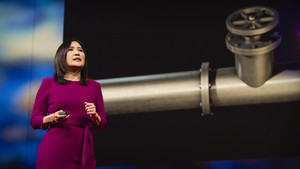
Often it's as easy as fixing a crack and a pipe.
Companies know how to do this.
It's just a matter of priority.
And that's what I mean by a people challenge.
Environmental defense fund is taking this on as the first environmental nonprofit to own and operate a satellite.
We are supporting both the technology and the advocacy.
Methane sad would not exist without generous donors, some of whom are a part of this TED community.
We'd like to thank you for your belief in our mission.
We'd also like to thank government entities like the New Zealand Space Agency who have invested in methane sad to build their space capacity, but also to better understand methane emissions from agriculture.
This powerful data and boots on the ground, our goal is to reduce methane emissions from oil and gas facilities by 75% in the next six years.
That's 75%. It's a lot and we have momentum.
50 companies representing 40% of global oil and gas production have already pledged cut their methane emissions by 90% by 2030.
Over 150 countries have signed the global methane pledge to be admired of the solution.
Purchasers can also influence sellers.
The largest import of natural gas in the world, the European Union, is already taking steps to extend its rules to apply to imports and setting in place rules that will allow them to buy from suppliers that have the least methane emissions.
And methane sad will help track all of that.
It's powerful when countries and companies have this knowledge, but it's even more powerful when we all have the knowledge because it provides the information and the incentive for people to fulfill their commitments.
This kind of radical transparency changes the dynamic.
It's what makes me hopeful and I hope you share that feeling as well.
With methane sad in space and the power of people on Earth, let's do everything we can as quickly as we can to slow the rate of global warming in our lifetimes.
Thank you. That was Millie Chewbarrad at TED 2024 and this ambitious idea is part of the audacious project, TED's initiative to inspire and fund global change.
You can learn more at audaciousproject.org.
If you're curious about TED's curation, find out more at TED.com slash curation guidelines.
And that's it for today.
TED Talks Daily is part of the TED Audio Collective.
It was mixed by Christopher Faisy-Bogan, additional support from Emma Taubner, Daniela Balorezzo, and Will Hennessey.
I'm Elise Hugh. I'll be back tomorrow with a fresh idea for your feed.
Thanks for listening.