Hello, welcome to Chinese Folk Tales.
I'm Victoria Meakin, and I've got another amazing story to tell you.
I hope you enjoy it.
It's all about friendship, maybe more than that.
It's about finding a person completely in tune with the way you think, express yourself and see the world around you.
In China, there is a word for this, qiyin.
It means soulmate, but really, much more than that.
Let me see if I can explain.
With a story, of course.
Let me take you back two and a half thousand years.
To a time that we today call the spring and autumn period in Chinese history.
There were small states.
Some lived in peace, others fought wars.
Despite this, it was a fertile time, especially for philosophy, the arts and music.
Many artists and musicians took their inspiration from the natural world.
They saw all about them the clear waters and the green mountains, a treasure trove of beauty and harmony.
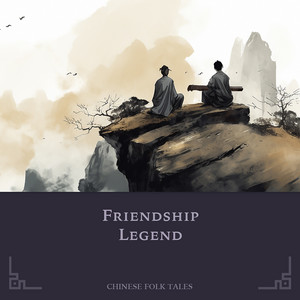
One day a young musician called Yu Boyer was getting a Gouqian lesson from his master as a kind of stringed instrument, a bit like a lute.
His master was patient, but very strict.
What do you think, master?
Good.
But you still have a long way to go.
Master, I'm trying my best.
I've mastered all the sounds and styles a Guchin can make.
I've learned all the songs you gave me off by heart.
What more can there be to know?
But the master simply smiled and urged him to continue playing.
He walked silently around him, breathing in the cool, clean air deeply and watching the birds gathering on the eaves of his house.
Beyond, the mountains rose majestically into the blue sky.
Day after day, the young player practiced, and at the end of each of those days, the master would simply say Better, but still not quite good enough.
I know you can do better.
Come back tomorrow and we'll try again.
Boyer was angry.
Maybe not angry, perhaps more frustrated.
On his way home.
Through the streets, he would stop total strangers and ask them to listen to his music.
Please, just a moment of your time.
Listen to this.
Tell me what you think. you play a battle song or something about the prince's daughters?
Something fun?
Fun?
Yeah, fun.
And the stranger walked away, as did everyone else he stopped.
Next day he returned to his lesson and told his master what he had done, how downtrodden he felt and how he wanted to give up the Gouqian and find another job.
The master listened to what he had to say, closed his eyes and thought for such a long time that Boyer thought he had fallen asleep.
Even my master thinks I'm boring.
But just at that moment his master's eyes opened suddenly, like he'd arrived at a very important decision.
Here's what we'll do.
Tomorrow morning, pack an overnight bag.
Some food and a fishing rod.
Oh, and your guqin.
Where are we going?
I am taking you to meet my own master.
The greatest master who ever lived.
Boyer went away that day more confused than ever.
But he did as he was told and arrived at his master's house the next day just as the cock was crowing and the first rays of sunshine were breaking through the tall trees that lined the mountains to the east.
The master took him to the coast onto a boat and away to Penglai Island, the fabled home of the immortals.
Right, you stay here.
My master will be along shortly.
And then he ran down to the beach, jumped into his boat and sailed away.
Oh, that's unexpected.
Boyer waited several days.
But his master didn't come back, nor did anyone else.
Why would my master trick me like this?
Day after day, he would sadly sit amidst nature, with only the babbling brooks, the call of the birds and the wind in the trees for company.
To keep busy, he would play his goqian and talk to the birds and the animals and imagine that all the sounds of nature were talking to him.
Sometimes he would play something, and listen for their response, and then play again.
One day, there seemed to be no difference between the music he played and the sounds he heard all around him.
He had become one with the natural world.
Eventually, his master returned.
Where on earth have you been?
Abandoning me here like that, it's not funny.
I didn't sign up to be your student just so you could play tricks like that.
But the master simply smiled and sat on a rock.
Play me some music.
And Boye did.
Something he had written on the island, inspired by the natural world around him.
A sweet and soulful song that seemed to be part of the landscape that surrounded them both.
When he'd finished, the master smiled.
Immediately Boyer realized what he'd done.
Now I understand.
You have learned from the best teacher there could ever be.
Now you are an accomplished guqin player and there is nothing more that I can teach you.
But let me warn you.
There are always two sides to every copper coin.
An accomplished player should always find an audience understands their music.
Boyau waved a fond farewell to his great teacher, the natural world of the island, but was troubled by the words of his master.
Sometimes he would play his music in public in the town.
But not everyone liked it.
Some even walked away as he played.
One day, Boyer decided to take a boat along the river.
He wanted to enjoy the birds and the trees, smell the air and gaze upon the majestic mountains.
But not long after he set off, there was a torrential rainstorm.
He pulled the boat into the bank to wait until it passed and saw a little summer house he could use for shelter.
Sitting in the little wooden hut, he listened to the rain and felt the excitement of inspiration.
He took out his gochien to play some music, to speak to the rain and listen to the rain speaking to him.
After a while, he realised someone was watching him.
A woodcutter was standing nearby.
He'd stopped his work and was resting his hands on his axe, listening to the music and swaying along with the melody.
His eyes were closed and he looked the happiest man alive.
When he stopped, the woodcutter said, No, no, please don't stop.
Play another.
OK, I don't normally do requests, but this one is called The Magnificent Mount Tyke.
And he began playing again.
And once again, the woodcutter seemed to be transported by the music, tears coming to his eyes.
When he stopped playing, the woodcutter stepped nearer.
When you play, I could hear the dignity of the mountains, the roar of the rivers and the whispers of the wind through the trees.
Boyer immediately ran towards the woodcutter and hugged him.
Steady on.
I've never met anyone who so fully understood my music as you do.
You've made me so happy.
Boyer played a few more songs and then, as the sun began to set, he said sadly that he needed to head back home, but promised that he would be back again and play for the woodcutter.
But he didn't.
At least not soon enough.
Filled with confidence he played concert after concert and everyone wanted him to play.
He became the busiest musician in town.
One day he remembered the woodcutter and took a boat down the river to find him.
But when he reached his village, the people there told Boyer that the woodcutter had died not long before of an illness, a sadness and a longing.
They said his last wish was to hear the music of Boyer played on the Gautien.
And he played the saddest song he had ever played in his life.
For he knew that he had lost a soulmate, a true friend.
Someone who had totally understood his music.
When he finished playing he broke his gochen over his knee and lay the pieces on the tomb of the woodcutter.
He never played again.
And so we go back to that word, qiyin, which literally means to know the tone.
Someone who gets you, a sympathetic friend, a soulmate.
But of course, it's not enough to simply find this person.
You have to realize it and treasure that friendship for life.
And with that, we conclude this episode of Chinese Folk Tales.
Thanks for listening.
If you like our stories, do give this podcast a five star rating.
Leave your comment and share with your friends.
To hear more, please subscribe to Chinese Folk Tales on all major podcast platforms.
We'll see you next time.
Bye for now.