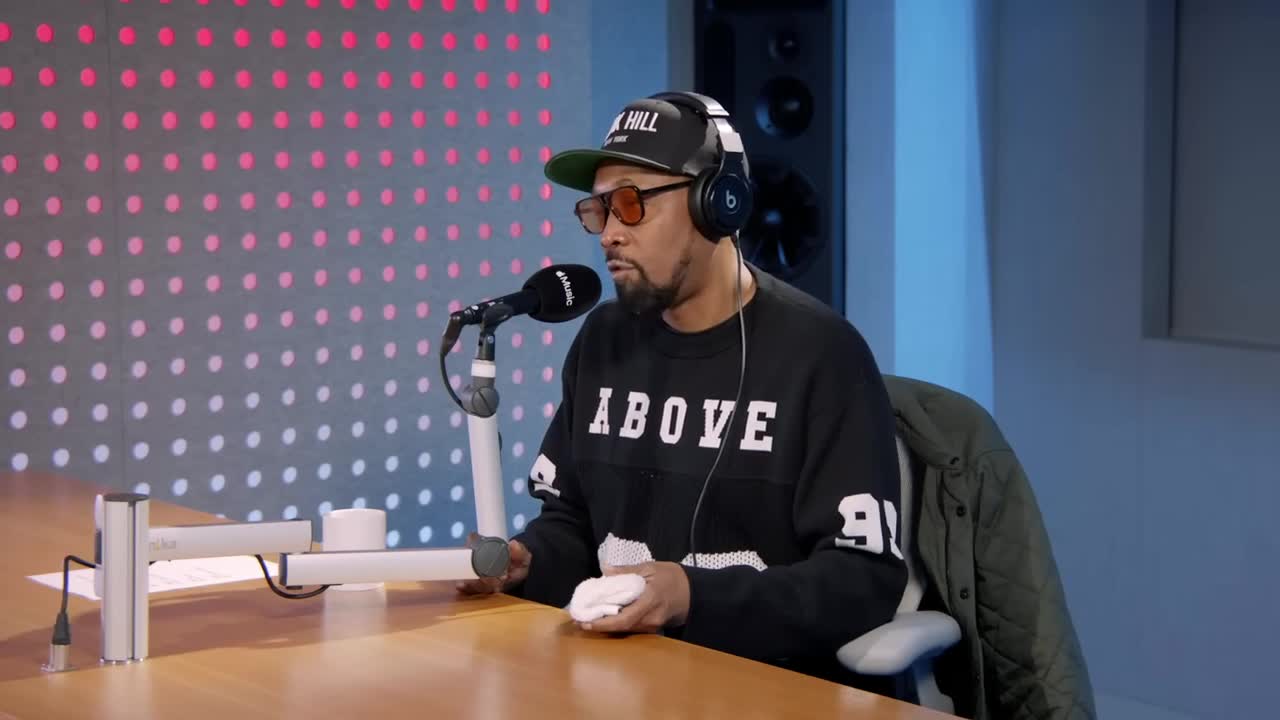
All right, RZA's here.
RZA is in the building.
I didn't really know where we were going to go musically today.
I had no idea.
Some people who come in, I'm kind of like yep, they're going to pick that that, that that with you.
No idea.
No idea, right?
And I think I made the idea even worse once you got the choice, right?
I have a reason behind the madness.
Some of it is self-gratification.
Some of it, of course, is sharing things that I think deserve to be shared.
Are you always on the hunt for new music?
Maybe not brand new songs, but just songs that are new to you that make you resonate?
Yeah, I'm the type of person that I could be in the city.
For instance, I was in Vienna about two weeks ago.
And they had Jensen Nielsen.
I probably pronounced his name wrong.
Great classical pianist.
And he was performing at the music hall.
I got five tickets.
And that's after the Woo concert.
I did the Woo concert, towed the house down and the next day I had a day off and they said do you want to go to the next city or do you want to stay in Vienna?
I said, I'm going to stay in Vienna, and I'm going to go check out this pianist.
So where do you think that came from?
Because I always find it really exciting when artists first start touring in exciting places, places outside their home state, whether it's the same country or worldwide.
I hear so many stories of people saying, I just love record shopping.
I love going and crate digging.
I love going and watching live music, even if I don't understand what I'm watching.
Was it similar for you when you first hit the road properly with Wu-Tang Clan?
Well, at first it was strictly record shopping.
Really?
I used to go to the plane with boxes of records, right?
You know what I mean?
This is why that song Gravel Pit ends up on our album because I found it in France.
It was just an old TV show soundtrack of their TV themes.
And I found that one track and I was like, I like that.
Eventually I started falling in love with the piano, and so I would just go like to different piano shops.
Then I fell in love with jazz.
Then I started going to, like, jazz clubs or whatever.
Now, at this age and at this point, it's like, if there's something interesting happening, got a day off and I could go and just be a fan.
That's what I'd do.
Do you find that quite easy then to take yourself out of.
You know your situation, where i mean you're doing arenas at the moment.
It's like 20 000 people a night can you easily flip from doing that on a thursday night and then a friday night you're in the crowd for somebody else's show and you're just you.
I might not be able to be all in the crowd, even though i've been in mosh pits.
Yeah yeah, yeah.
I've been in my space, bro.
And I feel like the guy tried to hit me harder because it was me.
He's going to see if I can take it.
Yeah, I like to explore, bro.
You know what I mean?
It's all about exploration, isn't it?
And that's kind of what this show is about as well, the five best songs on Apple Music.
Where are we going to go first of all, this first song that you've picked?
Okay, this first song is by Jason Isbell in the 400 unit.
It's called Cast Iron Skillet.
So I did a new film called One Spoon of Chocolate, and I was looking to cast somebody in the film that would play this guitar player who does this big moment on the bus.
I was in Atlanta and I was like, who can I get?
And somebody said, Jason Isbell is playing at this theater.
And he was there for like four days.
And I said, okay, I gotta get there one night.
And I got there one night.
And I sat there and I watched his concert and he did this song right here.
And I just thought it was so powerful lyrically.
And I didn't forget it.
And I was like, I never heard it before.
The story actually resonated with the story of what I was filming.
Do you know much about what the story is and what he's singing about lyrically then?
Yes.
My grandmother always said this.
You don't wash that cast iron skillet because all the flavors of everything you cook remains in it.
And you don't wash it.
You just keep cooking on top of it and cooking on top of it.
And that's when you get that home cooked soul food taste, you know?
Don't you find it interesting that there's so many parallels between rap and country in terms of the lyrics and the storytelling?
I mean, they are cousins, you know what I mean?
And they're finding their way to each other now.
You see guys like Jelly Roll and others, of course, but you know, and even Post Malone, he went rap RB to country like Storytelling, power of art is the oldest tradition we have.
Whether it's people sitting by a campfire, whether it's your mother talking about your grandmother or your great grandmother.
It's like this storytelling in an art.
We get a chance to paraphrase it, put it to music or put it to cinema.
You know what I mean.
Or put it into novels.
And it increased the imagination.
But country and hip-hop are two of the most lyrical forms of it.
Rock does it as well.
This is why some of my biggest rock songs.
You know, even yesterday is a yesterday.
All my troubles seemed so far away, right.
So it's like, it's still a story within that.
But country is and hip hop itself is.
I think those two hit the hardest, but in such different ways.
And it's a weird realization when you get that, because certainly for me growing up in England, country music was so far away from us culturally.
I think it's not quite as far away now as it was back in the day.
I never saw anyone in a Stetson and cowboy hat ever, other than on the TV.
So country music is just so different.
Yeah.
I walked in with a guy.
You walked in with what, about 10 minutes ago?
I was like, no way, the times are changing.
But that realization eventually that I had, that was like it's like listening to Outlaw Country and people like Waylon Jennings and Johnny Cash.
And you suddenly realize like wow, this shit is heavy.
They're singing about really yeah, Folsom Prison Blues.
What a, what a masterpiece.
So what kind of stuff do you listen to on a typical day at home, maybe when you're not touring and you're just, you know it's a Saturday or Sunday and you're getting up in the in the house, what are you likely to put on and listen to?
Well, it depends like, because I let my wife kind of control the, she controls the playlist because if she ain't feeling good, you know what I mean.
The party ain't happening, right?
Happy life, happy life.
Exactly.
But her playlist is great, yo.
She's a big Alanis Morissette head.
Is she?
Yeah.
So she may put that on, then she might go into Guns N' Roses and back to a Donny Hathaway.
Really?
Our musical journey on the weekend with some tequila is always a great night.
We just share music back and forth and try to make sure that love is in the air at all times.
So how's it been on this most recent tour?
Obviously the Wu-Tang Clan.
It's not a farewell tour, is it?
That's not the right word for it.
It's a reunion tour and it's about kind of connecting with the fans once again.
And say a thank you to the fans, bro. to be honest with you.
It's been emotional for you though.
Ah, super emotional bro.
This is extra emotional because we lost one of our founders and even though he wasn't known for rapping and making beats, you know his energy, his swag, it's all in our music.
You know what I mean?
It's all in.
You know, you hear that song Cream.
Or you hear Inspector Dex's verse.
You hear these verses.
Some of these verses are what they personally lived.
Some of these verses are maybe what they saw him live.
And not only was he special to us, his name was Power.
He also was the one that, when it was time that we needed a financial boost to stay independent before we got to Loud Records, you know we had to keep the.
You know we had some momentum going.
He came in and boom, he dumped a duffle bag full of money on the floor.
Like, yo, let's go.
So how important is it to anyone starting out now whether you're in a group or a crew or you're on your own, but you're starting out in music or something in culture now how important is it to have an HQ or a base and somebody like Power on your side?
I think it's vital.
I mean, when you go back to TDE, one of the biggest companies in the world, you see that Top is that to them.
He's that strength.
He's that connection and the economic powerhouse behind it in the days when that was needed.
You need that.
You go back to the South.
I'm going to my generation now.
You go to Master P. He's that powerhouse.
He's an artist.
But his strength, his family, his economic strength, it brings in a slew of artists.
I think that still happens now.
I think when I look at some artists they come through they seem to have with them someone that's their videographer, Someone that's just like kind of their quality control guy.
He's just there.
Like, what do you do?
You just let them know if it's good or not.
You know what I mean?
And they hopefully have someone that has a few extra dollars.
I think Joey Badass is another good example with the New Era movement where he had his family.
He had his moms there.
You know what I mean?
So he always had this, There's gravity.
Look, you could try it by yourself, but the old African proverb says it takes a village.
This next song that you've picked.
Of these five tunes, I think this is the only one that you are kind of affiliated in, even though I don't think you worked on this specific tune, right.
Yeah, I worked on it.
I mixed it for them.
All right.
And maybe I add that little string piece that goes in.
At the time, I was the number one producer of the family.
True Master considered himself a student of mine.
But him and ODB.
They went and built this first and then brought it to me, brought it to the Abbott to glue it.
That's not why I chose it, though the thing i can say is that the rest of the songs we're going to go through, they all appear in my new film today.
Yeah, and it's and it's very uh unique that they are in it right, and the reason why is because i i always like to give people a soundscape and, of course, in that soundscape, you're gonna have some type of Wu-Tang energy, right?
And so this is Brooklyn Zoo by ODB.
Take me back, when you hear this for the first time, can you remember that moment?
When he first played this demo, the lyric was a little older than the demo.
He would freestyle this lyric and battle people with it.
Because there's that line that's in Protect Your Neck as well, which is recycled.
Yes, recycled, yes.
But when he recorded this verse over this fucking track, I was like yeah, like I was blown away by his performance.
I knew he had something.
And so what we did was the shame on you.
That's the part that I took to keep like sampling and looping for him, like the glue it.
But if you listen to this song, back then, MCing was all we cared about.
We didn't care about the hooks or none of that.
But he does this whole song with no hooks.
The hook comes at the end of the song.
It's like the last 30 seconds, isn't it?
And it keeps going.
Yeah.
He's saying metaphors.
They get up like a pig and try to hog shit.
Then they say something, this is simple.
You can suck my... It's like, forget all the rap.
And that's what made him so special.
He was witty, but yet he was straight.
And then he was unpredictable.
Bring it on back.
Is he misunderstood now or do people get, is his legacy where it should be?
I know that he was special.
I hope that everyone knows that and feel that.
I hope people realize what he brought to the industry.
And not to be egotistical about it because you can't speak for yourself, but you know Elektra Records at the time.
You know they had some hip-hop.
They had Planubians, a couple of things.
But they weren't breaking gold artists.
That department had no gold artists.
He's the first one.
And once he goes, the system goes.
You don't get Missy Elliott to go if ODB don't go.
Busta...
You don't get busted to go if ODB don't go.
But even that continues now, Danny Brown and people like that.
It's like the lineage kind of starts.
With this man, yeah.
And what's so crazy, if you go back to one of Missy's first songs, she does a .
She's basically emulating ODB's Shimmy Shimmy song.
And so he was a raw talent.
He was confident in his talent.
I mean, he starts this song off saying, you gonna love this.
I said, wait, how you know?
He's like, trust me.
You know what I mean?
I'm the one man Army A's son.
What are your earliest memories of him as a kid?
One of my earliest memories, you're probably about five, six years old.
And there's a store called Pantry Pride.
And we would go there, pack bags, and get a nickel or dime.
But then we would take the shopping cart from the store and then push it through the community.
And we would take turns pushing each other.
And we'd be like all through the hood, like I'm pushing them in the cart.
That's like the best thing ever.
When you're seven years old, nothing beats that.
Nothing beats that.
And so even though he was my big cousin, he let me become his teacher, which I thought was...
It was really special.
Like you know, like a lot of the Wu members, like the judges, my big cousin, but they let me be the Abbott.
Like they saw that whatever I was developing.
Everybody bought into it.
A hundred percent.
Nobody, even as it went on, you know, everybody was still, was still into the overall vision.
I was going to say, I saw this.
PA TV interview that you would have done.
I reckon it was pre Wu-Tang Clan forming, but it's like the three of you and Dirty is so kind of quiet and pensive and calm.
And it's like, you know, eye of the hurricane type stuff.
Clearly you can see there's a lot going on in there.
And the judges doing all the talking, right?
Yeah, that one.
Let me say one thing about that interview, if you could.
And so for me, when I saw it like I saw it years later and it was good for me to see because I saw my own personality
Because when you see yourself, you can know what you're thinking.
And every time they asked, when she asked, she only asked me one question, but my answer was like nah, I don't know.
And I would throw, I said, man, I remember I was so conceited and so confident.
Like I wasn't worried about no dance and shit, all that.
Like I'm about to fuck y'all up.
That's what was in my head.
You know what I mean?
I advise people, as you get older, go back and look at your old photos.
Go back and look at yourself before your first drink, before your first time you had sex, before your mind got tainted by what this world has to offer.
It will help bring you back.
That's beautiful advice.
Actually help me.
That's why i'm sharing it.
It helped me a lot.
Yeah man, it's important, isn't it?
That kind of thing?
When you do come up against the tough parts of the story over the last, what is it?
It's 35 years now, isn't it?
30 plus years.
I mean, there were key moments.
And I'm thinking about when you were on the verge of going inside.
You were looking at an eight-year stretch.
And you got off.
You got acquitted.
Is that the key point?
Do you think in your life where it's like okay, i have these two worlds kind of concurrently going there's the street world and then there's the music world and they don't, they can't coexist, you know they couldn't coexist do you think you could nail it down to kind of like that moment, because you're about to become a dad?
At that point as well, there's a lot going on.
Yeah, i think for me.
You know, I got blessed with a second chance.
And so when you get a second chance, dude, you take the chance.
See, some people won't take the chance.
They keep going for what they know.
And right, so I took the chance.
And actually and I'll confess this because somebody was bringing up yesterday about like how you know, when you was young you used drugs and all that
36 Chambers is not drug music.
36 Chambers is sober music.
Meaning, you know, when I had to go You know, I was facing that trial.
I just cleaned myself up.
I stopped smoking, stopped drinking, started getting healthier like, started getting ready to prepare.
And I started making these fucking tracks and these songs.
And a lot of the songs you know.
Some of them predated 36 Chambers and some of the beats probably did have a blunt or two.
The meat of that album and the completion of that album was a sober mind.
Then everything else that followed.
How easy did you find it at the time then to just shut all that stuff up and stop it and be like okay, new page.
Well, it was really, to be honest with you, it was going backwards a little bit to who I really was.
See, before I got into this street culture, as we all do, I was a good kid.
You know what I mean?
I was smart.
I had a 12.9 reading level in the sixth grade.
So that means in America, they give you these tests.
12.9 means the ninth month of the 12th grade.
That's me in the sixth grade.
I had knowledge of self.
You know, studying the Holy Quran, studying the Bible, studying all these books of spirituality.
But I was living opposite to.
I realized that the negative, as the Bible said, for every negative action you do, we give you one in return.
But for every positive action, we multiply you.
And the first commandment given in the Bible to Adam was what?
Be fruitful and multiply.
And so I was like, okay, I gotta get on the multiplication.
You know what I mean?
And I went positive.
Of course, I gave some credit to my mother.
When I was doing the stupid shit, bro and I was in that court and they was talking about eight years and got a girl pregnant and career going down the drain.
Because my mother signed me out of high school.
Because I told her, I don't want to go to school.
I want to pursue music.
So she came up and signed that paper, bro.
I was 15 years old.
And I was doing it.
But now she's in courtroom looking at me like, yo, bro.
That must have been the worst moment in a way of the whole thing is seeing her face.
The disappointment of my mother's face cracks my heart.
But she said, you had a second chance.
She told me, she said, this is your second chance.
Don't blow it.
And I didn't.
And it was no better joy than after getting positive and getting all my brothers together and building a company and being able to buy my mother a house.
You know what I mean?
That was everything, bro.
She could sit there and have her heaven or earth.
I don't want to dwell on that point too much, but at that moment, when you were in that court defending yourself and I imagine you must have planned what you were going to say in great detail and you know, really set yourself out and say look, this is who I am and this is what happened and this is, you know, this is what I have to say.
Is there any kind of parallels in the act of doing that and then what you were doing musically at the time as well, in terms of the kind of just hitting on that really beautiful creative streak and even just going out and performing and doing an amazing gig?
Do you know what i mean?
It's a kind of you're up against two very different audiences there, but you're kind of showing your true colors in both situations.
That's a good analogy.
And uh, I guess I could share this with you.
Maybe remember that before the trial date, I had went back to New York for a few days.
The trial was in Ohio and I recorded all of my anger.
So the original track, Cream, wasn't cream, it was called I'm On Some Shit.
And I wrote down, I wrote verses of all this negative shit, of what I wanted to do.
Like the negative shit, like I want to fuck this, you know, all this sucker shit.
So it got out on me.
So the music is also a conduit to pitch a negative energy.
You know, look at heavy metal and the aggression that's coming out of this kid.
And yet the kid is the nicest guy in the world.
You see what I mean?
Like Marilyn Manson, that's my man.
You know what I mean?
But he crazy, but he ain't crazy.
You see what I mean?
So that moment did help me.
And then when I got to that, when I did get to the trial, you're right.
I had to face jurors and tell them what happened that night and tell them a diversion.
I had a great lawyer, Mr. Dominic Oliveto, who's my friend to this day.
What's up, Dominic?
If you ever listen, we always, we text each other just throughout the years.
And he's a good gentleman, him and his family.
And he also, he only represented me because of my mother.
You know to him, when he met me he was like listen, there's another.
But when he came to my house and he met my moms and he seen that my mother kept We was poor but yo, my mother house, always felt like you.
When you stepped in the house, you could be in the projects, bro.
When you step in our crib, you could be in the mansion, even though it was only 300 square feet.
You felt that.
She was so pristine and so prestigious in her conduct.
And he said that.
He's like wait, this is not what i expected exactly.
And because of her he considered representing me.
And then eventually, when he got to know me and say wow, you're pretty smart.
Yeah like, how do you get yourself in these situations?
And and we became friends as a lawyer client.
I guess i better jump to this to the song, because i could talk about that forever.
But the day that i won is actually perfect for the next song, because it was a good day.
This song, I like this song a lot.
It is in my film, but also Ice Cube was the artists that was able to represent the West Coast and yet win over the East Coast.
You know what I mean?
We loved them.
I'll never forget the first time they announced Ice Cube was coming to play the Apollo.
And everybody was trying to get a ticket.
You know what I mean?
I didn't get a ticket, actually.
My manager, Mel Kwan, did.
I just felt that he was like a special artist that was able to show us both sides of the world through his lyrics, through his music and through his approach.
So what do you think it was about him?
To dig deeper into why Ice Cube could do that and other people couldn't do it quite so well.
What are the qualities that he had that resonated so much on kind of all sides of the square?
I think as an artist he appreciated West Coast and where he was coming from, but he also appreciated hip-hop.
And so when he went and did the album with the Bomb Squad, it was like he was showing that there was a unification in the music versus separation of both sides.
And I think also, I think Ice Cube, as we could see as he went on to make movies, he's a smart guy.
That must have been a moment for you as well, considering what you've done in cinema in the recent kind of.
You know the last.
What is it?
It's like 10 years now.
Little longer I've been in.
I started, my first movie was 2011.
And then I think Boys in the Hood was 91.
Yeah.
Super, super early, but nobody had done anything remotely like that.
Even in wider music, not that many people had crossed the boundary in that way before.
He paved the way for a lot of us.
He's a special artist.
He's a lyricist.
He has great stories.
Like you feel this good day, you wish it was your day.
You know, he said, mama cooked the breakfast with no hog, right?
Which is funny because in those days we was all trying to stop eating pork, but your mother is still cooking pork.
You know what I mean.
And you can't say no.
Exactly so.
He felt like one of us.
Even like I said back in New York Ice Cube, he felt like one of us, you know.
When did you first meet him?
Wow, when I first meet Ice Cube.
Oh, one of Wu-Tang's first big concerts, where there was 6000 people, was us opening up for Ice Cube.
No way.
Yeah.
Ice Cube was the headliner.
I don't know if it was Baltimore or somewhere, but that was the first time that we met him.
And then, years later, my first trip to London was Ice Cube, Public Enemy Biohazard and the Gravediggers.
Oh, shit.
Really?
Yeah.
Jesus Christ.
Yeah, right?
So anyway, I've always been a fan of his and always appreciate what he do and appreciate how he raised his son.
I had a chance to...
As life went on, I had a chance to gain my strength in the industry and I had the thing called Rock the Bells Festival that I had a piece of, and we had a stage called the 36 Chamber Stage.
And our headline that year was Ice Cube.
So he actually came, and I was the promoter.
He headlined my stage.
And he brought his son with him, and I met him, and I said, this kid is a good kid.
Like, he really raised a good kid.
And then you see it later when the kid comes out and becomes a big actor.
Like, O'Shea is like, you know, he's in Godzilla.
He's like he's living his father's energy in a different way, you know, because he's doing his own version of it.
That's such a roundabout 360 moment, isn't it?
When you first would have met him, supporting him early on in Baltimore or wherever, and then later on he ends up headlining your festival.
Yeah, yeah.
I love that.
So when you were listening to music growing up in New York trying to work it out, I think you were born in.
69?
69, that's me.
Punk's hitting the mainstream in like 76, 77.
Yeah, right.
Okay, right.
Yes.
Ramones and the Dead Boys and CBGBs and all that.
And this next artist that we're going to play as well on the list.
Were you receptive to punk music?
Did you kind of see Mohicans and, you know, the leather and stuff around New York?
Did that leave an impression on you as a kid?
Because I always think that punks look so cartoony.
Because in New York in my generation, There was still the residue of Malcolm X, of the civil rights.
There was a lot of culture clashing.
Racism was heavy.
And so the punk was white boy shit.
And the image and the look of them was almost scary.
You know what I mean?
Even though you said it was, you said it, you just used the word comical or comic book.
Cartoonish, I said.
Cartoonish, yeah, cartoonish.
I think if you're a little kid, right, it's cartoonish.
But as soon as you reach like 10 to 15, it's scary.
It's almost like if they was on a train, we was on a train.
It's like a fight might happen.
Yeah.
It's like that type of thing.
Uh, but so that's, that's culturally, we didn't understand each other.
Right.
So people would say, oh, that's something evil that like they would say black or something evil.
One of my favorite things that happened to me in the last five years was we was doing this residency in Vegas and in the front row bro was the most punked out couple that i've seen in years like they were strictly straight 80s and the guy was at least six, five right.
He had his beautiful wife with him, right.
I don't know who they are at the time, just doing my shit and I just noticed them.
I'm like, wow, that's cool that they're here.
But then they actually had VIPs, so they came backstage and they hung out with me all night.
We hung out.
We drunk tequila.
All my guests that was coming in, like the AG team, Live Nation team, they coming in.
I was like, what the fuck is going on in here?
I don't know.
These are my peoples.
And they're just like audience members.
Yeah.
But what I've learned is that Wu has that attraction.
But musically, it makes sense to me.
And now it makes sense culturally.
And culturally, at first it didn't make sense.
Like I said, I grew up when those two things were almost opposing forces, you know what I mean?
The black B-boy, the punk rocker, the guardian Angel Beret the militant.
All this is in New York.
You know what I mean.
And they opposing each other, but eventually, it actually melds with each other.
And I think hip hop caused the melding.
But musically- Why do you think it melds?
Is it because everybody suddenly realizes, actually we're all outsiders here and we're not really that different?
I think that's one thing, but I think also the music melds us because We said Ramone, right?
Body rock, rock it in the pocket.
That's a hip hop beat.
That's been sampled by hip hop.
Billy Squire.
I got the big beat.
That's Run DMC.
You see what I mean?
So the music...
Hip hop is grabbing us.
Even Honky Tonk Woman by The Stones is a breakbeat to us.
You see what I mean?
So these things are starting to meld musically.
And so now you could be somewhere, whether you're in Chicago, whether you're in New York, and you drop that beat.
It's like the hip hop.
I think we're dropping something that's fresh and new to them.
But the punk rock is like, yo, that's my shit from the Ramones.
You know what I mean?
So music can be fun.
And then if you look at today's generation with great talent like AAP Rock and his fashion, he's basically punking it.
I know i saw that snl thing and i was just like man, this is just leaning into it fully.
He's parking it.
Yeah look, youngness.
And youth is going to always be like a new experiment that pops up and we're gonna go what the heck was that?
And then eventually we're going to realize it's just an expression of ourselves being artistically put into another body.
It's going to grow right back to us.
I always think if it confuses people, you're kind of doing something right.
Do you know what I mean?
I can respect that.
So this is a case in point, right?
This next tune.
Yes.
Now Blondie, once again, right?
Her song comes out in New York for me.
And I'm already writing lyrics already, but she's rapping.
This is a blend of punk and hip hop.
This is the CBGB days.
Fab 5 Freddy, he's helping to blend this culture.
And the crazy thing is, we didn't have MTV and videos like that.
Even if you had video music box, you didn't have MTV.
That was a cable thing.
I didn't get cable until later, right?
So since she's rapping, you think she's black. just because she's rapping.
We find out Blondie is white like two years later or some shit, you know what I mean?
But yet you got that record.
Your aunt is playing that record in the house.
Everybody's vibing with her.
And that's the beauty of music once again.
And then if you go back and look at her style, her leather, Her vibe.
It's pure New York.
It's as New York as you are.
Yeah.
And as the Puerto Ricans are at the same time.
And do you know what I mean?
Like there's so much influence in that city, the melting pot that you get there.
Is it your favorite city on planet Earth, do you think?
I got to say, yes, it's still my favorite city.
I love it more now because I could leave and come back when I want.
A lot of people say that.
Julian Casablanca from The Strokes said the same thing.
He said I don't live there anymore but I love it more than I did when I lived there because I can leave and come back.
Yeah.
I read somewhere that you wrote your first song when you were seven or nine or something like that.
Yeah, nine years old, wrote my first song.
What was it like?
It was a copy of something that Jizzle wrote before.
Would you have recorded it at that point?
No.
Oh, yes.
We recorded with the... Remember those tape recorders that you just... Yeah.
I guess it's only like five years later that you start getting you know proper equipment for tracks and drum machines and mics and things like that.
And you start thinking about it really seriously.
And that effectively is...
You know, the genesis of it.
We got our first turntable.
It was probably 13.
Echo Chamber, 14.
You're in Echo Chamber?
Echo Chamber, yeah.
Once you got that, you thought you had everything.
Yo, yo, yo, yo.
Check it out, out, out, out.
Yo in the place, the place, the place, the B B, B B.
My name is Prince Rakim King King King, King King.
Like, you know what I mean?
He was like, my shit is dope, yo.
Do you miss those days then?
When you think back to it now, how do you remember them?
Yeah, of course you're going to miss those days, bro.
As you know, As you grow and mature in life, you definitely appreciate every day you have now, but you definitely miss the simple.
Can it be all so simple yo?
Wasn't even nervous about love or hate.
The simplicity of life, being young and creating without a filter, creating without a purpose, just creating because you can create.
Those are the period of times that I definitely could say I miss.
I talked to my Wu-Tang brothers about that a little bit because, in all honesty, from my point of view, from my seat, the 36 chambers is an example of pure art.
We didn't get paid to make that album, bro.
We was there because we wanted to be there.
We got on the ferry, got on the train and ended up in brooklyn at firehouse studio because that's where we was going that day.
When you get to your second album, you got millions of dollars.
Now you know it's a different perspective shifts, doesn't it?
Because how can you be making the same kind of music if your life has fundamentally changed?
You can make a different kind of music, but you can never make that album again.
No, but i think that if you approach art with the freedom of you just doing it for the art, it comes out better.
So, speaking of perspective, When you go back to 36 Chambers and then all the records that followed it in that kind of period, they came really quickly.
It was just non-stop from 93 to 97, let's say.
There's like six different records that you are kind of out of the controls of.
Can you put into perspective how you were physically able to get that much music out, not just of yourself but of everybody?
It just blows my mind considering everything else that's going on as well.
There's the vision.
It was pervert-y.
It was like, this is what we're doing.
This is where we're doing it at.
Did I stink?
Yes.
I'm serious, bro.
If you came to my crib, it was funky.
The diet was out the window.
The diet is out the window.
But the music.
The music was everything.
I showered probably twice a week type shit, bro.
Raekwon has a lyric that says with the boots that paved the way, People don't know what the hell he mean.
He's talking about my shoes was so raggedy.
And not that I didn't have money, it's just that I didn't care no more.
I just was like hermit creative.
I sacrificed my family at the time too, to be quite honest with you.
You talked about me having a child, all that.
I actually told my family I moved them to Ohio so that, so that the woo could always come and we could be breaking day.
We broke day so many nights just making music.
Like, fuck it.
You know what I mean?
It wasn't no furniture, bro.
It was a TV with the 3DO Samurai Showdown video game and a studio.
I mean, you want to sit down, you go upstairs and sit on the floor.
And nobody had a problem.
Nas came over.
He didn't have a problem sitting on the floor.
Was it basement studio?
Did he have any light or anything?
Yeah, it was still, it was quality.
I spent maybe 60, 70 grand of equipment in that motherfucker.
So it was good, you know what I mean?
But I'm saying, like, Big Daddy can't come over.
It's like, there's no couch, bro.
You know what I mean?
It's the bedroom where I sleep, studio downstairs.
And I bought a house for my family in Cleveland Ohio, which let me just say this to you before we get to our last song.
So, cause I'm kind of proud of this, right?
I bought the first house in Cleveland, Ohio and I would commute back and forth, right?
Go home on the weekends or whatever.
But I would drive past the Rock and Roll Hall of Fame every time I went home.
Which is in Cleveland, isn't it?
It's in Cleveland, yeah.
And bro, Wu-Tang has been nominated to be in the fucking Rock and Roll Hall You must be so proud.
Personally, I probably feel... I know all the guys are proud, but I drove by that fucking place.
Yeah, yeah, yeah, yeah, yeah.
So many times.
So, yeah, that's...
That's one that I never would have seen.
That's beautiful, man.
Never would have saw that.
Never would have, like that's, like some things, oh yeah, I knew that, yeah, yeah, yeah.
That, no, I had no clue that that would be in the stars for us.
Did you think it was a gamble at the time when you were making all those records kind of concurrently?
Did you think, I hope this works at any point or was it just- No, that I knew, that's what I'm saying.
Did you?
I was like, how can I say it to you?
I mean, I could say it in a, I'm not egotistical now, but then I was.
I was the best, bro.
I was like Mike Tyson when he was coming in the ring, yo.
I'm the greatest.
He knew he was going to knock the motherfucker out, bro.
That was my spirit.
I felt the exact same way.
Talking about continuation then and moving things on.
I mean, this final song, when did this come out?
This is only 2021, this song.
When I first brought my cast together, on the first night we had this big dinner, right?
And the cast I had this young man named Shamik Moore or this young lady named Amiri Crutchfield, Paris Jackson, who we you know who she is.
And I had John L. Young, It's some good people.
One thing that they all had in common was they loved Tims.
And they kept playing her stuff throughout the dinner.
And I'm like, you know, I'm the OG.
I'm like, you know, I'm not going to hit my playlist, so let them do their playlist.
They young, having fun, and eating food, and popping bottles, and shit.
And then this particular song, and it just resonated with me.
And so when I was in Vegas about three years ago, two years ago.
And the film was kind of like getting ready to be done.
There was a scene where I have all these same young people together in a scene.
And I thought that would it be great to have this song play over that scene?
And so I went to a Tim's concert and I met her.
Bro, she did this song.
She said to the guy in the audience, do you mind if I come down here and sing this song to you?
Her confidence.
She got off the stage and went down and did this song.
And I just was so moved by it.
I waited till after the show.
No, I actually didn't meet her that day.
I waited till like two weeks later and met her in LA at another show and was like I want to pitch you a song in my movie.
Man, I love your dedication.
I love the research that you go into as well.
Just go into these gigs and be like, yep, that'll work.
Wow.
I mean, it's a song that took over the world and continues to take over the world.
Wizkid and Thames with Essence is undeniable, isn't it?
It's undeniable.
As a tune.
And Wizkid, you know, came in with the power of his self and was dominating the Afrobeat vibe, but then he bring her the joy and the party.
And it's just amazing.
It's like taking it to outer space, isn't it?
Outer space.
I love this song.
What it does for the film though, it removes the timestamp.
When you watch the film, you think one way, you think another, but then when this song comes on, you go wait a minute where we at.
You know what I mean.
This is such a youthful song, even though as an adult we can feel it.
It really feels that.
You feel that young love in it.
You know what I mean.
You feel that that young vibration of college students learning each other, feeling each other and uh, That's why I play it at that moment when these four kids are together out on a little date and it just comes on, you know.
So where do you stand now?
Once these gigs are over and you got this film.
It premiered at Tribeca last year and then it's coming out properly in a few months time, isn't it?
Yeah, May 1st, yeah.
May 1st, One Spoon of Chocolate.
When Wu-Tang is done with this tour, are you doing more music?
Are you just looking to film or are you going to take a rest?
What happens now?
What can I say?
I'm going to do it all, you know.
I'm here to be an artist.
I realise that, you know.
I don't know if they would have told me to be a general, or to be a president, or to be a carpenter or kung fu fighter.
I know I'm an artist and the art that I love is music and film, and in film, i get to do it all.
Of course, i get to pick other people into it as well, but i'm going to continue to do do those things.
You know, i'm writing a new script right now.
Yeah yeah, and uh, wu-tang.
Uh, i don't know if we are.
Yeah, we announced it, we're going to go to japan and yeah, i know, first time ever right yeah, or the first time in 20 years or some more than that.
But Good chatting with you, RZA.
Well, thanks for inviting me.
Pleasure.
Thanks for the music.
Peace.