Hi, I'm Kristen Bell. And if you know my husband, Dax, then you also know he loves shopping for a car.
Selling a car? Not so much. We're really doing this, huh?
Thankfully, Carvana makes it easy. Answer a few questions, put in your VIN or license and done.
We sold ours in minutes this morning and they'll come pick it up and pay us this afternoon.
Bye-bye, truckie. Of course, we kept the favorite.
Hello, other truckie. Sell your car with Carvana today.
Terms and conditions apply. This episode is brought to you by State Farm.
Checking off the boxes on your to-do list is a great feeling.
And when it comes to checking off coverage, a State Farm agent can help you choose an option that's right for you.
Whether you prefer talking in person, on the phone or using the award-winning app, it's nice knowing you have help finding coverage that best fits your needs.
Like a good neighbor, State Farm is there.
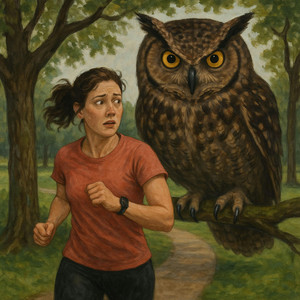
She runs to stop her mind running. But one day she sees an owl in the park. and reality stops running smoothly.
Keep listening to learn English. Hello my lovely learners and welcome to Easy Stories in English, the podcast that will take your English from…
OK to good and from good to great. I am Ariel Goodbody, your host for this show.
Today's pre-intermediate story is called Running.
As always, the transcript and PDF are available at easystoriesinenglish.com and you can find the link to that in the description.
So last episode, I recorded in a closet in a small wardrobe in my friend's flats.
And I had closed the door behind me. I had set up my recording equipment, recorded the episode.
I finished the episode. and then I clicked stop on my computer to stop recording.
And then I realized I was locked in the closet.
That's right. The door was stuck. because for some reason that door doesn't work very well and it doesn't open from the inside.
So, I started to panic because I didn't have my phone, I was in my friend's flat, my friend was not there, And I had no way of getting out.
I tried to break down the door. So I did cause some damage to my friend's door.
But that didn't work. Now, fortunately, because I had my laptop, I was able to message my friend and she could call the managers of the building and they could go to the estate agents to get the spare key to come and let me out.
But I was very anxious. I was really scared because I've never been in that situation before.
I've never been locked down. in a small space like that before and I almost had a panic attack so Although I sounded in a very good mood at the end of last episode, it was followed very swiftly by intense panic.
Luckily, all in all, I was probably only in there for about 30 to 40 minutes before they came and rescued me.
So phew. And the worst part of it was the acoustics weren't even that good.
I don't think the episode sounded that great.
If anything, it was great. too echoey, there was too much reverb, so it wasn't even worth it.
But anyway, as you can probably tell, I'm recording in a different space today and I do not intend to go back into that closet.
So today's story is something a bit different.
It's something that just came to me. Actually, I say something a bit different.
We've had quite a few stories of this ilk, of this style recently.
It's strange. It's poetic. It has animals in it. and the meaning of the story is very unclear.
In fact, it's unclear even to me. I don't know why recently but I seem to keep writing stories that have this same energy, this same theme, and it's all to do with creativity and fear and anxiety and navigating the world by yourself. and the protagonists are usually women and they're doing something like making art or doing lots of exercise.
I don't really know what the theme is here.
I think probably I've been processing a lot of feelings about the my move to China oh by the way as you listen to this I will be in China but I'm recording this before So sorry, you're just going to have to really be patient to hear all my thoughts.
But if you follow me on Instagram at Ariel Goodbody.
I've probably already been posting about my fun adventures in 中国, which means China in Mandarin Chinese.
So you know what, I decided to do something a bit different today.
Originally I wrote this as a beginner level story and I was going to do the thing where I read through the whole story and explain the meanings of bits and words and things.
But then I decided there's actually a lot of not super difficult, but not beginner level vocabulary in the story.
There's a lot of vocabulary in this story. that's maybe slightly higher level so I decided to re-level it to just call it pre-intermediate instead of beginner And I'm not going to go through the story twice.
I'm just going to go through it once. Now...
You may be thinking, I'm just lazy, that I'm just doing it this way because I can't be bothered to go through the story twice.
And to that I say, how very dare you. I am Ariel Goodbody, Queen of English Storytelling.
King of high energy performance. And I would never be so lazy as to not go through the story twice.
How very... dare you um yeah well you probably weren't convinced by that because the truth is i really can't be bothered No, no, I would.
But let's put a spin on this. Yeah. let's let's take gold out of dust let's oh sorry these are lots of metaphors again not very beginner friendly basically Think of this as a challenge to you.
Normally, I introduce a bunch of vocabulary or I go through the story once explaining things.
But I want you to try listening cold. Just try listening without any help from me.
I would recommend listening through the story once and then looking up the words you don't know, and then maybe listen to it again.
I will say, although there is a fair amount of vocabulary in this story that may be new for you, The grammar structures are very repetitive and quite simple.
It's almost like a bit of prose poetry. Prose poetry is something that's between prose, storytelling and poetry.
So you may just enjoy listening to the waves of my voice, the vibrations of the words, feeling of the story and even if you don't understand every word you may just enjoy the beauty of it Yes, that's my justification.
That's why I'm doing it this way, because If I went through it twice, I would ruin the poetry.
You wouldn't feel all the beautiful poetry.
But by doing it this way, you get BAM! You get hit in the face with all the beautiful poetry.
And maybe just maybe I'm a bit lazy. But you know what?
I'm allowed to be lazy. As I record this, I'm moving to China in three days.
Oh my goodness, there's so many little things to prepare.
Don't get angry at me for being a bit distracted.
That's silly. You would never get angry at me.
You're awful. So lovely. You're also kind and considerate.
You would never get angry at me, would you?
No, Ariel, we would never be mad at you.
You are our queen and king. Yes, as you can hear, I'm in a slightly strange mood today.
And that's probably indicative. That's probably true. representational.
That's a difficult word. And that's probably indicative of, that probably shows that I am stressed and tired.
Anyway, last night I went out with my friend to have fish and chips So I've filled my veins and my stomach with all of the Britishness And the next time you hear me, I will probably be full of pork and noodles because for the 20 millionth time.
I will be in China, if you didn't already know.
Okay, well, this episode is called Running, and now I'm going to go...
Run to the story and you're going to sit there unless you're listening to this episode while running, in which case I'm very impressed.
That's a lot to focus on while running. And I'm going to tell the story and you are going to listen and enjoy. running I'm running I'm running through the park I'm running as fast as I can I'm running like a dog.
No, I'm running like a cheetah. I'm running to escape.
I'm running to get away. I'm running for exercise.
I see a squirrel on a tree. It doesn't run like me, fast and straight.
It runs and stops, runs and stops. It throws its face around like an object.
Its eyes are as wide and open as the moon.
If it's looking for nuts, I have interrupted it.
When I run past, the squirrel jumps away hiding from me.
I see a dog. It has escaped from its owner's leash.
Good, I think. Just like me, the dog needs freedom.
But the dog's freedom is different from mine.
The dog's freedom is innocent. The dog wants to feel the wind touching its fur.
It wants to run without the leash on its neck.
It wants to run and not have its owner say, Melody!
The dog's freedom is light and sweet, like a delicious cake.
My freedom is a cup of Irish coffee. Sharp, bittersweet, dangerous.
My freedom... is hard to define. My freedom is impossible to have forever.
I want to have it forever. But I can't.
Every second with my freedom, I'm thinking about losing it, whereas the dog never thinks about losing its freedom.
The dog simply is. It runs and it is free.
I run past the dog and see an owl. An owl.
What is an owl doing here? Owls sleep in the day and it is daytime.
There are three possible reasons. One, the owl is mad.
Owls do not come to parks in the day Perhaps this owl is mad and it does not sleep in the day.
2. I am mad Well, I know I am mad, but perhaps I am so mad that I am seeing owls that are not really there.
That would be new. Three, it is not really daytime.
That would be strange. The sun is shining, but again, maybe I'm mad and I'm seeing the sun when it's actually night.
Or maybe I'm dreaming. I hope this is not a dream.
If this is a dream, then this running isn't real, which means I will wake up and then I will have to go running.
But right now the running feels very real, as I don't want to wake up and go running again.
As I run past, the owl turns its head. The owl's head follows me.
If the squirrel's eyes were as wide and open as the moon, then the owl's eyes are planets.
I truly do not like those eyes. I want to shout, stop looking at me, but I run so fast that I cannot talk.
I have run past the owl and I think I am safe, but then the owl flies.
It flies, and although I am running as fast as I can, the owl flies faster.
It flies past me and stops on a tree. It turns to watch me again.
I start to cry. I cry so much that it's hard to see.
If I can't see while I run I might fall over.
I used to fall over a lot while running.
I don't like falling over so I stop. I stop and cry and the owl watches me while I cry and while I cry my mind runs.
My mind runs through all the reasons this owl is here.
Is it a sign from God? Am I truly mad? Madder than I thought?
Is it a different bird and I just don't know what owls look like?
Is it someone's pet? Finally I stop crying and look up.
The owl is gone. Behind me, I hear the owner running after the dog.
"'Melody!' The owner has found his dog and now he is trying to put the leash back on.
I see an old woman sitting on a bench throwing nuts to the squirrel.
Everything is okay. Everyone is living their own lives.
There are no owls in the sun. Nobody has seen me cry. are too busy with their own lives.
There is no sun now, there are just clouds. but the clouds don't let out their rain.
I have cried as much as I can But the clouds sit full in the sky.
No rain today. Here is the easy version of my story.
One day I woke up and I was sad. I was often sad when I woke up.
So I went for a run. I went to the park near my house.
I liked this park. When I ran in this park, I felt happy.
I ran very fast. I saw a squirrel and a dog.
The dog had escaped from its owner. How funny.
That made me happy. Then I saw an owl. How strange!
Owls sleep in the day, don't they? But then I looked again and the owl was gone.
How strange! I came home and I felt strange, but then I drank a cup of coffee and I felt good.
I felt happy. The End In my dreams that night, I am the owl.
I am flying through the park at night. I am hunting something.
Owls usually hunt mice or other small animals.
They are brilliant hunters. They fly down silently and kill the mice just like that.
But tonight I am not hunting mice. I am hunting a woman who is running and crying.
For several days the same thing happens.
I see a strange animal in the park and then I dream about it.
First, I see a fox. Well, there are lots of foxes in cities But then I dream I am pulling food out of bins, except in one bin I find a woman hiding.
She jumps out and runs away, but I am faster and I am hungry.
The day after, I see an otter. An otter swimming in the lake of the park.
What is it doing there? It's hard to see since it's far away from where I am running.
But that night, I dream I am the otter. I'm swimming down a river, swimming after a woman who is running.
She isn't running very fast. It's hard to run in a river.
The dream ends just as I put my teeth in her.
I wake up from that dream shaking. I really don't want to go running.
But if I don't run with my legs. Then my mind runs and that is worse.
So I go to the park. That day. I see a horse.
I don't know where the horse has come from.
There are no stables near here. The horse is running free, no saddle on its back.
The horse runs all across the park. For a minute I think it's going to run straight into the lake.
I am so surprised that I stop running and watch the horse.
But it doesn't run into the lake. It runs around the lake.
I look around. Surely someone is running after the horse, but I see no other people. no dogs or squirrels, just the horse.
That night I am running free through a city.
I am the horse and there are no people around.
I run easily through the streets, jumping over bicycles and bins.
Every time I turn a corner, I think I will see a person.
But no, the city is empty. And I am not hungry.
There is no woman I am running after. If there is a woman, then she is finally faster than me.
Or perhaps she is inside me. Perhaps I am the woman and the horse at the same time.
In the morning, I decide I will not run.
I lie back on my bed and my mind runs. Then I take my journal and a pen and my hand runs over the page.
My hand runs all over the page, leaving words behind instead of footprints.
There is no easy version of my story, but when I close my eyes now, I see a path There are many footprints on the path.
My footprints. And there are the paw prints of a fox. the paw prints of an otter, the prints of an owl, the hoof prints of a horse.
Every day there are more footprints, paw prints and hoof prints.
And every day the path gets darker. until it will become one long black line.
Maybe one day that line will break into two paths.
Maybe three paths. Maybe one day there will be no more prints on that path.
Until that day comes. I will keep running.
The End Thank you for listening to this episode of Easy Stories in English.
I really appreciate all your support over these past few years and I hope you will continue to listen to the podcast during this exciting new chapter of my life in China.
If you'd like to support me, you can rate the podcast on whatever app you're listening on, whether that be Apple Podcasts, Spotify. or perhaps YouTube, although this episode won't be on YouTube.
And if you really want to make me happy, you can leave me a positive review.
I really appreciate it and don't forget to tell all your friends and family about easy stories in English.
In fact, for this episode, I think it would be particularly appropriate if you shared it with your running club.
All right. Thanks for listening. Goodbye.