Welcome to Spotlight.
I'm Bruce Gulland.
And I'm Anne Muir.
Spotlight uses a special English method of broadcasting.
It is easier for people to understand, no matter where in the world they live.
It is May 6th, 1954.
It is windy and raining at Iffley Road Track in Oxford, England.
Although the weather is bad, a crowd of people has still gathered.
They are watching a race.
The sound of a gun starts the race.
Six men start running.
But the crowd is watching just one of them.
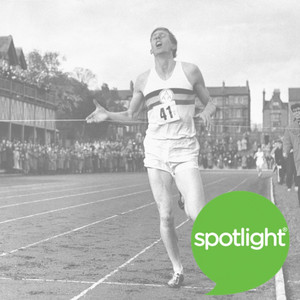
Roger Bannister.
Today's Spotlight is on the runner Roger Bannister.
On this day, Bannister set a historic running record.
A record that made him a global sports hero.
Roger Bannister started running as a university student at Oxford.
Over the next eight years, he became a top runner in the United Kingdom.
He won national races, competing against high-level runners.
Finally, he decided to try to compete in the 1952 Olympics.
However, at this Olympics he did not win any medals.
It was a difficult failure.
Bannister decided to set a new goal.
For years, long-distance runners had tried to beat a particular record.
They tried to run one mile in four minutes.
No one had ever run a four-minute mile.
But Bannister believed he could do it.
He began training and trying in races.
Over the next two years, he tried two times.
He failed both times.
Other runners were also trying to beat the four-minute mile.
In Australia, John Landy had made several attempts.
Bannister knew that he would have to make the attempt soon.
On May 6, 1954, Bannister had his chance.
At the start of the race, Bannister was not in front.
The man leading the race was Chris Brasher.
Brasher was one of Bannister's team members.
Brasher set the pace for Bannister.
He did this so that Bannister did not run too fast.
This helped Bannister to not use too much energy at the beginning.
Bannister wrote about the race in the magazine Sports Illustrated.
Bracia went into the lead and I stayed easily behind him.
I was feeling extremely full of running.
My legs seemed to meet no resistance at all.
It was as if I was propelled by some unknown force."
The race continued.
The men ran faster and faster.
The crowd got louder and louder.
A new team member, Chris Chataway, took Brash's place.
But then Bannister ran past Chataway.
His legs were moving faster than ever.
He remembered, I felt that the moment of a lifetime had come.
There was no pain, only a great unity of movement and aim.
The world seemed to stand still.
The only reality was the next 200 meters of running track under my feet.
I felt at that moment that it was my chance to do one thing extremely well.
I drove on, pushed by a combination of fear and pride.
The air I breathed filled me with the spirit of the running track.
The noise in my ears was from the faithful crowd.
Their hope and encouragement gave me greater strength.
Those last few moments seemed never-ending.
The finish line was a place of peace after the struggle.
I jumped at the finishing line tape.
My effort was over.
I fell down.
I knew that I had done it before I even heard the time.
I was too close to have failed.
The race was over.
Bannister lay in the arms of his supporters.
Suddenly, everyone began to shout.
Bannister had completed the mile in 3 minutes and 59.4 seconds.
After this historic race, Bannister ran very few races.
Less than two months later, John Landy beat Bannister's record.
Bannister raced Landy later that year.
In that race he won, but he did not set a new record.
Soon after that he retired from running.
He wanted to start his work as a doctor.
Bannister did not have a long running career, and his record did not last a long time.
But many people still remember his race as one of the most famous running races.
Today, his race still encourages other runners.
Sebastian Coe is another famous British runner.
He also broke world records for the mile.
And he won two Olympic medals.
But he still says that Bannister is the best.
Hickam El-Guruj is the current world record holder for the 1500 metre and mile races.
At the London Olympic Games, he talked to the independent news organisation about Bannister.
He said, He is my hero.
He is our leader in the 1500 and the mile."
Jan and Bob Burgess were at the race when Bannister set the new record.
They still remember that day.
Jan told the Oxford Mail newspaper, There was so much excitement.
I remember the loud cheer when they read his time.
Roger looked like he did not believe he had done it.
Bannister has received many honours for his record run.
In 1975, the Queen of England, Queen Elizabeth, made him a knight.
In 2012, along with many other people, he carried the Olympic torch.
The torch brings the Olympic fire from Greece to the Olympic Games.
This time the Olympics were in London and Bannister carried the torch at Iffley Track, the place he set his record.
People know Bannister because of his historic race.
But most of Bannister's life was devoted to his family and work.
Bannister served as a doctor for many years.
He was a neurologist.
As a neurologist, he did important research on the human brain.
He is proud of his research.
He is also very proud of his family.
His house is full of pictures of his family and paintings made by his wife.
It is not full of prizes from running.
The historic race is not Bannister's most important memory.
But he understands why people remember this part of his life.
He told the Telegraph newspaper, Great events are remembered a long time after they take place.
I still remember watching Sidney Wooderson run in 1946.
He was a positive influence for me.
So it is good to feel that what I did is still remembered.
People often ask Bannister about running.
They ask him what a person needs to have success.
In the New York Times newspaper, he explained his success this way.
The real secret is that I have worked hard.
The writer of this program was Lauren Anders.
The producer was Nick Mangels.
The voices you heard were from the United Kingdom.
All quotes were adapted for this program and voiced by Spotlight.
You can listen to this program again and read it on the internet at www.radioenglish.net.
This program is called, Running the Four Minute Mile.
We hope you can join us again for the next Spotlight program.
Goodbye.
Thank you.