Welcome to Spotlight.
I'm Roger Bassack.
And I'm Gillian Woodward.
Spotlight uses a special English method of broadcasting.
It is easier for people to understand, no matter where in the world they live.
Betty Skawooka has collected water for her family ever since she learned how to walk.
She learned from her mother.
Every day, she would walk over a kilometer to the river.
When she was a little girl, she carried a small water container as she walked behind her mother and sisters.
But as she grew older, she carried more water.
She would fill up a large container with 30 litres of water.
She would then lift this container up to the top of her head.
Betty would then walk all the way back home carrying this heavy container.
Betty would do this six or seven times every day.
She talks about how she used the water.
No one here has running water in the house, so we had to be so careful with the water because it was so hard to get and so heavy.
Today's Spotlight is on an invention that is helping women in Africa gather water more easily.
Collecting water is a common practice for many women and girls in country villages in southern Africa.
Usually, women and girls work in the home.
Men and boys work outside the home.
Women may spend up to 26% of their time collecting water.
Women and children provide almost all the water in villages.
Africa is the second driest continent in the world.
Two-thirds of its countries have very limited access to water.
In larger communities, the women are responsible for finding clean water.
The women know where to find and store good water.
But all this water collecting takes time and energy.
If a woman or child is spending much of their day collecting water, they do not have time for other activities.
They cannot go to school or care for sick family members.
Nelson Mandela was the first president of South Africa.
He once said, Freedom alone is not enough without light to read at night.
It is not enough without time or access to water for your farm.
It is not enough without the ability to catch fish to feed your family.
In some areas in Africa, women walk over 15 kilometres to get water.
They may have to travel twice as far if it is in the dry season.
But it is not just the distance that is a problem.
The water containers are very heavy when they are full.
Many women carry these containers balanced on their heads.
The women walk with up to 20 kilograms of water on their heads.
This weight can damage a woman's body.
Women can develop back and neck problems.
Carrying water like this may even damage a woman's waist bones, making it difficult for her to have children.
Many aid groups are working hard to provide wells for communities in Africa.
This is important, but sometimes the wells have problems.
The machines that pump the water can break.
And there is not always someone close by to fix the machine.
During dry seasons, the wells may become dry for months at a time.
In 1992, two South African engineers wanted to do something to help with these water problems.
Petty Petsa and Johan Joncke wanted to create a new way to carry water.
They thought of carrying water in a wheelbarrow, a large container with two handles and one wheel.
But when they started making the design they found that the wheel was the most costly part.
So they had an idea to put water in the wheel itself instead of in the container on top.
So the two men began a new design.
A container that could roll on rough ground.
A container that could carry more water than the women usually carried.
A simple container that would not break.
Would they be able to put all these ideas in one device?
After working for some time, the men had their design.
They called the container the Hippo Water Roller.
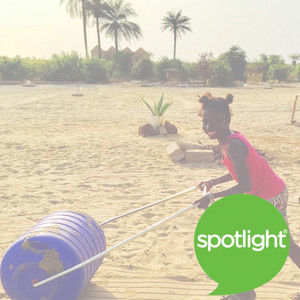
It looked like a large barrel.
A round plastic container turned on its side.
A removable cover was on one side of the hippo roller.
A long piece of metal attached to each side of the container.
A person could hold onto this metal handle and push the hippo roller on the ground.
The container acted as a large wheel.
It was made out of very thick, strong plastic.
The designers said this is why they called it a hippo roller.
A hippopotamus is an animal that is found in the water in Africa.
Sometimes it is simply called a hippo.
It has very thick skin, like the thick plastic of the hippo roller.
The Hippo Roller lets people carry 90 litres of water at a time.
It is easy to fill and easy to clean.
The thick plastic container can roll over rocks, sand and plants.
The metal handle is made from strong steel.
The handle can be removed to let the container stand up to be filled.
Using the hippo roller saves time.
It carries about five times more water than a usual water container.
For most families, this is enough water for one day.
Carrying the water in the hippo roller is less work for women and children.
It does not damage the person's body.
And the container can also be used as a clean place to store water.
Today, over 65,000 hippo rollers have been given to families all across Southern Africa.
Each roller costs too much money for these families.
So the Hippo Roller organization collects money from other people to pay the cost of the Hippo Rollers.
Families using the Hippo Rollers do not have to pay anything.
The United Nations estimates that at least 2 billion people in the world do not have good access to water.
For these people, water is difficult to get.
The Hippo Roller is helping with this problem.
One Hippo Roller can serve a family of seven people.
By using it, a family saves time and energy that can be used for other work and education.
People have even seen a change in family responsibilities because of the hippo roller.
The new technology is interesting and exciting to men, so they are more willing to help the women collect the water.
The creators of hippo rollers add that these are not a permanent solution.
Clean, running water is the best way to ensure access for everyone.
But the hippo rollers are an excellent first step.
Across the countryside of South Africa Zambia Tanzania, Zimbabwe and other nations, Groups of women and men can be seen walking through grassy fields.
In front of them, they push large rolling blue hippo rollers.
They push a device that carries water but also carries a better life for them and their family.
How do you get clean water to use?
What are the challenges for getting water in your community?
You can leave a comment on our website at www.spotlightenglish.com.
You can also find us on YouTube, Facebook, Instagram, Blue Sky and X.
The writers of this program were from the Spotlight team.
The producer was Michio Ozaki.
All quotes were adapted for this program and voiced by Spotlight.
This program is called Rolling Water.
Visit our website to download our free official app for Android and Apple devices.
We hope you can join us again for the next Spotlight programme.
Goodbye.