Hello everyone, and we have some unbelievably exciting news for you all.
Tom, if anything, you are underselling it, because this is truly spectacular.
On the 4th and 5th of july this year, we are going to be hosting the inaugural rest is history festival out of all places, hampton court palace and crucially, This is just for the people who mean most to us.
That is the members of the rest is history club.
Tom, am I right?
You are so right, Dominic.
So if you want to access tickets for the festival, then you will need to become a member of the rest is history club, which is so easy to do.
All you have to do is go to the rest is history dot com.
And it's a matter of seconds.
OK.
So remember, by becoming a member of the rest is history club, you will be able to enter that much prized ballot for tickets to this thrilling festival.
But of course, on top of that, you'll get all our episodes ad free.
You will get early access to our epic series, you will get weekly bonus episodes, you will get access to our exciting new exclusive mini series and, Most of all, you'll get an entree to our much loved chat community and many more such exciting benefits.
So if you want guaranteed access to two tickets, you can join the very top tier of the club and become an Athelstan.
You will also get the exclusive opportunity to upgrade to a VIP ticket, which includes a range of special perks, including and this is so exciting unlimited food and unlimited drink.
So go to the rest is historycom and sign up immediately.
It is going to be the most extraordinary weekend.
There'll be talks, there will be thrilling special guests, there will be historically themed music, there'll be all kinds of treats, there'll be all kinds of action, there might even be some battles, but above all, it'll be a time for friendship, to get to know your fellow members and to get to know Tom and me in a very, very special place Hampton Court Palace.
And I know that I speak for Dominic as well as for myself when I say we cannot wait to see you there.
With the approach of Muharram, we are about to begin the month of epic heroism and self-sacrifice.
This is the month blood will triumph over the sword.
The month truth will condemn falsehood for all eternity.
The month that has taught generations throughout history the path of victory over the bare net.
The month the tyrants will be judged. and the satanic government abolished.
This month will be famous throughout history.
The month that the powerful will be broken by the word of the right.
The month that the imam of the Muslims will show us the path of strength against the tyrants.
The month the freedom fighters and patriots will clench their fists and Win against tanks and machine guns.
When Islam is in danger, you should unite.
Rise and sacrifice your blood.
So that, of course, was this year's King's Speech.
It was Charles III addressing the nation.
No, it wasn't really.
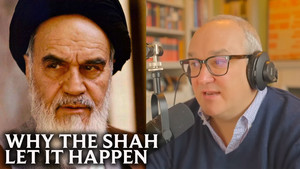
That was the Ayatollah Ruhollah Khomeini speech.
And Dominic.
It was a pivotal moment in the story of the Islamic revolution because he drafted that not in Najaf in Iraq, where he'd been in our previous episode, but in Paris, the French capital, in November the 1978.
And this message was the one that triggered the final uprisings, that led to the downfall of the Shah of Iran and paved the way for the triumphant return from exile of the Ayatollah Khomeini a few weeks later.
So an incredibly dramatic moment.
An incredibly dramatic moment.
One of the defining moments in world history in our lifetimes, I would say.
It's the moment that catapulted radical Islam into the headlines and completely transformed the Middle East.
We'll come back to that message in the context of that message later in the episode.
But let's just remind people of our story, of our three principal characters.
So last time we introduced the Shah, the second member of the Parvenu Pahlavi dynasty.
He's been in charge of Iran since 1941.
He's been spending his oil winnings to modernize Iran and to try and turn it into a regional superpower.
But he's seen on the streets as an American puppet.
He's a corrupt man, a repressive man, but also a weak man, as we will discover.
And that's a terrible combination, is it, to be both repressive and weak?
Exactly.
Be repressive and strong, I think, is the ideal combination, Tom.
That's the Sandbrook way.
So then you have the Ayatollah Khomeini, so this elderly cleric who has been in exile in Iraq since the mid-60s.
He is learned.
He is austere formidable, a ferocious critic of the Shah's modernisation and secularisation drive and of the corruption of his courts.
And of course, a massive beard.
Yes, a huge beard.
And then a stranger to a beard who is the US President, Jimmy Carter, who is another parvenu, actually another outsider in the halls of power.
So he's from Plains Georgia and he is this strange combination of Christian evangelical, of southern populist and a kind of technocratic micromanager.
So like the Ayatollah, he loves God.
He does love God, yes, but in his own way, I think it's reasonable to say.
Now, so far, Carter has enthusiastically backed the Shah, as did his American predecessors.
Like his predecessors, he sees Iran as a key ally.
Peace in the jigsaw of the american anti-communist alliance system, not least because detente is over and people are talking about a second cold war with the soviet union.
But the question for carter, which we ended the last episode as the revolution on the streets of iran gathers strength, is he going to stick with the regime or is he going to twist?
So dominic, we left the story in uh in the autumn of 1978.
And since that point you've had a cycle of demonstrations, of riots, of repression, gathering momentum.
It's a classic story of a revolution, isn't it?
I mean, it's basically, it's the story that we visited with our series on the French Revolution.
And, as in the French Revolution, you have this kind of coalition of groups who have lost faith of the regime.
So in Tehran you have the people who are called the bazaaris, the kind of urban shopkeepers and merchants and artisans.
Petit bourgeoisie.
Petit bourgeoisie who are alienated by the massive inflation caused by the oil boom.
You have all these thousands upon thousands of young men, rural migrants, who have moved to the big cities and feel alienated and left behind.
You have tens of thousands of university students who are chafing at what they see as the repression of the Shah's secret police.
And those are the classic ingredients of a 20th century revolution.
But the one ingredient that you don't get in other revolutions is the fact that there are also Shiite clerics, Islamic clerics, who feel undermined both ideologically and economically by the Shah's modernisation programme.
And all of this has gathered pace since the Sinema Rex fire on the 19th of August, when 500 people burned to death, probably caused by Islamic militants, but blamed on the Shah's secret police.
What has made it all worse is the Shah has conspicuously failed to follow a strong line in dealing with the demonstrations.
So he has neither appeased the crowds nor cracked down and cleared the streets.
Partly, I think, because he is ill with leukaemia.
So he cuts an increasingly listless and unhappy and disengaged figure, and his generals have been begging him.
There is a story of a general falling on the ground in tears, basically clutching his knees and saying to him please give us the green light to just go in and clear the streets and do what needs to be done.
And the Shah said, I am not a tyrant, despite what people say, I will not preside over a massacre.
And do you think that had the Shah given the green light, things might have been different?
Well, this is the question.
Michael Axworthy in his book Revolution in Iran says even if the Shah had not been ill, What would he have done?
Where is the magic wand that would have sorted things out?
Because it's quite like Bashar Assad in Syria, isn't it?
I mean, he came down hard and the whole Syria just disintegrated into decades of terrible civil war.
Would that have happened in Iran?
Possibly.
There are examples.
I was trying to think of examples where it works.
A famous example, a very bloody one, is Indonesia in the mid-1960s.
The world's biggest Muslim country, by the way.
There, the military and its allies with American support killed, I think, half a million people.
Many communists and people on the left killed them all.
And then it held power for the next, what, 30 years or so?
Tiananmen Square?
Tiananmen Square.
I mean, repression can work, right?
It's not a lesson that people like to, you know, it's not something we like to tell ourselves.
We like to tell ourselves the people will always triumph.
But repression can work, so maybe it could have worked, I don't know.
The Shah made one last effort to recapture the initiative on the 5th of November.
He brought in an emergency military government and he made an unprecedented TV broadcast to apologise to the people.
He said I'm so sorry about the oppression and corruption that you suffered under my incompetent ministers of old.
Nothing to do with me.
Yeah, of course.
But he says, I have heard the voice of your revolution.
And once this is all over, you will have free elections and all sorts of reforms and all of this.
Now, this is a classic pattern.
If he'd said this two or three years earlier, people would have said gosh, how enlightened and progressive the Shah is.
But now they say it's too little too late.
And there's actually lots of rioting that night following his speech.
And the U.S.
Embassy reports to Washington that banks and hotels and things in Tehran and Tabriz and other cities are ablaze.
So now the Americans have a big dilemma.
As we saw last time, they've always struggled to work out what's going on in Iran and they haven't really got a clear strategy.
Can I just ask, even by this point, have they fathomed the fact that actually for lots of the protesters against the Shah it's slightly more than just saying well, we'll have elections or we'll have reforms, that this is fundamentally a theological opposition is brewing and that can't be resolved by the kind of the tried and tested uh roots of democratic or secular politics?
Have they figured that out?
I think absolutely unequivocally the answer to that is no, because if you read, you can read online, you can read the texts of their cables and of their internal memos and all of this kind of thing, and there is very little mention of that.
It's constantly kind of rearranging the deck chairs on the deck of the titanic kind of stuff.
Now jimmy carter already out of his depth in Washington according to lots of people on Capitol Hill and kind of Washington insiders is totally out of his depth in kind of Middle Eastern foreign policy.
I mean, before he was president, he was governor of Georgia.
You know, nothing in his life has prepared him.
And also he's changing his foreign policy even as this is going on, because he's moving from detente to hawkishness towards the Soviet Union.
So there's no clarity at the top.
But an equally big problem, as so often in Washington, is there was a massive turf war going on to control American foreign policy.
And Carter had institutionalized this in a way that's very familiar to people who study American administrations, by basically appointing two different people to run his foreign policy, and they will play a part in this series.
So one of them is his Secretary of State, Cyrus Vance.
Dominic, can I just say, it's mad he's called Cyrus.
I mean, that's not a good sign to the Ayatollah, is it?
Cyrus is the first of the great persian kings and and the shah's personal hero so cyrus vance is the ultimate patrician wasp he went to boarding school he went to yale he's very good at ice hockey wasn't he yeah he's he's a kind of sporty you know um he'd wear a barber jacket now if he was around he'd wear a He was profoundly affected by Vietnam, which he came to oppose.
So he's cautious and dovish and sort of suave and elegant and whatnot.
Now, the other bloke is the National Security Advisor.
You'll be delighted to see his name looming on the notes.
Very Scrabble-friendly name.
Yeah.
So he's Zbigniew Brzezinski, and he's Polish-born, born in Warsaw.
He's a foreign policy realist.
He is tough.
He is hawkish.
He is very hard on Russia, as you would expect because of his Polish background.
He's kind of mates with Henry Kissinger.
He's very much cut from Kissinger's cloth.
And since the first day of the administration, Cyrus Vance and Zbigniew Brzezinski have been fighting for Carter's ear.
And by late 1978, there's basically this undeclared feud going on between the two of them.
The State Department on the one side, the National Security Council on the other, and they're both fighting for influence.
I mean, it's a very common thing in American administrations, frankly.
So they're massively dithering in Washington.
The Shah's inert because he's got his illness.
He doesn't know what to do.
And that means the initiative has really passed to the third of our principal characters, who is the forbidding figure of the Ayatollah.
And we left him in Najaf in iraq, from where his supporters have been smuggling in these tapes of his sermons.
Now the iraqis, the people who run iraq, are not keen on the ayatollah.
They've tolerated him being there all this time as a sort of little, you know, as a little sort of gesture of spite towards their persian neighbors.
But they are bathists, so the bath party are arab nationalists, they're socialists and they're relatively secular.
And Ba'athism has been the fashionable cause of the 1950s and 1960s in the Arab world.
But also Dominic.
Crucially, the Ba'athists, by this point, are almost exclusively Sunni, and the Sunnis are a minority in Iraq.
So I think Iraq is about 60-65% Shia.
And so that's another complication.
And obviously, in the long run, will be an element in the terrible war that Iran and Iraq will end up fighting throughout the 80s.
Exactly.
Now the big bloke in Iraq at this point is the vice president, a very familiar name, Saddam Hussein.
And Saddam Hussein, you know, because he's a Ba'athist, because he's a secularist, because he's a Sunni, all of these he thinks.
Why are we having this mad bloke, this Ayatollah?
Why do we tolerate him?
So eventually, in September 1978, he kicks the Ayatollah out.
And Khamenei at first wants to go to Kuwait or to Syria.
The Kuwaitis won't have him.
The Syrians won't have him.
And some of his acolytes say to him, this is mad, but why not go to the West?
Because actually, although you hate the West, if you went to the West, you'd have much more freedom.
No one would interfere with you, you'd have complete access to the world's press and it'd be dead easy for you to broadcast your message.
You know, what better place?
And so he says, okay, fine.
And on the 6th of October 1978, while all these protests are going on in Iran, Khamenei flies to Paris and he's settled in a small town west of Paris called Neuf-le-Château.
This little town.
He took a house, and he becomes, for the first time really, a massive international celebrity.
So the European media, who have now become interested in Iran, is starting to make the headlines.
This bloke turns up in Paris who, to them, seems like he's like coming in a time machine from the Middle Ages.
Yeah, because, you know, a cleric with a massive beard and black robes in Iran or Iraq isn't news.
But one at this point outside paris, absolutely is, and it is the incongruity, isn't it?
It's imagine if you're a generation game and you know the sex pistols they're past their prime that you know this is the world that you live in, and suddenly, on the front page of the newspapers, there's this bloke who's turned up in paris with this big beard And he gets up at three o'clock in the morning and he fasts and he prays and he talks about sin and good and evil and the end of the world.
You're like, wow, this guy's, this is wacky.
This is fun.
When I was in Iran, I went to this place, Hamadan, ancient Ecbatana.
And I met a guy who claimed that while he was in exile in Paris, the Ayatollah got very into buying expensive French lingerie for his wife.
And I have no idea whether this is true.
I'm not convinced he was an entirely trustworthy informant.
But if there are any specialists in the Ayatollah's sex life out there, let me know.
I mean, I find that very implausible, frankly.
I just want to distance myself from that rumor for the avoidance of doubt.
Now, within days of the Ayatollah arriving in Neufler Chateau, his house is surrounded by TV crews and reporters and so on, people demanding an audience.
And this is, you know, we've described him as a medieval throwback.
It's like he's arrived in a time machine.
But actually, in many ways, he is a very modern media figure.
Because in the few weeks that he's in Paris, he gives 130 separate interviews to the world's press.
And this is again...
A sign.
You know, it's easy to see him as pantomime villain, particularly for Americans, for whom he did become a pantomime villain in 1979 1980.
But he is more canny, I think, and more pragmatic, in some ways skillful, than people sometimes give him credit for.
Because when he does these interviews, he uses speechwriters who are not religious conservatives, but are people who have been dissidents before based in Paris, Iranian dissidents who are more liberal left-wing, secular.
And they craft his message and they downplay his Islamism.
Now, his Islamism is absolutely central, obviously.
It's heartfelt.
And it all comes down to a concept that he calls which means the guardianship of the jurist.
Now, this is going to be the basis for the Islamic Republic and the Islamic revolution.
So Tom, do you want to explain to people what this actually means?
On the one hand, it is exceedingly conservative.
So the Ayatollah, the clerical establishment in Iran, are deeply opposed to anything that smacks of Western-style legal innovations.
So, whether that is the concept of secularism, whether that's the concept of human rights or whatever, they see these as contrary to the law of God.
And this law, in the opinion of the Shia jurists, among whom the Ayatollah is the leading figure, derives from various sources.
So the Quran, of course, the sayings and practices of the Prophet and his family, the teachings of the various Imams.
So that's Ali, Hussein, and there are 11 of them.
And the 12th Imam, the Mahdi, is waiting to appear.
There is also scope for independent reasoning, but this independent reasoning must be rooted in the kind of the classical texts of Shiite Islam.
And This is centuries and centuries old.
And the Ayatollah is absolutely conscious of himself and proud of himself as the heir of this inheritance from the golden age of Islam.
And to quote Abbas Amanat in Iran, this had resulted in a fetishistic avoidance and frowning defiance of anything new, novel and unfamiliar.
So on one level, the Ayatollah is what he seems to be a kind of bristling bearded, beetle-browed conservative.
On the other hand, however, it is profoundly revolutionary.
The Ayatollah is a deeply subversive figure in the context of Shiism, let alone in the context of the Shah's secular state, because he is proposing something incredibly radical and novel.
For the first time in Shiite history, the Ayatollah is proposing that clerics like himself should shoulder the The Velayat, which is the guardianship of the state, so as in Velayat-e-Faqih, that was supposed to have perished with Ali and Hussein.
So we talked in the previous episode about how the attitude of the Shia jurists had always been one of.
You know well, any state is illegitimate.
But they're now saying, no, we can shoulder this burden.
We can run the state. you know, we're not going to wait for the Mahdi.
We are going to do it.
So it is, I mean, it takes, it's a massive theological innovation.
And I think what inspires the Ayatollah to do it is a genuine sense of himself as guided by God.
And he in due course will come to be called an imam.
So, you know, one of the lines of these imams.
I think also it reflects desperation, a sense that if they're going to topple the Shah, they need something else to put in his place, because the ayatollah is anxious that otherwise it will lead to communist revolution or socialism which in, i think, in the ayatollah's eyes would possibly be even worse than monarchy.
And i think ironically, there is also a hint of western influence, or perhaps one might say greek influence, because we mentioned how the ayatollah's area of academic specialization was greek philosophy, and particularly plato, and plato had this idea of a state being run by enlightened experts.
And you can see how that is something that could be reinterpreted by a Shiite philosopher.
And I just also wonder, you know, he goes to Paris, to France, which is the home of revolution against monarchy.
Perhaps just lurking in the background is an awareness of that.
I don't know.
So basically, this idea of the guardianship of the jurist, it means that for the first time in Iranian history, the clerics and their interpretation of Sharia law will be the basis of the state.
But actually what that means in practice at this point is very, very vague.
And actually it's one of the beauties of the Ayatollah's idea of Islamic government is because the details aren't spelled out.
Yeah, that's why it's so potent.
Yeah, they can assume it'll be whatever they like.
So he's got this idea that he's been developing all these years.
But in the interviews in Paris, he plays that down.
So what he says to the Western interviewers, he says, look, I'm just a teacher.
I'm just a scholar.
I hate the Shah.
I hate his corruption and his secret police.
I think Iranians should be free to choose their own government.
And people, a lot of the Western visitors say, what's not to like?
He's a holy man.
He's obviously not corrupt.
He's never been guilty of violence.
What could possibly be bad about him?
But I think there's also something that specifically appeals to people on the left, and particularly the anti-colonialist left, because the Ayatollah is very keen on a Quranic phrase the disinherited of the earth.
And in translation this echoes the very famous post-colonial phrase the wretched of the earth, which is the title of france fanon's book that came out in 1961 and is really the foundational text of kind of post-colonial theory.
And he's against imperialism right, he's against western imperialism.
So you're from the left.
But when people on the left hear him talking about the disinherited of the earth, you know it absolutely chimes with everything that they're they're reading.
There's a very famous example a left-wing activist, princeton professor, called richard falk, who wrote about him in the new york times.
He said when the Ayatollah comes in, he may well provide a desperately needed model of humane governance for a third world country.
Foucault was also a big fan, wasn't he?
Yeah.
This is the kind of commentary you get on him at this point.
Now, the messages that Khomeini is sending back to Iran strike a very different note.
You read one of those, the most crucial one, at the beginning of this episode, which was his jolly New Year message, smuggled into Iran for the opening of Muharram.
And it's really important and holy for Shiites, isn't it?
Because it begins with nine days of mourning.
And the 10th day is Ashura, which is this day we talked about in the previous episode, which is the anniversary of the death of Hussein at the Battle of Karbala, which is seen as this kind of cosmic moment of disaster.
Exactly.
And so Khomeini sends this message and he says, this is the month.
This is the month that we famous throughout history, when the freedom fighters will clench their fists and win.
You know when people should sacrifice their blood.
He says if you have to kill 5000 people, 10000 people, 20000 people, do whatever it takes to bring down the Shah.
And this rhetoric is revolutionary, but it's also apocalyptic.
The language of blood and sacrifice is hardwired into Shiite thinking.
And it strikes a massive chord.
Because for the next nine days, for the first nine days of mourning, there are thousands of people dressed in white mourning shrouds out on the streets.
I mean, Western reporters watching this said there were like an army of the dead or something.
It was an extraordinary scene.
All of these people dressed in white chanting against the Shah.
There are nightly confrontations with the Shah's soldiers every evening.
There are tanks and armored cars in the streets.
I mean, you talk about apocalypse, Tom.
There's a massive sense of apocalyptic dread in December 1978 on the streets of Iran.
And then, just as the Ayatollah had foreseen, the climax comes on Ashura.
So the night of the 10th into the 11th of December, which is your anniversary of the Battle of Kabul in 680.
And basically what happens is the Shah's army seals off the kind of ceremonial core of the city, the palaces, the ministries, the embassies, and they abandon the rest of the city to the crowds.
And there are some estimates that there are a million people in the streets chanting Maghbar Shah, Maghbar America, death to the Shah, death to America and all this kind of thing.
Now, the fact that they're chanting death to America tells you that they think the Americans are the Shahs.
They're the embodiment of westernization and secularism.
They're the puppet masters.
But the irony is if they are puppet masters, they are useless puppet masters.
It's because they can't agree what to do.
And we ended the last episode with Ambassador William Sullivan standing there in the US embassy and thinking this is a flipping nightmare.
It's all going to pieces.
We're going to have to change horses.
We should find out what the Ayatollah wants.
He doesn't like communism.
We don't like communism.
We could do a deal.
Right, there's some middle ground.
Let us build bridges with the Islamic clerics.
We don't know anything about Khomeini.
Come on, the window of time is closing.
Let's sort this out.
This goes down incredibly badly in Washington, especially with the hawkish National Security Advisor, Zbigniew Brzezinski.
Brzezinski says to Carter, your bloke in Tehran has totally lost his marbles.
Like the Shah is our man.
We should stick with the Shah.
Get the Shah to send in the troops, clear the streets.
Let's stop messing around.
They have a showdown in the Oval Office on the 10th of December.
Cyrus Vance, the patrician kind of boarding school guy.
He says I think we should actually listen to Sullivan.
He knows what he's talking about.
He's my man from the State Department.
Brzezinski says, are you mad?
You'd plot with some mad medieval fanatic against our own close allies.
I've got to put this in the notes.
Amazing story.
Brzezinski got an interview from Le Monde, translated and gave it to Carter.
And Carter read it and he sent it back with one word written in the margin.
Nutty.
This wasn't peanut diplomacy.
Such a missed opportunity.
This was his psychiatric diagnosis of the Ayatollah.
And so Carter said, the Ayatollah is obviously a madman.
We can't do a deal with him.
Now, Sullivan, when he heard the news, went mad in Tehran.
And he sent off an incredibly insolent telegram back to Washington.
And he said Carter has made a gross and perhaps irretrievable mistake by failing to send an emissary to Paris to see Khomeini.
I cannot repeat, cannot understand the rationale.
I'm going to say it right now.
Ambassador Sullivan was undoubtedly right.
I think it is a colossal mistake from Jimmy Carter not to have sent an emissary to see Khomeini.
Maybe Khomeini would still have ended up in power and it would still have an Islamic Republic of Iran or whatever.
But the Americans missed a window there.
But if you have no understanding of the potential power that Islam, and therefore the Ayatollah as someone who is channeling the power of Islam, has.
You can understand why he would just say, well, he's nutty.
That's what your ambassador's for.
Your ambassador is there to get the temperature on the streets, to understand what's going on.
I mean, Sullivan wasn't perfect, but he had a sense things are spiralling out of control.
I accept that.
But I'm just sticking up for Jimmy Carter here, that he doesn't know what he's dealing with.
Okay.
He definitely doesn't know what he's dealing with.
Anyway, Carter wanted to sack Sullivan straight away.
And Cyrus Vance said to him We actually need to keep an ambassador and we can't be sacking our ambassador at this crucial moment.
Anyway, the next day, Sullivan goes to the palace to see the Shah.
And it's an extraordinary scene, a ghostly scene.
The place is deserted.
A lot of the Shah's courtiers have already fled abroad.
They've been taking crates of furniture and jewelry and paintings and so on.
They've been making bank transfers to the Cayman Islands.
All they've got in gains, all of this.
But the Shah and Empress Farah are still there in this kind of marble prison of the palace surrounded by mirrors, these sort of sad figures dining by candlelights.
The power cuts.
Sullivan goes in and he says to the Shah, look, we had a plan to contact Khomeini.
I mean, you might not like it, but we did.
And we've scrapped it.
And the Shah is shocked because he has always believed weirdly, this thing about the Americans being puppet masters.
He's believed it too.
And he said, what, you don't have any plan?
Sullivan said, we don't have any plan now.
I'm really sorry.
I mean, it's a classic example, isn't it, of the way in which actually, conspiracy theories are a comfort blanket.
It reassures you that somebody knows what's going on.
You mean the British aren't masterminding this?
It's a real disappointment.
It is total anarchy.
And Sullivan says in his memoirs, up to this point, the Shah had imagined that we had some grand design that was intended to save his country and perhaps, somehow or other, his dynasty.
And it's like the scales fall from the Shah's eyes.
It suddenly became clear to him, as it had to me, that we had no design whatsoever and that our government's actions were being guided by some inexplicable whim, says Sullivan.
It was a bad day for both of us.
I mean, it's a particularly bad day for the Shah.
So events are now moving very quickly indeed.
A lot of Americans have already left, but there are still 10,000 or so in Iran.
But on the 23rd of December the most senior oil executive in Iran was a guy called Paul Grimm who actually managed and ran the oil fields.
He was ambushed and shot by militants.
He was the first foreigner to be killed in the revolution.
And the oil companies at this stage say, OK, we're pulling the plug.
We're getting the people out.
So they start getting their workers' families out.
And by the end of December 1978 The oil fields of Iran, which are so central to the world's economy, have been pretty much completely shut down.
So now, insanely, there is petrol rationing in Iran's cities.
Iran, this oil rich country, has no oil for its own people.
And in Europe, oil prices are going up daily.
They've gone up by about 20%.
So not good news for Jim Callaghan.
Not good news.
Although Britain is now, of course, about North Sea oil is about to come on stream for Britain.
So oddly, Britain is one country that wasn't massively affected.
Oh, well, that's a positive.
Yeah.
So we're the rigwiners in all this.
And on the last day of 1978, the Shah makes one final despairing effort to recapture the initiative.
He sacks his military government.
He brings in a new prime minister who is a moderate liberal dissident called Shapur Bakhtiar.
He's the kind of person who, a few years earlier, he'd have been a nice progressive hero with his lovely moustache.
But now, you know, he's just a sort of Shah crony and he's been left behind.
He's the Kerensky of the Iranian revolution.
Now, at this point, the Shah is already thinking, I'm probably going to have to get out.
The next time he meets Sullivan, he says...
I realise I'm going to have to go.
And Sullivan says, where do you want to go?
And the Shah says, a terrible thing, actually, the worst thing he ever did.
He says to William Sullivan I have a home in England but I don't want to go there because the weather is so bad.
But I mean, that's great news for Britain, isn't it?
Because it would actually have been terrible for him to come because... Do you know what?
Jim Callaghan, great friend of the rest of his history, he had already said he didn't want the Shah.
Didn't want him to come.
Like George V refusing Nicholas II.
Yes.
So Sullivan says to him, would you like to come to the United States?
Would you like me to organise an invitation for you?
And he said, the Shah leant forward like a little boy and said, oh, would you?
So Sullivan reports back to him and says, I've got a place for you.
Great publishing magnate and former ambassador to Britain, Walter Annenberg.
He's got a house in Palm Springs, California, and he says you can have that.
I've been to it.
Did you stay in it, though, Tom?
I didn't stay in it.
It was the Palm Springs Literary Festival, which I highly commend.
We had a little tour.
Well, the Shah.
He says I'm going to go to Egypt, first to see my mate, President Sadat, and then I'll go from there to California.
And Sullivan says, once they discuss this.
And once the Shah had reconciled himself to it, he seemed relieved, even excited at the prospect.
And it's interesting to think what would have happened had he ended up in California, because California becomes the great bolt hole, doesn't it?
For lots of upper and middle class Iranians.
So it really would have been a king in exile there, yeah.
So the plan is put in motion.
On the morning of Friday, the 19th of January, the Shah and his empress leave the palace for the last time.
The guards, it's an amazing scene.
The guards are all lined up, a lot of them in tiers.
They get on a helicopter that's going to take them to Tehran airport.
It's a freezing cold and windy day.
And as they look out of the helicopter, they can see these great lines of people waiting for emergency paraffin supplies and these huge queues of cars outside petrol stations that are being held in line by troops firing automatic weapons in the air to stop people getting out of line.
They get to the airport.
It's totally deserted because the strikes have shut it down.
There's just a row upon row of Iran airplanes standing there idle.
And there's a little group of politicians and officers that have come to say farewell.
There's this guy, the last prime minister, Shapur Bakhtiar.
And the Shah says to him, I entrust Iran to you and to God.
And he starts walking very stiffly towards the plane.
And he's clearly trying to hold back the tears.
Now, meanwhile, at exactly this moment, news has reached the city.
The Shah is fleeing.
People are going berserk.
They're blaring their kind of car horns.
They're tearing down statues.
They're tearing down street names.
They are burning portraits.
They're doing all this kind of thing.
The Shah gets to the plain steps.
And at this point, one of his generals, a very famous photographer, bends over to kiss his hand.
The general is crying uncontrollably and the Shah looks away.
He can't look at him because he and his face, you can see in the photo, his face is this mask.
It's absolutely stricken, but he's clearly trying to hold back the tears himself.
And then he gets on the plane and the plane lifts off and it goes up into the sky.
And a few moments later, he is gone.
The Shah of Shahs has fallen and the stage is set for the return the ayatollah.
And the exciting news dominic, is that the ayatollah will be returning after a commercial break.
Hello, welcome back to.
The rest is history.
And we left you at tehran airport on the 19th of january 1979, the shah was disappearing on a plane into the sky.
Um but dominic, let's pick the story up 16 days later and head back to tehran airport, because someone someone now is uh, is arriving.
Yeah, we haven't left.
So it's the 1st of february 1979.
Another plane is coming into land, and this is a chartered air france 747 from paris, and the plane lands, it taxes to a halt.
This time there's a huge crowd, massive crowd reporters cameramen, airport staff.
You can see the clips online.
The door opens.
A French flight officer comes down the stairs and he's holding with his left hand.
He's supporting this tall, gaunt figure behind him, dressed entirely in black.
And this is the Ayatollah Khomeini back on Iranian soil for the first time in 15 years.
It is one of the great set pieces in 20th century history, comparable to you know Lenin at the Finland station, one of these kind of you know Kennedy at the Berlin wall, one of these kind of iconic moments.
But the one person who's not moved by it is the Ayatollah.
He is totally impassive and, very famously, on the flight on the way over, there were loads of journalists and And ABC's American reporter Peter Jennings said to him what are you feeling at this moment?
And he said in Farsi, nothing.
I have no feelings.
And, you know, that's the Ayatollah to a T, right?
Not playing the game you know, defying the expectations of the Western media, preserving this formidable, imperturbable unflappability.
You know, I feel nothing.
You know, it's such a sort of powerful moment.
Anyway, he gets into the airport building.
There are a thousand clerics there.
There's a huge banner.
The flag of the revolution is in your hands.
You are our leader.
What no one knows is what that means.
But there is a hint, straight away in the airport building, when Khomeini addresses the crowds and he says to them Our final victory will come when all the foreigners are out of the country.
I beg God to cut off the hands of all evil foreigners and all of their helpers.
I mean, that's a delightful way to pay back that French guy who'd helped him down the stairs.
Down the stairs.
I think he would probably make an exception for him.
Oh, that's good.
Well, you know, does he mean it?
I mean actually, as we'll see later on, Khomeini was not always, you know, incredibly unfriendly to foreigners in tehran, but a kind of nativism, i think was a nationalism, was always a key part of his appeal.
Yeah, it's interesting because on the flight over he'd been asked should we destroy persepolis, the ancient city of the persian kings, And he'd said no, because it's part of the glory of Iran.
There's a nationalism to the Iranian revolution and to the Islamic Republic that I think is possibly sometimes overlooked by Western observers.
They see it purely in terms of the Islamism of it.
But the Iranian nationalism is, I think, a really important element.
Well, the Shiite character of Iranian Islam in a way enables the nationalism and the islamism to to blend and blur exactly.
So then he travels from the airport into the city.
This unbelievable scene, i mean.
He's in a mercedes van and he is traveling along the streets.
The streets are packed with people.
There are people on the rooftops, on balconies and hanging from cranes on every ledge, screaming and shouting.
Le monde estimated that there were 10 million people there.
I mean, how can you possibly tell?
But there are undoubtedly millions, plural, and millions more watching on TV.
I mean, it is one of the defining moments of Iranian history.
And they stopped when they finally got to this huge cemetery in southern Tehran, the biggest cemetery in the city, and he gave another ferocious speech.
The Shah destroyed our country and filled our cemeteries.
His government are criminals.
I shall appoint my own government.
I shall slap this government in the mouth.
Robust.
It is robust.
Now, he's talking about the Shah's government.
Khomeini is returning to a country in total and utter chaos with a complete vacuum at the top.
The Shah's last prime minister, Mr. Bakhtiar, is still supposedly running the country.
Now, Bakhtiar had tried to contact Khomeini in Paris and Khomeini had completely ignored him.
Khomeini had said, your government is illegal.
You're appointed by the Shah, who's a bad man.
You should quit.
I don't care what you think about anything.
When Khomeini announced that he was coming back, Bakhtiar tried to stop him by closing the airports.
There were massive demonstrations.
The troops fired onto the crowds.
They killed several dozen more people.
And that was Bakhtiar, basically tarnished forever, because he just looks like the Shah's puppet and another version of the Shah.
So now, when Khomeini returns, Khomeini has the.
He absolutely has the initiative, but no one knows what he will do.
And, to be honest, I actually don't think he knows himself what he will do, because he hasn't been in Iran for 15 years.
But God will guide.
He knows that God will guide, but what will God want him to do?
Michael Axworthy in his brilliant book on the early days of the revolution says you know, probably Khomeini thought that he would end up being a kind of figurehead, a guardian for a regime in which there would be different elements jockeying for power, or he just doesn't know.
How can you know?
Certainly a lot of his colleagues and a lot of the people that he works with in the first months of the revolution thought he'll be there at the beginning.
He'll be the standard bearer, he'll be the face of it, but over time he'll fade into the background.
I mean, he's never had political power.
He's never run anything.
Because that's, Shiite clerics don't have power.
It's unheard of, the very idea of it.
Yeah.
At first, he sets up a revolutionary council at a girls' school in the city centre.
Now, funny enough, this is exactly what the Bolsheviks did in 1917 at the Smolny Institute in Petrograd, another girls' educational establishment.
So maybe this is an argument for outlawing girls schools because they become hotbeds of revolution, i don't know.
And he appoints his own rival prime minister, who actually is very like mr bakhtiar.
He's a man called medhi barzagan.
Does he have a mustache?
He does.
He's got a mustache and a kind of little very it's an intellectual's mustache and beer sort of goatee combination, so not not a full-throated one, oh no.
He's another liberal dissident, kind of democratic dissident.
And Mehdi Barzagan, you know, when he goes in front of the cameras he says you know, we're going to have an elected constituent assembly.
We'll have a right to new constitution.
We'll have democratic elections, all of this.
It's very kind of European revolution.
Because I guess, at this point, those secularist revolutionaries against the Shah's government, whether they're the kind of centrist dads, or whether they're the socialists, or whether they're the communists,
They think that they can use the Ayatollah.
I think they do.
I think they undoubtedly do.
Riding a crocodile and very soon we'll be swallowed up by it.
There's a sort of perhaps an ominous hint from Mr Barzagan at this press conference, because Khomeini is there and Khomeini says this isn't going to be an ordinary government.
It's a government based on the Sharia.
Opposing this government means opposing the Sharia of Islam, a revolt against God.
And revolt against God is blasphemy.
You know, people can't say they weren't warned.
And in Michael Axworthy's book he says these two elements of the revolution are always in tension, not just in the early days but actually throughout the history of the Islamic regime, to the present.
On the one hand, it's the Islamic Republic of Iran.
You know, there is a kind of Republican idealism.
But on the other hand, it's the Islamic.
Yeah.
So people do vote.
There is a parliament.
Women can vote.
And they still can vote today, right?
They have elections.
They have competitions for offices.
And yet, at the same time, there is the Islamic foundation and the idea that opposing it is blasphemous and opposing Sharia law and all of that kind of thing.
I mean one of the amazing illustrations of the way in which, if it's banned by the Sharia, then you can't do it.
So, say, homosexuality would be banned.
But there is nothing... in the Sharia about sex changes.
So Iran, I think, historically, is the country where there's been the largest number of sex changes.
Yeah, that's right.
I know it's a really weird thing, isn't it?
Now, there is a potential threat to Khomeini's new order, and that is the army.
I mean, always the issue, right?
In revolutions, what's the army going to do?
Carter had sent an American general, General Heiser, to encourage the Iranian generals to stand firm and to make plans for a coup.
But they couldn't trust their own men.
They've got thousands of conscripts who are precisely the kind of young working class men who have been attracted to Khomeini's message.
These men start deserting on the 10th of February.
So we're just, you know, less than two weeks after Khomeini's return.
Crowds of Khomeini's supporters invade the police stations and barracks to find weapons.
There are two prime ministers, remember.
There's Bakhtiar with his moustache and Barzagan, moustache and goatee beard.
Bakhtiar orders the army to restore order.
So now the generals have to decide who to back.
And on the next day, the 11th, which is remembered in Iran today, is the moment the revolution basically reached its apotheosis.
The army issued a statement.
They said, we're going to stay neutral.
All troops must remain in their barracks.
And for Khomeini and his supporters, this was a massive victory, because they were now free to take over the ministries, the prisons, the police stations and the TV stations and so on.
And there's an interesting moment here.
On this day, the 11th, in chaos, a group of American military advisors were taken prisoner by the crowd.
And basically, Ambassador Sullivan had to get them out.
And in the middle of all this, he got a call from the White House.
And it was the Undersecretary of State.
And he said, I've got a message for you from the National Security Advisor, Zbigniew Brzezinski.
He wants you to organize an army coup against Khomeini.
We've realized, get the army to intervene now.
And Sullivan said, are you joking?
Like, the army have said they're going to stay neutral.
And a load of our advisors have been captured.
And I'm negotiating with Khomeini's men to get them out.
I'm not going to organize a coup now.
And the Undersecretary of State said, He really, really wants you to focus on this coup.
Please get this coup done today.
And Sullivan said, and Tabby, you'll have to bleep this out.
Please tell Brzezinski to f*** off.
The undersecretary of state said, that's not very helpful.
And Sullivan said, oh, I'm sorry.
Would you like me to translate into Polish for you?
And then he slammed down the phone.
So, Dominic, we've I mean, we've been listening to the rate, you know, what's going on in Iran.
Shah's gone, government's collapsed.
Khomeini's followers are getting their hands on the levers of power.
But what is going on in America at this point?
So, as this would suggest, the Americans don't really have a clue what's going on.
Until the end of 1978, most Americans had probably never ever thought about Iran at all.
The first time it really made front page news was when the Shah left.
And most American papers said, oh, the Shah's left Iran.
Well, he was useless and corrupt.
Thank God he's gone.
He should have gone earlier, if anything.
But there are people within the kind of foreign policy establishment who are very alarmed.
So Henry Kissinger, the Shah's old friend, Kissinger said do-gooders and liberals and human rights people have undermined the Shah and it's all their fault.
This is classic Kissinger.
And then Kissinger went on to say you know, you can say what you like about the Shah going on.
New order for Iran.
This is going to be a massive disaster for us, for the Middle East, for the international order.
I mean, you could say on this latter point, Kissinger's not entirely wrong, right?
No, I mean, he's not wrong at all.
The other people who are very alarmed are US businesses.
So some American businesses had invested very heavily in Iran in the 1970s.
I'll give you an example.
The Starrett Housing Corporation.
So that might not sound an exciting corporation.
They were the people that had built the Empire State Building, and they have just signed the contract to build Trump Tower.
Imagine Trump Tower in Tehran.
Well, they were going to build a housing complex on the edge of Tehran.
Half a billion dollars the contract was worth and they are now facing if this revolution goes ahead and they lose the contract, they're facing massive losses.
The list of companies, Gillette, Pepsi, Colgate, Coke, Johnson & Johnson, General Motors, all of these companies have got factories, they've got investments in Iran.
They're going to lose a lot of money.
So in the 50s, Anayatollah had actually issued a fatwa against Pepsi, but that was because it was owned by a Baha'i industrialist.
The franchise, the local franchise?
The local franchise, yeah.
Wow.
I think not because he was particularly opposed to Pepsi per se.
Yeah, these are going to be dark days for Pepsi drinkers in Iran, I think, in the early 1980s.
The bigger issue, of course, for Americans is oil.
Remember, Iran is the second biggest oil exporter in the world, but its production has been shut down since December.
Prices are surging all the time because people are very worried that this revolution is going to spread across the Middle East to other oil-producing countries, to Kuwait.
There are articles in Western papers saying It could spread to Saudi Arabia.
Egypt could be the next country.
Who knows?
So in the next few weeks, the basic price for a barrel of crude oil went from $13 to $34.
And of course, it's that classic thing.
You're an ordinary driver.
You read in your newspaper that petrol prices are going to be shooting up.
You think, well, I'm going to start filling my car.
I'm going to never let it go below three quarters full, because I don't want to have to pay more for my petrol.
So you get queues at pumps everywhere.
The demand rises, the price rises, you get a massive inflationary spiral.
And for Carter, this is politically poisonous.
Most Americans, let's be honest, they don't give a damn about Iran.
I mean, it's not Vietnam.
It wasn't in the newspapers year after year.
When Carter runs for re-election in 1980, Iran might come up, but it's not the thing.
If you're an ordinary housewife in Ohio...
Iran isn't the first thing you think about.
You do care about inflation, though.
You massively care about it.
Even in 1978, the US inflation rate was 9%.
Now Carter had been confident he would get that down with interest rates, but he didn't expect an Iranian revolution.
And actually what happens?
As a result, through the course of 1979, inflation doesn't come down, it goes up 10, 11.
12% by October.
No one expects the Iranian revolution.
No one does.
And if you open any American newspaper from 1979, it's full of people complaining about price rises.
So John Updike wrote a book called Rabbit is Rich, one of his rabbit novels set in 1979.
He wrote it a couple of years later.
And his everyman character in the Rabbit novels, Harry Angstrom, is always whinging about inflation.
I mean he puts his money into South African Krugerrands in the novel because he tells his wife this is a way to deal with their savings being eroded by inflation.
He'd be a crypto dealer now.
Exactly, he would.
And we know from 2024, when Kamala Harris lost to Trump, how much prices matter.
You know this is the classic bread and butter issue american voters and all western voters really care about.
So don't.
This is the lesson from history.
For those you know wondering who was going to win in the last election, you only have to study this period and you'd have known.
So jimmy carter.
Let's get to jimmy carter.
People will remember jimmy carter.
He's basically 50 evangelical sunday school teacher and 50 humanist policy wonk.
You're kind of guy, yeah.
So basically, if you jimmy, if you ask jimmy carter for his ideal evening, it's putting on his cardigan TV, addressed to the nation, unveiling a 73-point energy plan and telling everybody to turn the heating off and put on their hair shirts.
And so that's what he does on the 5th of April, 1979.
He goes on TV and he says to the American people, you're going to have to pay more for your gas.
I would like you.
I mean, this is unbelievable in American... I mean, imagine...
This you can't conceive for a 21st century American president doing this.
He says, I would like you to drive 15 miles a week fewer than you do now.
At least once a week.
Take the bus.
Go by carpool.
If you work close enough to home, walk.
The thought of the commander in chief of the United States telling people to get the bus.
This is not what they were used to hearing from John F. Kennedy or Richard Nixon.
And obviously if you live in quite a cold part of the United States, in the Northeast or the Midwest, where people use more oil and they're paying more for it, they don't want to hear this.
They don't want to hear they have to pay more for their gas.
And these places already have a lot of working class Democrats who are very Carter skeptic.
So even at this point in the spring of 1979, a lot of liberal Democrats and sort of labor union bosses and things so crucial to the Democratic Party saying how the hell did we wind up with this bloke from the south, this weird evangelical christian who's telling us to turn the eating down, like we should get rid of him?
Get in ted kennedy.
I know ted kennedy disgraced himself.
Yeah, they're forgetting the whole drowning the woman thing.
They're forgetting that that's not a deal breaker anymore.
If he's going to get the petrol prices down, they get kennedy in and actually in the next few weeks things go from bad to worse.
So by May there are huge lines outside gas stations in Southern California.
There was rationing in California.
So basically, if your registration page, if your license page of your car ended in an even number, you could go to the gas station on an even-numbered day.
Was this under Governor Jerry Brown, whose nickname was Moonbeam?
Yeah, Governor Jerry Brown.
And that might sound mad, but actually lots of other states copied that that rationing even in odd-numbered days.
Because, within weeks, the gas stations are running out of petrol in New York and the mid-Atlantic states.
And people start basically driving to other states to get their petrol.
Wouldn't that use up all your petrol?
Well, of course.
So there are huge lines of cars everywhere.
It's a complete shambles.
Compared with what's been going on in Iran, this might not sound like a very big deal.
But in the context of 1970s America, when you consider that people are already very bruised after Vietnam and Watergate, this is really really dangerous for Carter and his administration.
And there are two elements of it, actually, that are very resonant today.
So one of them is there are loads of conspiracy theories about all this.
So polls showed that eight out of 10 Americans thought that somebody was controlling all this.
And they usually said it's corrupt Washington politicians.
It's Arab oil shakes.
It's bankers probably in league with the British.
It's always the British.
So it's kind of weird echo of Iranian conspiracy theories.
Yeah.
Paranoid resentments that are very deep seated.
And then the other thing is nationalism.
So you start seeing bumper stickers on cars.
Nuke their ass and take their gas.
Or posters.
People make posters showing GIs standing over kind of dying Arabs, with nuclear mushroom clouds in the background.
And the caption says, how much is the gas now?
Did they not know that the Iranians are not Arabs?
Well, I knew you'd be thinking that.
So this crisis peaked on the weekend of the 23rd and 24th of June 1979, by which point about two-thirds of the gas stations in America had closed.
And people were waiting sometimes days to get petrol.
And in one place in particular, which becomes a symbol of this crisis, this turns into violence.
This is Levittown, Pennsylvania.
And it's so symbolic because this is your classic post-war planned suburban community.
It was built by Levitt and Sons for returning GIs after the Second World War.
A symbol of the american dream, a symbol of their dependence on the car.
There's rioting outside a service station.
It spreads the two days of riots, people looting shops, the post office, setting cars on fire.
The local officials have to declare a state of emergency.
All of this kind of thing.
You know it's small beer compared with what's going on in iran, but in the context of us politics it's.
It's a terrible look, and especially with an election coming up.
Well, an election in 1980, a year later.
So what's Carter going to do?
Carter has been planning a fifth nationwide address to the people about energy, but he decides to cancel it.
And the reason that he cancels it is that his wife Rosalyn, and his opinion poll guru, who's a 29-year-old wonk called Pat Cadell, have persuaded him that this is actually about something much bigger than petrol prices.
Remember, Carter is an evangelical Christian.
And they say to him the US is suffering from a deep spiritual malaise and you have been appointed by history, or indeed by God, to bring about the regeneration of the American people.
Again, such a weird kind of distorted echo of what's happening in Iran.
Right.
Except I can't really see the Ayatollah doing what Carter does now.
Carter goes into this sort of retreat and he gets loads of trendy cultural theorists.
People who were very well known in the 70s, kind of forgotten now, like Daniel Bell and Christopher Lash.
These people who wrote these?
You know they would write articles in the New York Times about the cultural contradictions of capitalism or the new age of narcissism and all of this stuff very fashionable in the 70s.
Carter meets dozens of these people.
I mean, dozens and dozens of them.
And he takes reams of notes.
And he says, yes, this is absolutely right.
I need to educate the American people, all of this kind of thing.
His vice president, Walter Mondale, thought that Carter had lost his marbles and actually wanted to resign.
He thought that this was a terrible idea.
He had to be talked out of it.
But finally, on the 15th of July Carter, when he'd finished his sort of self-reeducation, he went on TV.
He'd been secluded for 10 days writing this speech.
And he goes on TV to address the American people.
And he says I know you're worried about oil prices, but we are suffering from a national crisis of confidence.
Too many of us worship self-indulgence and consumption, but we've discovered that owning things and consuming things does not satisfy our longing for meaning.
Piling up material goods cannot fill the emptiness of lives which have no confidence and no purpose.
It's very Sunday school.
It's very Sunday school, and it's good stuff from a Sunday, if you're in a Sunday school.
Imagine you're a truck driver from Cleveland.
Yeah, I can see that not going down well with that.
Also, he begins the speech by listing all the things that people have been telling him why he's terrible.
Yeah.
Which is not a great way, is it?
He lists his own faults.
Yeah, this girl says I'm rubbish.
This bloke says I'm terrible, i'm really odd.
And then he says you know, you probably want some practical things to do.
You know, first of all, you should look into your hearts and stop being so consumerist.
And secondly um, stop driving your car, take the bus.
Nothing obey the speed limit, set your thermostats to save fuel, all this kind of thing.
And then he ends with the sunday school again.
With god's help and the sake of our nation, it's time for us to join hands and commit ourselves to to a rebirth of the American spirit.
I have to say I cannot imagine Jim Callaghan saying something like this to the British people in 1978.
Maybe he should have done.
He should have done, I think.
Anyway, to the people watching this speech, 65 million people, this is bonkers.
First of all, Americans are not used to being lectured about crisis of confidence, moral failings.
They don't like downbeat speeches, do they?
They like to be told everything's great.
And if it's not, then it's the fault of other people.
For a US president to be denouncing consumerism is unheard of in the post-war era.
I mean, it's unimaginable to think of JFK telling people off in 1962 for owning their enormous cars with tail fins and gigantic fridges the size of a house or something.
And also Carter's spiritual themes.
You know, presidents don't talk about this kind of thing.
For him to be talking so earnestly about faith and rebirth, and you know what, what life's all about and whatnot.
I mean, this is mad stuff to a lot of people again now you know.
I mean americans and iranians are both you know.
They're getting lectures from, from moral leaders yeah, from spiritual leaders.
And then carter follows it up by purging his own administration.
So he sacks his treasury secretary, his attorney general, his energy secretary and so on, and at this point people just think this bloke's lost the plot.
So the dollar plummets, his approval ratings go down to 23.
And this speech becomes.
It's hung around his neck forever as a sign of his perceived weirdness and failure.
So it's called the malaise speech.
And Tom, I know you're a big fan of The Simpsons.
When a statue of Jimmy Carter is unveiled in Springfield, the place where The Simpsons is set, it is inscribed with the words malaise forever.
And people in the crowd are shouting, look, it's history's greatest monster, Jimmy Carter.
Poor Jimmy.
But worse is to come, isn't it?
Because we now move on and we're approaching the moment that I'm sure all our listeners have been waiting for.
The fishing trip to a swamp.
So I think what's unprecedented now in the 20th century is the degree of contempt for Carter in the press corps and in the kind of Washington establishment.
So.
You mentioned that he's starting to look very haggard.
He's actually very fit because he's into jogging.
And he does a run near Camp David.
It's a 10k run and collapses, unfortunately.
Do you know, I remember it so vividly on the front page of the newspapers.
It was kind of when I was first starting to read newspapers.
And he just looked like I always felt when I had to go on a run.
I felt enormous sympathy and fellow feeling for him.
He goes on this run and he looks like this tottering grey figure.
He collapses and has to be held to his feet.
And his press secretary, Jodie Powell, said, if Carter had been set upon by a pack of wild dogs...
The press would have sided with the dogs.
And actually, is he then set upon by a wild animal?
Is this what happens?
Great.
Come on.
Tell us about this.
But not the dog.
So in August 1979 it's a month later the Washington Post broke the news with the excellent headline Rabbit Attacks President Trump.
It's the biggest moment in 20th century American history, isn't it?
And to read the story a killer rabbit attacked President Carter on a recent trip to Plains Georgia, penetrating Secret Service security and forcing the chief executive to beat back the beast with a canoe paddle.
The rabbit swam towards a canoe from which Carter was fishing in a pond.
It was hissing menacingly, its teeth flashing and nostrils flared, and making straight for the president.
So this rabbit, this aquatic killer rabbit, attacked Carter in a swamp.
And the mad thing is what happened next, which is wildlife charities attacked Carter.
And they said he shouldn't have hit the rabbit with a paddle.
And Carter was forced to issue a statement.
Which he said, I didn't hit it with a paddle.
I just splashed water towards it.
Ladies and gentlemen, the leader of the free world.
To try to deter the rabbit.
And at that point, when he said, oh, I didn't hit it with a paddle.
It was just splashed water.
The Republicans and indeed more hawkish Democrats said, OK, that's it.
I'm finished with this guy.
What an absolute wimp.
He wouldn't even hit a rabbit.
No wonder we are losing Iran.
And actually, this takes us back to Iran, finally, from the rabbit.
So in the last few months, while the Americans have been going mad, what's been going on in Iran?
The streets have been taken over by various paramilitary groups, loyal to Khomeini, to the Islamic Revolutionary Guard most famously.
Revolutionary courts have been set up under Sharia law.
They have been holding trials in secret.
They have been executing officials who are loyal to the Shah.
They have started to reverse.
What they see is symbols of westernization, most obviously women's rights.
So they brought about the veil.
By spring of 1979, women have already lost some of their divorce and child custody rights.
They're not, interestingly, the right to vote.
There are new censorship laws, so liberal newspapers have been shut down.
And Iran has adopted its new constitution, which explicitly pledges to export the revolution and unite the entire Islamic world.
So it's kind of Trotskyite Islamism.
Exactly so.
But for Khomeini's supporters, the struggle is not over.
As so often in revolutions, they are very anxious about enemies without and within.
And by the late summer of 1979.
So precisely the point when Jimmy Carter is giving his sort of breast-beating speeches.
They are focused on two threats in particular.
First of all, the shah.
The shah has not gone away.
He has not yet gone to the united states.
He's been wandering the earth as we will discover next time, from morocco to mexico and, of course, the shah still sees himself as the rightful emperor of iran and he still has people who support him.
And secondly, Communist supporters are becoming fixated on something in the heart of Tehran, the ultimate symbol of Western imperialism, the place they call the den of spies, the place from which the CIA, they believe, plotted its coup in 1953 and might do again.
The United States Embassy.
And even as Jimmy Carter is fending off accusations that he hit this rabbit with a paddle, a group of Iranian students are meeting to discuss what they're going to do about the US embassy.
And what follows is the defining episode in the Iranian revolution and one of the greatest humiliations in American history.
Well, thank you, Dominic.
Really set up for... as you say, I mean, just one of the defining moments of 20th century history.
And our Restless History Club members can hear the next two episodes in the series.
So that is the story of the seizure of the US embassy, which will be in the next episode.
And then the final episode, which will be about Jimmy Carter's disastrous attempt to rescue the hostages being held in tehran right now.
If you want to join the club, then please do so at.
The rest is historycom, but for now, goodbye.
Goodbye, One of the darkest scandals of the modern era.
A billionaire financier.
Powerful friends.
Hidden networks.
And questions that refuse to go away.
Was Jeffrey Epstein a spy?
I'm Gordon Carrera.
And I'm David McCloskey.
And we're the hosts of.
The Rest is Classified the intelligence and national security podcast from Goldhanger.
And we've just released a gripping new series investigating whether Epstein was linked to any spy agencies and asking what those agencies might have known about him.
Listen or watch now on Spotify, YouTube, or wherever you get your podcasts.