Takeaway Chinese, where you can take some Chinese away and experience progress day by day.
Takeaway Chinese, we will promise you a difference.
你好,欢迎收听随行汉语。 Welcome to Takeaway Chinese.
I'm Nia Honglin with Steve in the studio.
Hello, Steve.
Hello, how are you doing?
I'm doing very well.
How are you these days?
Yeah, getting ready for the winter season to come.
Are you a fan?
Of winter?
I like all four seasons, but if I get to choose, spring and summer is better than cold, cold winter for me.
It's just that the hobbies change a little bit and sometimes they disappear.
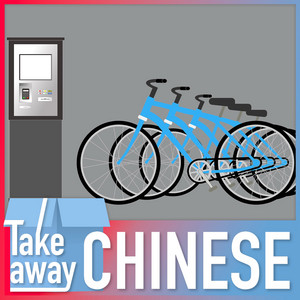
For example, one thing that my wife and I like to do in spring, summer and fall is is rent the bicycles, the shared bicycles.
Rent those and then go for a ride sometimes 20 minutes, sometimes an hour, and 20 minutes, sometimes longer and then just leave it wherever you are.
It's one of the really convenient things about renting the bicycles here.
But in the wintertime...
That hobby kind of disappears.
But I like the fact that I can rent a bicycle instead of owning my own to go to places.
Because when I commute to work, I sometimes ride a bicycle that I rent in the morning.
And in the evening, sometimes it's windy.
Sometimes I'm just too tired or it's just really cold outside.
I can choose to walk home or take a bus.
I don't have to worry about my bicycle being alone outside, left out in the gate of the.
You know where i work.
It is one of the major advantages of being able to rent.
Yes, it is.
And do you know how to say rent in chinese?
I do not, Zhu.
Zhu.
Precisely, that character carries the meaning of rent something.
The official two-character, two-syllable word is Zhu Lian.
Zhu Lian.
Yes, Zhu Lian means to rent, but Zhu Lian is used in very official occasions.
For example, if you say Zhu Lian He Tong.
Zhu Lian He Tong.
He Tong is an agreement, a document, and Zhu Lian is a rent agreement.
Your landlord okay mostly, and if we're talking about bike renting or bike sharing yes, online.
You pay a deposit and then you pretend that you finish reading all of the articles which nobody does, nobody does, and you click sure at the end and you sign up for it.
That is also a, so it's like an official renters agreement, rental agreement, Rental agreement would be 租赁合同.
And you see the word 租赁 in these kind of situations.
Of course, you can basically 租赁 anything these days.
Question.
So when you go out and your battery on your phone is dying and you rent one of those battery packs external batteries is that also the same type of rental agreement?
I think it's a similar one with the bike.
Because the reason we're calling these kind of things in Chinese as 共享自行车, 共享充电宝, shared bike or shared power bank, is because you rent it in the sense that you get it, you use it, and you return it very, very fast.
It's not like you keep it for a while.
Whereas when you're renting an apartment, when you're renting a car household appliance which is a thing nowadays here in china when you're renting a cell phone for a while, a camera for a while, you're keeping it for a while and you return it and someone would check the situation of the gadgets of the thing, the condition, relatively more carefully.
Whereas when you're renting one of the bikes, you know there is a function on the bike sharing apps if someone broke the bike.
If something happened to the bike, it's a broken one and you cannot scan and start using it.
You can just report and someone would go fix it.
So instead of holding whoever breaks it countable, people don't really care about that much.
Yeah, I know.
It's a I think it's a new model rental relationship between you and the company.
Yes.
And the way it works when you rent the bikes.
If it's not in proper working order which does happen sometimes, if you park the bike almost immediately, like within I don't know what the time limit is, but let's say five seconds, 10 seconds or something like that then you don't pay for you don't pay for it and it asks you why you are stopping already.
Yeah, returning what?
What's wrong with it?
Yeah, and then you click a button and then you just pick another one.
Yes yeah, but you have to do it very quickly, because if you don't, and then you you know, let's say you pick up the bike at one intersection and then drive through that traffic to another drop-off location, that might take you like a minute and a half.
If you try to return it, then it's still going to charge you for the like.
Because you use it for a while.
Yeah, exactly.
Yeah.
But sometimes the handlebars aren't perfectly.
I'm very picky, by the way.
The handlebars sometimes aren't perfectly aligned.
I know what you mean.
And so it makes it a little annoying to ride.
Or my bigger issue, sometimes the seat doesn't.
Some of the seats go higher than others. oh yeah you can adjust it no but some of them adjust higher than others okay so sometimes i get stuck with the it feels like a children's but maybe it is a children's bike and then my knees are like up around my face i know what you mean yeah so i return those as well yeah but when it comes to these kind of renting or rental relationship we say share so we're sharing these things because we swap them so fast and so frequently.
And so, yeah, so often.
That is why in Chinese we say 共享, that is share.
So it's shared economy, not exactly rent economy.
But rent economy is also big in the Chinese market these days.
Yeah, it's growing in the US too.
I was reading articles about Gen Z and their preference to rent things as opposed to own things.
And one example that really stood out to me was a CEO who just rents an apartment, shared apartment with like a shared kitchen space, shared bathroom space with strangers.
But he's the CEO of a successful company.
And in the article it even talked about the fact that he gave up his backpack because he doesn't like the concept of owning things anymore.
So he doesn't own a car.
He doesn't own a house.
He owns as little as possible.
Yeah, I kind of get it.
If you want to stick to one principle in your life, of course you want to make sure all the little details go along with it.
So in Chinese?
Well, I think in any language the idea of rent is the temporary transfer of the right to use things, but not the ownership.
So 使用权 instead of 拥有权, perhaps.
It's kind of like having a niece or a nephew as opposed to having a child not, but i know what you mean.
It's exactly like that.
You play with the niece or nephew till you you know you're tired and you want to go home, and then you transfer ownership back to their parents yes, to their parents.
And then the next time you want to play with them, that's up to you.
Please don't use that metaphor to their parents, though.
I think it's kind of common knowledge, isn't it?
Okay, so when it comes to renting, let's talk about the relatively traditional ones.
For example, 租房.
租房.
Yes, 租房 is to rent an apartment, rent a house.
No matter how big or how small the place you're renting, you're renting.
So it's all 房. So 房 is the living space.
Yes.
Fang is 房子 or 房间.
房子 would be a house.
房间 would be a room.
So no matter if you're renting a house, an apartment, it's fine.
Just 租房.
租房.
We mentioned 合同 being agreement.
So 租房合同 would be the rental agreement that you sign and you would be a bit more careful.
I don't know about in other countries, but in China, for example, when you're renting a place, you are paying for the water.
You use the electricity, most occasions the internet connection, but you do not pay for the central heating system.
I never understood.
Yeah.
That is interesting.
So that's always covered.
It's covered by the landlord, 房东.
房东.
房 is, again, the house or the room.
And 东 is 东家.
东家.
This is a funny one.
东 is east.
And it's not only in the occasion or in the word 房东.
It's in a lot of different words.
东, the direction kind of character carries the meaning of the host or or the lord or the boss, or what's the connection between the direction and the owner well, or the boss or whatever it has something to do with, who is a little bit more honored and respected in ancient china, and also the sitting position of the host and the guest in a banquet in ancient china.
I do not know anything about this.
Please explain.
Yeah, that is only a ritual or a common habit for a longer time.
For example, we say zuodong, be the east.
Be the east.
When you're being the east, you're being the host.
So you're hosting something.
You're holding a little banquet and you're inviting people to come.
Okay.
And also in Chinese history, we have Xi Xi.
Xi is west and Xi is a place or a sit that you can permanently stay or temporarily stay.
And Xi Xi is a teacher that in ancient days, ancient Chinese people invite students, private teachers, to their homes and they can stay in their homes and teaching their kids.
And you couldn't do that in the west, north or south, you?
Well, that one is the west.
Oh right sorry north, south or east, it's the name.
The cc is the name for these stay in home guests, slash teachers.
Yeah, I still don't see the connection with the direction.
Yeah, the direction is more like a habit or a tradition.
It is considered that the east side represents the host and the owner, whereas the west side represents the guests.
Hmm.
So you see a lot of words in Chinese language related to direction and the relationship between host and guest.
Oh, that's interesting.
Yeah, we say 东道主.
东道主 is, for example, won the 2022 Winter Olympic Games. got hosted in Beijing.
Beijing is the Dongdaozhu, is the hosting city.
So Dongdaozhu is the hosting one.
And Fangdong, we talked about this being the landlord.
Fangdong.
Fangdong.
Fangdong.
Yes.
How do you say return? or just works.
So cares the meaning of return and the is the official relatively more official Chinese word.
So you keep saying like official rental agreement and official return.
Does that imply that there's some different words for like casual rental agreements or casual returns?
I don't even know what that would mean.
No, no, no, no, no.
It's not like that.
It's that when you're talking to each other, 我最近租了一个房子。 Recently, I rent a house.
这是我的租房合同。 This is the house renting agreement that I had.
Yet, when you're looking at the official document, the paper of your rental agreement, On the paper, the title would definitely say 房屋租赁合同, 房屋, the house, the place, 租赁, rental, 合同, agreement.
So official setting or official or writing form require these relatively more official words.
Whereas in daily conversations, if you say, Steve, I need a pen.
Can I borrow one from you?
And then you say, okay, I finished using it.
Here you are.
I'm returning it to you.
Thank you.
But if I say, it's just a little bit weird because it's just too formal.
Yeah.
And also you're not renting the, well, assuming I don't charge you anything for the use of my pen.
Oh, that is a good one because 归还 or 还, it's just return.
It does not have to be rent and return.
Give back.
归还.
But if I do rent it from you, I might would have to pay a deposit.
Kind of like a security money, giving you 10 bucks to make sure I do not break your pen, but I get it back when I give you back or 归还 the pen to you, right?
Yeah.
I don't think the pen is the perfect example for this.
No.
Maybe like a hotel.
If you go into a hotel, then you have to pay a deposit sometimes.
归还.
归还.
归还.
归还 the apartment and you get your deposit back, which is 押金.
So is like i give you something to make a point, but i am taking it back when i prove that i didn't lie to you, when i deliver my promise, no matter that promise is borrowing some money from you or rent a bike or an apartment from you, no matter what that promise might be.
The deposit is to give you something to show that I would deliver.
Yeah, exactly.
And to use the phone battery rental thing again, if you have a certain score in your.
I'm not even exactly sure how this system works, but if you have a certain score in your phone app then you don't need to put a deposit down to rent the battery.
I don't have that score.
So I need to pay 99 yuan to rent the battery to...
For like an hour or whatever.
And when you put the battery back, it deposits the 99 yuan back into your account.
Yes.
My wife somehow does have the score and doesn't need to pay any deposit.
And she always makes the same joke every single time.
Because I complain every time.
Like, I pay my bills on time.
What do I need to do?
She's like, China doesn't trust you.
Okay, now I can give you your perfect hit back.
It's because she does online shopping much, much, much more than you do.
I never online shop.
That's why, when she does online shopping, when she receives her product and allow the money to be transferred to the shop owner's account, it shows that she's someone that people can trust, because she allow that transaction to happen smoothly and And she didn't do any online fraud by saying that oh, my product is broken.
I need you to return me the money without actually having a broken product.
And she also didn't refuse to pay even if she has already enjoyed the service.
All of these things, they all add up.
It's, you know, their score.
So just by, you know, like paying your phone bill on time or like other stuff.
If you're doing it on your online payment platform, it counts.
But... You're only doing that like once a month.
Exactly.
So it's going to take a lot longer to add up.
Yes. golly, I got to start doing some more shopping online.
Because it's the same thing when we go to the subway station, you know what I mean?
And you try to buy the juice.
You don't rent the juice, but your score will open the fridge to pay for the juice.
My score doesn't open the fridge, so I always have to get her to do it for me.
Well, getting her to do it for you is also sweet.
I know, but I just want this to change.
So now I know.
When we order stuff, I'll just do it on my phone instead of hers from now on.
Well, yeah, I understand the feeling.
Anyway, we're getting off topic.
We're supposed to be talking rentals here today.
But since we talked about this already, there's the 信用, credit.
But 信用 is different platforms would call it differently.
They have different terms for it.
But the idea is what we've just explained.
It's the score.
And you can use that score as a way to showcase that you're honest and trustworthy person who do not need to pay a deposit.
So 信用 is credit and 卡 is card.
So 信用卡 is credit card.
Yes, yes.
We don't use credit card that much.
Yeah, nobody seems to use them here in China, I guess.
Scanning a QR code with your phone is just that easy.
Yeah, and I guess, like the only times people would use it, perhaps if you're like traveling internationally and needed to book hotels or something like that.
Yes, yes, for sure.
But many of these places outside of China also open to Alipay.
Yeah, yeah, depending.
Yeah.
That being said, even if you're a totally trustworthy person when you're renting something major like an apartment we talked about, you still kind of want to make sure that the other party is also that trustworthy.
Of course.
Meaning that sometimes finding a place and directly having any kind of agreement or transaction with the landlord, and also 租户, by the way.
租户 would be the tenant, so 租, we know, is to rent.
户 is a household or someone.
租户 is those who are renting, so the relationship between them cannot be formed that easily, which requires a different role.
That is 中介, so 中 is in the middle, 介 is a media, like the rental agency agency.
中介 yes, and now a lot of the zhongjie or the zhongjie role or the zhongjie function is being my feeling.
Is that replaced by online platforms?
Interesting, because if we're talking about renting an apartment, of course you still need someone, because this someone not only voucher for both you and the landlord, they're also taking you to see the houses, recommending blah blah blah, all these things.
But nowadays in china, young people would rent all sorts of things.
They would rent a sports camera when they're traveling around on any kind of platform.
And you can even rent it and have it sent to your hotel and return it from your hotel.
So you only rent it when you need to use it.
You can enjoy the service, enjoy the fun without owning one, without spending too much.
And it totally makes sense for a couple of different reasons.
If you're going on vacation and you're going to be taking a lot of photos and you want a great camera for that, but that would be the only time you're going to use that great camera, then why would you buy it when you can just rent it?
So that aspect totally makes sense to me.
And the other thought is that maybe you're considering buying a specific brand.
Yes, you can just try it out and see if you like it, see if it suits you.
In Chinese, we say 试用.
试用.
试 means to try, and 用 is use.
Try using it for a while.
Do you use that about clothing as well?
We say 试穿.
试穿.
So 试 again is try, and 穿 is to wear, to put on.
So 试穿.
试穿 sounds like yes.
Yes, similar pronunciation, different tone.
So if you go into a clothing shop, that's trying something on as opposed to trying to use something right, you're putting it on, you trying it out a little.
Yes, And according to a news report, as of September 2025, rentals of mother and baby medical devices also grew by 130 in just half a year.
Also makes sense.
Because you're only using it for a while.
Yeah.
When the kid grows up a little bit, you're not going to use that anymore.
And also many of the major machines can be quite expensive.
I'm talking about the mother baby care related, like a milk pump, and also the kind of machine that can calculate or that can help you listen to the heartbeat of the baby.
Like a baby monitor?
No, not a baby monitor, but a baby heartbeat detector, something like that.
And some moms, when they're in really vulnerable stages.
They also need to have a bit more oxygen inhale, and that can also be provided by a machine.
Oh, cool.
Yes, and all these things.
The majority part or the core function provider part of the machine is quite heavy, quite expensive, especially if you're looking for a high-end one.
But the other parts that directly touches your body or directly touch the breast milk.
Those parts are replaceable and you can use your own, but you purchase one with just dozens of yuan or a hundred yuan, which is much cheaper and clean.
Yeah.
I saw a story from the United States.
I think it was a university student's school project idea.
I could be wrong about this.
But anyway, the idea was renting baby toys as opposed to people... Purchasing.
Purchasing them.
And the idea behind it was that kids get sick of their toys very quickly and they always want something new and different.
So instead of buying it and then just having to sell it or give it away to somebody, you just rent the toy until the kid gets tired of using it, and then you just replace it with another one.
Interesting concept.
Yeah.
Turned out to be a pretty successful business too.
Yes.
And when it comes to renting, another key element would be how long you rent.
So your lease period or your lease term.
And that in Chinese is 租期.
租期.
期 is 期限.
期限 is the period of time.
Or one, it's expired.
So 租期 is the lease period and or rent period.
And the idea is that if you decide to rent it for longer time, then the money per unit to the price per unit would be a bit lower.
Usually.
Okay.
Yeah.
So if you rent for two years instead of one year, you'll get a better rate.
Yes.
And this is also very interesting in the sense that we talked about the kind of services, the kind of equipment that you only use for a short period of time.
And if you rent it, it's definitely more economical, cost effective.
And that applies to not only the sports camera or the mother baby product, but also another fun category, that is, the beauty product.
What beauty products can you rent?
You can rent all sorts of them.
So, for example, hair growth helmets, LED beauty lamps, eye spa instruments and people who are having these two reasons.
One is that, like you said, want to try it out, see whether or not they like it.
I know what two of those things are.
I don't know what a hair growth helmet is.
A hair growth helmet is something that claims to prevent hair loss through light therapy.
So you wear it for a certain period of time every day and it will help you grow more hair.
Cool.
And you'd also get the added benefit of looking like one of the X-Men.
And you do need to record yourself during using it.
Uh yeah, what's an eye spa thing like?
It's a little bit yeah yeah, a little, and sometimes there are also massage functions and you can add in certain, i think, medical product so that mist can carry okay, certain medicine.
That's good for your eyes, for people with really dry eyes maybe who sit in front of a computer all day, like that.
That's cool.
And you know, for the first half year of 2025, the broader beauty and wellness device category jumped 664 year on year on renting, when people really want to rent these things and see whether or not they like them and see if it can help.
Yeah.
And again, it's the same concept, right?
Because the idea is you might not be using that over and over again or you might be interested in buying it.
And so you just want to try it out, because the eye spa thing, I can imagine that that might be useful again.
Many, many times for people.
So it might be worth owning.
But it's also the type of product where people might think, huh, what's that?
I've never heard of that before.
Let me try it out.
Let me try it out.
Yeah, yeah.
That is a very fun thing that you can do.
And also different products might have different function.
Or might be suitable for different people.
When I was raising my kid, I rented several different types of milk pump just to see which one is the best one for me, so that I can buy the right one.
Oh, they're different.
They're different for different people.
I didn't know that.
You don't have to.
Right.
That is useless information for me.
I won't even ask how to say that in Chinese because I'll never say it.
But the idea is that you can find the perfect one after trying it out.
And renting it for several days is the best way to try it out.
Question.
I don't know how popular the system still is in the West, but we at least used to have something that was really popular called layaways.
Do you know what that is?
Layaway is when you are putting a deposit down and then you will continue to make payments on something.
But the difference is now we have like buy now, pay later, right?
Where you make a deposit and then you take the product yourself.
But layaway, the company keeps the product and they hold it for you.
And until the time that you make the final payment.
When you make the final payment, then they give the product to you.
I've never heard anything like that here in China.
Never.
So let's say that the hottest new pair of sneakers comes out from a company, right?
But you don't quite have the money right now.
So you go to the shoe shop and you say, please hold these for me because they're super popular.
If you don't do it, they're going to sell out.
Please hold these for me.
I'll give you, you know, 300 yuan today.
And then for the next two months, I'll give you 300 yuan again and again.
The company will hold that product for you in their shop until the final payment.
No, never heard of it.
And I think for those who really, really want to buy the product, they have a lot of platform to buy get some money from the bank and then get their product and then return the money with a interest.
Yes.
And also here in China.
One thing that I have heard of, one thing that is not really the same with what you said, but I think also carries a little bit of money and product don't come together.
Kind of feeling is that when you're renting something, you can choose to rent something a brand new one and after renting it for a certain period of time, you can decide to buy it.
Yes, rent to own.
Yes, rent to own.
How do you say that there's no certain, a fixed term for it?
They just would describe that after renting it, for example, for how long you can get it Your rent can be used as also part of the money that you purchase.
I see.
Do you know something that's just occurred to me?
I've never even thought about this before.
A loan is renting money.
You have to return it.
You're renting.
Yes.
You have to give it back.
And the interest is the amount of money you pay for the amount of money you rent.
Exactly.
That's the rental cost.
I wonder if in any language a rent or a loan is described or is called rent money.
If not, we can make our own language.
Yeah.
That's funny.
So for those of you who are listening, if in your language alone is a rent money, please leave a comment in our comment section so we know we can learn something from you as well.
It would make sense because that's exactly what it is.
Yes, it is.
And that brings us to the end of today's Takeaway Chinese.
Thank you so much for listening.
If you're interested in knowing more fun China-related information, you can check out our Facebook page Learn Chinese.
And if you want to listen to more of Takeaway Chinese, you know, just search for Takeaway Chinese wherever you listen to your favorite podcasts.
Thanks so much.
See you next time.
Thank you.