This is Hidden Brain, I'm Shankar Vedantam.
Ask yourself what makes you happy?
Many people would say spending time with close friends, quality moments with family, playing with a pet.
Most of us can agree, relationships are at the heart of a life well -lived.
Social science research bears this out.
Countless studies suggest that our emotional ties to others shape our long -running analyses that track people over time show that social connections are not just about our emotional well -being, they're important determinants of our physical health.
But it's one thing to say that relationships are important, it's another to go about getting them or preserving them.
Lifelong friends move away to other towns and countries.
Romantic relationships come done.
Relatives pass away.
And especially as people get older, many find it difficult to form new relationships, even as they yearn to feel close to others.
New psychological research suggests a solution to this problem, or at least a partial solution, and it's one that's easily accessible to everyone.
Last week in our Relationships 2 .0 series, we looked at the common mistakes we make when negotiating with other people.
This week on Hidden Brain, we bring you a users manual on how to boost your social connections and your happiness.
Support for Hidden Brain comes from Discover.
It's smart to always have a few financial goals, and a really smart one you can set, earning cash back on what you buy every day.
And with Discover, you can.
Discover automatically matches all the cashback you've earned at the end of your first year.
Seriously. All of it.
See terms at discover .com slash credit card. Support for Hidden Brain comes from Amazon.
Have you ever gotten sick on a very expensive, very non -refundable family trip?
Amazon One Medical has 24x7 virtual care, so you can get help no matter where you are.
And with Amazon Pharmacy, your meds can get delivered right to your hotel, fast. It's kind of like the room service of medical care.
Thanks to Amazon, health care just got less painful.
Support for Hidden Brain comes from Stripe.
Stripe helps many of the world's most influential businesses grow their revenue and build a more profitable business.
Whether it's Hertz making checkout a smooth ride for their customers, OpenAI answering unprecedented demand, or PGA chipping away at back -office inefficiency, Stripe's financial infrastructure platform helps companies achieve ambitious goals.
No matter what success looks like for your business, Stripe helps ensure the complexity of financial systems doesn't get in your way.
Learn more at Stripe .com.
Rigorous studies suggest that the problem of loneliness is growing around the world.
Many people feel they don't have others in whom they can confide.
Making friends can be hard, especially if you are someone who is naturally shy.
At the University of Sussex, psychologist Jillian Sandstrom studies what we can do to combat the growing challenge of social isolation.
Jillian Sandstrom, welcome to Hidden Brain.
Hi, thanks for having me.
Gillian, I understand that you were somewhat introverted and shy as a child.
Can you describe the younger version of yourself to me?
I was definitely a shy kid, very bookish.
And so I remember, you know, anytime we went to my grandma's house for Christmas and all the cousins and aunts and uncles were there, I would be off in a room somewhere with a book just finding the quietest place in the house, just sitting there reading.
And my dream when I was a kid was that I would grow up, and I would live on an island.
I don't mean like a tropical island, I mean an island that was just me.
My own island. Where I had a big library, and that was my dream.
As a teenager, Jillian's shyness intensified.
It got to the point she found it difficult to even have routine phone conversations.
Oh, gosh, that was the worst. And I felt like every time I did it, I would get off the phone as quickly as possible.
and then and then my mom would say, well, did you ask this?
Did you say that? And of course, I never did any of those things.
So it just felt really stressful and anxious about about talking to someone on the phone.
I understand this must have been especially hard for you because you had one member of your family who was the polar opposite of you.
Tell me about your dad.
Yeah, actually, I feel like my whole family was the opposite of me, but especially my dad.
So my dad is just I think he's sort of a king of talking to people.
He had this knack for approaching people and starting figuring out how to connect with them and start a conversation.
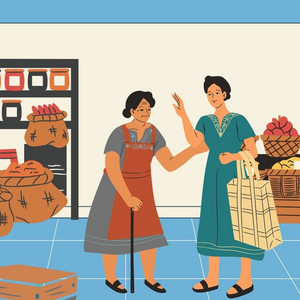
And so anywhere we went would take a really long time, you know, going to the grocery store would take three hours because he would stop and talk to everybody, especially kids he loves talking to kids, he always tease them and get them talking, but he would ask kid who looked like they were about five or six years old, he'd say, how old are you?
12, 13. You know, just something ridiculous that would make them feel like they had to sort of disagree with what he'd said.
Or he'd ask them, you know, if they had any pets at home and, and, you know, ask if they had a pet alligator or a pet hippopotamus, you know, just ridiculous things that would, that would make them respond.
And did you really feel like you were embarrassed when he did these things?
Did you, did you try and prevent him from doing it?
I definitely would say, Dad, you know, why are you...
Like, I couldn't understand the compulsion that he had.
You know, like, why are you doing this, Dad?
They don't wanna talk to you.
You know, they're doing their grocery shopping, you know?
Why would someone wanna stop and talk to a complete stranger?
And what would he say in response?
He would just ignore me and enjoy his conversation cause he was having such a good time.
He likes to say, you know, everybody has a story.
So he just loves meeting people and having a chat.
As an adult, Gillian's desire to fade into the wallpaper began to have real consequences.
So I was I think about 25, and I was on the plane on my own on this business trip, which seemed quite exciting.
And I'd just recently gotten married and I'd taken on my husband's surname.
And they were making an announcement about a bunch of different people's names being called out, something to do with baggage.
I didn't know what was going on.
But at some point, they said, would passenger sandstrom please identify themselves?
And I thought, well, they couldn't mean me, because that's not my name anymore.
And I knew I should have checked, but I was too anxious and embarrassed to push that button and call over the flight attendant.
So I didn't say anything.
And so of course, what happened is I got to the other end, got off the plane, went to the belt to collect my luggage, and of course, it wasn't there.
And so I had to go and buy a tourist T -shirt, which is what I wore to the first day on this business trip.
Several years after the luggage incident, Jillian signed up for a graduate program in Toronto.
She had been working as a computer programmer for a decade but wanted to try something new.
She decided to get a master's degree in psychology.
Gillian was in her thirties.
As she looked around at her graduate school cohort she worried she wasn't smart enough.
But on top of all that, I had the feeling, you know, I'd given up this other career that had been going really well, you know, did I make the right decision?
Should I be here? You know, all these people are so much younger than me.
So it's just this feeling, you know, kind of imposter syndrome feeling of, you know, did I make the right decision?
Should I be here? Soon enough, however, Gillian settled into a routine.
It gave her more than structure.
It gave her an insight.
I would go to the research lab to do my studies, but then my supervisor had an office in a different building.
And so when I walked between those two buildings, I would pass on the street corner, and there was a hot dog stand because I was at a university right downtown Toronto, and I started to develop accidentally develop a relationship with a lady who worked at the hot dog stand that I would pass by.
And seeing her there and knowing that she recognized me, you know, we'd smile, we'd wave, I don't even know if we talked to each other, but we just had this relationship built on these little minimal signs.
On some days as Jillian crossed the street, she noticed something curious.
The hot dog what was curious.
The thing that struck Jillian was her own emotional reaction.
So on a day when I didn't see the hot dog lady I would feel disappointed and and kind of not lonely but sort of unmoored you know because I think I came to think that the hot dog lady and people like her like the kind of we have lots of relationships like that these little tiny relationships that maybe don't seem particularly important but I feel like they kind of You're kind of woven into the social fabric, you know, and so I felt a bit unmoored and Uncentered when she was missing So Jillian when you think about these relationships that you're talking about like your relationship with the hotdog
lady they're different than the kind of relationships you would have with a spouse or a child or even a colleague at work and Sociologists have come up with names for these kinds of relationships.
Can you talk about the different terms they use for these kinds of relationships?
Yes, so a sociologist in the 70s named Mark Granovetter coined these kind of relationships, weak ties, and as opposed to strong ties which are the ones with close friends and family.
And it's tricky to come up with a definition because, you know, one of the original thoughts was there are people that we see less often.
But I don't think that's necessarily true, because people like the hot dog lady I would see here on a very regular basis, or, you know, you might run into someone at the school drop off every day.
So I don't think frequency is necessarily a factor here, but definitely close friends and family are the people that you feel the most comfortable with and you'd be most willing to sort of share your deepest, darkest secrets with.
But, you know, weak ties are the, you know, you can feel fondly towards them positively, but you're probably less likely to feel like you'd want to confide in them and share something that feels very personal.
So a little while later, you were starting a PhD – and I believe this was in the lab of Elizabeth Dunn, who we've previously had on Hidden Brain as a guest. And Liz Dunn asked you what you wanted to study, and how did you respond?
I said I wanted to study the hot dog lady.
She said, what makes you happy?
You know, that's…her lab is the happy lab.
What makes you happy?
And I said, well, the hot dog lady makes me happy.
You know, having these little interactions throughout my day with people that I'm not really close to and would never, you know, invite over for a drink or anything, but, you know, having this familiarity and feeling of connection with those kind of people just really feels good to me.
And I wanted to know, you know, is it just me or is this a more general thing?
Do people generally feel good from having these kind of relationships?
When we return, how the people we least expect to matter in our lives can have a profound impact on the way we experience the world.
You're listening to Hidden Brain, I'm Shankar Vedantam.
Support for Hidden Brain comes from Peloton.
Everyone has a reason to change.
growing old, heartbreak, a fresh start.
The road through life's biggest moments can feel uncertain and even endless, but along the way, something unexpected happens.
You grow. You get stronger, faster, and more grounded, stepping into the best version of you.
Peloton is just there to help you along the way with workouts that challenge and motivation that keeps you coming back.
With Peloton's Tread and All Access membership, you can set your targets, track your progress, and get stronger making your fitness goals a reality.
Thousands of members have had their lives changed by Peloton.
What will you accomplish?
Find your push. Find your power.
Peloton. Visit One Peloton dot com.
Support for Hidden Brain comes from Discover.
It's smart to always have a few financial goals.
And a really smart one you can set?
Earning cash back on what you buy every day.
And with Discover, you can.
Discover automatically matches all the cash back you've earned at the end of your first year.
Seriously, all of it.
See terms at discover .com slash credit card. This is hidden brain I'm Shankar Vedanta.
When you think about the most important people in your life you probably think about a spouse or a best friend your children maybe even a beloved pet.
Chances are you don't give much thought to the people on the periphery the woman selling hot dogs on your way to work.
The person sitting across from you on a train.
Even when we encounter these people every day.
We often ignore them.
If our lives were a movie, they wouldn't even be supporting characters.
They are the extras." Gillian Sandstrom is a psychologist at the University of Sussex. She studies these relationships, and why they are much richer than most of us think.
Gillian, some time ago, you ran an interesting experiment involving a little tool called the clicker.
Tell me about that study.
I wanted to know, does the number of interactions that people have with weak ties sort of relate to their happiness?
So my hypothesis was, given my personal experience, maybe on the days that you have more interactions with weak ties, you feel a little bit happier.
So I got students at first and then later just members of the community, to carry around two clickers, sort of in their pocket, two different colors.
And every time that they talked to someone throughout the day, they were supposed to click.
So one of the clickers was to count their interactions with strong ties.
That would be people like you just mentioned, a close friend or family member.
And then the other clicker was to count the number of interactions they had with weak ties.
If a volunteer smiled at someone they didn't know very well on their way to class, click, weak tie.
If they had a conversation over lunch with their best friend, click, strong tie.
And as you'd expect, you know, the number of interactions you had with your close others, your strong ties, predicted happiness and feelings of belonging.
But also, independently, the number of interactions that people had with weak ties also mattered.
So, on average, people who tended to have more interactions on a given day with weak ties tend to be a little happier than people who have fewer interactions with weak ties.
But then also, regardless of what your personal average is, on a day when you talk to a few more weak ties than you usually do, you tend to be a little happier than you usually are.
So, Gillian, we talked earlier about the sociologist Mark Granovetter and his work on weak ties.
if I recall correctly, he had a famous paper called The Strength of Weak Ties, looking at how in some ways our connections to people who are peripheral in our lives are actually very important to us.
This has been borne out in lots of studies looking at how if you're searching for a new job, for example, you're much more likely to find that job through a network of weak ties of people whom you know slightly compared to the network of people who are very close to you.
Granovetter and others have looked primarily at the power of weak ties in the context of professional relationships, but in some ways what you were realizing from the clicker study was that the strength of weak ties might also affect our social lives and our emotional wellbeing.
So yeah, I was looking at weak ties as having other advantages that maybe hadn't been looked at before.
So these wellbeing benefits and emotional benefits.
So the biggest source of weak ties comes from the world of strangers or people we don't know.
Can we talk a moment about whether there's a difference between strangers and weak ties?
I mean, what's the difference between someone who we would call a stranger and someone we would call a weak tie?
I think the difference is actually pretty small.
So I think a weak tie, my definition is just someone with whom you have sort of mutual familiarity.
So the hot dog lady was a weak tie, the first time I talked to her she was a stranger.
But when we saw each other again and she recognised me and I recognised her, I think at that point she's no longer a stranger, she is a weak tie.
You started to conduct other studies besides the clicker study looking at the power of weak ties.
Can you talk about some of that work?
One of your studies, I understand, took place in a coffee shop.
Right. So, you know, sort of inspired by the hot dog lady.
I thought the closest thing I could think of, you know, I really wanted to study that phenomenon.
And I was aware that lots of people have sort of their favorite barista at the coffee shop and people go into the coffee shop and the person knows their name and knows what their regular order is, and it makes you feel really good.
And so I really wanted to study that phenomenon.
So I asked people, I recruited people walking past a Starbucks in Vancouver, gave them a gift card. And I said the only catch is that when you go in to buy your coffee, you have to follow some instructions.
And some people, the instructions were, when you go in to buy your coffee, just be as efficient as possible.
And I tried to tell people this would be a good thing.
The barista is busy and just wants to get through their day and we'd be helping them out so have your money ready and avoid unnecessary conversation.
I mean, you have to talk to place your order.
And then the other group of people I said, okay, when you go in try to turn it into a real genuine social interaction.
So, smile, make eye contact and have a little chat.
And you know, plenty of people said they do this anyway.
And I said, well, just amp it up.
Do it even more than you usually do.
And so, people bought their coffee, He followed the instructions and then when they came out, I asked them to fill out a short survey, and what we found was that people who'd had this just tiny little social interaction, you know, had treated the barista as if they would treat one who knew their name and knew their order, if they had that social interaction they were in a better mood and they felt more satisfied with their Starbucks experience and they felt a greater sense of connection to other people.
In Julian's study, people had an incentive to talk to strangers.
In the real world, talking to people you don't know can be awkward. We worry our small talk won't be well -received.
We fear that people will think we're obnoxious, silly or unlikable.
We've talked about this trepidation on the show before.
In our episode featuring the psychologist, Erica Boothby, she called it the liking gap.
It's the gap between how we believe others see us and what they actually see.
Julian has found evidence of the liking gap phenomenon in her own research. What we find is that after two people talk for the first time, they each tend to think that the other person liked them less than they actually did.
So we have this negative voice in our head that says, why did I say that, why did I not say that, did they understand me, did I embarrass myself?
And we tend to listen to that negative voice and think that everything went horribly wrong.
But our partner doesn't have that say, you know, they're probably doing the same thing, right?
So they don't even notice the thing that you think went horribly wrong because they're stuck in their own head thinking about what they did wrong.
And so I read the abstract that Erica was part of where she was talking about the liking gap and I thought, oh, I have, I have data, we should talk and so I reached out to her via email and we've been collaborating ever since.
So it's a great example of reaching out to a stranger.
I'm wondering Julian if you can talk a moment about how our intuitions and forecasting errors are sometimes compounded by the messages we receive from society I want to play you an old public service announcement about how children should think about strangers most people love a little child some grown -ups though are bad the bad ones look like good ones like any mom or dad So that is why you must not talk to strangers that you meet.
Don't let them give you any toys or anything to eat.
If someone that you do not know should offer you a treat, remember how he looks and talks.
But run fast, stop the street.
Run fast. So it's not just our internal messaging that gets it wrong, Jillian.
Sometimes the external messaging is also saying keep to yourself.
Yes, absolutely. and I think norms and those kind of cultural messages make a huge difference to what we do.
I think it's really hard, isn't it?
Because it's a very nuanced message that we want to convey because we don't want to make people scared to talk to others, but we do need to be aware of our personal safety.
And I'm not suggesting that people go down a dark alley and start talking to people, but in most situations if you're in a public place surrounded by other people, you know, there's so many benefits to talking to strangers.
I'd like to talk about some of those benefits that you yourself have realized in your own life.
You've actually tried to walk the talk of your research and practice what you've preached.
Tell me about a time that you had an interesting conversation on the train with a woman who was carrying a very fancy cupcake.
Yes, this was one of the first conversations that I can remember deliberately starting with a stranger.
And if I think about it, I've definitely had conversations before then, but this is one that was really memorable to me, I think because it felt like I had deliberately done it rather than it just happening accidentally.
And so I was on the train in Toronto, and it was during the time when all these very fancy cupcake shops were coming out, and this woman on the train had this beautiful just delicious looking decadent cupcake.
And so I couldn't help but ask her about it.
Basically, just wanted to comment on how beautiful this cupcake was.
And so we started talking and I think maybe it was her birthday or something and she was reminiscing about other birthdays and she told me that in the past she had gone on a trip to South Africa and when she was there, she had ridden an ostrich. And you think about it, did we get from cupcakes to ostriches?
I don't know! And so I was really hooked.
I just thought this is amazing, like, I would never have known this, if I hadn't talked to a complete stranger.
Jillian, being a psychologist went a step further.
She realized that weak ties are a source of novelty in our lives.
Once she had this insight, it started to pop up all the time.
Yeah, I've learned all sorts of things that I found interesting.
I remember talking to someone on a plane who was from Slovenia who told me that Slovenia is 70 % forest, and I thought, OK, someday I need to go to Slovenia, because that sounds awesome.
Forests are a great place for an introvert.
I remember talking to someone on the bus at the university who told me that there was a region in China where the majority of people or there was a huge number of people who have red hair like me, and I went home and googled it right away and found that indeed it was true.
I have had free vegetables from people.
I got a ride from a couple once, that saved me from having to...
you know, the train wasn't running and so they gave me a ride so that I didn't have to take the bus instead of the train late at night.
I was with my husband.
I felt very safe about it.
Again, I'm not suggesting people get in a stranger's car, but I felt comfortable having talked to them for ages first. I joined a book club after talking to a stranger.
I've talked to all sorts of different interesting kinds of people.
I've talked to Freemasons.
I talked to someone who made theatrical wigs.
I've talked to children's book authors, and a poet.
I don't know, I've just met all sorts of really interesting people and just had some really interesting conversations.
and also a lot of just sort of average, meh, conversations.
We often fail to see the benefits of talking to strangers because of our own biases.
We worry that people won't like us.
We assume that small talk is empty talk.
In reality, these interactions have a subtle but significant effect on our happiness.
Weak ties, it turns out, offer tremendous value in our lives.
But during the COVID -19 pandemic, many of us have experienced a catastrophic loss of these connections.
During the pandemic, people generally found ways to stay in touch with the people they were closest to.
But with acquaintances, sometimes we don't even know how to reach them.
They're just the people that we happen to cross paths with during the course of our day.
So because the patterns of our day change, we just didn't see them.
You know, I had Barry at the pet store who would remember me and recognize me and ask about my cats.
I wouldn't reach out to Barry at the pet store, would I?
I don't even know how to do that.
So I think the pandemic sort of disproportionately affected our relationships with weak ties.
And at the same time, Gillian, I think a lot of people are reporting, even people who enjoy working from home and feel like working from home has actually allowed them to spend more time with family and have a better work -life balance.
because many people then report, you know, I somehow feel cut off from the world in important ways, and perhaps part of what they're experiencing is what you're talking about here.
You know, your spouse is still your spouse.
Your child is still your child.
Your coworker is still your coworker, and you have fixed ways of dealing with them, weak ties are what bring in surprise and unpredictability into your life.
I think that's true, and I think that that has a bigger or maybe different impact than people think.
So, talking to our close friends, we're probably already watching the same shows on Netflix.
We already know all their opinions.
We sort of have nothing new to talk about because nobody was able to go out and do new things.
And so I think it's the weak ties that sort of get us access to new kinds of information or new stories or new adventures, and because we were cut off from them I think we really missed out on a huge portion of the novelty that we tend to get day to day.
As we go about our daily routines, there are countless opportunities to connect with others.
We often take these opportunities for granted.
When we come back, techniques and strategies for making the most of our weak dice.
You're listening to Hidden Brain.
I'm Shankar Vedanta.
Support for Hidden Brain comes from AllModern.
Have you met AllModern?
AllModern thinks making your space modern with fresh furniture and decor should be easy.
That's why AllModern's team of modern obsessed experts hand vets each design for quality.
And not to mention, they offer fast and free shipping.
Yep, that means you can upgrade your home in days, not weeks.
So, whether you're updating your living room with a plush new sofa, setting up an alfresco dining area with a modern table and chairs, or designing a cozy fireside retreat, All Modern has everything for your modern, outdoor escape – all in one place.
That's modern made for real life.
Shop now at allmodern .com or visit them in store in Linfield and Denham, Massachusetts, or in Alston, Texas.
Support for Hidden Brain comes from Stripe.
Stripe helps many of the world's most influential businesses grow their revenue and build a more profitable business.
Whether it's Hertz making checkout a smooth ride for their customers, OpenAI answering unprecedented demand, or PGA chipping away at back office inefficiency, Stripe's financial infrastructure platform helps companies achieve ambitious goals.
No matter what success looks like for your business, Stripe helps ensure the complexity of financial systems doesn't get in your way.
Learn more at stripe .com.
This is Hidden Brain.
I'm Shankar Vedantam.
Across a number of research studies, psychologist Jillian Sandstrom has found that people are happier when they have lots of casual conversations with strangers or people they know only slightly.
The cafeteria worker who makes you a sandwich, the lifeguard who watches over your kids at the swimming pool, usher at the theater.
Most people don't prioritize these relationships, perhaps because they are fleeting.
Julian grew up shy, but has tried to become more outgoing in conversations with strangers.
In recent years, she has developed something of a science on how to go about talking to strangers.
She has discovered that there are distinct psychological problems in starting conversations, maintaining conversations, and ending conversations, and each problem requires its own solution.
She explained to me the challenge involved with breaking the ice.
When I was doing my PhD, I used to talk to people on the bus all the time.
And it wasn't a common thing to do.
You don't talk to people on the bus.
So when I would do that, I think people's original reaction, their initial gut reaction is, do I know you?
I think that's, you know, they think maybe that's why you're talking to me.
maybe I've met you before.
And then they realize, uh -oh, I don't know you.
And then they think, uh -oh, what is happening here?
What do you want? You know, what is going on?
And then I think you get to the third phase, which is just, oh, you're being friendly.
Cool. And then you have a nice chat.
So I think sometimes people, you know, you have to be aware that there is going to be that awkward moment because, unfortunately, it is just not the norm.
And so people have to sort of make sense of what's going on.
But I think if you can be a little bit patient, you almost always get to that stage where people can accept that you're just being friendly.
Breaking the ice involves, well, breaking the ice.
You have to accept there are going to be a few moments where the other person might be wary.
There may also be situations where someone clearly does not want to be engaged in a chat.
As they say, read the room.
I can think of a time not too long ago when I was on the Tube in London and the unwritten rule is that you do not talk to people on the Tube.
So it's just breaking all the norms to do it but I've had some really great chats on the Tube so I just keep doing it.
But I remember once being on the Tube and turning to the person sitting on my right and trying to start a conversation and you know she was polite.
She, you know, I think I started to say, you know, how are you?
Have you had a busy day?
And, you know, she responded, but it was very clear from her body language that she just did not want to talk.
She was getting out a book and sort of getting herself set up and plugged in, whatever.
And so I thought, okay, that's fine, you know, I don't think we should push ourselves on people, and so I literally turned my head to the person sitting on my left, and I started talking to them and we had a really nice chat.
People worry too much about rejection, because, first of all, I don't know why that woman didn't want to talk to me, but, you know, there's 100 reasons, and I could choose to believe that she didn't like me or something about me, but I could also choose to believe that, you know, like I said, maybe she's shy, maybe she's anxious, maybe she just really is reading an amazing book and you know, I get it.
So, you know, I can choose to believe something that isn't so personally negative.
And just, you know, most people do want to talk and, you know, it didn't surprise me that the person on my left was a bit more willing.
The second problem people face in talking to strangers is in maintaining the conversation.
If breaking the ice feels scary for many people, awkward silences can be terrifying.
I think it helps to sort of pre -think, what might I do if that happened.
And it could be things like, well, I'll share something about myself, or I'll comment on something that was in the news today, or I'll ask them a question, or I'll take a breath and just wait a moment and it'll be fine, but I have to make sure I don't panic.
That would be a good thing to think about.
Sometimes, Jillian says, the problem is not an awkward silence, but a perfectly interesting conversation that suddenly goes sideways.
I saw this man with a net and he was scooping up fish.
And I thought, what in the heck is he doing?
And so I went up and I asked him, I said, what are you doing?
And he said, he lived nearby.
And he said, you know, this happens sometimes we get a heavy rain And the fish sort of washed downstream and they get stuck somewhere and then the water goes down and they're in big trouble.
So I'm just, you know, catching the fish and moving them to somewhere where they're safe.
And I thought, oh, this is amazing.
This guy's a fish hero and what a cool story, you know.
And so we continued talking and the conversation shifted away from the fish and, you know, it was early days and the pandemic.
So, inevitably we ended up talking about that.
And I discovered that he thought that the pandemic was a hoax and, you know, that the government was making up stories and, you know, that's not my view, I couldn't understand why someone would think that way, you know, why would the government do that?
And so, you know, I started to think, you know, who is this person and what's going on here?
Here they are, a fish hero.
You know, how is the fish hero also having these?
You know, you just never know someone, do you?
And did you sort of sidle away from the conversation at that point, Gillian?
What did you do? You know, I just think that we can serve a benefit to other people by talking to them and by listening to them, so I think it's pretty rare.
At least in my own experience, I don't tend to get into any kind of heated topics when I'm talking to a complete stranger.
It's usually fairly innocuous and fun.
It doesn't get into politics and religion and all the heavy stuff that we avoid at the Thanksgiving dinner table.
You know, I'm just seeking out a fun interaction.
So I just let him talk a little bit.
But yeah, it just sort of drew to a natural close and I moved on.
Can you talk a little bit about how when we have conversations that are awkward or conversations that start off being interesting but end up in an odd place, many of us draw the wrong conclusion from this, which is that the next conversation is also likely to be difficult or the next conversation is likely to be unpleasant.
In some ways, we over -count the likelihood of negative interactions.
So yeah, I've run a bunch of studies in the lab where I've asked people to predict how a conversation will go, then they actually have a conversation with a stranger and then they tell me how it went." And the people's worries before the conversation are quite high, but after having the conversation they say, you know, none of those things actually happened.
But, if you ask them to predict what would happen if they had another conversation right now, those fears sort of creep back up.
Not all the way to the level that they were at before the study, but definitely higher than they should be based on having just had a pleasant conversation.
So it seems that people have trouble generalizing.
And it makes some sense because every human is unique, right?
So it'd be easy to think, well, just because I had a nice conversation with this person, why would I expect to have a nice conversation with the next person?
Julian wanted to figure out if she could override people's tendency to undercount the likelihood of good conversations and overcount the risk of bad conversations.
The only way I could think of to fix this would be to get people to have a lot of conversations so they can start to see a pattern, start to see that most of these conversations are pleasant.
But how am I gonna do that when people don't even want to have one conversation with a stranger, let alone lots?
And so, I kind of stole an idea.
I was thinking, you know, I need to turn it into a game, I need to make it fun somehow, and so I was thinking, ah, maybe I could turn it into a bingo game or something, but a researcher in my department had placed posters around the building, they were recruiting people for a study involving a scavenger hunt, and it was a study about memory, but I thought, oh, a scavenger hunt, I could get people to do a scavenger hunt game that involves finding and talking to strangers.
What was the scavenger hunt game that involves talking to strangers?
I thought scavenger hunts are about finding treasure.
Well, people and conversations with strangers are treasure, come on!
So yeah, I came up with a list of missions that were things like, you know, find someone who's wearing a hat, or find someone who's drinking a coffee.
I came up with a whole list of missions, about 30 of them and you know I wanted them to be easy.
I didn't... you know most scavenger hunts you're trying to make it a little tricky.
So people can't find everything, right?
But I wanted people to be able to accomplish every single mission.
Some volunteers were asked to merely observe the strangers they found.
Others had to engage the strangers in conversation.
We found that over the course of the study, every day people reported being less and less worried about being rejected by the people they approached, and more and more confident in their ability to start and maintain and end the conversation.
And so it really did seem that there was this gradual improvement and that repeated practice was important.
Just having one conversation was not enough, it was this gradual improvement over time that stuck even a week after the scavenger hunt had ended.
People still had more positive feelings towards talking to strangers.
Julian began to see how important it was to not just have the insight that talking to strangers could be fun, but to actually practice doing it.
She has developed a workshop to get people to practice these skills.
It's called How to Talk to Strangers.
The workshops sort of became research and then the research fed back into the workshops.
But really it's just a big practice session.
You know, you're bringing in a bunch of people who think they'd like to learn more how to talk to strangers.
And so before the workshop starts, it's very quiet in the room.
There's crickets. because everyone feels a bit awkward. And they don't know what to do, what's going to happen.
And so I always start the workshop by just saying, okay, you have to turn to someone sitting next to you and just have a conversation right now.
And then it's just this beautiful moment because there's this buzz in the room and it's just like, oh my God, people are talking.
And then it's really hard to shut people up.
Do you have icebreakers yourself that you've used Jillian in terms as you've become a better conversationalist and better at talking to strangers.
What do you go up and talk to strangers about?
How do you start a conversation?
What do you do? Yeah, I have a few different go -to methods now.
So maybe it's, especially an English thing, they joke about it all the time, but it's talk about the weather, right?
And I think the reason we do that is because it's a shared circumstance, right?
It's something we're both experiencing at the same time.
So I think that principle can be used more broadly.
So if you're in the same place as this person at the same time, then you have various things in common with them already.
So you can comment on the shared situation that you happen to be in.
If you're on a bus or something and something unusual happens, then all of a sudden you're all on the same team, aren't you?
Everybody talks when they never would have talked before because you've experienced this situation together.
But sometimes I do it in a different way, which is by pointing out something that I'm seeing in the environment.
So, sometimes, I'll point out happy playful dogs to someone else that's walking past me in the park and just draw their attention to it or I've pointed out the spring flowers that are popping up.
But that's also linked to sort of the last sort of main technique I use, which is just to tap into your curiosity.
So, I can't tell you how many conversations I've started just by going up to someone and saying, what you doing?
Like I did with the fish hero, you know, I saw him scooping up fish in a net and I thought, what is he doing?
And so I've gone up to lots of different people.
I think you have to be a little careful because you don't want it to come across as accusatory.
It has to come across as curious.
So you have to do it with a sort of lightness in your voice that it's just out of curiosity and fun, rather than being an accusation.
So there have been studies that found that conversations don't end when, you know, one party wants them to end, and they don't even end when both parties want them to end, partly because people are so uncomfortable with terminating conversations, conversations can go well past the point.
They're enjoyable for either party.
How do you get out of conversations with strangers, Gillian?
Yeah, I really am still trying to work that out.
I mean, most of the time that I talk to strangers, I'm out walking around the park or something, and it's really easy to just sort of walk away when you're finished, as opposed to being on a bus or sitting next to someone on the plane, people don't talk until it's 15 minutes before the landing because otherwise they're stuck there for the whole flight, right?
But I've definitely gotten stuck in conversations and I feel like I'm still not very good at figuring out how to get out of them.
And I've run these How to Talk to Strangers workshops and like I said earlier, people can come up with 100 ways to start a conversation, nobody really knows how to end them.
Most of the time, when people are brainstorming, it's just a list of lies.
It's just, you know, I need to go to the bathroom.
I need to make a phone call.
Or texting a friend and asking a friend to call you in the middle of a conversation so that you can be pulled away.
Right. Yes, we've all seen those episodes on TV, haven't we?
If you haven't heard from me, call me in seven minutes and help me get out of this.
It depends on the situation.
like if it's a mixer or a networking event where it's sort of intended for people to have, you know, talk to multiple partners then there are some sort of clever things you can do, like introduce the person to someone else and then move on.
But when I've taught these workshops there's always one person, and I think it's literally one person, who says, you know, that they just thank the person for the conversation and sort of signal that it's over and it's time to move on, and maybe even explicitly say that.
You know? It's been nice talking to you, but I think it's time for us to go now.
And everyone looks at this person and kind of says, you can do that?
So, you know, that tells me how uncommon it is.
But, you know, why not?
So I've definitely trying to do that more often is to just, you know, thank the person, and acknowledge, you know, I think that's what we want, right, we don't, it's very unpleasant when you're talking to someone and instead of saying that, they just start looking around and you can see them kind of fidget, like that's the worst, right?
It'd be much better if someone just said thank you and I'm going to move on now.
I'm wondering if at these workshops, Jillian, anyone ever brings up the question of gender.
And I asked this question because some time ago we came by an interesting post on Reddit, a trans man named Lysandre Baker wrote that he had transitioned from female to male over the course of the pandemic, and he'd noticed that his social interactions had changed.
I want to play you a clip of what he told us.
It made me realize how difficult it was to try to socialize just casually as male because everybody around me was perceiving me as a threat.
And then it struck me, it's like, oh, it's because I'm now being perceived as male, and suddenly it's a whole different ball game.
So Lysander told us, Jillian, that he felt that his license to talk to strangers had suddenly expired.
My interactions with strangers changed mainly because the rules changed completely.
Before, I could get by with lighthearted jokes, you know, one -off zingers, but after that started to become much more poorly received.
So, what do you make of this Jillian?
This mandated Talk to Strangers.
Is it some ways harder, if you're a man, compared to a woman?
So at the How to Talk to Strangers workshops that I've run, I've heard those kind of comments from both genders, actually.
So women are nervous about talking to a man because they don't want to send the wrong signals.
And men are worried about talking to women because they don't want to have their behavior interpreted in the wrong way.
So yeah, I think everybody's sort of nervous about talking to each other and it's really a shame, isn't it, because we don't want to not talk to half of the human population.
But I don't think we have to get stuck there.
I think there's probably things we can do in our body language to signal that by keeping some distance.
Maybe less intense eye contact.
I think there's probably some things we can do to signal that we're just being friendly and not…or we could explicitly say it like, look, I'm not hitting on you.
I'm just being friendly.
We started this conversation, Julian, by talking about how you thought of yourself and perhaps still think of yourself as being introverted.
But I understand that, you know, partly maybe learning from your own experience as an adolescent or as a young person at parties, you now make it a habit to go up to the person who is standing by themselves in a corner at the party, the person who is, you know, clearly the introvert and actually strike up a conversation with them?
Yeah, and there's a few reasons for that.
One is completely selfish because, you know, I'm very much an introvert.
And so that's still an environment that I don't feel comfortable in when there's a lot of people, especially when there's lots of people I don't know or it's a really, kind of, noisy environment, that's when I feel the most uncomfortable.
And I know that the way to fix that, to make myself feel better, is to get into a one -to -one conversation with someone.
But then, in addition to that, I'd like to think that there's a pro social motive as well.
You look around the room and you see someone else who doesn't have anyone to talk to.
I know now that so many of us feel anxious, as socially anxious or socially awkward. So there's guaranteed to be somebody else who doesn't really know anybody and doesn't have someone to talk to.
And so I'll look around for that person and go and start a conversation with them.
And so I'd like to think that it's helping both of us.
So in many ways, Gillian, you grew up thinking of yourself as being shy and introverted and in some ways it's kind of remarkable how far you've come.
You've really practiced changing your own behavior.
Do you ever think to yourself, It's remarkable how far I've come and how much I've changed.
Just recently actually, a couple of weeks ago, I had a moment where it really struck me how far I've come.
So I was at the opera and I had come back from the intermission and I started chatting with the people who were sitting next to me sort of farther in from the aisle than I was.
And I said, how are you doing?
And they said, fine -ish.
And I thought, oh, something is really wrong if a complete stranger admits that they're not just fine, right?
And I said, what's going on?
And it turned out that the woman had Parkinson's.
And she was feeling very uncomfortable sitting where she was.
And she was worried that she might need to leave partway through the second act.
but she was so far in from the aisle that it would mean disrupting everybody.
She had thought that she would be sitting on the aisle, and so she was very upset to find out that she wasn't.
And so, I said, would you like me to ask if people would be willing to move over so you could sit on the aisle?
And, you know, I offered this thinking, you know, probably she's going to say no because it will feel like a big deal.
But surprisingly, she said yes, that would be wonderful.
I would feel so much more comfortable.
And so I said, no problem.
And so I talked to two couples and I asked them if they'd be willing to move over and of course they were happy to do it, you know, most people are kind and if you ask them, you know, they'll do something like that.
I'm sure they felt good to be able to do that.
So we all moved over and the couple, you know, moved over to the aisle.
And as her husband passed me, he said, you know, thank you so much I couldn't have done that.
It really just struck me in that moment, past Jillian couldn't have done that either.
It was really a moment where I realized, wow, somehow everything has changed in these baby steps.
You know, I'm a complete introvert.
I never would have thought of talking to strangers years ago.
Here I am asking people to move over and their seat was just not a problem at all.
I didn't even think twice about it.
You know, like it just has no fear for me anymore because I've had so many pleasant conversations with people over the years that, you know, I knew it would go well.
Your dad would have been proud of you, Gillian.
My dad would have been proud.
Yeah, I did tell him this story.
I think he was quite proud.
Gillian Sandstrom is a psychologist at the University of Sussex. Jillian, thank you for joining me today on Hidden Brain.
Thank you for having me.
After the break, we are trying something new on the show.
For the last several months, we've been running a feature called Your Questions Answered in our Hidden Brain Plus feed.
It's a feature where listeners post follow -up questions to some of our favorite guests.
Because our listeners are amazing, they regularly ask the most thoughtful and thought -provoking questions.
We've decided to run some of these conversations in our regular feed.
Today, after the break, we pose your questions to researcher Erika Bailey who studies authenticity and what it means to present our true selves to the world.
I love both the questions and answers, and I think you will too.
You're listening to Hidden Brain.
I'm Shankar Vedanta.
Support for Hidden Brain comes from Stripe.
Stripe helps many of the world's most influential businesses grow their revenue and build a more profitable business.
Whether it's Hertz making checkout a smooth ride for their customers, Openai answering unprecedented demand, or PGA chipping away at back office inefficiency, Stripe's financial infrastructure platform helps companies achieve ambitious goals.
No matter what success looks like for your business, Stripe helps ensure the complexity of financial systems doesn't get in your way.
Learn more at Stripe .com.
Support for HiddenBrain comes from BetterHelp.
Let's talk numbers.
Traditional in -person therapy can cost anywhere from $100 to $250 per session, and that adds up fast. But with BetterHelp Online Therapy you can save up to 50 % per session and pay a flat fee for weekly sessions, making therapy more affordable and easier to fit into your life.
Therapy should feel accessible, not like a luxury.
BetterHelp connects you with licensed professionals who can help with everything from anxiety to everyday stress at a price that makes sense.
Your mental health is worth it and now it's within reach. With over 30 ,000 therapists and 5 million people served globally, BetterHelp is the world's largest online therapy platform.
It's convenient, flexible and you can switch therapists anytime.
Your well -being is worth it.
Visit betterhelp .com slash hidden to get 10 % off your first month.
That's betterhelp .com slash hidden.
This is hidden brain I'm Shankar Vedanta it's a Friday evening and you've made it to the end of a long week you settle in on the couch with your favorite takeout order and turn on the TV it's time for an episode of the show you don't admit you watch but secretly love you know the one you take a deep breath and let it out you feel relaxed unhurried completely yourself.
Now here's a question.
Who's allowed to see this authentic version of yourself?
Your partner or spouse?
Your roommate? If your boss were to call unexpectedly, would you be embarrassed to tell her about the show you're watching?
If your mom surprised you at the front door, would you panic about the stack of unwashed dishes in the kitchen sink?
Being authentic, even with people who ostensibly know us well, isn't always easy.
It can feel scary to show our true selves to others.
And sometimes we aren't even sure what it means to be our true selves.
We discussed all of this recently with the researcher Erica Bailey, who studies authenticity at the University of California, Berkeley.
If you missed our initial set of conversations with Erica, you can find them in this podcast feed.
The first is called Wellness 2 .0 Be Yourself, and the second for Subscribers to Hidden Brain Plus is Wellness 2 .0, The Us in Authenticity.
Erica Bailey returns to the show today to answer your follow up questions.
Erica, welcome back to Hidden Brain.
Thanks so much for having me again, it's so good to see you.
Erica, I'd like to start by talking about a space where many of us spend a lot of time and it's also a space that can feel sometimes inherently inauthentic which is social media.
You once posted a self -revealing message on Twitter that seemed to strike a nerve in the academic community.
Can you tell me the story of what happened?
So I had just had my very first paper accepted and that's a huge accomplishment as a PhD student.
You're obsessed with getting a certain number of publications in my mind.
This is one step towards my dream job.
And you usually share these papers or these announcements with people, other academics, this used to be a space on Twitter, we called it academic Twitter.
Now I think we're sort of migrating to different platforms, but usually you'll have an announcement, this is the paper I just published, this is who I worked on it with and it can be a sort of self -promotional impression management self -expression.
And I felt that drive to tell everyone how amazing I was that I had just gotten this paper accepted.
it. But what I thought would be even better is to sort of poke fun of at the whole idea, right, that we're constantly trying to show other people this badge of our worth that we get externally.
And so I tweeted, I just had my first paper accepted.
And I'm happy to report that my self esteem is now perfect and everything that's broken in me is fixed.
And as you can imagine, that kind of went viral in its own way, because I was poking fun at this idea that of course, we to share our accomplishments with other people but at the end of the day we're still here living with ourselves.
I kind of didn't feel any different two days later after that paper got accepted.
You know in some ways your story reminds me of that researcher who wrote a failure resume that included all the jobs that you know he didn't get and academic programs that rejected him.
You know I can I get why it can be powerful for other people to hear failure stories and to know they're not alone.
But your research suggests that there is a benefit to the people who are sharing those stories as well.
You found that when people are actively prompted to be more authentic in their self presentation on social media, they feel happier?
Yeah, part of the pressure of social media that is so maladaptive and harmful for people is this pressure to always be sharing positive things and to only see the positive things that are going on in everyone else's life.
This also happens at academic conferences.
I go to talk after talk of an amazing paper, and then an amazing experiment, and a crazy keynote speech that's summarizing someone's entire career, and that pressure that can make you feel like everyone is living this perfect, glamorous life, because you don't see all the messy details that went into what people are going through, or the steps that it took for them to get to where they are.
And sometimes sharing that information can be really powerful, especially from people who you think have really figured it out.
So I try and do this with PhD applicants or people that wanna work in my lab is to explain, I look a certain way to you and let me show you how much consternation there was to get to this point and how much of it is messiness and figuring it out and luck and chance and that's as much a part of successes as hard work and timing and effort.
So, whether on social media or face to face, I think many of us feel torn between presenting what feels like an authentic version of ourselves and a more idealized version of ourselves.
Is this tension a bad thing, Erika?
It's an aspect of life beyond social media.
It's something we feel in many social contexts.
It's almost a quintessential feature of being human, is balancing this need for impression management concerns with wanting to share with people who you really are on the inside.
And maybe your deeper insecurities and criticisms. And what we want to try and find is the right balance between those things?
So you talked about people showing their failure resumes.
Sometimes I have to look at my own success resume, my actual resume to remind myself that as much as these stories of grandeur are not true, so too are sort of the overdue criticisms that we kind of put on ourselves.
So there's a balance between being aware of your shortcomings and how you can grow, and the messiness of being human, as podcasters like to say, with with being aware of your growth and the potential that you have. Are there situations where you think, in fact, it is smarter to only show the polished version of ourselves?
In a job interview, I would say that's a classic experience for people tend to feel very inauthentic and I think those pressures are normalized because we expect that in a job interview, it's only self -promotional or a networking context is something where people feel that they really cannot be authentic.
And sometimes what I like to do is just name that pressure.
It can help relieve that for all of us involved if I'm at a networking event to tell someone, I know this is awkward, but we're here to meet strategically.
This is not like a normal social setting.
And just by saying that, somehow it relaxes the impression management concerns that we have. Let's turn now to listener questions.
The first is from Bulant who wanted to ask about a specific memory that you discussed in our earlier conversation.
You talked about driving down the road in high school with your friend, singing along to the radio, and it was a moment that made you feel particularly authentic.
Here's Bulan's question.
To me, authentic moment feels like the times when the friction that we feel in the environments that we are in to be as close to zero as possible so that the emotional labor that we spend for our inner cells to come out is almost zero.
My question is what are the ingredients of those authentic moments that make them an authentic moment?
Is it the feeling of feeling happy?
Is it the feeling of feeling free.
Are there any other things?
Thank you. So Erika, take us back if you were to that moment in the car with your friends and say more about why it felt authentic to you and then respond if you could to Bülaan's broader question about the ingredients of an authentic moment.
Bülaan is... I'm gonna hire him to work on this paper together.
I think this sense of freedom is related to autonomy or the that you have, the sense that you have that you're making deliberate choices of your own free will.
He also mentions this sense of frictionlessness or feeling like there's not that external pressure and that's what I was getting in that moment in the car from my friends.
I could sing with my not amazing Adele like voice and we're all laughing we're all doing this together so I felt that I could share some part of myself without having to worry how I was coming across So that's absolutely part of it.
One thing I've found in my research is it tends, authenticity also tends to emerge in these social environments where we feel very safe or connected to other people.
We are social animals.
We really feed on each other and we really desire to share our inner world with other people.
So other people can be an important conduit towards feeling more like yourself.
We've talked in many different contexts on the show about how the culture in which we live can shape us as individuals.
A listener named Kelly had a question about how culture might shape our sense of authenticity.
I've read about how different cultures around the world vary in how much they prioritize emotional expression versus social cohesion.
The example I often hear is how America differs from Japan.
My question is, how does your authenticity research translate across different cultures?
Do people in more emotionally controlled cultures experience more negative effects or is authenticity conceptualized differently in different parts of the world?
So this is an important question, Erika.
What does the research tell us about how authenticity is conceptualized in different parts of the world?
I think of authenticity as really this important alignment between your inner sense of self and how you're expressing yourself in the world.
And when I think about how that's experienced in different cultures.
The end product to me that end authenticity is the same, but it's that content of either the self -aspects that are really salient or the situations that make you feel really authentic, those might differ depending on cultural norms or backgrounds or experiences.
So for example, the listener mentioned cultures that are maybe more individualistic versus a culture that's more collectivistic.
And in an individualistic culture, maybe these moments where you feel like, I've really found myself.
I've really expressed myself.
I've reached the pinnacle of self -individualization.
That moment might make you feel really authentic.
And for someone in a more collectivistic culture, interdependent culture, social harmony, or moments where they feel really embedded in their social group, or that there's a high level of social positivity among all of us in the room, maybe that's a moment that draws out this experience of authenticity.
So it gets us to the same place, but maybe different pathways to get there.
Another important cultural belief is about how we think about the self as something that's really fixed or stable versus something that's really fluid and evolving, and so that can also be a predictor or a moderator on the situations that people feel the most authentic in, or the types of self aspects that they relate the most to.
What happens if the culture that you're in, in some ways, is out of step with your own personality?
Does it become harder then in some ways to be authentic?
Because it's harder to get that inside version of yourself to align with the outside perception of you?
It could be for the individual, it also might not be.
One thing we know from research is people do tend to take their own cultural lens and apply it to whether they think you're being authentic.
So if you're someone who's living in a culture that's very different than your own people often might be confused about why you're doing what you're doing or if you're not as emotional when we're in a highly emotional situation, people might be curious about that emotionality that they're used to seeing in other people.
So there is a sense of cultural matching, but it typically happens on the perceiver side when people are trying to make sense of why you're doing what you're doing.
So national identities are of course, only one way that culture shapes who we are.
We may have different ways of being at work compared to when we're with family or friends.
Listener Jennifer had a question about being authentic when you're inherently uncomfortable at work.
My question is what do you suggest if I really want to be my authentic self, but I'm in a work environment where I am constantly on edge and feel like everybody's expecting me to do badly, therefore I'm always nervous and timid.
I don't feel comfortable to speak up and be the person that I know that I am.
It makes me less articulate, it makes me seem less intelligent.
And I know that I want to be me and I think that everybody would appreciate the real me a lot more but I can't seem to bring that person out of me in that environment.
What would suggest for that, thank you.
So this is an interesting predicament, Erica.
What do you make of Jennifer's story?
I feel for Jennifer.
I really... I really hope she can find a new environment that helps her feel more comfortable.
I have felt this absolutely as a woman in academia, as a younger professor.
There are some people who you just cannot tap into that sense of self.
You can't relax, or be comfortable and it's so frustrating to know that you have more than you're able to surface in those moments and in those environments.
It's really a shame and it's a struggle because work is such an ever -present part of our lives, it's a huge part of our time and our energy and for a lot of people where we get a lot of meaning.
If I was going to give Jennifer advice, I would say try to find buddies or allies at work for whom she feels that she can be herself and find those moments to sort of relieve that tension and see if there are ways that they can team up.
Maybe in these meetings she needs to look at a friendly face or smile or even after the meeting, decompress and talk to someone about how she came across.
Did you hear what that person said?
Did you hear this other person repeating what I just said and that made me feel like did they even hear me?
Did they even see me?
The other thing I would recommend is you know there is a narrative that I hear a little bit in what Jennifer is saying that other people on the one hand are waiting for her to fail and at the other hand maybe they could benefit from her being her authentic self and I would sort of interrogate those narratives most people want other people to be authentic and most people don't think about other people that much and that kind of always makes me feel a little bit better like most people you're talking to are really wrapped up in their own heads.
They're thinking about whether they're being authentic, whether you think they're competent, whether you think they're intelligent.
And kind of a moment you realize most people are not thinking about you at all, maybe that will help her feel some of this freedom and autonomy to express herself authentically, and take a risk, and see, are people excited when she steps forward?
Or does she face that backlash that she's expecting, and then how can she recover?
I love the suggestion of trying to find elements of the job where you can feel authentic as a way to feel more at home in the workplace, but do you think it's the case that if someone truly feels they can't be themselves in some environment, is that really a signal to them that this is not the right environment for them.
So when we feel like we are constantly being inauthentic in some situation, is that a way of us telling ourselves, maybe I need to find a different situation?
I love taking cues from your environment to learn more about yourself.
It might tell you the people you don't want around you.
It might tell you that you don't like this job that much or maybe that you're just new at your job and you need some time to sort of relax and acclimate.
I do think it's important to pay attention to when she can find authenticity at work and what are the features of that situation.
Maybe she can approach those situations or tailor her existing job to fit that.
We also know from the research that that kind environment is ultimately not going to be productive for her manager or her team.
It sounds like it's not a place where there's high psychological safety, where people feel that they can take risks.
So, to the extent she could maybe surface this with her manager or her leader and say, I have a lot more to give, and you're not maximizing on my potential.
What can we do? How can we break down these barriers that are either perceived but still feel very real or maybe are really real and preventing not just me but likely other people at the table from sharing what could be really valuable for the company.
How confident are you in your shipping process?
If you are not using USPS ground advantage service, you might not be as in -the -know as you could be.
Here is the deal. With USPS ground advantage service, staying informed is not just an option.
It is the standard. Imagine this.
When your shipment leaves the dock, you know about it.
Its in transit. boom, you know.
And when it reaches your customer, you guessed it, you're in the know again.
But this is more than notifications.
With USPS ground advantage service, it's one seamless journey, one trusted partner.
That means fewer headaches, more peace of mind and greater confidence in your shipping process.
So whether you're shipping locally or across the country, USPS ground advantage service gives you the reliability, visibility and simplicity your business needs.
Take control of your shipping at usps .com slash in -the -know today.
Because when you know, you know.
Support for Hidden Brain comes from Progressive, where drivers who save by switching save nearly $750 on average, plus auto customers qualify for an average of seven discounts.
Quote now at progressive .com to see if you could save. Progressive Casualty Insurance Company and Affiliates.
National average 12 month savings of $744 by new customers surveyed who saved with Progressive between June 2022 and May 2023.
Potential savings will vary.
Discounts not available in all states and situations.
This is Hidden Brain.
I'm Shankar Vedanta.
At the University of California, Berkeley, Erica Bailey studies authenticity and how being true to ourselves shapes our personal and professional lives.
We featured Erica's work in a series of conversations in December.
You can find the links to those conversations in the show notes for today's episode Erica here's a question.
We received from listener Lauren who writes the whole time.
I was listening I was hoping she would address the disconnect that people of color feel in the world They live in in America We often feel completely different in a home or church or community group setting compared to a work setting We are still a very racially divided country.
Unfortunately. We often feel we are our authentic selves at home but somehow are constantly fighting to be someone else in the workplace, molding to the values of the majority and the cultural norms of the majority, which are slightly different from those with which we grew up.
If I could learn to bring my authentic self to work and stop worrying about those small perceived judgements or slights, I believe I could be a much more productive and integral part of my work team.
What are your thoughts on Lauren's email, Erica?
It's such a great question.
and it's very layered and complex, and I have some research that I'm working on that I would love to talk to her about, but it's gonna be about a couple years before that gets through the peer review process, but she's absolutely right that there are these norms about professionalism and this idea of what researchers call the ideal worker stereotype that are basically built around highly competent white male techy workers that sort of have dominated the professional workplace and those are difficult for many people to live up to I think even people who sort of fit that prototype feel that they
might not always be the ideal worker and these pressures can really really limit our ability to feel authentic to feel safe with the people that are around us and I think from some of the researchers that I know, these boundaries between our personal and professional lives can be really important for people to stay safe, to protect their mental well -being, to engage in self -care.
I don't think everyone has to be authentic all the time.
And for some people, that can be a life or death decision with whom they share certain identities that they have. And for others, it becomes a barrier that people see you with a visible identity like your race or ethnicity, your age or gender, visible disabilities and they make assumptions about you and it's really a shame because they miss how complex each person is and the value that you bring both from people's own perspectives but also your competence and warmth and everything else that you could bring to your company.
So it's the company that's really missing out I would say.
This next listener question adds an extra layer of complexity to our conversation.
What does it mean to be authentic when you may have multiple and perhaps competing identities?
This comes from listener Guadalupe who writes, all my life I've had to edit or censor which parts of myself I'll need to leave outside the door when I enter a room.
I'm Sephardic Jewish, Mexican Latina.
Part of the indigenous tribal people of Kwawulteacan and a lesbian identified nun.
I'm also an elder with disabilities.
I've worked very, very hard to live authentically.
And it's not always been easy.
Because I'm a Roman Catholic nun, I've had the benefit of a spiritual director who insisted that part of my spiritual path is to live authentically.
God can only work through us as a vessel to the extent that we name and claim all our identities.
I wonder if there's a place on your program to discuss the gifts and challenges of living authentically with multiple strong identities.
Erika does this conversation become more complicated when our true selves are multifaceted?
It becomes complicated to the extent that you perceive maybe boundaries or conflictions between these identities.
So researchers call this self concept complexity.
So we all have lots of aspects of ourselves.
Some pieces feel like they fit together where they're really overlapping and others feel really far apart.
And part of what authenticity can emerge from is where you make sense of those identities or the narrative that you tell about how they got you to where you are now.
So even if these identities might feel far apart, what I'm hearing from the listener is there's some logic to how she created her life now and there's some path that she feels that she's followed that has allowed her to express these various identities in different ways.
And I think what a rich tapestry to connect with other people on.
What a way to surprise people about something that you wouldn't have expected and maybe that will allow them to share something that they have that's unexpected.
And then how does that inform how we see our sense of self and our identity and our ability to grow is all about that way that we think about our overlapping senses of self and how different situations pull these things out of us.
Some research about this topic that the listener might find interesting is about code switching.
So this is where people speak slightly differently or express themselves differently when they're in different cultural frames.
So for example, with different people.
That can be confusing to outsiders who see inconsistency.
So you speak like that with these people, and then when you're with me, you speak differently.
I don't know what to make of that.
and a very simple intervention in this paper is just to say I have different cultural identities and this is a part of me and now welcome to my backstage where I'm gonna tell you more about who I am that's gonna help you make sense of this.
And most people understand what it's like to have multiple identities and it could even be a creativity exercise for another person to connect with you to realize oh yeah actually I guess I do sometimes talk about football with this one person and then I talk about mathematics with someone else.
So Erika, one of the realities embedded in this conversation is that as humans, we are social creatures and we face enormous pressure to conform to the expectations of the people around us.
That may be particularly true for people with autism spectrum disorder.
Listener Peggy says that she was only recently diagnosed with autism and ADHD.
She writes, what happened to me and most young girls and some boys is that during the young years of inner personal expiration, We are watching how others behave so we will fit in and have some friends.
I always felt like a pretender and didn't know why or how to become authentic, that is now an enormous challenge.
So the email speaks to how daunting it can feel for many people, including those who think of themselves as neurodivergent, to present their true selves to the world.
First of all, you have to figure out what it means to be your true self.
And then the next step is to move through a world that may penalize you for behaving in ways that feel authentic to you, but maybe frowned upon by society more broadly.
That feels difficult, doesn't it, Erika?
Absolutely. And I think you're getting a sense for why authenticity is such a fun topic to study and so complicated, because these questions, you know, it sounds really good to just be your true self or bring your true self to work, or, yeah, be you.
And then the second you start to realize, oh, that you is really complicated sometimes, or maybe the you doesn't fit in this environment in quite the right way, which I think most people don't feel like there's that perfect fit.
It starts to get much more complex of a question.
Again, I would sort of go back to this idea, and I have some empirical data that shows this, that people's perceptions of whether someone is authentic are all over the place.
The judgments that I make about one person's authenticity are almost completely different than the judgments someone else makes of the same person even if we sort of know that person together in the same social group.
And in that same research I looked at outcomes of well -being and what I found is like other people's ratings of your authenticity really don't relate to your well -being it's really the sense of authenticity that you have is really important for your own well -being so going around and trying to convince other people that you're being authentic maybe it would work for one person at a time but trying to convince everybody in in your workplace, that you're authentic.
No, I'm really authentic.
No, I really mean this.
So this is how I am.
To some extent, can be a way to connect with other people.
But it's really difficult to convince people that you're being authentic.
Especially if they have it in their heads that they're not going to try to understand you, or they're not going to take your perspective, or they're going to view you through a stereotypical lens.
And so what I usually tell people is authenticity is worth pursuing for its own sake, for you, for your well -being, in places where you feel that you can be authentic safely.
What other people think about you, that's their business, and I think all I can say is create healthy distance between other people's perceptions of you and your authentic pursuits to discover who you are and find places where you can bring that forward. We had several listeners who reached out asking for books and other resources on living authentically.
I'd love for you to share any reading materials that you would recommend, Erika.
And, before you do, here's a related question we received from listener Laurie.
As someone who was born with a disability, I've never found any kind of counseling or discourse that explores the self -esteem and coming to terms with who you are when you are very different from your peers.
I grew up having to work a lot harder than my peers because of my disability and being deaf.
I would love if you could explore this question a little bit more or just guide me to some kind of references or information so I can learn more about being myself as a person with a disability.
Any suggestions, Erica?
Well, it sounds like she has a book to write that I want to read.
That's also close to my heart.
My advisor is blind and always talking to her about her sense of self and how she's viewed in the world.
And how she experienced going to grad school in the 90s, for example, is just completely different than the way that I've experienced the world.
And it's so fascinating to understand people who experience the world differently than you do.
So I would love to read her book should she ever write it.
I'm kind of a funny academic where I mostly read fiction books and I kind of don't read academicky self -help books even though they might be very helpful.
I would say the one academic book that I'll recommend is a classic it's Erving Goffman's The Presentation of Self in Everyday Life.
A lot of these ideas about society as a social performance about people with stigmatized identities where other people would judge them or make inferences about them because of a visible or invisible identity are really something that he thought about in the 60s.
But in terms of books like fiction books I feel are a really great place to explore narratives by being in someone else's head.
You get to experience the world through someone else in a safe environment, you know, sitting on your couch. But you're fighting dragons, or you're in the 1960s in Poland, and you're experiencing the world through another person's lens.
And I've really found that books help you kind of pick up who you are, and look at it from different angles, and think, oh, I would've never realized that that's how someone else experiences the world.
So, some books that I jotted down that you know are about this self -exploration and communicating yourself with others is All the Light We Cannot See which is incredible very timely.
The other two books I really like are The Safe Keep which is about sort of someone who grew up in a very particular type of household who finds it really difficult to connect with other people until like sort of a rambunctious woman comes into her life and you know destroys all these nice boundaries that she set up for herself and through the process she learns a lot more about who she is, both literally her history but also who she could be.
And then the last book is called The Power.
The Power is about what would happen if gender roles were sort of flipped and what parts of our gender are sort of core to who we are and really important and predictive and what parts are just sort of society's story that it's told about who you are in your place and how you view other people.
And I think all three of those books helped me look at aspects of my own identity in a new way, and think about who really am I, and sort of how do I relate to these different aspects of the self.
So that's part of why I love fiction books.
And I'll come back with some good academic e -books for you next time.
So, Erica, in our earlier conversation, you talked about growing up in a fundamentalist church and making the decision to leave that community.
We received a question from a listener named Hannah, who says she experienced a similar religious upbringing and has since left her church. I think the hardest part for me has been trying to reconcile my new set of values with a way to live a purposeful life that feels as fulfilling as the religion did.
As I'm sure that she understands, religion was not just like a part of my life, it was my entire life and it dictated the entire trajectory of where I thought I was going.
And without it, sometimes it feels that like a normal life, like my career and things like that, they almost don't hold up to the meaning that religion gave me.
So I guess my question is coming from that context of a very religious upbringing that basically defined your identity and your life for you, do you have any specific suggestions or advice on how you were able to find meaning and purpose and an ultimate goal to your life that feels as fulfilling as religion did.
So what I take from Hannah's question Erica is that there can be a very painful trade -off when we make the decision to live more authentically, and in Hannah's case, being true to herself meant giving up the sense of purpose that religion had given her.
Is that something that you experienced as well after leaving your church and how did you cope with it?
Absolutely. It's a dizzying feeling to kind of come out of that world that has a very strong narrative about who you are and where you're going and you know it's like to this day the idea oh I could just go to France tomorrow like there's no one to ask right you could just do it there is a no sort of set plan for my life I make that plan and that's empowering and also scary like I hope I figure it out I hope I make the right choices what I found is you figure it out by doing not as much by thinking It's really hard to know what's going to give you purpose and meaning or what you're going to find
fulfilling before you actually do it.
So there's some experimentation that you can do to learn what gives you meaning, what matters, sort of what helps you find a sense of authenticity in your daily life.
And then I also try and be realistic that almost anything I do, I'm gonna get annoyed with it.
there's going to be a day where I'm like, I do not want to do this dream job that I worked so hard for.
I think that's common, people adapt really quickly to their environments, both good and bad.
And so there's not a day where you reach the pinnacle of who you are and you're happy forever.
And that kind of can help take the edge off these difficult days where you think I should feel happier, right?
Or I just got tenure, I just got to this point in my career.
I should kind of finally feel something that I thought was there.
and it's just still you.
It's still that sense of who you've been all along that's kind of still with you and you have to make peace with that.
The other piece of advice that I love is from Tig Notaro and she talks about the joy of the phrase, nothing matters, and how it can be really sad to be like, oh, nothing matters, at the end of the day, maybe my job is super fulfilling but what's gonna be left of it in a hundred years?
But there's also something so freeing about that, that you know what, nothing matters.
I made a mistake at work, my life will go on, you know, I write expensive PDFs for a living." And that's funny.
It is very rewarding for me, but at the end of the day you know it is silly, in hindsight, my great grandparents who were farmers would look at what I'm doing and say, what is this bright screen you're tapping into all day long?
So I think it's healthy to have some sense of like life is partially meaningless and partially deeply infused with meaning that we bring it and that we give to it and that we give to our relationships along the way.
Erika Bailey is a social scientist at the Haas School of Business at the University of California Berkeley.
Erika thank you so much for joining me again on Hidden Brain.
Great talking to you.
Hidden Brain is produced by Hidden Brain Media.
Our audio production team includes Annie Murphy -Paul, Kristen Wong, Laura Correll, Ryan Katz, Auden Barnes, Andrew Chadwick, and Nick Woodbury.
Tara Boyle is our Executive Producer.
I'm Hidden Brain's Executive Editor.
Do you know someone who would enjoy this episode?
If so, please share it with them.
Show them how they can follow Hidden Brain on their preferred podcast app.
Your word -of -mouth recommendations are the most powerful way to connect people to the ideas we explore on the show.
Thank you for being an ambassador for Hidden Brain.
We really appreciate it.
I'm Shankar Vedanthan.
See you soon. Support for Hidden Brain comes from Sierra Club.
This year, when one thousand National Park employees were fired, the Sierra Club sued to protect parks and their workers.
Continued attacks put these places at greater risk than ever, but you can help defend public lands.
This Earth Month, all gifts are matched for a limited time for double the impact.
Protect our public lands.
Donate now at CRAclub .org slash SiriusXM.
Support for Hidden Brain comes from the State Department's Bureau of Consular Affairs.
Maybe your idea of a trip abroad is an all -inclusive cruise, or exploring museums and local delicacies, or climbing the planet's tallest peaks.
There's a whole world of wonder out there, and you need a valid passport to go.
So check, apply for, or renew yours at least six months before you travel and visit travel .state .gov for State Department guidance on passports, country -specific safety info, and more.