You're listening to TED Talks Daily, where we bring you new ideas to spark your curiosity every day.
I'm your host, Elise Hugh.
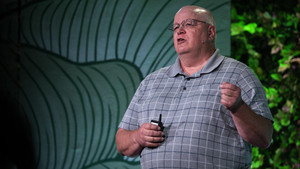
Over his decades of farming and ranching, Gabe Brown observed a troubling trend.
The conventional farming techniques he used were degrading the soil.
It's true of most farming today.
Since then, Brown has found a different path, one that is regenerative for the Earth and for humans who these farms feed.
His story of transformation is coming up after the break.
And now, our TED Talk of the day.
Let me take you on a journey.
A journey of regenerating dirt into soil.
My career began in 1983 when I moved on to my in -laws farming operation.
I was influenced by college, by land -grant universities, by the current farm program, by years of tradition, and by the large agrochemical industrial mindset.
In 1993, immediately after my wife and I purchased the ranch, I started down a path of no -till.
I bought my first no -till drill, sold all the tillage equipment.
I was committed. 1994 came along.
We had switched to 100 % no -till.
We had a pretty good crop.
And I thought, boy, this is easy.
Well, 1995 came along.
The day before I was going to start combining 1 ,200 acres of spring wheat, we lost our entire crop in a hailstorm.
That was pretty devastating for a young family starting out.
We weren't able to pay the bank back the operating loan.
1996 came along. I started to diversify the rotation a little bit.
Lo and behold, we lost 100 % of our crop to hail again.
Things were starting to get pretty strapped financially.
My wife and I took off farm jobs.
We had a young family to feed.
Obviously, we had a mortgage to pay.
I had to figure out, well, how am I going to do this without borrowing money from the bank?
They weren't willing to loan me any more operating money.
1997 came along, and it was a devastating drought throughout central North Dakota.
Nobody harvested a single acre.
By then, things were looking pretty lean.
1998, we lost 80 % of our crop to hail.
Those four years left us $1 .5 million in debt, unable to borrow any money to buy expensive inputs.
I was really starting to question my choice of careers.
My wife was starting to question her choice of husbands.
LAUGHTER But I started to notice some positives.
Realized that 1998 hailstorm occurred early enough in the year where I was able to plant a cover crop.
Then, not having the money to be able to put that cover crop up for forage, we simply grazed our livestock on that cover.
We were integrating them back onto the landscape.
What I began to see was life returning to our ranch.
We suddenly had earthworms in the field.
We suddenly had pollinators.
We suddenly had greater bird populations.
The soil, the ecosystem, was healing itself.
And it was then that I really began to realize that what I had been doing when I farmed conventionally was I was degrading the resource.
The thickness of one sheet of paper is the equivalent of one ton of topsoil per acre.
Wherever I travel now, I realize that we're all farming and ranching degraded resources.
I have the good fortune today among hundreds of farms, ranches all over the world.
I can tell you I have never, ever stood on a single one, including my own, that's not degraded.
30 % to 75 % of the carbon that was once in our soils is now in the atmosphere.
What does that lead to?
That leads to climate change.
Climate change is really about degradation.
It's about lower water quality.
It's about flooding because we're no longer able to infiltrate water into our soil profile.
It's about the loss of income.
We're losing our rural communities.
We're sucking the life out of them.
We're sucking the profitability out of them.
And it leads to the degradation in human health.
What we call food today has but a fraction of the nutrients in it that it once did.
I know this for a fact.
In March of 2022, I was diagnosed with amyotrophic lateral sclerosis.
I was given two to four years to live.
You see, one of the things we need to realize, ALS, the known cause of it, is exposure to toxic chemicals.
The same toxic chemicals that I was exposed to when I farmed conventionally now has become my death sentence years later.
But realize there is hope.
The hope lies in regenerative agriculture.
Many people ask, well, what is the definition of regenerative agriculture?
In my mind, regenerative agriculture is farming and ranching in synchrony with nature to repair, rebuild, revitalize, and restore ecosystem function, beginning with all life in the soil, moving to all life above the soil.
And the way we do this is simply by following six time -tested ecological principles.
Briefly, those six are number one context.
You have to farm and ranch in context with your environment.
The second principle, least amount of mechanical -chemical disturbance possible.
Realize that one of the reasons we have so much carbon in the atmosphere and not in our soils is because we've tilled those soils to death.
We've applied way too much caustic chemicals, herbicides, fertilizers, fungicides.
Third principle, armor on the soil.
You should never see bare soil.
Walk into a forest, walk into a native prairie.
Do you see bare soil?
No, bare soil is prone to wind erosion, water erosion, evaporation.
The soil temperatures rise when we have bare soil.
The fourth principle is that of diversity.
Where do you see a monoculture?
Only where mankind has put one.
Or where mankind's actions have caused it to appear.
Nature abhors a monoculture.
It thrives on diversity.
The fifth principle is that of a living root in the soil as long as possible throughout the year.
Take a look at the agricultural production model being used today.
A farmer plants a crop, they harvest that crop.
The soil sits idle without a living plant for the greater part of a year.
Nothing pulling carbon out of the atmosphere.
Nothing feeding soil biology.
We need to change that.
And the final principle is that of animal and insect integration.
Ecosystems do not function properly without animals and insects.
If we follow these six principles, we then can drive the four ecosystem processes.
And these ecosystem processes are constant all over the world.
It is sunlight, the energy cycle, a diversity of plants photosynthesizing.
Those plants then put root exudates, carbon compounds out into the soil to feed biology, along with mycorrhizal fungi.
They build soil aggregates.
That improves the mineral cycle and the water cycle.
It all starts here, beneath our feet.
We have to realize there are more microorganisms in a teaspoon full of healthy soil than there are people on this planet.
Think about that. Yet how many of us when we go to our garden, when we go out into our fields, understand that.
They don't understand that what drives life above ground is that life below ground.
And now back to the episode.
It's up to us as land managers, whether you own a garden, a small land holder, a large land holder, your management, or as I prefer to call it, your stewardship makes all the difference.
So what did I do on our ranch to drive life?
For one thing, we no longer plant monocultures.
We're grown several species together.
We're then able to separate those.
We get the benefit that diversity adds, collecting more solar energy, putting more carbon into the soil.
We have documented over 144 different plant species in those native prairies.
That's the diversity that natural ecosystems have.
And then we've integrated a lot of animals.
Animals simply add another dimension to the building of soil health.
We now have deep, rich topsoils, and we do this with a variety of animals, plants.
Life is returning to the operation.
We now have over 10 times as much wildlife on our ranch as compared to when we operated conventionally.
We now have insect species returning.
Renowned entomologists and agroecologists, Dr.
Jonathan Lundgren, taught us that for every insect species that's a pest, there's 1 ,700 species that are beneficial or indifferent.
Why in agriculture do we spend all our time and energy killing that pest?
Why not provide the home and habitat for those beneficials?
Besides that, we've seen bird species return.
A bird survey done last year on our ranch showed 105 different nesting species of birds.
During that time throughout the whole year, we have over 150 species of birds that use the ranch.
What has this done to the soil?
In 1993, when we bought the ranch, we could only infiltrate a half of an inch of rainfall per hour.
Scientists today have measured we can now infiltrate over 32 inches of rainfall per hour.
Bismarck, North Dakota has never received 30 inches in a year, let alone 30 inches in an hour.
What have it done to the carbon levels, organic matter?
When we started, we had 1 .7 % organic matter in our soils.
Today, we're bumping close to 8%, over four times as much carbon.
This equates to an astounding 396 tons of CO2 equivalent per acre.
I tell people I used to wake up every morning trying to decide what I was gonna kill that day.
Was it gonna be a weed?
Was it gonna be a pest?
Was it gonna be a fungus?
I was gonna kill something.
Now today I wake up every morning, how do I get more life on our ranch?
One of the things we have to realize is what built those deep top soils?
We now have topsoil, a well aggregated soil, deeper than four feet, where I started with three inches.
What built them was the integration of animals.
Animals are awfully vilified.
Oh, we need to get rid of the animals.
Let me ask you this question.
In the world over, where are the richest top soils?
The richest top soils are found where large herds of grazing ruminants moved across those landscapes.
Look at central plains of the US.
Look at the Serengeti.
What do they have in common?
Grazing animals. You see, you may not want to eat that animal, that's your choice.
But you can't deny the facts.
The animals help develop those deep topsoils.
Groundbreaking studies done by Dr.
Stefan Van Vliet, Dr.
Fred Provenza, and Dr.
Scott Cronberg are shown that foods grown in and on healthy soils up to 64 % higher in vitamins, 239 % higher in essential fatty acids, 67 % lower in oxidative stress markers.
In his book, What Your Food Ate, Dr.
David Montgomery writes about a study he did taking our grass -finished beef and comparing it to wild salmon.
What he found is our grass -finished beef is higher in omega -3s, higher in fatty acids than is wild salmon.
If you truly care about your health and about saving the environment, putting carbon back in the soil, perhaps you should choose the grass -finished beef.
The beautiful thing about this is we can do it all over.
We can address climate change.
We can use less fertilizer, less pesticides, less fungicides.
We can revitalize our rural communities.
We can have a positive impact on nutrient density.
We're doing this world over, anybody can do it, because the time -tested ecological principles and processes are the same.
So it's going to take each and every one of us.
It's going to take us as consumers to know where our food is grown and raised.
We need to source regeneratively grown and raised food.
We need to support school programs to put those foods in our schools.
We need to support nonprofits who are educating people as to these regenerative practices.
You can also grow a regenerative garden.
For you see, if we all do this, we truly can realize the hope that is in healthy soil.
Thank you. APPLAUSE That was Gabe Brown speaking at Ted's Countdown Dilemma series on the future of food in 2024.
If you're curious about Ted's curation, find out more at Ted .com slash curationguidelines.
And that's it for today.
Ted Talks Daily is part of the Ted Audio Collective.
This episode was produced and edited by our team, Martha Estefanos, Oliver Friedman, Brian Green, Autumn Thompson, and Alejandra Salazar.
It was mixed by Christopher Faizi -Bogan.
Additional support from Emma Toppner and Daniella Balareso.
I'm Elise Hugh. I'll be back tomorrow with a fresh idea for your feed.
Thanks for listening.