NPR. A little over a year ago, something mysterious happened in the skies over Russia.
Caught on camera, unverified footage of the plane tumbling from the sky with a missing wing then bursting into flames north of Moscow.
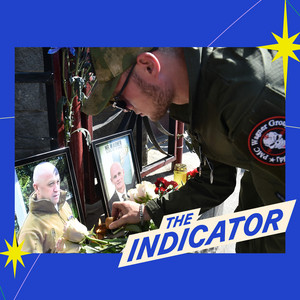
And believed to be on board that plane, a man named Yevgeny Progogen, the head of a company, a private military contractor hired by Russian President Vladimir Putin.
Ten bodies have been recovered.
President Putin didn't confirm Progogen's death, but spoke of him in the past tense.
I knew Progogen for a very long time.
He was a man with a complicated fate and he made serious mistakes in life.
This ominous sequence of events may have been the end of Progogen, but it wasn't the end for the private army he built, the Wagner Group.
This is the Indicator for Planet Money.
I'm Adrian Ma. Today on the show I talked to Sean McFate, who studies mercenary groups, and he explains how the Wagner Group was rebranded, why he's called it the world's most dangerous private army, and how Wagner's business model creates a blueprint for others to follow.
This message comes from WISE, the app for doing things in other currencies.
Send, spend or receive money internationally and always get the real time mid -market exchange rate with no hidden fees.
Download the WISE app today or visit WISE .com.
Tease and seize apply.
This message comes from Indiana University.
Indiana University drives discovery, innovation and creative endeavors to solve some of society's greatest challenges.
Groundbreaking investments in neuroscience, climate change, Alzheimer's research and cybersecurity mean IU sets new standards to move the world forward, unlocking cures and solutions that lead to a better future for all.
More at IU .edu slash forward.
Support for this podcast and the following message come from Dignity Memorial.
When your celebration of life is prepaid today, your family is protected tomorrow.
Planning ahead is truly one of the best gifts you can give your family.
For additional information, visit dignity memorial .com.
Sean McFate knows a thing or two about armies.
The government funded kind and the private mercenary kind.
Back in the nineties, he served as a paratrooper in the U .S.
Army and later he worked as a unit commander for a private military contractor, DynCorp today.
He's a professor at National Defense University in Washington, D .C., where he teaches classes on the strategy of war and to explain why he's called the Wagner Group, the world's most dangerous private military.
We asked him to start with a bit of background on how the company came to be.
Sean says it was started around 2014 by a man named Yevgeny Pragozhin.
He was an opportunist who was a businessman who owned oil companies.
He owned factories and cyber things and the Wagner Group.
He would see a regime in a place like Africa or the Middle East that was in distress.
He would go to them and make them a deal.
He would say, look, I can help you with my Internet guys to like politically assassinate your political opponents.
I'll use my Wagner Group to create a regime and defend you.
And in exchange, I want natural resources like oil, gold, diamonds.
And you have to kiss Putin's ring and essentially become a client state for Russia and, you know, shirk the U .S.
and Europe. And he did this throughout Africa and through Syria.
And, you know, it worked because everybody got a payout from him.
Over the next several years, Yevgeny Pragozhin continued to build the Wagner Group's power in Africa and the Middle East.
But then came 2022 when Russia invaded Ukraine.
Vladimir Putin wanted more boots and guns on the ground there.
So he hired the Wagner Group to supply those troops.
But Sean says those troops sent to Ukraine were not like the ones operating in Africa.
The Wagner Group was not one group, but two.
There was an old guard and a new guard.
Now, the old guard was recruited like in 2014 until recently.
And they were top troops.
They were recruited from former Soviet Republics.
They were paratroopers and special forces.
Now, the new guard are all those Russian prisoners that Russia dumped out into the battlefield to fight in Ukraine as cannon fodder in the summer of 2022.
And they are not troops, they are just criminals with AK -47s.
The old guard remained mostly in Africa, which is where Pragozhin had most of his business interests, while the new guard was sent into Ukraine to simply be killed.
Yeah, these relatively unskilled new guard troops faced heavy losses fighting in Ukraine, although Yevgeny Pragozhin blamed the Russian government for failing to equip them properly.
Then, in a move that might have sealed Pragozhin's fate, he ordered his troops to march on Moscow.
Putin had a mutiny on his hands.
I mean, this has always been the case in private warfare when a mercenary group and their master have a contract dispute.
There's no court of law that they can go into.
So typically, the mercenary marches on their master to renegotiate.
And when Pragozhin was marching up the road to Moscow, he was probably talking to Putin or Putin's representatives renegotiating.
And the last minute they pulled into Belarus, a neighboring country.
Pragozhin called off his troops.
And for a moment, it seemed like they had successfully renegotiated the contract they had with the Russian government.
And then Putin renegotiated the contract when he blew up Pragozhin's plane with all his lieutenants on board.
Basically, Putin took over the Wagner group for himself.
You say flat out that Putin blew up Pragozhin's plane.
And so it sounds like you're not saying that this was a mysterious plane accident.
Yes, we're confident that Putin blew up the plane.
Some people think that the plane is empty and that Pragozhin's sitting someplace in the Caribbean on a yacht with a beard and a Mai Tai, but we just don't know.
He's out of the picture.
Basically, think of it as like a corporate takeover.
When one company buys another company, they fire the C -suite, the leadership, which was the exploding plane.
They changed some middle management and they read them, the employees, the new corporate values, which happened in January this past year when Russia says you are now working for the Ministry of Defense.
You're going to sign a contract of loyalty and we're rebranding you the Africa Corps.
And lastly, they just want to have the Wagner group keep on doing what it's doing in Africa.
So can you say more about what they're doing in Africa?
Like what countries are they operating in?
What are they doing there?
So Africa, they're doing a couple of things in Africa.
They're operating in this belt across like think of the Sahara and just south of that.
So like Mali and Sudan and Chad and Regina Faso.
And they're trying to create this swath of Russian influence territory and also that they extract natural resources like gold and diamonds, which they smuggle into Russia to fund the war in Ukraine.
And so the basic business model of the Wagner group continues in Africa under new management and it's going to produce 5000 more mercenaries that are skilled in Africa.
Because remember, they are in an industry vested in conflict and the most conflict prone continent in the world.
And if that scenario were not concerning enough, Sean says Wagner's business model has created a sort of blueprint for other mercenary groups to follow.
We're going to see probably more of that, especially as the world turns to rare earth minerals over, say, oil.
The only places left to tap in the world are under conflict zones like Afghanistan and Africa, and it's going to take pirate oil companies and mining companies to go in there protected by bands of mercenaries.
So there is a lot of opportunity for this model to develop in the decades to come.
Kind of a scary thing to think about.
Well, it is because I think, you know, what oil was the 20th century rare earths are becoming to the 21st because everything that sounds like tronics in it is powered by rare earths.
I can't help but wonder whether what Wagner is doing kind of at the behest of Vladimir Putin is something that the U .S.
should worry about.
The U .S. has missed some opportunities.
The mercenary army of Wagner and the Russian military had this ongoing friction between the two of them, which is, frankly, pretty typical history between private and public warriors.
And we should have exploited that if we were lucky to get the Russian and the Wagner groups to not trust or work with each other and to fight against each other even.
And that could have ended the war in Ukraine in 2023.
These mercenaries, they're not a direct threat to the United States, but they can become a problem in regions around the world that we care about.
This episode was produced by Cooper Katz McKim with engineering by Kwesi Lee.
It was fact checked by Sierra Juarez.
Kakin Cannon edits the show and the indicators production of NPR.
This message comes from Indiana University.
Indiana University is committed to moving the world forward, working to tackle some of society's biggest challenges.
IU makes bold investments in the future of bioscience and cybersecurity, cultivates visionary work in the arts and humanities, and prepares students to become global citizens by teaching more languages than any other university in the country.
Indiana University.
Nine campuses, one purpose.
Creating tomorrow, today.
More at IU .edu. This message comes from WISE, the app for doing things in other currencies.
Send, spend, or receive money internationally and always get the real time mid -market exchange rate with no hidden fees.
Download the WISE app today or visit wise .com.
Tease and seize apply.
Support for NPR comes from NPR member stations and Eric and Wendy Schmidt through the Schmidt Family Foundation, working together to create a just world where all people have access to renewable energy, clean air and water and healthy food.
The Schmidt Family Foundation is part of the philanthropic organizations and initiatives created and funded by Eric and Wendy Schmidt to work toward a healthy, resilient, secure world for all on the web at the Schmidt .org.