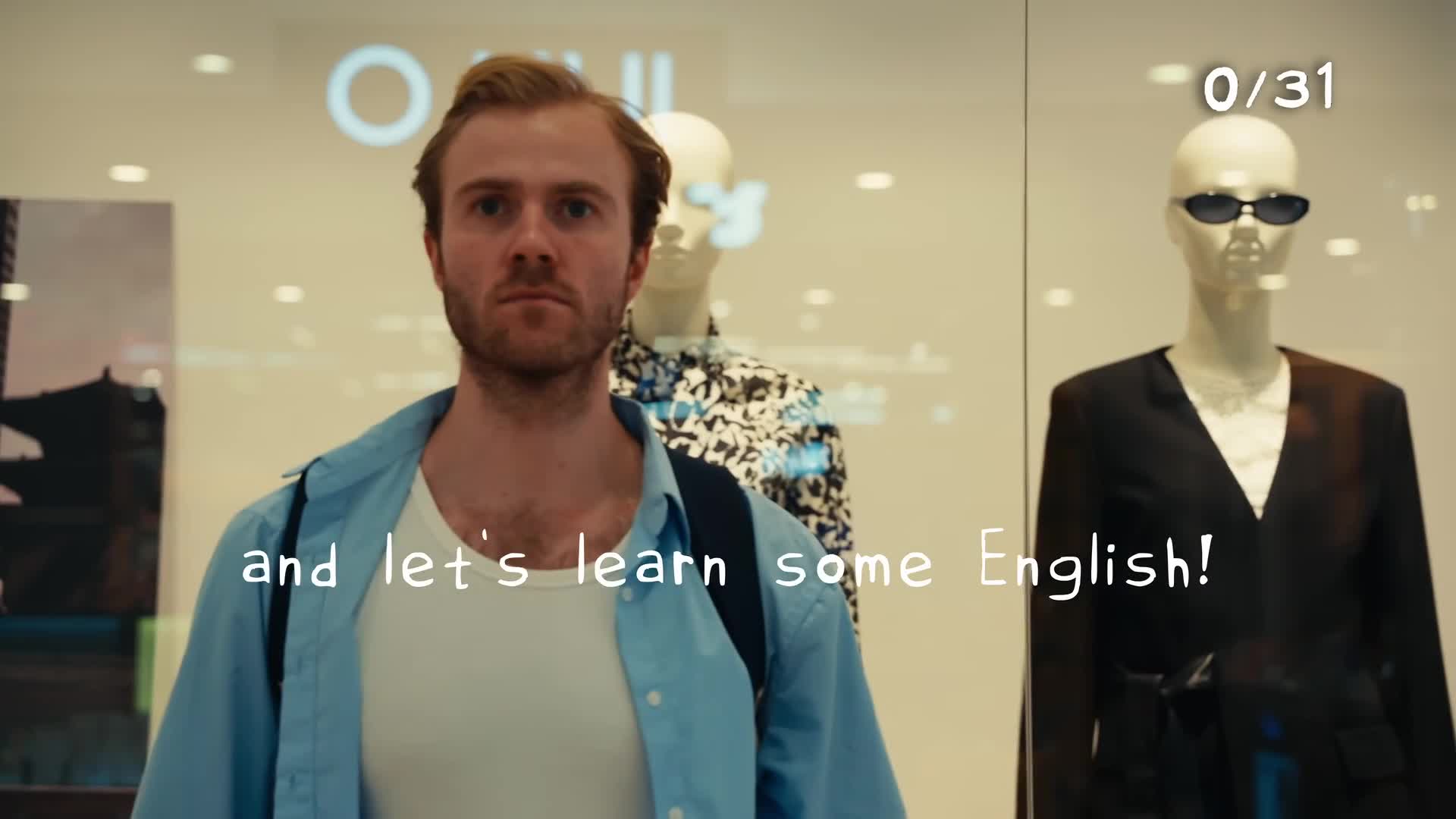
The first word is escalator.
I'm going up the escalator.
We're in the mall and obviously there's a car inside here, because you know it's good to drive around the mall.
This is a big yellow car.
This is the bonnet, the front part of the car, which you can lift up.
These are the wing mirrors.
The wing mirrors are the side mirrors, which you check.
Okay.
This is the door handle.
In the UK, we call this the boot.
The boot, the back of the car.
This is the side door.
And the wing mirror.
This is a red car.
One wheel, two wheels.
This is the license plate.
These are flip-flops.
Funny word.
Flip flops.
They're shiny.
They're glittery.
Glittery?
Flip flop.
These are old trainers.
And they are displayed in the shop window.
They are displayed on shelves.
Wooden shelves.
Hello. with a baby in a pushchair or a buggy.
The floor is checkered or checked.
So in the mall there are lots of designer shops, designer brands.
Designer brands are usually a bit more expensive.
In the UK we have something called a high street.
The high street is the main street in a town with all the general shops on like This is the shop entrance or the shop front.
Let's go inside.
These are mannequins.
I'm here in H&M looking for a shirt.
Not this one.
Tonight I've got a friend's birthday dinner, so I want a new piece of clothing.
Ooh, this is lovely.
I think it's perfect for me.
I wonder what Chang thinks.
Chang, what do you think of this?
Ooh, it's nice.
Oh no!
This is a pink hoodie.
Show the hoodie.
This is the zip.
I'm unzipping the hoodie.
Here are the accessories.
These are rings.
They go on your finger.
A necklace that goes around your neck.
Down here, we have a pair of sunglasses.
These go on your face and protect your eyes from the sun.
These are caps.
They go on your head.
This is a beanie.
We call this a beanie hat.
I know, I probably don't look very good.
I don't suit hats.
Anyway, this is for the purpose of English.
This is a bucket hat.
What do you reckon?
It's called a bucket hat because it's, excuse my messy hair, it's shaped like a bucket.
There you go.
And again, here is the beanie for winter or autumn.
Ooh, pink.
No.
Blue.
Hello.
We are in the changing rooms.
This is a mirror.
This is a rail where you hang up your clothes.
Over here we have the hooks, the hooks.
I'm hanging up the clothes on the hook.
This is a number four and it means I have four items of clothing, four pieces of clothing.
On my back you can see a rucksack or a backpack.
Now let's get changed into these clothes.
You cover your eyes.
First piece a cream polo shirt.
Eight out of ten might get it.
Got four more items of clothing to try on, so see you in a bit.
Next item of clothing We've got some very large buttons on this one.
Massive buttons.
Not keen on this one.
I'm not keen.
I don't like it too much.
I'm not a big fan.
Next one.
Ready?
I feel like I could be on a yacht somewhere with this on.
I like the whites.
I'm wearing a white linen shirt.
The material is linen.
It's relaxed.
Doesn't suit these trousers.
I think I need to wear some darker trousers.
But overall, I'm gonna say 7.5 out of 10.
Next one.
New shirt, polo shirt.
Quite tight my arms, and here it's a bit short.
See my hairy belly, don't like it?
Nah, see you in a bit.
Got my clothes, two shirts now, let's go buy them.
Come on, shank.
This is normally where people queue.
Oops, i'm walking into it, but uh, there's no queue right now.
Hello, hello.
Do you have membership in vietnam?
Uh yes, i do, i believe.
Yeah, you have membership.
Yeah, are you living here?
Yes, i'm living here.
Can i know your phone number?
Yes oh one two, one.
Do one.
Yes, please.
That's fine.
Thank you.
This is the checkout counter.
Yeah, that's fine.
Perfect.
Thank you.
Just inserting the card.
Yeah, no worries.
I'm entering my pin number.
Thank you.
Can I take it?
Thank you.
Okay, thank you.
My receipt, my brown paper bag.
Let's go.
Next time for all you ladies out there, I'll teach some women's clothes next time.
Sequins, nice.
Chang's attracted to shiny things.
All right.
Got my Goods 2 shirts in my brown paper bag.
Now let's continue shopping.
Capybara.
Teddy bears.
These are soft toys.
Soft toys.
Wacky glasses.
Uh wait, put it down, put it up.
Yeah, prefer that.
This is a bucket and spade.
A shop is full of shelves.
On these shelves we have glasses and vases or, if you're american, a vase.
A vase, or a vase is what you put flowers inside.
Oh, what's that?
This is a gift box.
She's opening the box, my gift to you.
What's inside?
Oh, so sweet.
A shoelace.
It's just what i've always wanted.
I think i'm gonna cry.
A photo frame.
You can hang this on your wall and then put the picture inside the frame.
This is a photo frame or just a frame.
Down here.
Ayup.
Hello.
I just said ayup.
Ayup is a slang term for hello.
In Yorkshire, we say ayup.
It's very colourful in this store.
Oh, so nice.
Okay, Chang just brushed my hair.
She brushed it.
My Barbie hair.
This is not a brush.
This is a comb.
A comb.
Yeah.
A comb has teeth.
These are teeth.
Individual teeth.
You can hear them?
Teeth.
This is a comb.
This is a brush.
And these, you'd call them bristles, are metal.
These are the teeth of a comb, just like the teeth in our mouths, teeth.
Visual on the word comb, it's spelt comb, but we pronounce it comb, comb.
This is not a hairbrush, but it works.
Speaking of brushes, this is a useful word.
This is a dustpan and brush. causing a riot in here.
Dustpan and brush.
I'm using the dustpan and brush to sweep up the crumbs.
A broom has thick bristles.
Thanks for all these good questions, Chang.
Yeah, this is a sweeping brush.
A broom tends to have thicker bristles.
These are the bristles.
They're wobbling.
This is a mop and you can use it as a verb.
You can use it to mop the floor.
I'm mopping the floor.
I'm pretending to mop the floor.
We've got some dog balls, some tennis balls, pet toy tennis, some backpacks or rucksacks as we say commonly.
What have you found here Chang?
A bath sponge.
What do you use it for?
You use that for washing yourself in the shower or the bath and it makes a lot of foam with the soap.
It's called a bath sponge.
To infinity and beyond!
Thanks shopping for jewellery.
Jewellery.
What about these?
These ones.
Yeah, I quite like them.
Yeah, they're nice actually.
Again guys, this is jewellery.
We say jewellery.
Jewellery.
These are tweezers.
Tweezers.
And you pluck your eyebrows with the tweezers.
You got these hair bubbles, a bubble, that's a fun word.
This one is, this hair bubble is furry, furry.
This one is made of silk.
This one is made of lace.
All right, in the basket.
These are cushions.
A cushion, a red cushion, and it has tassels on.
This is a tassel on the corner of the cushion.
That's gonna go down there.
Next to the cushions, we have bath mats or shower mats.
Here's a floor mat of a panda.
Nice.
Chang's turning left.
I'm turning left.
Turning left again.
Oh, she's seen something.
No surprise there.
What's she got?
A book.
Nice.
Now you're talking my language.
She's got a notebook.
That's quite nice actually.
Can I see the front cover?
Okay, notebook in the basket.
Yes.
This is a travel pillow, or a neck pillow that goes around your neck when you travel on a plane, supposedly making you more comfortable.
Here we have some pans, frying pans.
These are stainless steel.
This is a non-stick pan.
This is an oven glove.
Hello.
Chang is wearing an oven glove.
It looks like a shark.
The shop assistant is bagging up the items, putting them in the plastic bag.
Trying to synchronise my feet with yours.
Let's go up the elevator.
Escalator, not the elevator.
The elevator is the one that goes up like that.
Can I grab the camera and get some funny shot?
Right, come up now.
Hello.
We chose the Thai restaurant and it was obviously my choice.
Could I have one pad thai?
Pad thai with scallops.
Scallops, please.
Could I have one tom yum soup?
Spicy okra.
Spicy okra?
No spicy.
Less spicy.
And two coconuts, please.
Yes.
Also, could I have... Where's the okra?
One green okra.
This one.
Okra, please.
That's all.
Yeah, of course.
Perfect.
Thank you.
How to order politely in English.
Come on.
Hey, you got it.
So sweet.
Can't believe nature made this.
All you Thai people, watch him.
Whatever that is.
Chopsticks.
I just got my pad thai, which is noodles with tofu, eggs, carrots, bean sprouts.
I got some scallops on the side, some spring onions.
Looks delicious.
I'm gonna eat it.
Can you close up?
Yeah.
Chang is ladling the tom yum soup into the bowl.
The big spoon is a ladle, the small one is just a spoon.
Good.
This is okra, or okra.
Don't know the correct pronunciation.
Even British people make mistakes.
Mistakes are fine.
Help me learn.
Thank you.
Thank you.
Now I need a wee.
Where is the toilet?
Oh, that reminds me.
If you want to ask for the toilet, you can say, where's the toilet or where are the toilets?
Chang, do you want to ask me?
Where's that toilet?
It's over there.
Just go straight and then turn left.
Go straight, then turn left.
Slang for toilet in British is the loo.
I'm off to the loo.
That means I'm going to the toilet.
See you in a bit.
All right, let's get our tickets.
Thank you.
Thanks so much.
Okay, the ticket is coming out of the machine.
Got the tickets for the cinema.
We're gonna watch it in... 20 minutes.
It's a Studio Ghibli.
Miyazaki Ayo.
This is the director of this film and the film is called The Wind Rises.
This is the wind rising.
There are two people standing with a white umbrella.
The woman is painting on a canvas and this is an easel.
This whole thing is called a poster, a film poster.
This is a pumpkin.
Scary.
The pumpkin is wearing a witch's hat.
The ticket box.
Up here is a large TV screen on a brick wall.
To my left, we have a billboard which is like a large advert for something.
In this case, it's a film.
Down here, we have the film poster.
This is advertising the film.
Over here, to my left, there are some massage chairs and Arcade machines.
These are the claw machines.
This is a claw.
The claw drops down and picks up a soft toy.
Very good.
Mmm!
Popcorn.
Alright, we're gonna order some popcorn, some drinks.
I need to have a look at the menu.
They're the popcorn machines.
Do you want a water?
You want a Milo?
Okay, I'll get a Milo too.
Two Milos.
Hello.
Hi.
Can I have two Milos?
Milo?
Yes, Milo.
Yeah, two Milos, please.
One water.
Yes.
And one caramel popcorn, please.
Thank you.
If you're ever in England, we love to say can I have or could I have whatever you want, and the magic word please?
You tap your card to pay.
Thank you, man.
Let's say not cold yes, thank you.
Oh, look at that.
I didn't know they were going to be this big two milos, which is like a chocolate milk, thank you.
So good.
I've heard milo at the cgv is very good, so i'm yet to try.
Give you a taste test soon.
Well, come on, thank you, get these.
Get my bucket of popcorn.
We've got caramel popcorn and cheese popcorn, which in the uk is a sin cheese popcorn.
Yes, we have salted popcorn or sweet popcorn or a mix.
I've never actually tried a cheese popcorn, to be fair, so this is my first time trying it.
Honest to God.
I need to get a straw.
BRB, which means be right back.
Guess who's back, back, back, once again.
Jay is back, back, back, tell your friends.
Popping the straw in.
Here's for you, Chang, and Milo.
All right, taste test.
Give it a shake.
It's good.
It's very refreshing.
Slightly sweet, slightly watery, but good.
Seven out of 10.
Caramel popcorn, I know I like this.
Yeah, it's good.
It's standard flavour.
Cheese popcorn.
Not sure about this one.
A bit weird.
Give it a sniff.
It's alright.
Not bad.
It's stale.
5 out of 10.
Caramel gets an 8 out of 10.
My favorite flavor of popcorn is salty and sweet mixed together.
This is us in the sweet box.
This is cool.
Never been here before.
Sweet box.
Right, we're in the cinema.
We're eating our popcorn.
The film's about to start.
I should turn my camera off.
Thank you for watching.
Make sure to go check out the Sprout YouTube channel.
Loads more videos on there.
A lot more fun.
One question before you finish.
What is your favourite movie?
That is the final word of the day.
It's a question for you.
What's your favourite film ever?
Put it in the comments.
I'd love to watch it.
I'm a big film nerd myself, so let me know.
Have a lovely day.
Much love.
Bye-bye.