How does it work?
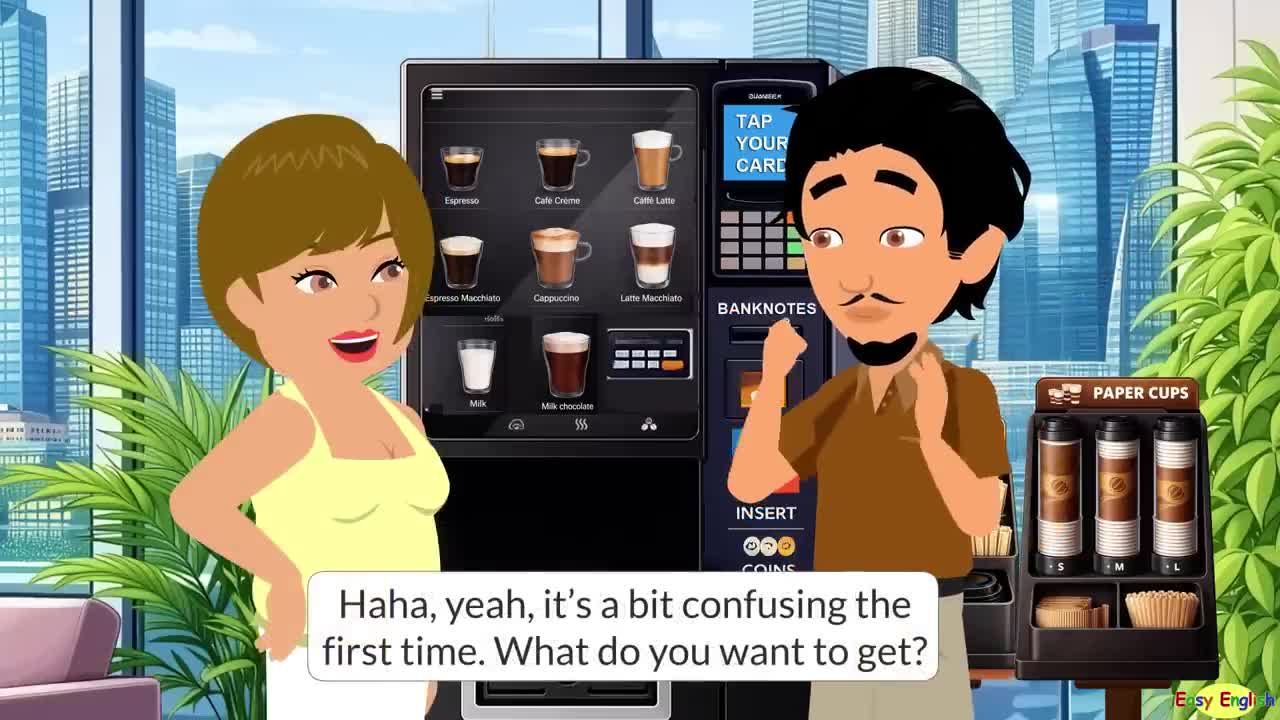
Hey, do you know how to use this coffee machine?
I've been staring at it for like five minutes.
Yeah, it's a bit confusing the first time.
What do you want to get?
Just a simple espresso.
Nothing fancy.
Easy.
Okay, first, look at the screen here.
See the espresso option in the top left?
Oh, I see it now.
Do I just tap it?
Yep, just tap it once.
Okay.
Now the machine asks you to customize your drink.
You can choose the size, adjust the strength of the coffee, or add extra milk.
Oh, that's nice.
I'll go with a medium size, normal strength, and no milk.
Perfect.
Once you're happy with the settings, just hit Confirm.
Done.
Now you need to pay.
Either tap your card or insert cash.
I'll use my card.
Okay.
Tap your card on the reader.
Done.
Now place your cup under the dispenser.
If you don't have one, you can grab a paper cup from the side.
Should I press anything else?
Just press start and the machine will do the rest.
Got it.
That wasn't so bad, actually.
Oh, it's already making the coffee.
Yep, it usually takes about 30 to 60 seconds.
That's really quick.
And where do I add sugar?
There's a station right over here with sugar, lids, and stirrers.
Ah, got it.
So I add it myself after.
Thanks so much for your help.
Anytime.
Enjoy your coffee.
Cheap meals I can cook at home.
I'm trying to save money lately.
Do you know any quick and cheap meals I can cook at home?
Yeah, definitely.
One of the easiest things is pasta.
It's cheap and you can add almost anything, like tomato sauce, veggies, or even some cheese.
That sounds good.
I'm not a great cook, though.
No worries.
Pasta is super simple.
You just boil it and heat up the sauce.
Done in like 15 minutes.
Nice.
What else?
Eggs are your best friend.
Scrambled eggs, omelets, even egg sandwiches.
They're fast and affordable.
True, I do like eggs.
What about something more filling?
Try rice with vegetables or chicken.
You can cook a big batch and eat it for a couple of days.
Oh, meal prep.
That's smart.
Exactly.
Also, sandwiches and wraps are great when you're in a hurry.
This actually sounds manageable.
Maybe I don't need takeout all the time.
Definitely not.
Cooking at home saves money and can be healthier too.
All right, you convinced me.
I'm starting with pasta tonight.
Basic ingredients you should always have.
I'm trying to cook more at home, but I never know what ingredients I should always have.
Any ideas?
Yeah, start with the basics.
Things like rice and pasta and bread are always useful.
Okay, that makes sense.
What about for flavor?
Definitely keep salt, pepper, and some cooking oil.
Those are essential.
Maybe garlic and onions, too.
They make everything taste better.
Oh yeah, I use onions a lot.
What about protein?
Eggs are a must.
They're cheap and super versatile.
You can also keep canned beans or tuna.
They last a long time.
That's a good idea.
I hate when food goes bad quickly.
Exactly.
Also, having a few sauces helps.
Like soy sauce, tomato sauce, or even hot sauce if you like spicy food.
I didn't think about sauces, but yeah, they can change everything.
For sure.
And don't forget some frozen vegetables.
They're easy to store and quick to cook.
This actually sounds simple.
I just need to keep a small, smart stock of food.
Yep, once you have the basics, cooking becomes way easier.
Storing food properly to avoid waste.
You know, I feel like I waste a lot of food.
Do you know how to store it properly?
Yeah, that used to happen to me too.
First, you should always keep your fridge organised.
Put older food in the front so you remember to use it.
Oh, that's smart.
I usually forget what I have.
Exactly.
Also, use airtight containers.
They keep food fresh longer and prevent smells from spreading.
What about fruits and vegetables?
Mine go bad really fast.
Some of them should go in the fridge, like berries and leafy greens.
But others, like potatoes, onions and bananas, are better at room temperature.
I didn't know that.
I keep everything in the fridge.
Yeah, that can actually make some food spoil faster.
Also, try not to wash fruits and veggies until you're ready to eat them.
Really?
Why?
Because moisture can make them rot.
Oh, and freezing is a great option if you can't eat something in time.
It is.
It saves money and reduces waste.
You just need to plan a little.
Getting around the city.
Hey, I'm trying to cut down on expenses.
What's the cheapest way to get around the city?
I'd say public transportation for sure.
Buses, trams, or the subway are usually the most budget-friendly options.
Yeah, I was thinking about that.
Is it better to buy tickets every time or get some kind of pass?
Definitely get a weekly or monthly pass.
It saves you a lot of money if you travel regularly.
That makes sense.
I also thought about getting a bike.
Biking is cheap, and you don't have to worry about traffic or waiting for buses.
True, but what about longer distances?
You can mix options.
For example,
Take public transport for longer trips and bike or walk for shorter ones.
I like that.
Walking is free after all.
Exactly.
Plus, it's good for your health.
You'd be surprised how many places are within walking distance.
What about car sharing or ride apps?
They're useful, but not cheap.
I'd only use them in emergencies or late at night.
Got it.
So basically, public transport, biking, and walking.
Yup, that's the winning combo if you want to save money.
Sounds good.
I'll start with a monthly pass and maybe rent a bike.
Perfect.
You'll save money and probably enjoy the city more too.
I've been trying to save money, but it never really works.
Do you have any tips?
Yeah, I used to have the same problem.
First thing, track your spending.
You need to know where your money goes.
I guess I don't really pay attention to that.
Exactly.
Once you see it, you'll notice small things that add up, like coffee or takeout.
Yeah, I do spend a lot on food.
Try setting a monthly budget.
Decide how much money you want to save and think of it like a bill you must pay.
Exactly.
Move that money into savings as soon as you get paid.
That actually sounds smart.
What else?
Cut unnecessary subscriptions.
Do you really use all of them?
Probably not.
I forgot about some of them, honestly.
See?
That's easy money saved.
Also, try cooking more at home instead of ordering food.
Yeah, I know.
I'm just lazy sometimes.
Same here, but it makes a big difference.
And you can also look for discounts or buy things on sale.
That's true.
I usually just buy things without thinking.
One more tip.
Set a goal.
Saving is easier when you know what you're saving for.
Good point.
I'll try that.
You'll see small changes every month can really add up.
Is it better to rent or share an apartment?
Do you think it's better to rent your own place or share an apartment?
Honestly, it depends on your budget.
Sharing is definitely cheaper.
You split the rent, utilities, everything.
Yeah, that's true.
But I really like having my own space.
No noise, no arguments about cleaning.
I get that.
Privacy is a big plus.
But living alone can get expensive, especially in big cities.
That's what worries me.
Rent prices are crazy these days.
Sharing sounds like a smarter choice.
It is, but it also depends on your roommates.
If you get along, it's great.
If not, it can be stressful.
Have you ever had bad roommates?
Oh, yeah.
One never cleaned.
And the other was always loud at night.
It wasn't fun.
That sounds terrible.
Still, I guess sharing helps you save money and maybe even make friends.
Exactly.
And you can always move out later when you can afford your own place.
Good point.
Maybe I'll start by sharing and see how it goes.
That's a smart plan.
Try it first, then decide what works best for you.
Thanks for watching and be sure to subscribe to our YouTube channel for more videos like this.