Hello, welcome back to Learn English with Camille.
Today just felt like a great day to put on a hoodie.
This is a hoodie.
It has a hood, you can see, and read a story.
So go ahead and grab your coffee or your tea or matcha whatever it is that you're drinking today and get ready to enjoy a story.
This is from the first book I ever wrote called Short Story.
Travel Stories for English Learners.
Since then, I've gone on to write a ton of books.
I have beginner short storybook, intermediate short storybook and advanced short storybook and dialogue books so many things.
You can find them as PDFs on my website, learnenglishwithcamille.com or on Amazon.
I love learning languages with stories because you learn vocabulary in context and you have fun while doing it.
And the reason I wrote these short stories is it gives you a sense of accomplishment.
I know we're all busy.
We have a million things going on.
So you can take just five, ten minutes out of your day and go through a short story and feel accomplished and learn some English.
So I marked this with my paper bookmark.
We call that a bookmark.
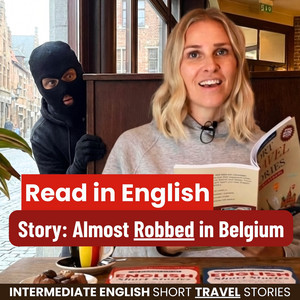
And I'm going to read this story, which is called Almost Robbed in Belgium.
So I'm going to go ahead, I think, and read the whole story through.
It's a page.
So it's a whole page.
And then after I'll go through and explain things.
And then at the end, we will go over some comprehension questions.
Feel free to pause this video at any time if it feels too overwhelming.
Feel free to watch it more than once.
Are you ready?
Okay.
We Calvin, three friends and I were tired when we arrived by bus to Brussels Belgium, and night was quickly approaching.
We didn't have a place to stay, so we were searching for a hostel.
None of us had a smartphone, so we had to rely on a good old fashioned map and the people on the street.
A guy told us a name for a great hostel and even circled it on our map.
The problem was we couldn't find it.
We ended up chatting with a guy named Daniel on the way and he told us we could go to his apartment to use his internet.
The two guys went up, while us three girls waited in the mail room which was next to the apartment entrance.
But you needed a key to get into the apartment area.
We saw two guys peering through the windows but assumed they lived there when they entered and began to check their mailbox.
Things quickly got strange.
It turns out they didn't live there.
We had all of our hiking backpacks in a pile on the floor and one of the guys pretended to faint on top of our backpacks and was gasping the word water.
But it was a setup to distract us so the other guy could steal some of our stuff.
We panicked, of course, as it was now dark and we were just three girls alone there.
But then we saw two more guys peering in the window and we yelled, help, they're trying to rob us.
The quickly fled the scene.
Wow, we thought they were with you girls, a part of your group.
Our rescuers said no, no.
We said thank you for rescuing us.
They used the key to get us into the apartment area.
I'm still so thankful for them.
What a strange experience.
So this story is real.
This actually happened.
All of these stories are real.
I've traveled a lot and I'm 40 years old.
So I traveled a lot with no smartphone.
And so this was in the days where we had no smartphone and travel was a little more difficult.
We couldn't just pull up our phone, use a map, Search the internet for a hostel.
None of that stuff.
Call somebody.
So these days it was a little more, I guess, adventurous to travel, like more unknown, unfamiliar.
So I hope you enjoyed this story.
Let me go ahead and go back through it.
Just kind of hitting on some words that might be new to you or explaining some things.
Okay.
Okay.
So night was quickly approaching.
So approaching night was quickly coming.
Approaching is just a more advanced word.
Or if you approach somebody, you get closer to them.
You can approach someone on the street.
Okay?
So we were searching for a hostel.
A hostel is a cheaper area with shared rooms.
You can find private rooms in a hostel, but normally there are a bunch of rooms with bunk beds.
Bunk beds are one bed on top of another.
And back then they were like $20 a night.
I think now hostels are a little more expensive.
But we were looking for a hostel.
Of course, you know, smartphones.
A good old-fashioned map.
So if something is old-fashioned, it's what we used to use back in the day.
So maybe some clothes that your grandmother wore, we could call them old-fashioned.
Or even an old style of teaching could be old-fashioned.
So we were looking for the map, like a paper map.
So that could be called old-fashioned.
Okay.
And we would talk to people on the street.
So a guy literally circled a hostel on the map that we could not find.
And we ended up talking again to this guy, Daniel, and he was so kind.
He was like, come up to my apartment.
You can use the internet because of course we didn't have access to internet.
And it was dark.
Night was, night was upon us.
It was approaching.
So at this apartment, there was like this little mail room.
A mail room is where it's like a little box and people can put your mail, maybe your electric bill.
Maybe you order a magazine and it comes monthly.
Again, this might be old fashioned, because a lot of things now are digital and some people might not even have a mailbox.
So we were waiting there.
And peering.
We saw two guys peering, which is just a fancier word to say looking.
So kind of peering.
You're just looking.
So they were looking.
And we thought they lived there because they came in and were like fiddling around with their keys, pretending to look in the mailbox.
And then...
We had our hiking backpacks in a pile.
So which just means kind of everything was there together, one on top of another.
Pretend.
So one of the guys pretended.
If you pretend, that means you're acting.
It's not actually happening.
So right now I will pretend to sneeze so you know.
Achoo!
I was pretending.
I didn't actually sneeze.
Okay?
So they were pretending to faint.
And to faint, it's just when you pass out or you fall over.
That's called fainting.
Usually people faint because they need some.
They have low blood sugar, or maybe it's a medical condition, or maybe they're lacking water.
So he pretended to faint.
Okay.
And so he was gasping the word water, which was, like he was saying it kind of in a way, where he was lacking air like water, water kind of like.
That describes gasping.
But it was a setup, which means it was planned to distract us.
So if we get distracted, we don't see what's actually happening.
So we often get distracted on our smartphones.
Maybe you're distracted now.
Maybe you're watching this video and a message came through that would distract you.
It would take your attention away from what you're supposed to be doing.
So they could steal, which means rob, which means take without permission some of our stuff.
So we panicked.
That means like we got afraid because it was dark and we were alone.
But then two more guys came and they actually lived there.
And we asked them for help and they helped us.
And so the two thieves, thieves are people that are robber would be a synonym.
Now, fled the scene.
So fled means if you fled somewhere, you left quickly.
So they fled the scene.
It's a way to say they left the place.
Like you could say they fled the scene of the crime.
You know, if somebody did something and then ran away, they left the place, which would be considered the scene.
You might hear that in crime.
Crime shows, law and order, things like that.
The scene of the crime, the place the crime happened.
And we said, thank you for rescuing us.
Thank you for saving us.
Thank you for helping us.
Nothing got stolen.
We were very lucky.
And then they used the key to get us in.
I have traveled a lot.
I have been robbed a few times.
An iPod was stolen in Barcelona.
I had more robbery attempts in Barcelona.
I was just in Majorca and I don't know when it happened, but somebody stole 30 euros out of my little wallet.
No idea when it happened.
So it seems like Spain is a place where people like to steal.
So be careful if you go to Spain that you don't get distracted.
But I think we always just need to be aware of our surroundings and what's going on.
And yeah, I learned from that experience.
So at the end of this there is a massive two-page word list.
Just to clarify if you're confused, like pretended, not genuine or real gasping, like straining to say the words steal, take something that's not yours.
So it kind of puts it in easy context so you can understand.
So after that, we have a quiz at the end of every story.
I believe this book has How many stories?
There's at least 28 stories.
There might be 30 stories in this book, but it is packed with stories.
And there's 420 vocabulary words as well that you'll learn.
So let's test your comprehension.
So number one, what kind of accommodation did we have in Brussels?
And again, accommodation means...
Your housing, where you're staying.
A, hotel.
B, hostel.
C, apartment.
D, Airbnb.
If you said hostel, yes, you are correct.
Number two, the girls were waiting where while the boys used the internet.
A, the apartment, B, on the street, C, in the mailroom, D, in the apartment entrance.
I'll give you just a second to think.
Do you have your answer?
If you said C, in the mailroom, that is correct.
Okay, let's just do one more, even though there's five.
What is the definition of pile?
A, a heap of things lying on top of one another.
B, a pill.
C, clothing.
D, fall over because of weakness.
I will let you write this one in the comments and I'll also let you know if you're correct or not.
Thank you guys so much for being here with me.
Thank you for reading from my short stories travel book.
Again, if you're interested in learning English with short, interesting stories, this book is filled with them.
You can get it on my website or Amazon.
Thank you so much for being here and I will see you again soon.
Don't forget to subscribe to the channel.
If you haven't already bye guys.