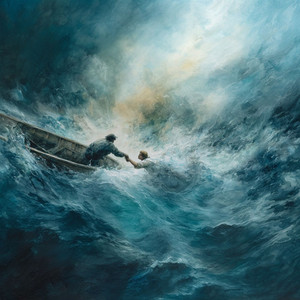
This is Hidden Brain. I'm Shankar Vedantam.
In April 2017, a woman hurried to step off a subway train in the Bronx just as the doors were closing.
New Yorkers pull off such near escapes every day, but this passenger was not so lucky.
The subway doors pinned her in place, half in, half out of the car.
What happened next was deeply unnerving.
It wasn't that the subway train started moving.
With one of its doors partially open, the train was not going to leave the station.
No, the shocking thing, visible in a cell phone video recorded at the scene, was the sight of people walking past the trapped woman.
The woman was walking off the train when the doors closed on her.
And no one walking by seems to notice or care.
Instead of helping, one witness recorded it.
Once the video went viral, horrified reactions poured in.
Like, how could somebody just pass by that?
People just caught in their own head. They want to do their own thing.
Like, you know, I don't have time. What does that say about New Yorkers?
I would be flailing and freaking out. In time, a subway employee got the doors open, released the woman, and allowed her to go on her way.
But for those who saw evidence of her lonely plight, a question lingered.
A person is suffering, clearly in need of help, and those who see her simply walk by.
Is this what we can expect from human nature, callous indifference and heartlessness?
Or is there more to the story? This week on Hidden Brain, the science of altruism, why some human beings perform acts of extraordinary selflessness, and how the rest of us can learn to be more like them.
No matter who we are, no matter how physically strong we may be, and no matter how many resources we have, all of us will need the help of others at some point.
In the hour of crisis, will someone extend a hand?
Abigail Marsh is a psychologist and neuroscientist at Georgetown University.
She has long been interested in why people help one another and also why they don't.
Abby Marsh, welcome to Hidden Brain. Thank you for having me.
Abby, 30 years ago, you were a college student.
You were driving on Interstate 5 to Tacoma after meeting a friend in Seattle.
It was around midnight. I understand this was an extremely busy freeway.
Yes, it's an incredibly busy freeway, very heavily trafficked.
I was coming into Tacoma on I-5 South from Seattle when the freeway rises up over an overpass.
And so there are no shoulders whatsoever.
And yet somehow a dog had made it onto the freeway that night and it ran across the freeway right in front of my car.
And I did what I now know you should never do, which is I swerved to try to avoid it.
And unfortunately, I hit it anyways. And the combination of hitting the dog and swerving sharply sent my car into a series of fishtails across several lanes of freeway.
It's a miracle I didn't hit anybody. And then it ended up, as I tried to wrestle back control of the car, spinning in these huge donuts around and around until finally it came to a rest in the fast lane of the freeway facing backward. into the oncoming traffic just past the crest of the overpass.
So your car is now sitting on the highway facing in the wrong direction in the fast lane?
In the fast lane. And the engine had died as a result of all of this spinning around.
And there's no shoulder because it's an overpass that didn't have an end.
So there was nowhere I could drive the car to or that I could jump out of the car and run to.
I was just stuck in this fast lane of the freeway with cars barely swerving in time to avoid me because they just... you know, just caught sight of me as they were coming across the crest of the overpass.
And so my car would shake every time these big cars and semis would swerve around it at the last minute.
And I knew, I just knew it was a matter of time until one of them was going to hit me.
Well, this is absolutely terrifying, Abby, and you had no way of moving the car.
You had no way of getting out of the car.
The car wouldn't start. You must have thought these were your last moments.
I did. I did. It was the most terrified I've ever been in my life.
And I remember trying over and over to turn the car back on, and I couldn't figure out why.
I couldn't get the engine to reengage. I remember turning on the brights.
I turned on the flashers just to try to alert people to my presence.
But I didn't have a phone because it was the 90s, and so there was absolutely nothing else I could do.
And I thought that eventually I was going to get hit, and I would either get very badly hurt or killed.
So while this is happening, cars are coming by you at great velocity and swerving and missing you at the very last second.
Something happens now on the other side of your car, on the passenger side.
Tell me what happens. Yeah, one of the great shocks of my life.
So it was a summer night and the windows were rolled down.
And I was very surprised in the middle of all this to hear a knock on the passenger side window, which because of which way I was facing was on the very narrow sort of tiny ridge on the edge of the fast lane.
And I turned to see a man standing outside the car wearing as best as I can recollect a suit.
And he had a shaved head and chains around his knackle jewelry and sunglasses, even though it was the middle of the night.
Abby had a lot to be worried about in that moment.
But the first thought that leaped to her mind was about the stranger's intentions.
He asked if she needed help. And I remember the silly thought flashing through my head of like, oh, no, oh, no, you know, this is a stranger.
I'm not supposed to let strangers into my mom's car.
And he said, you look like you could use some help, which was quite an understatement.
And of course, I said, yeah, I do. What did he say?
What did he advise you to do? So then he said, okay, do you mind if I get into the driver's seat?
So I said, okay, that's fine. And I scooched myself over the central console into the passenger seat while he waited for a break in the traffic, which took a minute because of course, all while we're talking to each other, the cars are still continuing to blow by.
So he waited for a break, ran around the car at top speed, opened the driver's door and hopped in the driver's seat.
So now he's put himself in great danger because now we're both gonna get killed if we get hit.
He figured out the car was still in drive, which is why I couldn't get it to turn back on, put it in park, turn it back on, waited again for a break and all the cars blowing by us.
And then he gunned it real fast and arced us across the freeway into the off ramp on the other side of the sort of stripy section by the off right where his car was parked.
And there we came to a stop. And we were more or less safe at that point.
And again, I remember the sound of his voice as he looked at me.
I'm gray, I'm sure, and sweaty and shaking.
I felt awful. And he said, you're going to be okay.
Do you need me to follow you home? And I said, no, no, I'm going to be okay.
I'll be okay. You know, I wasn't thinking quite straight in the moment.
And he said, okay, you take care of yourself.
And out of the car he got and went back to his own car and drove off into the night.
And that is the last I ever saw of him. Did you even get to thank him, Abby?
It is one of the things that eats at me to this day that I don't think I said thank you.
And I didn't get his name, so I'll never be able to thank him.
So I'm wondering, Abby, did you ever figure out how he came to be standing by the passenger side window of your car?
How did he get there? It's a great question.
I only figured it out later. And what I realized is that he must have been among all of those cars that came across the crest of the freeway and saw my stranded car there.
He was the one that decided in the fraction of a second he had to make a decision to pull over into the off-ramp area and then run across six lanes of freeway traffic in the middle of the night to get to my car.
So he pulls off the freeway, gets out of his car, runs across the freeway, middle of the night, comes to your side, gets you to move over to the passenger side, risks his life again getting into traffic to get into the driver's seat, finds a way to turn on the car, again waits for a break in the traffic, risks his own life to pull the car around to safety.
I mean, he risked his life three times that night for you.
He did. He did indeed. I'm wondering how this left you feeling in the days and weeks that followed, Abby.
Well, in the immediate aftermath, I was so shaken up that my mom could tell when I woke up the next morning something terrible had happened.
I was in a little bit of shock, I think.
Dog lover that I am, I was horrified that I had killed a dog.
That really ate at me for a long time. But more than that, I was in real shock over how close I had come to dying, closer than I have ever come before since dying.
And that dissipated over time, as it does.
What didn't dissipate is this worm in my brain that I sort of felt at the idea that the reason I had died or been terribly injured was because of the decisions of this man and struggling to understand what caused him to make the choice that he did, to endanger his life multiple times so seriously to help a person he'd never met and whose identity he could not possibly have known when he made the choice to help me.
Could you have imagined doing this for someone else if the tables had been turned, Abby?
That's a hard question to answer. I have never been put in exactly that situation, but I've never done anything so dangerous to help a stranger.
Certainly not. No, I think it's a very, very rare decision to make, and I have never made it.
So you're still in college at this time.
I'm wondering whether the experience changed the course of your college career and what you thought you wanted to study.
In retrospect, absolutely. I had already taken a course in psychology and had fallen in love with the idea that there is a science of human cognition and behavior.
But what very quickly happened after that is I started thinking about the psychology of why people help other people.
Why on earth somebody would make the decision to risk their own life to help another person?
And very quickly, my research took a turn toward that specific topic.
We often assume that people are fundamentally self-interested, that everyone is out for themselves.
How then to explain the fact that some people help others at great cost to themselves without any expectation of recognition or reward?
When we come back, the psychology of selflessness.
You're listening to Hidden Brain. I'm Shankar Vedantam.
This is Hidden Brain. I'm Shankar Vedantam.
At Georgetown University, psychologist Abigail Marsh studies why some people are given to great acts of selfless generosity.
Her interest was spurred by a dramatic moment in her own life when a stranger rescued her after her car spun out of control on a busy freeway.
Abby never learned the stranger's name, but she realized afterwards that he had risked his life multiple times in order to save hers.
Abhi, after your encounter with this extraordinary altruist, you became a psychologist and you became interested in altruism writ large.
Now, that includes people who engage in these kinds of heroic rescues, but also a very select group of people whom you sought out to study.
Who were these people? The first group of people that I chose to study to try to understand real-world extraordinary altruism was altruistic kidney donors, or as they're sometimes called, non-directed kidney donors, who give a kidney to an anonymous stranger knowing they may never meet them or know anything about what happened to them at the time of the donation.
And I chose altruistic kidney donors to study in part because it had only very recently become even permissible in the United States to donate a kidney to a stranger, and at the time it was very, very rare.
And luckily, there are databases of people who have donated kidneys to strangers.
So I was able to reach out to start recruiting participants that way.
When you began identifying and working with these donors, you were struck by the characteristics they seemed to share.
One was their willingness to help you with the research.
Yes, it was incredible. When you're studying a rare group of people, which I have done in other contexts, it sometimes can take a long time, years, to recruit enough people to fill even a small study.
And I was shocked when I started recruiting altruistic kidney donors that the very first missive I sent out asking for altruistic kidney donors to please reach out if they would like to participate in research, I had sent right before leaving for a conference.
And I remember getting to the conference, sitting down in the coffee shop of the hotel, I think, opening my laptop to check my email and seeing an absolute flood of emails from people who had donated kidneys to strangers offering to participate in research in the most cheerful and just helpful way you could possibly imagine.
One young man from the Midwest told you that he was interested in taking part but would need a few months to save up for a plane ticket in order to come and be part of your study.
He did. He did. I couldn't believe it. I said, no, no, no, of course, we will pay.
You don't have to pay to take part in our research.
We will cover everything for you. It was incredible.
But really what it indicated was not just his willingness to take part in this, but his willingness, in fact, to make further sacrifices to take part in the study.
Absolutely. And taking part in research is an altruistic thing to do because we don't compensate very much.
Unfortunately, we can't. And that's also by design.
We don't want to be coercive and pay so much money that people will do it just for the money, even if it's something they don't want to do.
And so by design, psychology research is set up to require a little bit of altruism.
And I discovered just how much altruism plays a part when I started recruiting people who are altruistic.
So once you got these volunteers into your lab and started to study them, you found that extreme altruists, as you came to call them, display a very high sensitivity to when other people might be frightened.
Tell me about this research, Abhi. The germ of this research was research I'd conducted previously in people who were at the opposite end of what I call the caring continuum.
So people vary quite a bit in their capacity to care about other people's welfare.
And at the low end of this continuum are people who are psychopathic.
So people who have callous personalities and engage in frequent antisocial behavior.
And what we've known from over a decade of research with people who are psychopathic is that they tend to be insensitive to other people's distress.
They have trouble recognizing it. So if they see the face of somebody who's afraid, they might not even know what the expression is called.
A friend of mine, Essie Beding, in the United Kingdom was testing a psychopathic person in a jail once about their ability to recognize emotional facial expressions.
And this man failed to recognize every single fearful facial expression that she showed him.
And he knew he was doing badly. And that is a pretty bad performance, even for somebody who's psychopathic.
Because when he got to the very last fearful expression, he said, you know, I don't know what that expression is called, but I know that's what people look like right before you stab them.
And this reveals a real sort of emotional blindness to other people's distress, which may help us understand why people who are psychopathic are so callous in response to other people's distress.
They don't even really know how to interpret it very well.
And the origin of that is partly deficits in a brain structure called the amygdala.
And the amygdala is a complicated brain structure.
It does a lot of different things. But it's not essential for doing that many things.
One of the things that seems to be really important for doing is representing fear in other people.
So generating an internal representation of that state that helps you then recognize it in others.
And what we hypothesized at the beginning of our research with altruistic people is that if very uncaring people seem to be unusually insensitive to other people's distress, and that is underpinned by deficits in a structure called the amygdala, both in its reduced activation in response to other people's distress and its lower volume.
So people who are psychopathic have amygdalas that are unusually small on average.
Maybe people who are unusually caring and highly altruistic will look exactly the opposite.
They'll be sensitive to other people's distress, better recognizing it, and we would see increased amygdala activation in response to that distress and maybe larger amygdalas as well.
So those are our hypotheses setting out.
Is that what you found? That was exactly what we found.
The altruistic people that we tested on our very first study looked the opposite of people who were psychopathic.
They were relatively better at recognizing other people's fear, and they were not better at recognizing other expressions.
So we also tested how well they recognized anger, and they didn't recognize anger better.
In fact, they recognized it a little worse, but they were very specifically sensitive to other people's distress.
And we also found that in our brain scanning studies, their amygdala showed more activation in response to images of other people's fear.
Whereas again, it did not show that response to other people's anger.
And finally, their amygdalas were on average about 8% larger than in a comparable group of adults that we also tested who were not altruistic kidney donors.
So another characteristic of extraordinary altruists that you identified was a dramatically reduced tendency to engage in what psychologists call social discounting.
What is social discounting, Abby? So social discounting reflects how you value other people's outcomes as a function of their social distance from you.
Basically, how much are you willing to sacrifice to benefit another person?
And most people in standard social discounting tasks are very willing to sacrifice to benefit people close to them, but their willingness to sacrifice drops dramatically, hyperbolically, as people become more socially distant.
So in other words, if I have $100, sharing it with a partner or a parent or a child, very easy to do.
Sharing it with someone whom I don't know at all, very unlikely I'm going to do it at all.
Exactly. And across testing sessions and countries, we see that people have very limited desire to share resources, to sacrifice, to benefit people that they don't know or barely know.
And what did you find with the extraordinary altruists?
When we tested the altruistic kidney donors in the social discounting task, we found a curve unlike any that's ever been found in any social discounting task, which was a curve that dropped almost not at all across social distances.
So people who donate kidneys to strangers... are willing to sacrifice as much to help a stranger as most people are willing to sacrifice to help somewhere between a distant friend and an acquaintance, even though they don't know that person at all.
That person's welfare clearly intrinsically matters to them.
So in other words, it's almost as if the circle of who they thought as being connected to them was just much, much larger.
Yeah. Exactly. They have a much wider circle of caring.
They view the outcomes of people they've never met before as intrinsically valuable, as something that it's worth caring about and worth sacrificing for.
You met one kidney donor named Harold Mintz, whose attitude exemplifies this phenomenon of reduced social discounting.
Tell me his story, Abby. So Harold was one of the first altruistic kidney donors in the country, and he was the first in Washington, D.C.
He actually donated to Georgetown, where I work.
And Harold came up with the idea to donate a kidney to a stranger on his own.
He had never known anybody who'd done it before, but he knew you could donate bone marrow to strangers, and he knew you could donate kidneys to people you know.
And so he thought, hey, if I could donate a kidney to somebody I know, and I don't know anybody that needs a kidney, why don't I just donate to somebody that needs a kidney?
And so he called around to several transplantation organizations and they sent him a bunch of pamphlets for deceased donation.
And he said, well, that's not what I want.
I want to donate to somebody now who needs my kidney.
And he didn't hear anything for a while.
And then eventually they ran a pilot program in D.C. to try non-directed altruistic kidney donation.
The person that was chosen to receive Harold's kidney was a woman who had no eligible donors in her own circle and other people had been tested and was dying of kidney disease.
It's an awful disease. Living on dialysis is like a living death is how people describe it.
And Harold didn't know who she was when he decided to donate to her.
He went into surgery, had a kidney removed.
It was planted into his recipient. Transplant surgeons describe it as a Lazarus effect.
When there are very few diseases like this that you can perform a surgery, the kidney starts working immediately.
It starts producing urine right away. And the person is like brought back to life.
You know, that a plant that has been watered in a time lapse... is how quickly they're restored to health and life and vigor.
And it was a tremendous success. I'm sure it contributed to the fact that we now have programs like this on a wider scale.
And Harold and his recipients remain very good friends to this day.
So one of the things that's striking about Harold and some of the other donors that you spoke with is that these donors often don't feel like their altruism requires an explanation.
When you ask them, you know, why are you so altruistic?
Their question is, why isn't everyone so altruistic?
Yes, that's one of the most important things to know about altruistic kidney donors is that although many people who themselves would not consider donating a kidney find the choice to donate a kidney to a stranger in need of explanation,
Actual donors feel exactly the opposite.
They think if you have two kidneys and you could survive just fine with one, which is true, that if another person is going to die unless they get your kidney, the choice to donate to them is the obvious choice.
It feels to them so intuitive and so clear that they have trouble understanding why anybody wouldn't make that decision.
Another distinguishing characteristic of these altruists was their striking sense of humility.
Can you talk about this idea, Abby? Yes.
It was something I was really surprised to discover when I started working with altruistic kidney donors.
And I thought maybe how humble they were about their choice to donate was sort of just a quirky little bug.
But I now believe it's an intrinsic feature of the decision to help other people.
Many donors I've worked with, I would say most donors, including Harold, have told me that they're happy to take part in my research.
They're glad I'm doing it, but they're pretty sure I'm not going to find any differences between them and other adults because there's nothing special about them or anybody else who wants to donate a kidney.
It's just a function of having the right information, being in the right place at the right time.
It's something anybody could do. And I've had many altruists reassure me that there's nothing special about them.
And that to me makes perfect sense because if you really do believe that you're the most special person, why would you want to share with somebody less special?
That doesn't make any sense. The most special person should have all the kidneys.
But if you're such a humble person that you don't think you're any more special than anybody else, it does make complete sense that you would say, well, why should me, who's not in any way special, have all the kidney resources?
It really makes much more sense to allocate them among anybody who happens to need one.
One of these very humble altruists is the actor Danny Trejo.
For listeners who might not be familiar with him, tell me what kind of roles he portrays and how he came to your attention.
I'm familiar with Danny Trejo from his role in Spy Kids, where he plays a villain, as he often does in the movies, because he has this very gravelly sounding voice and a craggy face and looks very forbidding.
And so he usually plays villains in the movies.
And so how did he come to your attention as an altruist?
Well, he was in the news for something very altruistic and heroic that he did.
He was running errands, I think, near his home one day when he witnessed a terrifying car crash when a sedan next to his car collided with an SUV.
And it resulted in this chain reaction that flipped this SUV upside down.
And inside was trapped a little boy who I believe had special needs along with his mother and his grandma.
And Trejo, as is often the case in these situations, reacted immediately.
He could smell gas trickling out of the wreckage of the cars.
But despite that, he crawled into the SUV, which was upside down at that point, and figured out how to extract the boy from the car and then sat by him and helped keep him calm while emergency rescuers got the rest of his family out of the car.
So I understand that when people asked him afterwards, you know, why he had done what he did, again, he didn't draw particular attention to himself.
He didn't single himself out as special.
Absolutely. His quotation was perfectly characteristic of how so many altruists and heroes describe their own actions.
What he said afterward was, people have to understand that God put us on this earth to help each other.
We're here to serve. We're here to welcome.
We're here to love. That's what we're supposed to be doing.
I'm just thankful to God because he let me do that today.
I think the implicit message was, it's not about me.
I'm not special. I was just doing what any of us should do and what any of us could do in a similar situation.
So, Abby, your research has also found that these altruists not only feel that strangers are as worthy of their help as loved ones, they also engage in mental processes that orient them toward taking action to help strangers.
Can you talk about this research? Well, the researchers who study emotion know that there are different ways that you can appraise emotional situations or interpret those situations that do change the way that you're likely to act in those situations.
When you see a distressing situation, if somebody is in danger, for example, it's very upsetting.
And sometimes people tend to interpret those situations differently. in a way that reduces their own negative feelings but doesn't induce them to act.
For example, there's probably nothing I can do.
Somebody else will help, for example. But there are also hopeful ways that you could appraise situations like that.
For example, I bet that there's something I can do to alleviate that person's distress.
Maybe I could donate money in a way that would help people like this elsewhere in the world.
And we did find in a study that we conducted of altruists and controls that having a more hopeful appraisal pattern was associated with being more likely to help people in need.
You may have noticed a pattern in the extreme altruists that Abby has studied.
Like Danny Trejo, or the man who rescued Abby on the freeway, they don't arrive at the decision to be altruistic by thinking through all the pros and cons.
They arrive at their decisions quickly, intuitively, sometimes instantaneously.
One of the really interesting things about altruistic kidney donors is even though they do have a lot of time to make their decision, it's not sort of a flash decision they have to make like a heroic rescuer.
They do report that the decision itself was made very quickly and spontaneously.
They discover that it's possible to donate a kidney to a stranger and that there's tens of thousands of Americans in need of a kidney on the waiting list.
And they often think essentially immediately, I'll do it.
I would love to do that. So you tell the story of a man who leaped into action without really thinking very much about it.
His name was Lenny Skutnik, and this happened back in 1982.
Can you tell me his story, Abby? Lenny Skutnik was a government worker who in the early 80s was carpooling home from his job in D.C. to Virginia.
And while he was in the car, a plane taking off from Reagan National Airport crashed into the Potomac River.
It was a really horrific plane crash. And, of course, all the traffic backed up on the bridge, and Skutnik ended up getting out and walking to the bridge and seeing... all of these people who miraculously had survived the crash, but now were slowly freezing to death and or drowning in the icy river.
It was the middle of winter and the de-icing problem had been why the plane had crashed.
And obviously it took crews a long time to get to the scene of the crash, in part because of all the backups.
And Skutnik incredibly decided that he was going to help.
And he walked down to the banks of the Potomac and I think he took off his shoes and his coat and leaped into the river and ended up rescuing a woman who had been clinging, I think, to a piece of ice or a piece of wreckage in the river and bringing her to shore at enormous risk to his own life.
And when you talk with these people, when you talk with these extraordinary altruists, you often find that they do not use the language of rationality to explain their actions.
So they're not basically saying this is a cost-benefit equation.
Perhaps after the fact, they say, you know, this is a cost-benefit equation.
But in the moment, that's not how they're coming to their conclusions, is it?
Absolutely not. No, they almost always report that they didn't even think about anything before they started to act.
That oftentimes they hardly even realized what they were doing until they were in the middle of rescuing somebody.
And that afterwards, they often think, oh my gosh, I could have really been badly hurt or something else terrible could have happened.
But in the moment, no, they're not thinking about the risks and costs to themselves at all.
They really act immediately on a very, I think, sort of deep impulse.
The extraordinary altruist that Abby brought into our lab might seem superhuman, but her research offers clues that selflessness might be more common than we imagine.
When we come back, why all of us already possess the capacity for extraordinary altruism and how we can cultivate it.
You're listening to Hidden Brain. I'm Shankar Vedanta.
This is Hidden Brain. I'm Shankar Vedanta.
If you have follow-up questions, comments, or stories about altruism and generosity that you'd be comfortable sharing with the Hidden Brain audience, please record a voice memo on your phone and email it to us at ideas at hiddenbrain.org.
Use the subject line, generosity. Abigail Marsh is a psychologist and neuroscientist at Georgetown University.
She's the author of The Fear Factor, How One Emotion Connects Altruists, Psychopaths, and Everyone in Between.
From what we've heard so far, Abby, extraordinary altruists seem impossibly different from the rest of us.
But actually, you say that the capacity to care deeply about others is woven into our species as a whole?
Absolutely. I think many people are surprised when I say that humans are an unusually altruistic species, but there's no question about it.
We are. If you look across, for example, other primate species, humans are the most altruistic.
They're the most likely to share freely with other people with no expectation of benefit for themselves.
And the reason seems to be, maybe a little bit surprisingly, that humans are also what's called an alloparental species.
And that means that human adults are prepared to care and do care for infants who are not their own.
And that's not something you see in that many primate species.
But if you look across species, the very best predictor of how altruistic a species is, is how much care they provide for babies that are not their own.
And humans do this a lot. And it seems to be the best explanation for why we're so altruistic.
And of course, when you think about doctors or the medical system or nurses, it's the same idea, right?
People are devoted in some ways to caring for others in a way that really is very unusual when you think about it and think about what other species do.
It's truly astonishing. And I think one of the reasons it's easy to forget is we spend so much of our life immersed in stories about the worst things that happen all around the world, which, of course, unfortunately, is what many social media and some traditional media sources are incentivized to tell us about.
And all that information pours into our brain about the terrible things that people do.
And it can leave people with sort of a cynical view that, oh, humans are so awful.
We do such awful things. But what I always tell people is think about the interactions you have.
Think about the people around you in your real life that you spend time with and that you interact with.
How have those interactions been? Have those people genuinely been pretty helpful, pretty cooperative, willing to help each other out in a pinch?
And when you do that, I think most people think, oh my gosh, I'm really lucky.
I spend my life surrounded by a lot of really nice people.
You and others have also pointed out that even within human societies, there seems to be a historical trend where this kind of generalized caring is becoming more common and is being extended in some ways to ever widening circles of people.
Can you talk about that idea that even when we look down history, we might actually be more generous and altruistic now than people, let's say, 500 or 1,000 years ago?
That's certainly true. Humans, we believe, evolved to live in societies of 100 to 150 people where they very rarely would have encountered strangers.
And when they did, it was just as likely to be a dangerous interaction as one in which there would be any cooperation.
And it's only quite recently in the course of our species history that we've even had the capacity to know what is happening to people on the other side of the world and people that we've never met before.
Never mind help them. And so I think in that context, it's really remarkable just how much time and energy and money people spend trying to help people who don't live in their town, don't live in their country, they've never met, they never will meet.
But still that person's welfare matters enough that people, many people, are willing to give and help.
You say that 100 years ago, people would have thought it ludicrous to donate their blood and bone marrow to complete strangers today.
So in some ways, it's possible that maybe 100 years from now, people will think that donating a kidney to a stranger is just as normal and ordinary as we think donating blood is today.
Absolutely. I think many people aren't aware of just how strange it was considered when blood donation first became a thing that anybody would want to open up their veins and let blood be taken out by a stranger and given to another stranger.
And in fact, you know, there are many places in the world where people really don't give blood in this way. but I think in part because people are becoming generally more altruistic and certainly more toward a widening group of people over time.
And as that is happening, things like blood donation are becoming more normative.
And so it's become sort of a matter of course for many people that, oh, blood donation is something you do.
If there's a national emergency, if there's a blood shortage, this is a way that we can all pitch in to help.
And so it's gone from, I think at one time, being a somewhat extraordinarily altruistic thing to do to being a more ordinary form of altruism.
And I hope that in the future, rare forms of altruism like donating bone marrow or donating organs will maybe follow the same course.
Are there differences, do you think, between countries in their capacity or willingness to exercise altruism, Abby?
At the national level, we find that countries that are overall wealthier, that are healthier, people live longer, that have higher levels of education, and also where people report higher levels of flourishing and life satisfaction, we see much higher levels of altruism than countries in which both objective and subjective well-being are lower.
I mean, it is the case that there are people who hoard their wealth and billionaires who sit on their fortunes without sharing any of it.
But I remember reading just recently that Bill Gates, for example, is thinking of giving away 99% of his wealth, $200 billion, to philanthropy.
And again, when you think about it from an objective standpoint, that is actually kind of crazy, right?
That one person is basically saying, I have enough money to basically give to my children and grandchildren and great-grandchildren, you know, essentially from now until eternity.
And he's saying, no, I want to give it away to strangers.
Isn't that remarkable? I think that it's something that we should not overlook and think, oh, well, that's what billionaires are expected to do.
Why would they be expected to do that? It's incredible that this is something that is so common among very wealthy people to just give their money away to help various causes.
And Fortunately, it is something of a norm among the very wealthy.
Now, I will also say that it's true that people who are very selfish and narcissistic and greedy often desire to have a lot of money and power and status.
And so, of course, there are people of any strata of the wealth distribution who are very unselfish and people who are very selfish.
There's no question that that's true. And there are some very selfish people who do seem to seek out a lot of wealth.
That said, if you look across the whole spectrum of objective well-being, including variables like social status and wealth, on average, it seems like the better off people are, the more likely they're willing to give to help others, which I think suggests that when people have the physical and psychological resources to help other people, helping other people is the natural thing to do, and it is what most people do.
Can you talk a moment about how crisis and disaster in some ways unlocks the altruism that is inside many of us?
It may seem a little bit paradoxical that if improved well-being leads to greater altruism, that times of crisis could also lead to greater altruism, but both things seem to be true.
This fact is very surprising because we're all familiar with stories like the Lord of the Flies where a disaster setting brings out the worst in people and causes them to turn on one another.
But if you look at real life scenarios of crises and disasters, it's astonishingly common how often people actually band together to help one another.
We saw after the COVID-19 pandemic that globally altruistic behavior went up in the aftermath of the pandemic.
People actually reported giving even more help to strangers, volunteering and donating to charity than they had before the pandemic.
Perhaps because that acute fear response we get in times of disaster actually motivates us.
It gives us the sort of urgency to help other people just the same way it gives us the sense of urgency about helping ourselves.
You tell a remarkable story about a group of Florida beachgoers who noticed that there were some people who were at risk of drowning.
Tell me that story. What did they do, Abby?
This is an incredible story. A couple of years ago on a Florida beach, a riptide formed and sent two young boys, their parents and their grandmother, way out to sea.
And of course, riptides are very dangerous.
People drown on them all the time. But what happened this particular day was that 70 strangers spontaneously formed a human chain out into the water that extended almost all the way to the drowning family.
And then a woman named Jessica Simmons and her husband swam out to the end of the human chain, rescued the family, and got them all back to safety one by one.
So you recently had an opportunity to perform a small act of helping.
This happened in your neighborhood when you were out on a walk.
Paint me a picture of what happened, Abby.
So it was a rush hour, a busy morning, and I had just returned from dropping my child off at school on foot.
And as I was walking down a very busy boulevard, I encountered a man standing on the side of the street with his hands cupped in front of him, but he was looking around into the trees around him.
And it was such strange behavior. I had to stop and ask what was going on.
And he lowered his hands to reveal a fuzzy little baby blue jay crouched in them, its little black eyes glittering up at us.
Very calm, interestingly. And he said, I saw this little baby bird out in the road, and I had to go and get it, but I have to go to work.
I don't know what to do. And I said, well, I'll take over.
And so he dumped the little bird into my hands, and I – took over scanning the trees around me, looking to see if there were any parents nearby that I could leave the baby with.
And there was just nothing. And so I couldn't possibly leave it there.
And so I luckily was right next to a local vet.
And I wandered in with a bird, hoping dimly that maybe they would be able to help with the bird.
All they could do was give me a box to put it in.
And so I put the little baby bird in a box.
I walked home with it, called my local animal rescue center, and they said they would be happy to take the baby bird in.
And so I took about an hour out of my morning and dropped the baby bird off at a little wildlife center.
Now, this wasn't sort of a dramatic act of altruism.
You know, you were not giving up a kidney.
You were not sort of putting your own life in danger.
But it is actually, when you step back and look at it, it's kind of extraordinary, which is that, you know, the blue jay is not even your species.
This is not a creature that belongs to your species.
And yet you are willing to take time and effort to protect its well-being.
Absolutely. And this really was a very good example of alloparental care when I look back on it.
I was not this baby bird's parent, but I was immediately willing to take over in loco parentis and provide the care it needed to make sure that it was going to survive.
And, again, it's such a tiny thing in the scheme of things.
It was just no huge sacrifice on my part.
But looking back, that altruistic impulse that I had to help, regardless of the fact that it was going to cost me certainly quite a bit of time and effort, really didn't matter to me at all.
I just needed to make sure that this little baby was going to be okay.
What was your feeling after you dropped off this bird at this wildlife rescue center, Abby?
I found that I had grown very attached to it in a short period of time, and I kept track of it.
The Wildlife Center very kindly sent me emails about it, that it was being raised with a bunch of other blue jay fledglings that had been dropped off.
It had learned to fly. It had learned to feed itself.
And then they let me know when it was finally ready to be released back into the wild.
One potent factor that stops us from acting selflessly is fear.
We worry for our own safety. When we come back, a remarkable story of heroism and what we get wrong about courage.
You're listening to Hidden Brain. I'm Shankar Vedantam.
This is Hidden Brain. I'm Shankar Vedantam.
We're talking today to psychologist and neuroscientist Abigail Marsh about the science of altruism and generosity.
If you have follow-up questions, comments, or stories about altruism and generosity that you'd be comfortable sharing with the Hidden Brain audience, please record a voice memo on your phone and email it to us at ideas at hiddenbrain.org.
Use the subject line, generosity. Psychologist and neuroscientist Abigail Marsh has spent years studying selfishness and selflessness.
She has found that one of the most powerful barriers to offering assistance to others in distress is fear.
Abby, in 2012, when he was mayor of Newark, New Jersey, the politician Cory Booker carried out a remarkable act of heroism.
Can you set the scene for me and describe what happened?
Absolutely. It's an incredible story. So Booker was coming home one night with a couple members of his security detail.
And when they got close to his house, they discovered that the home of the neighbor next door was on fire.
Smoke was pouring through the windows and Booker's neighbor, whose name was Jacqueline Williams, was outside in the yard screaming that her daughter was still trapped inside the house on the second floor.
And what Booker said later is exactly what many, many heroic rescuers say, is that he acted without even thinking.
He jumped out of the car, he ran across the yard and started to run into the house with one of his security detail running right behind him.
And, of course, once he got into the door, he discovered that the air was full of smoke, and he could see hardly anything as he's gasping and choking his way up to the kitchen on the second floor.
Once they got there, they discovered that there were flames everywhere, going up the walls, across the ceiling.
They could hear little explosions, and the security detail, whose name was Rodriguez, He was like, I've had enough.
We're not going any further. He tried to get Booker to leave the house without rescuing his neighbor's daughter.
Booker refused. They wrestled for a little bit.
Booker said, you know, you have to let me go in.
If I don't go in, she's going to die. And so he, the detective said, okay.
And Booker plunged into the house, fought his way through the smoke into the bedroom where his neighbor's daughter was barely conscious.
Pfft. flung her over his shoulder and staggered back through the kitchen, which was engulfed in flames at this point.
Burning embers are raining down on him. And he finally makes it back out of the house and collapses into the yard where he was taken by ambulance to the hospital with injuries from smoke inhalation and second degree burns to his hands.
So when the story explodes in the media and it takes off on social media, a lot of people describe what Booker did as almost the actions of a superhero.
Can you talk about that, that people talked about him as if he was a superhero?
Absolutely. So I think when we look at acts of courage like this from the outside, it's not obvious to us how the person is feeling on the inside.
And we often assume, well, I would be too afraid to do that.
That person must not have been afraid at all.
And some of the quotes on social media were really interesting. hilarious in painting booker as this you know impervious to fear superhero um you know one of my favorite was uh when chuck norris the action hero has nightmares cory booker turns on the lights and sits with him until he falls asleep yeah one of my other favorites is somebody who posted cory booker isn't afraid of the dark the dark is afraid of cory booker I'd like to play a clip of Cory Booker appearing on the program CBS This Morning, talking about what the experience was actually like for him.
It was very different for me when he finally got him to let go of me, went through the flames.
It is a very, very scary thing. And I'd like to say that at that point I was feeling so courageous, but honestly it was terrifying.
So we think that people who act bravely feel no fear, Abby, but that doesn't seem to be the case at all with Cory Booker.
Absolutely not. In every interview he gave after what happened, he was very honest about how terrified he had been throughout.
And I think it's really important to distinguish between people who are truly fearless, which is really a form of recklessness to not even log the danger that you're confronting in a scary situation, and people who are brave.
And people who are brave are people who recognize that there's a danger to themselves, who might feel quite frightened on their own behalf, but who realize that there's something more important than their fear for themselves and who act anyways in the face of their fear.
And that's real virtue. And I hope that people can appreciate just how often real heroes are very frightened and they're acting anyhow.
I mean, this was true for many of your kidney donors as well.
I mean, it wasn't that they lacked trepidation about going through major surgery.
It wasn't something that they brushed off as basically trivial.
Absolutely. I've worked with many altruistic kidney donors who have true phobias of needles.
One 19-year-old altruistic kidney donor that we worked with would often faint when she got blood draws.
She was so frightened of needles. And of course, you get a lot of blood draws in the process of donating a kidney.
But because she cared much more about the welfare of the person whose life she would be saving than she cared about her own discomfort or fear in the moment, it just didn't bother her that she would have to feel a little fear and discomfort in order to help.
So are you saying that one of the first steps toward dealing with our fear is in some ways pushing back on the idea that we shouldn't feel fear or cannot act if we feel fear?
That's exactly right. Emotion is, I think, a good source of information, but it's a very bad boss.
We should never assume that our emotions are the true source of truth.
And oftentimes our fear is telling us to do things that aren't consistent with our values, right?
If you really do want to help somebody, it's normal to feel afraid when you know that there's a risk that you might be injured or that you might experience pain or discomfort.
And truly heroic people act in the face of that feeling and despite that feeling.
So there is a domain where large numbers of people put the well-being of another creature above themselves.
Talk a moment about the courage that parents show when their children are in danger and what this might teach us about the relationship between fear and love and courage.
I think I had just a little taste of what some true heroes and altruists experience.
One summer afternoon when one of my kids was younger and had just learned how to swim and was paddling in a neighbor's pool and got trapped under like a life preserver shaped pool toy and didn't know how to tread water.
And so she started to sink underneath the surface of the water.
And just before her little face went under, She screamed, Mommy, help me!
In this voice that like zapped like lightning through my brain.
And I truly acted without thinking. I was in the pool, fully clothed, phone in my pocket, before I had thought even just for a second about what I was doing.
And I pulled her out from under the life preserver and I got her back onto shore.
And there was no thought whatsoever involved.
I was going to get in that pool and I was going to help her no matter what.
I can imagine the situation could have been much more dangerous for me and I would have acted exactly the same way.
And I think most parents would. So we talked earlier about this idea that humans are designed to be alloparents, that we are interested in caring not just for our own children, but for other people's children.
And I'm wondering, given your research on how this urge to help may be rooted in our capacity to provide care to young children, one way to increase our altruism in some ways is to expand the circle of alloparenting.
In other words, to think about people, other people, strangers, the way we might think about our own children.
Absolutely. I mean, it helps to remember that everybody out there once was a child, that many of us need help and assistance from other people as adults just the way that we all do when we're younger.
It's not something you ever completely grow out of.
And I think if we can adopt the same mentality when thinking of the needs of other people that we would when we're thinking about the needs of children, we would be much more inspired to help.
You say that one way we might overcome the fear that could hold us back from helping others is to expose ourselves to scary experiences?
The capacity to work through your fear and frightening situations is a capacity that can be developed.
And there's pretty good evidence to suggest that people are more capable of acting bravely in dangerous situations when they've been in enough dangerous situations to be able to manage their fear and to have a good sense that they can handle it, right?
There's nothing like learning by experience that I've been in a dangerous situation, I felt scared, but it was okay.
I managed and I got through to the other side and I did what I wanted to do.
And so the more that we can expose ourselves to challenges and risks that give us the experience of feeling afraid and it being okay in the end, the more likely we are to act the way we want to in dangerous situations, including those when somebody else is in danger.
I think it's really quite interesting how often Hollywood actors who are action heroes leap in to help other people from danger, with Danny Trejo being one example, but the actors Jamie Foxx and Tom Cruise and Kate Winslet and...
Benedict Cumberbatch, like there's an enormous number of celebrities who have helped real life people in danger.
And I think it's not a 0% chance that that's because they have acted out, acting heroically in dangerous situations many times previously.
I mean, in some ways, what I hear you saying is that the way to become more altruistic is to be more altruistic.
It's really as simple as that. Oftentimes, Changing your behavior comes before changing your mindset.
People often think, well, I need to change the way I feel about a situation before I change the way I act, when often it's the reverse.
Really, you have to just start doing the thing you want to do, and your brain, your mind, your mood will catch up later.
And so the best way to become more altruistic is to just start.
And start small. Start as small as is comfortable.
Start as small as is easy. But the best thing about altruism is that it feels really good. for most people it's intrinsically rewarding to help other people and this is true for a lot of reasons it's because we feel proud when we've done something consistent with our values we feel a sense of self-efficacy when we've acted to take on a situation that was challenging and of course we feel the vicarious reward we get for making somebody else feel good and because altruism is reinforcing the more we do it the more we'll want to do it So when many people confront a challenge, especially a big problem like starvation or disease or war, you know, they tell themselves, what can one person do to stop this?
How can one person make a difference? What advice would you have for them, Abby?
It is really hard when we confront all the suffering and challenges in the world to feel motivated to act because these problems can seem so big.
And I think there's very good reason to believe that our brains really didn't evolve to handle challenges at the kind of scope and scale that we have access to knowledge about at this moment in time.
And so I think it's really important to focus on the kinds of challenges that you can solve.
Just like forming any other plan, right?
If you want to act in ways that match your values, you think of what's the next step I can take to bring my actions closer to alignment with my values.
And so it's really important to just look around the world around you, the physical world that you inhabit, and think.
Take notice of situations where there's somebody who is in need.
This could be local charities where your actions really could make a difference.
It could be strangers that you pass by in the street who, if you're paying attention, you may see that they have a need, that they are in trouble in ways that you could help.
So you told me the story about how you rescued your daughter from your neighbor's swimming pool.
Now, presumably, you know, you're a decent swimmer.
You didn't really fear for your life when you jumped in the pool.
But some years ago, I understand that you were on a local ski hill and something happened where you had to rescue someone.
And in this case, perhaps you were not as good and confident a skier as you might have been a swimmer.
Tell me the story of what happened. Yes, this was more recently on a local ski hill.
And one of my kids decided that they wanted to ski in the terrain park area of the ski hill.
And I am deeply afraid of terrain parks.
I am a fine skier, but I definitely do not like going very fast and I do not like doing jumps.
But I waited at the top of the terrain park while one of my kids decided to go down the terrain and And lo and behold, they were not well enough equipped for this terrain park and ended up, you know, juddering over a bunch of bumps and then disappearing from sight, flying in the air and disappearing from sight.
And I panicked because I knew that they could have fallen in the spot that they were and hurt themselves really badly.
And before I knew it, I found myself flying through this terrain park, avoiding as best I could the really big jumps, much faster than I'm normally comfortable skiing. to get to my child and make sure that she was okay.
Now, she had smashed her face pretty badly at the bottom of the series of jumps she'd been over and blood was pouring down her face and she wasn't very happy in the moment.
Luckily, she was okay. But I do remember thinking afterward, that is the fastest I have skied in a very long time.
But I just, you know, as so many people I've talked to over the years have told me, you know, you don't think of yourself in the moment.
You just think of what the other person needs and about trying to help.
It's been a real pleasure. Do you have follow-up questions, comments, or stories about altruism and generosity?
If you'd be comfortable sharing your thoughts with a Hidden Brain audience, please record a voice memo on your phone and email it to us at ideas at hiddenbrain.org.
Use the subject line, generosity. That email address again is ideas at hiddenbrain.org.
Hidden Brain is produced by Hidden Brain Media.
Our audio production team includes Annie Murphy-Paul, Kristen Wong, Laura Querell, Ryan Katz, Autumn Barnes, Andrew Chadwick, and Nick Woodbury.
Tara Boyle is our executive producer. I'm Hidden Brain's executive editor.
Our unsung heroes today are a group of super fans I met recently in Portland during a stop on Hidden Brain's live tour.
Forrest Ingram, Leif Mo Anderson, Don Schneider, Catherine Cornai, and Amy and Dave Valente, it was wonderful to meet you and have the opportunity to share a meal with you.
Thank you for your support of Hidden Brain and the work that we do.
We're truly grateful. Upcoming stops on what we're calling the Perceptions Tour include Phoenix, Baltimore, Washington, D.C., and Los Angeles.
For more information and to purchase tickets to those shows, go to hiddenbrain.org slash tour.
I'm Shankar Vedantham. See you soon.