
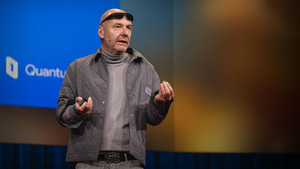
[The Quantum Leap: Harnessing the Multiverse for Future Computing]-[Quantum computers aren’t what you think — they’re cooler | Hartmut Neven]
📋 Summary
The Quantum Leap: Harnessing the Multiverse for Future Computing
In this enlightening TED Talk, Hartmut Neven, the lead at Google Quantum AI, demystifies the complex world of quantum computing. By moving beyond the binary logic of classical machines, Neven illustrates how quantum physics offers a revolutionary approach to computation that could solve humanity’s most pressing challenges.
The Superpower of Superposition
Traditional computers operate on binary logic—zeros and ones. In contrast, quantum computers utilize the laws of quantum physics, specifically superposition. Neven explains that this technology takes the concept of the multiverse seriously, effectively "farming out computations to parallel universes." By existing in multiple configurations simultaneously, quantum systems can process information in ways that classical computers cannot.
To illustrate this, Neven uses the analogy of searching a closet with a million drawers. While a classical approach would take half a million steps on average to find an item, a quantum algorithm could achieve this in just a thousand steps by leveraging the advantage of performing computations across parallel worlds.
Creating "Little Pieces of Magic"
Currently, Google Quantum AI is focused on preparing unique quantum states to study their properties. Neven describes these experiments as "creating little pieces of magic." Notable achievements include:
- Traversable wormholes: Simulating physics by throwing a qubit in and observing its reappearance.
- Time crystals: Systems that change periodically without exchanging energy with the environment, representing the closest physical approximation to a "perpetual mobile."
- Non-abelian anyons: Exotic systems that change their overall properties when identical parts are exchanged, a phenomenon previously unseen in human experience.
Toward Practical Commercial Applications
While no practical application has been perfected yet, Neven announced a breakthrough: a new quantum algorithm designed for signal processing. This could lead to consumer-facing technologies, such as an "electronic nose" capable of detecting dangerous viruses or monitoring free radicals in the bloodstream via a smartwatch.
The Roadmap to Error-Corrected Computing
Building a large-scale quantum computer requires a million physical qubits, a goal Neven breaks down into six milestones. Google has already achieved two major ones:
- Beyond Classical Computation: In 2019, Google demonstrated a computation that would take today’s top supercomputer "one billion years" to perform, validating "Neven’s Law," which suggests quantum power grows at a double exponential rate.
- Scalable Quantum Error Correction: To combat the high error rate of current systems (where machines crash after a thousand steps), Google is combining physical qubits into "logical qubits" to reduce errors to one in a billion.
Solving Humanity’s Urgent Challenges
Neven highlights several transformative applications for future large-scale quantum computers, often referred to as "Feynman’s Killer App":
- Medicine: Simulating complex enzymes like cytochrome P450 to design more targeted drugs.
- Sustainability: Developing lighter, faster-charging batteries and accelerating the design of fusion reactors to combat climate change.
- Optimization: Solving ubiquitous problems in finance and machine learning, ensuring that "quantum AI will win" in competitive computational tasks.
The Intersection of Consciousness and Physics
Perhaps the most profound ambition mentioned is the intersection of quantum information science and neurobiology. Neven posits a fascinating conjecture: that consciousness may be the experience of a "single classical world" emerging from the "many the multiverse is composed of." By testing this hypothesis, researchers hope to understand the fundamental nature of conscious experience.
In conclusion, Hartmut Neven views the quantum computer not just as a machine, but as a "gift to future generations." By providing a tool to solve problems that are currently unsolvable, quantum computing promises to expand human potential across space, time, and complexity, marking a pivotal shift in the trajectory of technological history.
Deep Learning with ListenLeap


