Grownups, Wondery Plus subscribers can listen to Wow in the World early and ad-free right now.
Join Wondery Plus in the Wondery app or Wondery Kids Plus on Apple Podcasts.
Hey, Wowzer fans, Mindy here.
And before we start the show, I gotta let you know that this November, with a special new episode featuring our friends at Circle Round and Terrestrials on Radiolab for Kids,
And don't miss when Elmo from Sesame Street stops by Wow in the World to make us all belly laugh on November 24th.
Oh, but that's not all, Reg.
On December 1st, we are sharing our 250th episode of Wow in the World with all of you.
We think this one is going to be music to your ears.
Literally.
Did I mention it's a musical?
And if you're a member of the World Organization of Wowzers...
Oh boy, do I have a surprise for you.
You can listen to our 250th episode early with me and other members from around the world on Saturday, November 22nd, at 7 pm.
Eastern.
That's right, we are throwing another listening party.
Join us as we dance along to our new songs.
React to the episode with other members in the chat and more.
Grownups.
If you want your wowzer to join this members-only listening party, you can sign up to become a member today at Tinkercastcom.
Slash wow.
Already a member?
Well, you can find the link and password to join the event when you sign in at Tinkercastcom.
Slash wow.
That's it.
It's going to be a November to remember.
But for now, let's get on with the show.
Woo! to take all of your belongings with you as you exit from the our starboard side of the vessel.
And just have fun.
Roger.
No silly voices.
I won't tell you again.
Aw.
Come on.
Wake up, Guy Raz.
We're almost there.
No.
No, not the peanut butter.
I have a dairy intolerance.
Guy Raz, wake up.
We're getting off at the next stop.
Oh, sorry, Mindy.
I must have Dozed off there for a second.
Well, wake up.
We're going to miss our stop.
Come on.
I was up late last night reading up on today's competitors.
Oh, I know.
I have been so excited that I went ahead and just refilled all the ants in my pants.
You what?
Anywho, when I heard that our little old town was going to be hosting the Inner Species Face Pulling World Championships this year, I thought you know who likes twisting and pulling his face into different expressions.
This guy, Roz.
That's a good face.
Or you could pull it this way with your ears out and your nose up.
Mindy.
Or the classic tongue out, one eye closed face.
Mindy, let go of my tongue.
Or you could go for the, Mindy, stop pulling my face.
Oh, but it's so stretchy.
It's like crazy putty.
Ouch.
Oops.
Uh.
Sorry.
Well, anyway, Mindy, I'm so excited.
Making a face and mimicking other people's faces is, scientifically speaking, an incredibly rare thing, an ability only held by a few select animals.
And this is where the best of the best come to compete against each other.
That's right.
What we're about to see, Mindy, is a natural scientific phenomenon.
The next station is...
Sour Patch Arena.
If you're attending the World Face Pulling Championships today, argh, this be your stop.
Roger.
That's it.
I'm replacing you with the robot voice.
No!
Here we are, Mindy.
Don't forget your stuff.
Forget my stuff?
How could I forget this?
What is this?
What even is that thing, Mindy?
The what?
Well, every time we go anywhere, I pack my adventure tool kit, and then you take one look at it and say Mindy, it looks like you brought everything but the kitchen sink.
So this time, I made sure not to forget it.
Well, I didn't literally mean bring the kitchen sink, Mindy.
And now you can fill up your reusable water bottle without having to find a toilet to dunk it in.
Okay, let's get off this train and...
You want to get the door?
Sure.
Doors opening.
Yarg.
Ah, come on.
Okay, let's see here.
We should be able to get out this way here.
Follow me, Mindy.
Right behind you.
Excuse me.
Excuse me.
Pardon me.
Coming through.
Don't mind me.
Excuse me.
Pardon me.
Coming through.
Sour candy here.
Get your sour candy.
100% genuine face pulling championship mouth pullers.
Ooh, Guy Raz, you want a mouth puller?
A mouth puller?
Yeah, check it out.
Um, hello, sir.
One mouth puller, please.
Okay, here you go.
And here you go.
Thank you very much.
Okay, let's see here, Guy Raz.
You put one end in one side of your mouth.
Then the strap goes around here.
And then you get the other part and put that in the other side of your mouth.
Then that goes around that ear.
And ta-da!
Mindy, get it off!
Get it off!
Aw, looks like you got a permanent grin on your face.
I think I'll leave the face pulling to the professionals, Mindy.
Are you ready to head in?
You know it.
Gracia!
I told you before, I can't run in this jacket.
I thought you said it was a sports coat.
What?
Mindy, wait up!
Whoa, hold your horses there, missy.
Sorry, got a little carried away there.
No, not you, the lady behind you.
Excuse me, you, miss, with the horses.
Please hold the horses.
We don't want them running around loose now.
Sheesh, some people.
How can I help you?
Okay.
Well, anywho, I've got two front row tickets to the face-pulling world championships.
Here you go.
Okay, let's just have a look here.
Ooh, I'm sorry, ma'am, but these tickets appear to be counterfeit.
Totally fake.
What?
That's impossible.
The weasel that sold them to me is one of the most trustworthy.
The rodents I know.
I think it's pretty well known that weasels are typically kind of sneaky, Mindy.
What?
That is a misconception, actually.
Statistically speaking, weasels are quite trustworthy.
Now, possums, those are weasels.
Anyway, afraid I can't accept these fake tickets.
Look, the name of the event is even misspelled.
Let me see that.
The Space Dulling World Dampening Ships?
Open and shut the case.
Oh, no.
I was really looking forward to these championships.
Don't give up that easy, Guy Raz.
I bet someone around here is selling tickets.
Uh, tickets!
Looking for two tickets, please.
Hmm, let's see.
I see a woman dressed up as a giant lemon.
I see a Sherbert salesman.
Hey, what's that?
What's what?
Up there in the sky.
It's a bird!
It's a plane!
Nope, it's...
Not just any bird, though.
Reggie!
Oh, Reg, what are you doing at the World Face Pulling Championships?
Selling tickets?
For charity?
So, Reg, you think you can hook us up?
We need two tickets.
Oh, Reggie, thank you so much.
You saved the day.
Oh, Reggie, thank you so much.
And I gotta pay you.
I think five paper clips and a pinch of belly button lint should cover it.
You can keep the change.
Okay, let's try this one more time, Guy Raz.
Walk, walk, walk, walk, walk.
Hello again.
Why, if it isn't Miss McPhoney Ticket Face.
Yeah, that's me, but not for very much longer.
Check it out.
Bam, two tickets.
Okay, let's see here spelling errors.
And yes see, these tickets are elastic, so they're genuine.
Let's go wait a minute.
What's that you're carrying?
It's the kitchen sink.
Read the sign, please.
No outside food or drink, no skateboarding and no Kitchen sinks.
That's right.
Except for, of course, medical kitchen sinks or emotional support kitchen sinks.
Is that an emotional support kitchen sink?
Well, uh... Just what I thought.
I'll need to confiscate that sink.
Whatever.
Let's just go, Guy Raz.
Here, catch!
Wait, don't!
Let's go!
Wow.
This place is huge, Mindy.
It's even bigger than I thought it would be.
Now we just got to find a place to sit.
Oh, look.
I bet we could find somewhere to sit in that fancy booth over there.
Ooh la la.
VIP section.
Brought to you by Lemon Juice.
Wrinkling faces and going places since 1912.
Ooh, a sponsor.
Mindy, VIP?
We're not VIP.
Not with that attitude, we're not.
Mindy?
Guy Razzi?
Look, just follow my lead.
Nose up, pearls on.
Pearls?
And just say stuff like this when you walk in.
Oh, excuse me, sir.
Could you show me to the caviar?
Excuse me, sir.
Could you show me to the caviar?
Yeah, just like that.
Okay, follow me.
Wah, wah, wah, wah, wah.
Pardon me, madam.
This area is for VIP members only.
Oh.
Excuse me.
I didn't see your pearls.
My apologies.
Come right in.
Not to worry.
As you were.
Come on, Guy Raz.
Excuse me, sir.
Could you show me to the caviar?
Of course.
Right there next to the shiffer robe.
I shall have someone fetch you a crystal spoon and freshly buttered toast points from the butler's pantry straight away.
Thank you kindly, sir.
Over here, Guy Raz.
Check out these seats.
Nice seats, Mindy.
It even has a vibration mode.
Wow, you can see the whole arena from up here, Mindy.
And it looks like the first event is just about to start.
Ladies and gentlemen, birds and bees, welcome to the annual Interspecies Face Pulling World Championships.
This is so exciting, Mindy.
I know.
I've been watching the face-pulling world championships since Grandma G-Force was a kid.
I can't believe I'm actually here.
So remind me, Mindy, are they playing by European rules or North American rules?
Oh, North American.
So here's how it works.
Two competitors go face-to-face, literally, and pull the funniest face they can muster.
Then the first animal to break loses.
I'm so excited.
Have you seen the lineup for this year, Mindy?
Oh, yeah.
So first we've got some of the regular competitors.
You know, the apes, the monkeys, the humans.
Did you see when Brad the Human won the competition last year?
I mean, he beat out my favorite face puller, Chad the Chimp.
Ha!
Ha!
Remember that face he pulled with his bottom lip stretched all the way over his nose?
Ha!
Ha!
Yeah, but this year there's a newcomer.
Someone completely unexpected.
Who's that?
Round one of the face-pulling world championships is set to begin.
Ooh, I'll tell you all about it after this round.
In the red corner, hailing from the jungles of Java, weighing in at 190 pounds, his favorite food is bananas.
Give it up for Oscar the Orangutan!
Woo in the brew corner from Columbus Ohio, Mr Prexy, Face the man with the moldable mug, Brother Human.
Hello.
Ladies and gentlemen, let's get ready to face-ball!
Okay, you two.
Only funny business.
Three, two, one, pull.
Brad has gone for the nose of his outfit.
Amazing.
How is it even possible without a third hand?
Oscar, going for a teeth out, eyes crossed face.
Oh, I think I heard a snicker.
It looks like Brad is about to break.
Just like that, Brad is eliminated from the Face Pulling World Championship.
What an upset.
Brad, the reigning champion from last year's competition, is out.
Ooh, that's gotta hurt.
Man, I did not see that one coming.
So Mindy, what about this newcomer you were talking about?
Someone that's never been in the competition before?
Oh, yeah, right.
The species everyone's keeping an eye on this year.
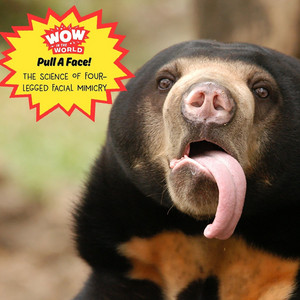
The underdog for this whole competition, the newcomer, is Susan the sun bear.
Susan the sun bear?
Yep.
Not only is it the first time that a sun bear has competed in the world face-pulling championships, but it's also the first time that any species like it has competed.
Well, what do you mean, Mindy?
Ladies and gentlemen.
Oh, hang on.
I'll tell you in a second.
Let's hear it for our semi-finalists.
First up, you might remember his famous move from last year's competition, the Twisted Kisser.
Give it up for the one, the only, Chad the Chip.
And his challenger...
From the North Central African Savannah with her bright red cheeks and even redder face.
Please welcome Brenda the Bubba.
All right, no boogers, no farty noises.
Three, two, one, call!
Let's see what Chad has for us this year.
Oh, he's going for a nip over the nose move.
What a feat.
I mean, what a face.
Brenda, already starting to grin.
And... Oh, and Chad the Chip has shown once again why he's one of the best in the world.
He will be moving on to the finals.
Oh, you're a big chimp fan, huh?
You bet, Mindy.
Check it out.
I have his trading card here in my wallet.
It's my good luck token.
Aw, look at that face.
Right?
He's a shoo-in for sure this year.
Sky Roz, remember that new species of a competitor I was telling you about?
Susan the sun bear?
Yep.
And remember how I said that she wasn't just a first of her species to compete in the face-pulling world championships, but also her type of species.
Yeah.
Well, what I meant by that was that sun bears are what are known as solitary animals.
Huh.
And solitary animals are species that tend to live by themselves in nature rather than in groups.
Yes.
And animals that like to live in groups are called social animals.
So, like monkeys and apes and, well, basically every other competitor in this competition.
You're right, Mindy.
Brad the human, Oscar the orangutan, Brenda the baboon...
They're all primates.
Mm-hmm.
So what you're saying Mindy, is that Susan the sun bear is not only the first of her species to compete in the face-pulling world championships, she's also the first solitary animal to ever pull a face here.
Bingo, Guy Raz.
Many animals, including us humans, use our faces to convey or to show how we're feeling with the people around us.
From anger...
To joy.
To sadness.
And we humans and other social animals are super great at this.
We mimic or copy a friend's face to show that we care about what they're saying.
Yeah, and for the longest time, scientists thought that this was just something that only a few skilled social animals could do.
Right, but it's like Susan the sun bear came along and proved them all wrong?
Exactoritos.
So there was this primatologist, you know, a scientist who studies primates.
Primates like monkeys, chimps, and other apes.
Yeah.
So a primatologist named Marina de Villaross from the University of Portsmouth in England wanted to see if this skill at mimicking or copying faces was more common in the animal kingdom than we thought.
So did she go out into the wild to spy on animals?
Well, not exactly.
She went to a rehabilitation center for animals in Malaysia.
And a rehabilitation center is a place where injured or endangered animals are taken to get better or reproduce before being let back out into the wild.
Exactly.
She went to one of these rehabilitation centers to see if any animals other than primates were able to mimic faces.
And what did she find?
Well, she filmed 22 different sun bears for a bunch of days And when she got back to the lab and looked over the footage, she saw that most of these bears, when interacting with each other, pulled faces at each other.
Well, what kind of face pulling are we talking about here, Mindy?
Like when I put hooks in your cheeks?
Or when I pull your tongue out?
Let go of my tongue!
Or when I push your nose in?
Oh, sorry.
So anywho, what I was saying is that the researchers observed, or noticed, that the sun bears would often come up to each other bare their teeth.
Ha, fair.
Nice one.
Thank you very much.
They would bare their teeth and open their mouths really wide.
And then a split second later, the would do the same thing back.
Suggesting that the bears were communicating with each other using their faces.
You know it.
And, like I said, up until now, scientists had thought that this was something that only social animals could do.
Whoa, talk about an underdog story.
Oh, I think it's about to start again.
It's all come down to this, folks.
The final face-off.
Please welcome the returning challenger from the heartlands of Africa, the great ape with the foldable face, Chad the Chim.
We love you, Chad!
Go, Chad!
And his opponents from the depths of the Malaysian woodlands, Weighing 140 pounds and measuring 5 feet 2 inches.
The honey bear with the moldable muzzle, the great grimacing wonder of the world, Susan the Sun Bear.
Oh, yeah.
Susan the Sun Bear.
Pull that face, girls.
OK.
You know the rules.
No plastic teeth.
No fake noses.
3, 2, 1.
And the battle begins.
Chad is going with the ears pulled, tongue out.
Susan, baring all her teeth.
Chad, trying to regain the upper hand with the reverse cross-eye underbite.
Susan, unfazed, continuing to bare her teeth, opening her mouth wider.
Chad's bottom lip begins to quiver.
He's about to break.
Gentlemen, what an upset here at the Sour Patch Arena!
Chad the Chimp defeated in the final, and we have a new champion!
Susan the Sunder!
Susan the Sunder!
Oh man, what a finale!
Sorry your Chimp didn't win, Guy Raz.
It's okay, Mindy.
He'll be back next year and besides, I think that this is a really important victory for solitary animals everywhere.
That is true.
So what are these researchers hoping to do with this information next?
Well, now that we know that face copying or pulling or mimicking isn't a trick that only social animals can do, the researchers are looking to see if other solitary animals, like leopards, for example, can also communicate with their faces.
So what you're saying is that the World Face Pulling Championships is just going to keep on getting more and more diverse?
Maybe, with more and more species added every year.
So...
So it looks like Chad might have some stiff competition yet.
Could be, Guy Raz.
Only time and more research will tell.
Pardon me.
May I refill your caviar goblet?
And perhaps I could interest you in our VIP pearl polishing service.
Wait a minute.
These pearls aren't pearls.
They're breath mints.
And a button?
I dare say you aren't VIP at all.
I'm afraid I must ask you to leave.
Can I at least keep the caviar?
No.
What?
I was going to put it in a taco.
Completely uncivilized.
Let me tell you something, buddy.
We're VIPs.
VIPs.
We're VIPs, baby.
Wow in the World will be right back.
Grunups, this message is for you. grown-ups it's mindy and guy ross here from wow in the world mindy and i have some brand new wow in the world toys out in the world just in time for the holidays made for the kids who love science and for the ones who don't yet from our 100 experiments that wow kit to the telescope and astronomy kit our wow in the world toys help your wowser learn about their world through play plus You can hear exclusive audio content from me and Guy Raz to help your wowzer discover even more wows.
Grownups.
Give the gift of wow and wonder this holiday season with our latest Wow in the World toys designed with your curious wowzer in mind.
You can shop our Wow in the World toys at Tinkercast.com slash toys.
That's Tinkercast.com slash toys.
Hi, thanks for calling Wow in the World.
After the beep, get ready to record.
Hi, Mindy and Guy Ross.
My name is William and I live in Naperville, Illinois.
My Wow in the World is that buffalo birds... lay their eggs in other birds' nests.
Hi, Mindy.
Hi, Guy Raz.
My name is Quincy, and I'm from New Orleans, Louisiana.
My wow in the world is that there was once a carnivorous marsupial that lived in Australia.
Bye!
Hi, Mindy, Guy Raz, and Reggie.
I'm Kayden and I live in Fort Worth Arizona, and my wow in the world is that a pineapple is actually a bunch of berries put together.
Yes, I sing along with the song in the beginning of the podcast.
And your podcast is the best.
Thank you, Guy Raz and Reggie.
We love you.
Hi, Mindy and Guy Raz.
My name is Colin.
I live in Lake Ridge, Virginia.
My wow is that sharks' eyes go back in their head when they try to bite.
So if what they're biting attacks them, it can't get their eyes closed.
Say hi to Reggie and the annoying Dennis for me.
Ahoy there.
Hi, Mindy.
Hi, Guy Raz.
My name is Jillian and I'm from Seal Beach, California.
And my wow in the world is that did you know that spiders are arachnids, not insects, because of their eight legs?
Bye.
Say hi to Reggie for me.
Hi, Mindy and Guy Raz.
My name is Ezra.
I live in New York.
My wow in the world is that turtles can breathe through their butts.
Bye.
I love your show.
And bye, Reggie.
Hi, Mindy and Guy Raz.
My name is Genevieve, and I live in Ithaca, New York.
And my wow in the world is that one of Jupiter's biggest moons Titan, so much like Earth that it even has water and an atmosphere.
Hi, Mindy and Garaz.
My name is Julia, and I live in Rabat, Morocco.
My wonder world is that the longest crocodile can be 20 feet long.
Bye, I love your show.
Tell Reggie and Dennis to stay away from crocodiles.
You know the old saying, Reggie.
See you later, crocodile.
You know, I don't get that old saying.
Hey everyone, thank you so much for hanging out with us this week on Wow in the World.
And to keep the wow rolling, check out this week's scientific conversation starters at our website wowintheworldcom.
And grown-ups.
There you can find more info on how your kids can become members of the World Organization of Wowzers shop, our wow shop.
Upload photos and videos to us and check dates for our upcoming live events.
That's wowintheworld.com.
Our show is produced by Jed Anderson, who provides the bells, whistles, and silly characters.
Say hello, Jed.
Hello.
Our show is written by me, Guy Raz, and Thomas Van Kalken, who also provides silly characters.
Tom?
Hello there.
Thanks also to Jessica Bode, Casey Koffer, Rebecca Caban, Kit Ballinger, and Alex Curley.
Meredith Halpern-Ranzer powers the wow at Tinkercast.
Our theme song was composed and performed by The Pop-Ups.
For more info on their two-time Grammy-nominated all-ages music, find them at thepopups.com.
And grown-ups, you can follow Wow in the World on Facebook, Instagram, and Twitter at wowintheworld.
And our email address is hello at wowintheworld.com.
And if you're a kid with a big wow to share with us...
Call us at 1-888-7WOWOW for a chance to be featured at the end of the show.
Also, if you haven't already done so, please subscribe to Wow in the World on Apple Podcasts or wherever you get your podcasts.
Yeah, leave us a few stars, a review, or just tell a friend about the show.
Thanks again for listening, and until next time, keep on wowing.
Jinx!
And before you go, tell us about yourself by filling out a short survey at wondery.com slash survey.