Ted Audio Collective You're listening to Ted Talks Daily, where we bring you new ideas to spark your curiosity every day.
I'm your host, Elise Hugh.
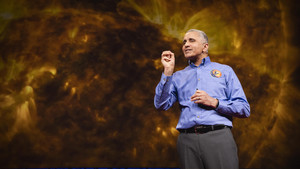
Astrophysicist Noor E.
Rawafie is part of a project to help us better understand the star most important to us here on Earth – the sun.
In his talk, he explains a technological marvel called the Parker Solar Probe and why it is such a big deal.
And he shares some surprising things about the sun that I still can't stop thinking about after a short break.
AI is shaking things up and it's fascinating, confusing, and sometimes scary.
Our new podcast, The Ted AI Show, helps you understand what you need to know about AI and how it's changing our world.
I'm your host, Belaval Sedoux, a creative technologist and AI innovator.
And I ask experts, artists, journalists, and beyond to guide us through the thrilling world of tech and how it's going to affect the future of our health, art, everyday lives, and so much more.
Each episode will leave you more informed and with tools to help you understand how AI will change your future.
Check out The Ted AI Show wherever you get your podcasts.
And now, our TED Talk of the Day.
We all know, love, and admire the sun.
I'm an astrophysicist.
I live for studying the sun, its complexity and the weird and powerful weather system it creates.
Sometimes, when I get so into it, which is most of the time anyway, my wife will ask, are you also married to the sun?
And I'll say, technically no.
But if it doesn't upset you too much, yes.
No, having said that, I'm not sure where I'm going to sleep tonight.
So I can confirm that we know the sun better than any stellar system in the whole universe.
But I'm going to let you in a little secret.
Sometimes I feel like we don't know the sun at all.
As a child, I was captivated by the sky glittering with stars, which are nothing but distant suns.
Now you're back on summer night, look up at the heavens, and there you have it.
Whichever direction you look, there is a star shining at you, another sun.
That was the start of the journey of wonder and curiosity.
Stars come in all sizes and flavors, from monsters to dwarfs.
If we were to draw up the largest known star in the universe into our solar system, it would extend well beyond the orbit of Jupiter.
The smallest is about the same size as the planet Saturn.
But no matter the size and type, stars hold great significance for us.
We are all made of star dust, star babies.
Yet no star holds greater significance for our past, our present and our future than our very own.
The sun is responsible for life on Earth, powering photosynthesis, warming the planet, providing clean and free energy.
But it is also violent, explosive and unpredictable.
Here's what I mean.
The northern lights are beautiful and mesmerizing, right?
On September 1, 1859, people could see O 'Rory even in daytime around the entire globe.
Turns out that was the result of the most intense geomagnetic storm in recorded history.
This was the Carrington event.
It was likely a giant current mass ejection, or CME, that disrupted telegraph lines and sparked fires at their stations.
Can you imagine the repercussions of such a storm today?
It could shut down the entire power grid, not for hours, but weeks and months or even years.
The potential for human distress in the affected areas is well beyond our scale of comprehension.
The economic impact alone could be in the trillions of dollars.
So learning about the one star in the universe that humans cannot do without is vital.
And that's what physicists like me are trying to do.
So what do we know already?
The Sun holds over 99 .8 percent of the solar system total mass.
Its sheer size is mind -boggling, requiring more than 1 .3 million Earths to fill its volume.
All of that mass is in the form of plasma, a glowing soup of electrically charged particles.
At the solar core, gravity is exceedingly high, producing temperatures in excess of 15 million degrees Celsius.
The extreme pressure forces the protons to come together and diffuse into helium while releasing in a burst of energy.
This is nuclear fusion.
And if we can replicate this process sustainably in Earth, it would provide almost limitless clean energy to power the entire globe.
Many of us have witnessed total solar eclipse, like the one in 2024.
This fascinating celestial spectacle has captivated humans for millennia.
As the moon gracefully positioned itself between us and the Sun, the solar corona burst forth in all its majestic splendor.
But the corona also harbours some of the most perplexing phenomena.
The solar surface is plenty hot, 6 ,000 degrees.
Hot enough to melt anything we know.
But in the corona, we're talking millions of degrees Celsius.
How can it be over 300 times hotter despite being the Sun's outermost layer?
Physicists have suggested since the 50s that all of that heat must generate a constant flow of particles.
This is a solar wind.
It speeds away at up to 3 million kilometres per hour.
At that speed, you can get from the Earth to the moon in under 20 minutes.
This cosmic stream is like celestial rapids.
And that's where we live.
Behind all this is the Sun's magnetism.
As solar magnetic fields twist, bend and tangle, they store enormous amounts of energy.
And when they snap, huge explosions, like flares and coronal mass ejections, release this energy and turn it into heat and accelerate with plasma.
It takes only a handful of these strong events to fulfill our current energy needs for some 200 ,000 years.
That is the whole span of modern humans' existence.
The Sun does that in minutes to a few hours.
These same explosions propel particles to nearly the speed of light and turn them into formidable hazards to spacecrafts and humans in space.
Does the loss of 40 SpaceX satellites ring a bell?
A moderate solar storm knocked them out.
Our power grid came from a victim, like in March 1989 in the northeast of the US, Canada, when a succession of solar storms caused an intense geomagnetic storm.
Even deep seas can be affected.
In 1972, dozens of sea mines spontaneously exploded.
The likely cause? You guessed it.
A powerful coronal mass ejection.
So we need to learn how the Sun does all this and more.
Since the dawn of the Space Age, NASA has wanted to fly a spacecraft as close as possible to the Sun to solve these mysteries.
But getting very close to a star is extremely risky and really hard.
How would we protect a probe from just melting?
How could it adjust for any problem on its own when you cannot communicate with it?
Until recently, we simply didn't possess the technology.
In 2018, that all changed with the launch of Parker Solar Probe.
Parker Solar Probe is the first spacecraft to ever fly through the solar corona.
It has revolutionized our understanding of the Sun.
In five -plus years, we've already learned so much.
We now know how the solar wind is generated at its source.
We are the closest ever to understanding what heats and accelerates the plasma in the corona and the solar wind.
And we have the most detailed observation of coronal mass ejections.
Can you hear that? This is one of the most powerful CMEs ever recorded.
It erupted on September 5, 2022, and it was traveling at more than 2 ,500 kilometers per second when it hit our brave probe very close to the Sun.
For days, we didn't know whether Parker Solar Probe made it or not because it was on the backside of the Sun.
But once it emerged on the other side, it called back, saying, everything is fine.
And we have a ton of data for you that will give you an unprecedented look at how these events accelerate particles to almost the speed of light and sweep almost everything in their way, leaving a near -perfect vacuum behind.
And that is just a sample.
We cannot catch our breath with this mission.
Every few months, we have a close approach to the Sun and a new load of data to investigate.
It's overwhelming at times.
But this data will serve many generations to come.
Parker Solar Probe is a two -mission for the ages.
So are you curious how did we do it?
Parker Solar Probe is not a large spacecraft.
It could fit under a basketball hoop and carries about half the weight of a compact car.
But it is a marvel of technology.
The only thing standing between the probe and incineration is an ingenious 11 .5 -centimeter thick, 2 .3 -meter wide carbon -form shield.
On Christmas Eve 2024, the shield's sun -facing side will endure about 1 ,000 degrees Celsius.
About one meter behind, it's almost a long temperature.
How does Parker shed all that heat?
This special ceramic coating on top of the heat shield reflects as much light as possible.
The heat shield itself absorbs a huge amount of heat in the radiators elsewhere.
Meanwhile, a network of tiny pipes runs through the solar panels, extracting heat and expanding it through the radiators.
It uses a liquid -based cooling system.
The liquid is a simple gallon of water.
All this system will be operating on December 24, 2024, when Parker Solar Probe achieves humanity's closest -ever approach to a star.
This will be a monumental and audacious achievement.
In 1969, we landed humans on the moon.
In 1924, we're going to embrace the star.
So all this is very cool, amazing science and really fun to geek out about.
It also happens to be vitally important for your lives and to mine.
Delving into the sun's history, we discovered periods when it entered long, tranquil phases that lasted for decades.
During these times, called the solar -grant minima, solar activity diminished to the point of near -non -existence, along with extreme climate conditions on Earth.
One such episode lasted for an astounding seven decades, from 1645 to 1715, and it coincided with the Little Ice Age.
This episode seems to occur every 200 to 300 years or so.
Now, here's the thrilling intrigue.
We are overdue. Is the sun about to enter a new and extended law of minimal activity?
When will it happen?
How long will it last?
How deep will it be?
We don't know. The most important thing, however, is what impact this phenomenon could have on our lives, our movements, our energy, our food sources.
How would it affect our climate and our atmosphere?
The sun is not a driver in Earth's current changing climate.
But if it enters an extended period of tranquility, how much could it slow the pace?
Again, we don't really know.
To answer all these critical questions that shape the fate of our society, we must unlock the sun's secret from its fiery core to its outer riches.
For our future, for the world we live behind, for our children and theirs, we must transform the way we observe the sun and deepen our understanding of how it influences its surroundings, in particular, how it shares the planet Earth.
Without doubt, this undertaking poses formidable challenges.
But it's another adventure unlike any we've been on before.
Here lies yet again another opportunity to transcend ourselves and forge ahead with our epic journey of progress and prosperity.
For better or worse, the sun dictates our past, our present, and our destiny.
Thank you. That was Noor E.
Ruwafy at TED 2024.
And now, as a special treat, here is my conversation with Noor after he spoke at TED, recorded on -site at this year's conference.
Okay, professor, we are recording this in April, so we just were lucky to be treated to a total solar eclipse in North America.
I'm curious where you were to experience this event.
I was in Carbondale, Illinois.
So was I. Yeah, which was one of the best places.
What was meaningful about this particular eclipse for you?
Because I imagine this wasn't the first time that you experienced one.
Yeah, it's not the first time, but you know what?
Whenever you go to see an eclipse, it's always a first experience.
I've been working on the sun and the solar corona for over 25 years now.
But when you look at the solar corona on day -to -day basis, it is changing all the time.
It's never the same.
When you see an eclipse and you see another one, the corona is totally different.
And if you compare, for example, images from the solar eclipse in 2017 when the sun was very quiet, but when you look at images from last year or this year, it's totally different.
There is way more structures in the corona.
So the experience itself is kind of...
Yeah, I remember seeing and being really mesmerized during the actual eclipse.
There were solar flares or what looked like solar flares.
What were we seeing?
They are structures in the solar corona.
And these actually what some of them causes what we call coromas ejections.
These big explosions, ball of gas that erupts from the sun and flies in different directions.
And these are the main driver of space weather.
We all remember the loss of 40 satellites of SpaceX.
They were caused by an eruption like that one.
And then from what I understand, the sun has kind of 11 -year cycles or something?
Okay, when we look at the activity of the sun, if you count sunspots, they have a cycle of 11 years.
So they go from very small number to a maximum and then to another minimum, the span of that period is 11 years.
And when we are at the maximum, the sun is way, way more active.
And for this year, we are so close to the maximum.
That's why this eclipse is so special because it's almost at a solar maximum.
And the corona is crazy.
It's absolutely crazy.
You have called the sun the most important star in the universe, but just to be fair, the universe is very large.
It's vast. So why does the sun deserve this title from you?
When you look at the whole universe, what we think it has one septillion stars.
One septillion is basically right one and there is, I believe, 23 or 24 zeros behind it.
So it's just a crazy number.
Unfathomable. It's a huge number of stars.
But for us, all those stars are important.
But without the sun, we wouldn't hear today talking to each other.
We didn't even exist.
Life wouldn't exist on Earth at all.
But also we have to be extremely careful of the sun.
All this activity that we talk about, space weather and all that stuff, it can affect us in so many ways.
Yeah, because we live our day -to -day lives with this assumption of the sun being constant.
And the eclipse recently really helped us understand how dynamic and constantly changing and evolving it is.
We really don't know what the sun will do.
The sun is so big, so huge, the sun will do what the sun wants to do.
It will not ask for our permission or anything.
So it will do whatever the sun wants to do.
We are just a subject.
We have just to adapt to it.
We talked about the 11 solar cycle.
So that's basically a day -to -day basis we have to look at the sun.
That's the short term.
But this longer term, a centennial variability that occurs over centuries.
And when you look at the history of the sun, we have these periods when the solar activity almost disappeared.
The Little Ice Age.
And the last one occurred in the 1600s, 1700s.
And it lasted for seven decades.
And they occur every something like 200 to 300 years or so.
I have to admit that I got a little scared when you mentioned that we were overdue for another kind of mini ice age.
Should we be preparing?
Probably not. But you never know.
We can enter it anytime.
Or not even just human life, but all of biodiversity.
We don't really know.
And simply we don't know because we don't have the data.
But wasn't the past kind of helpful or predictive in any way?
We have been observing the sun pretty well over the last maybe three to four decades.
But before that, we didn't have much data at all.
So when we talk about these periods in 1700s and before, the data we are relying on is so sparse and so superficial, if you will.
Now what we have to do is when it comes to the sun, it's really changed the way we observe the sun.
We should not observe the sun like we see it from Earth here, from one viewpoint.
We have to observe the sun as a 3D thing.
Because variability on the sun occurs all over the solar disk.
So we have to, even if it is happening with the other side, it can affect us.
And that's the beauty of the Parker Solar Probe?
Parker Solar Probe in a way, it is helping so much into that.
But in the future, we need to do more.
The best way to do it is to have constellations of spacecrafts that are looking at the sun from different viewpoints.
And when you put all the data together...
You have aggregate understanding.
Yeah, and the main aspect of these observations is information about the solar interior.
Because it's the big opaque part of the sun that we have some information about it, but not much.
What are the biggest challenges to getting to that kind of observation?
I think we have just to be aware of what lays ahead of us and just have the will to invest into it.
You mentioned Parker Solar Probe.
Parker Solar Probe is not a new idea at all.
Parker Solar Probe dates back to 1958.
Oh my gosh. But it took us so long to build the mission because we did not have the technology, that's one.
But also it was a little bit expensive that NASA couldn't afford it.
But now when you really put the right investment and the right time, you start making breakthroughs.
And that's actually what we are seeing with Parker Solar Probe.
Parker Solar Probe is not only helping us to understand these big mysteries about the corona.
We are uncovering other phenomena that we didn't even know.
And that leads me to my final question.
After you deployed the Parker Solar Probe, what sort of new questions came up or new mysteries do you want to solve based on those findings?
The big three questions that we wanted to solve is what we call the coronal heating.
The coronal is much hotter than the surface, and we want to understand why, because it's counterintuitive.
The outer layer should be cooler in principle.
Also the solar wind, when you look at the speed of solar wind, it's just out of this world, it can propagate at 3 million kilometers per hour.
And you have also solar activity, we talked about it.
These are the big main science questions for Parker Solar Probe.
But there are other science that we thought Parker Solar Probe is going to help us to understand.
It's actually a 90 -year -old hypothesis put by a theorist saying, okay, when you look at stars, there is dust around them, all over the place.
Okay, dust is what we are talking about, micron -sized particles.
But he says, okay, when you look at these particles, when they get very close to the star, they get so hot, they will sublimate, and they will be cleaned out.
So basically you end up with a region around the star that is totally devoid of dust.
We call it the dust -free zone.
The first star to look at is the sun, is the closest.
And people over the decades, they look over and over again.
But they couldn't really find serious hints about it.
But Parker Solar Probe from day one, it's there.
That's one of the big discoveries we've made.
One of the things that we saw also from the first data we got, actually it gave us a scare.
It's what we call these switchbacks.
When you look at the magnetic field, basically what they do, they flip over themselves all the way back to the sun and out.
They form like an S -shape, like a molten switchback.
And these have been observed by previous missions far away from the sun, but they were so, so sparse.
But when Parker Solar Probe got close to the sun, we looked at that data and said, oh my goodness, something is wrong with the instrument.
We observed a gazillion of them.
Oh no. We thought it was an error.
We were not used to that.
We were used to small fluctuations, but these are humongous.
But it took us about 10 to 15 minutes, did a few tests, we realized it's all physics.
The instrument works as design.
What we are looking at is something new.
And that observation is guiding us toward understanding where the solar wind is coming from, how it is formed, how it is heated, and how it is kept accelerated away from the sun.
It's so exciting and also full of promise and more questions.
Thank you so much. Yeah, thank you.
If you're curious about Ted's curation, find out more at ted .com slash curation guidelines.
And that's it for today.
Ted Talks Daily is part of the Ted Audio Collective.
This episode was produced and edited by our team.
Martha Estefanos, Oliver Friedman, Brian Green, Autumn Thompson, and Alejandra Salazar.
It was mixed by Christopher Faizi -Bogan.
Additional support from Emma Tomner and Daniela Vallerezo.
I'm Elise Hugh. I'll be back tomorrow with a fresh idea for your feed.
Thanks for listening.