Hey, Alex here. Do you live in the New York area?
If so, come see Planet Money Live, August 18th at the Bell House in Brooklyn.
There'll be a bunch of us there from Planet Money in the Indicator, and if you buy early access tickets, you can hang out with us before the show.
We're putting together a blend of storytelling, guests, and a tribute to unsung economic heroes.
Alexi might be in costume.
It's going to be a mix of different things designed to be a celebration, a fun night out that is also about economics and asks big questions like, what should the government do to make us all richer and life more affordable?
This is a taping for part of the finale for summer school and will crown a valedictorian.
There'll be a quiz and trivia segment that you can be a part of.
So you might end up on the podcast. Buy your tickets at npr .org slash planet money live.
That's npr .org slash planet money live.
You can do it right now on your phone.
Here's the show. This is Planet Money from NPR.
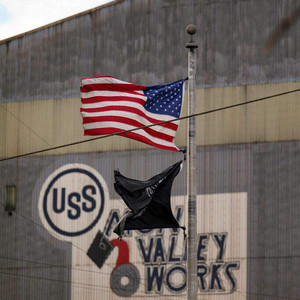
I live in Pittsburgh, Steel City, and for more than a year, I've been inundated by ads from the company U .S. Steel, like this one.
Welcome to Irvinworks, just one of three U .S. Steel plants here in the Mon Valley.
I'm fourth -generation steel, and I'd like it to remain here.
The American steel industry is not what it used to be.
There were once dozens of steel plants employing many thousands of people.
Now they employ just a few thousand.
And a year and a half ago, the company announced it was going to be sold.
And not to an American company, to a foreign company, a Japanese company.
And U .S. Steel said, this is a great thing for us, a lifeline.
Otherwise, we will have to shut mills down.
So these ads are full of hard hat wearing steel workers trying to convince viewers that this sale was the right thing.
Towns like ours. Restaurants like this one.
All depend on the plants running.
Let's get it done. U .S. Steel and Nikon Steel.
The future of American steel.
So the company really wanted this deal.
But when it was announced to the public, it was right in the middle of the election cycle.
Pennsylvania is a swing state, very purple, yeah.
And U .S. Steel is this storied American company.
And just about every big -name politician on both sides of the aisle freaked out.
I will stop Japan from buying United States Steel.
U .S. Steel should remain American -owned and American -powered.
American -operated by American union steel workers, the best in the world.
In fact, before leaving office, President Biden blocked the sale, said it threatened U .S. national security.
But just recently, in a dramatic twist, We're here today to celebrate a blockbuster agreement that will ensure...
Trump completely reversed course.
He approved the sale of U .S. Steel to Nippon Steel.
We're going to have a great partner.
We're going to have a great partner.
And I have to tell you, Japan has been a tremendous friend of mine during my years as president.
So the company was sold, but with one big caveat.
Even though U .S. Steel is now owned by a Japanese company, the United States government will be very involved in managing it.
Yeah, the American government has its hands all up in this deal.
The U .S. government can appoint a member to the company's board. No factory can close and workers' pay can't be reduced without President Trump's approval.
Nippon cannot change U .S. Steel's name.
And Nippon has to invest billions of dollars updating mills and building a new one.
Which kind of sounds like foreign ownership, but with handcuffs.
The question is, is this a new way to secure foreign investment while also protecting American interests?
or is this unprecedented government overreach?
Hello and welcome to Planet Money.
I'm Erica Barris. And I'm Solly Helm.
How did this deal happen and why?
Today on the show, an attempt to protect U .S. manufacturing jobs through foreign money and government meddling.
The U .S. deal, Nippon deal.
President Trump is calling it a golden share.
Is it the first of its kind?
And is this step to protect government interests a step away from the free market?
Nothing as powerful as the power of us.
Visit usbank .com today to learn more.
Member FDIC. Copyright 2025 U .S. Bank.
This message comes from NPR sponsor Holiday Inn by IHG.
It's a new day for a new stay at Holiday Inn for business travelers.
With modern spaces for meeting and working, plus delicious dining from breakfast to happy hour and dinner, you have everything you need to get work done.
Give your everyday business travel an upgrade.
great. Book your next business trip at Holiday Inn by IHG.
Visit HolidayInn .com to book your stay.
When it comes to foreign investment in the United States, we all know about the invisible hand of the market, but there are also the invisible hands of the government.
The U .S. government is actually quite involved in defining the shape of big international business deals, and it's useful to understand the mechanics of that, like the mechanisms of control.
When a foreign company wants to buy an American company or invest big money, they can't just like go ahead and do the deal.
There is an entire vetting system designed to determine if a foreign investor will be a good fit for our country.
And part of the vetting is going before this agency that, despite how important it is, is not a household name.
It's called Sisyphus.
That is not Sisyphus.
Sisyphus, of course, would be a mythological man who is even now pushing a boulder up a hill.
He can't stop. No, this is CFIUS, the Committee on Foreign Investment in the United States.
It is like America's gatekeeper when it comes to foreign investment around things that involve national security.
And the vast majority of what they do is top secret.
Did you have to take an oath?
I got a top secret security clearance.
Sarah Bowerly -Dansman is a political economist who did a stint at the State Department as a CFIUS case officer.
And I got like an extra layer of security clearance above that so that I was able to go into what's called a SCIF, which is a place that has like extra layers of protection so that you can talk about things that are classified at the top secret level.
CIFIUS is this interagency committee.
Its members come from Treasury, Homeland Security, Commerce, Energy, Defense, Trade, and folks from the White House.
And their whole purpose is to protect the security of the United States by scrutinizing any foreign players trying to buy American companies or to invest in the country.
Foreign companies and people invest more than $5 trillion a year in U .S. companies.
And CFIUS was created to make sure those companies and people don't mess with U .S. interests.
Like, if you're going to come here, you've got to be on our side.
They strike deals with companies to make sure of that.
National security agreements.
And historically, those deals have had to do with defense.
They have all been companies that are integrated into the defense industrial base or providing important kind of critical infrastructure services.
So the U .S. will look at companies and tell them, OK, you can operate in the U .S., but here are some rules.
You can't share certain key technologies or you might be required to fill orders from the U .S. government.
Like CFIUS required the Japanese company SoftBank to agree to a bunch of rules when it acquired the cell phone company Sprint.
Or in more extreme cases, the U .S. government will just say, sorry, you can't buy this American company.
Like in 2016, President Obama blocked the sale of a company that makes parts for semiconductors to a Chinese -controlled business.
The following year, President Trump blocked the sale of an American semiconductor company to Chinese investors.
And starting with the first Trump administration, the U .S. has used CFIUS more often and more aggressively, expanding the definition of national security.
And in fact, during Biden's administration, he doubled down on Trump's broader definition of national security.
He officially expanded the category of industries that CFIUS should review.
So today, national security includes things like cybersecurity, AI, biotechnology, biomanufacturing, clean energy.
The U .S. government is increasingly determining that a larger and larger set of industries and companies have national security relevance.
And now this U .S. steel deal.
And look, yes, steel is important for some military purposes.
But much of the rhetoric around this deal was about a different kind of security.
U .S. steel is not producing steel in any kind of major or important way for the Department of Defense.
What's the rationale?
What I would say is that there has been this general idea that having the capacity for the U .S. to produce steel is important for being able to be self -reliant, particularly in a time of war.
The idea is steel production is part of military readiness.
So this deal might be about national security, but it also seems to be about job security, protecting American manufacturing, American jobs.
On the day the deal was signed, a White House spokesperson said it will help safeguard U .S. national and economic security.
And the Commerce Secretary posted about it.
Yeah, it's like the government is thinking of national security not through the battlefield, but through the factory floor.
Economic security. Of course, CFIUS does all this vetting, figuring out whether a company or investor is the right fit for the USA behind the scenes.
They don't disclose what they're discussing, what confidential security information the different agencies are sharing.
And what happens after all that vetting is also secret.
That is the part where, when necessary, foreign investors and the U .S. government agree to some terms in something called a national security agreement.
Most of the time, no one hears anything about it.
CFIUS is not allowed to release information about this.
What happens if someone does?
Like, do you get in trouble?
Yeah, it's a criminal offense.
So it's not just that you could be fined, but you could be thrown into prison.
So people take it very seriously.
But in this U .S. Steele acquisition, we learned a lot more than we usually get to.
The U .S. government did disclose it to the public, like it was on all the social media platforms. Like everyone's been talking about it.
I mean, the rules are different under Trump.
Steele is doing great now because of what we did.
Trump talked about it.
Commerce Secretary Howard Lutnick posted details.
Pennsylvania Senator Dave McCormick did interviews about it.
I think this is great for our security, great for our national security, economic security.
Maybe because after months of swearing to stop this deal from going through, they needed to explain to the public why they were, instead, clearing the path for it.
Now we're really doing great.
A big investment is being made in Pennsylvania.
The CEO of Nippon Steel was quoted in the press about the unusual control his company conceded, but he said they'll retain sufficient managerial freedom.
At a press conference, he said Biden's rejection of the deal was unreasonable and now Trump has made the right decision.
The White House said the deal has, quote, powerful terms that directly benefit and protect America.
Some of the stipulations?
Nippon will not be allowed to move U .S. Steel's headquarters away from Pittsburgh without permission from the president.
It cannot reduce or delay its billions of dollars of investment, move jobs out of the U .S., close steel plants over the next decade, even reduce salaries.
And Trump used an unusual term to describe the new arrangement.
And we have a golden stock.
We have a golden share, which I control or President controls.
A golden share. What on earth is that?
That's after the break.
When I first heard of the sale of U .S. steel to Nippon Steel and the U .S. having a golden share, I was like, what?
Because golden share in Trump sounds very on brand for Trump.
Like the golden visa, golden phone, a fragrance that comes with a gold statue of him.
Is a golden share a new thing?
No. It's a new thing for the U .S. This is Sarah Bowerly -Dansman again, professor at Indiana University.
She has also written about Golden Shares.
I learned about the Golden Share that was supposedly part of the Nippon Steel arrangement when someone sent me a text and said, what does this mean?
Was it me? It was not you, Erica.
Before I tell you what a golden share is, let's just remember what a share even is.
Imagine a company has like 100 shares.
In most situations, the more shares a shareholder has, the more voting rights and power they have in that company.
And some shares have extra powers.
A golden share is a different class of shares in which a government government can own a very small percentage of the company, but has outsized voting rights.
So essentially the government is a shareholder, but they are like a super special shareholder.
Yes. The idea of golden shares comes from the UK in the 1980s.
The UK was going through this period of industrial decline.
Its economy was struggling.
The same stagflation that had plagued the U .S. in the late 70s was happening there.
And the UK needed a way to revitalize its economy.
So remember the Thatcher Revolution?
The Iron Lady. Yes.
So Margaret Thatcher and Ronald Reagan are BFFs.
They're very focused on the idea of privatizing industry.
Privatization. That was Thatcher's idea of how to get the UK growing again.
Because there were all these industries that were state -owned, like their telecommunications, aerospace, energy, and Rolls Royce.
Yes, Rolls -Royce has cars, but also has these really important, fancy aeronautical engines and parts and so forth.
Rolls -Royce also has nuclear reactors and submarines, which the British Navy uses.
To get the economy rolling, Thatcher decided to turn these nationalized industries into private companies.
But she didn't want to totally give over control.
Because what if the new owners botched everything and suddenly the British no longer had a functioning telephone system?
Or Rolls -Royce sold itself, and now another country had that British Navy intel.
So she decided on this idea called golden share, a way to ease into a freer market economy.
The government would own some small percentage of shares in the companies, but the shares would be special.
They would give the British government more say.
Since then, other countries have also used golden shares to ease into free market economies while trying to protect industries that they see as national champions.
Russia has held golden shares in mining, engineering, and transportation, China in some of its tech companies.
And in the mid -90s, Brazil kept a golden share of its aircraft manufacturing company.
Still today, Brazil's government has a say in everything from who it will appoint to the board to whether the company can change its logo.
But what Trump is doing with the U .S. deal, it's an unusual take on golden shares.
The U .S. government will be like a powerful shareholder, but without having any kinds of shares at all.
It doesn't appear to be a golden share.
At least not a typical one, she says.
Because the U .S. government does not appear to actually hold an equity stake in U .S. steel.
What does that mean?
It means that the U .S. government and therefore the U .S. taxpayers are not shareholders in U .S. steel.
They can't benefit economically.
Instead, what the U .S. government has is kind of extra special governance rights.
If it's not a golden share, then why would it have that name?
Because it sounds cool.
Sarah did more research after we spoke and where she landed, it's a symbolic golden share.
When we asked the White House why they called it a golden share, they said something very funny.
They said, quote, the golden national security agreement outlining certain provisions and stipulations governing Nippon Steel's acquisition of U .S. Steel didn't really have the same ring to it, end quote.
Wait, that's really what they said?
That's really what they said.
And then when I asked why gold was in its name at all, they said, quote, because metallic gray share didn't have the same ring to it either, end quote.
But U .S. Deal did reveal more information about the agreement in a recent filing with the Securities and Exchange Commission.
So, Sarah and I both read that document, and that's where you see what the president's new role in the company will be.
Walk me through this, because it's not written in, like, plain speak.
Yeah. Let me pull it up so that I can… In the filing, there's some pretty typical stuff—name, address, how many shares, some Latin—but it gets more advanced.
It specifies how soon a specific ailing steel mill could be closed, not before 2027.
And more unusual, the U .S. president's name is listed.
You're saying it's weird. This is not typical.
It is a novel arrangement.
The filing says the company can't move U .S. Steel out of Pennsylvania.
They can't acquire any competitors of U .S. Steel.
It disqualifies the participation of three specific people who try to scuttle the sale.
Also, the U .S. president himself has veto power over any big decisions.
At any time when Donald J.
Trump is serving as president of the United States of America, the written consent of Donald J.
Trump... That's the thing that Sarah found most surprising, that Donald J.
Trump's name is included.
There's a list that we're going to get to that are all of the things that the company cannot do without written consent from President Trump or, when he's no longer president, the CFIUS monitoring agency.
I see that, yeah. That's super weird. It's so weird. It's like the weirdest thing.
That's not normal. In any other situation, the whole thing about, like, getting Donald J.
Trump's express consent would not be there.
It's bonkers. It's, like, the most bananas thing.
So what does all this U .S. government control over the new Japanese -owned company mean?
In the Golden Share deals that we've talked about in other parts of the world, like the U .K. or Brazil, those were governments that were moving towards free market economies.
They were privatizing industries but using golden shares to keep some control over them.
This golden share move with U .S. Steel, it's more like a step away from the free market.
What he has done is kind of muddy the waters between a private company that's publicly traded versus a state -owned enterprise because the U .S. government now has substantial influence over the operations of U .S. Steel, but it doesn't own U .S. Steel.
How is that different from nationalizing a company?
So I think there are three ways that we can think about this.
To put this move in perspective, Sarah walked me through some of the other ways our government has asserted control over important industries.
In some cases, the government has straight up owned industries, critical infrastructure like utilities.
Today, the closest thing we have to our government owning a company is Amtrak.
The U .S. government is a majority shareholder, so not a small shareholder with special powers like a golden share.
The U .S. government owns more than 51 percent, and the U .S. government also helps prop it up.
So if the company is operating in the red, the government will just give them the money.
Oh, nice. That's great for them.
Exactly. Right. Yeah.
And so they're not as beholden to market forces because they can make it up.
Another version of the U .S. government playing an active role in companies was during the financial crisis that hit in 2008.
The economy tanked and the government didn't want crucial companies like General Motors to fail.
So it put around $50 billion into GM and got involved.
Let me be clear, the United States government has no interest in running GM.
That was President Obama explaining the strategy to the American people.
What we are interested in is giving GM an opportunity to finally make those much needed changes that will let them emerge from this crisis a stronger and more competitive company.
GM couldn't trade stocks and the U .S. government was involved in key management decisions.
General Motors got the nickname Government Motors.
motors. After a few years, the government divested itself of its hundreds of millions of shares of General Motors.
So that was almost like a temporary nationalization.
And now we have this new version of government interference, this U .S. steel deal that Trump is calling a golden share.
Which is about the government having influence over the company without having an ownership stake in it.
It's about state influence.
And that influence is really through that national security agreement we told you about, through CFIUS, the Committee that Oversees Foreign Investment.
The U .S. is using its influence to help keep U .S. steel alive and in service of the country while allowing a Japanese company to own it and using its latest expanded definition of national security that includes economic security in the process.
And that could be a good thing.
The government gets what it wants and Nippon Steel gets to expand their company, their global footprint.
But economists don't love the idea of governments running industries, even in small ways.
One reason? Other investors don't want governments having disproportionate influence.
Like, designating different kinds of shareholders could feel unfair.
Because if you're not in the golden share category, you might be like, I'm a second -class shareholder.
Maybe you don't want to invest at all.
That's not great for markets.
Like Brazil's big say in what happens to the country's prized aircraft company, Embraer.
It might prevent regular shareholders from making the maximum profit.
The Brazilian government is going to say that's a price we're willing to pay, right?
Like, it's amazing that we as a middle -income economy can compete with the likes of Boeing and Airbus.
So they're not going to give that up, right?
They don't mind if it costs them some money.
But the other shareholders might mind.
Basically, there are tradeoffs.
And any government that is using any of these tools to keep their fingers in private companies has to deal with them.
So if the U .S. government is using golden shares or just using CFIUS agreements more extensively to meddle in how international investors can run companies, Sarah says there are going to be consequences.
And if this deal with Nippon Steel is any indication of how the U .S. government is going to handle foreign ownership moving forward, Sarah worries it could give foreign investors pause.
Buying U .S. companies is probably going to be seen as a less lucrative or have less of an upside.
side. Foreign investors play a big role in the kind of U .S. manufacturing that Trump is trying to encourage.
Sarah lives in Indiana, and she says a lot of the plants in her state are doing well because of foreign investment.
If owning those plants in the future will mean handing over controls to the U .S. government?
They might be less willing to do so, and that could mean that the manufacturing sector grows more slowly.
The companies that decide to take these deals, you know, they're exposing themselves to quite a bit of risk because they're going to allow the government to make pretty substantial decisions about capital allocation.
That means that those decisions are no longer going to be determined by market conditions, but instead will be determined by political conditions.
It is hard to know what CFIUS has been doing and will do because this U .S. Steel agreement is the rare case of anyone talking about any of that.
What we do know is that there's been a huge expansion of the business transactions CFIUS reviews under Trump and under Biden.
And increasingly, the government has used that looser definition of national security.
Still, only a small fraction of the reviews actually result in a binding national security agreement.
But those can last years and years.
So the total number of companies following orders from the U .S. government keeps piling up.
One more thing I know is this U .S. steel deal is good for a small group of my neighbors, the few hundred steel workers whose mill is about 12 miles from my home.
because the CFIUS agreement says that mill cannot close for the next 10 years.
On our next episode, it's Planet Money Summer School.
We'll look at one way the government can encourage innovation, the protection of intellectual property.
And we've got a meaty case study to discuss whether you should be able to patent a cut of steak.
A quick reminder that Planet Money Plus supporters get early access to new episodes of Summer School.
So if you haven't signed up yet, now is a great time to join.
You also get sponsor -free listening and help keep our work going.
Just go to plus .npr .org slash planetmoney.
You can find a link in our show notes.
This episode was produced by Willow Rubin and edited by Marianne McCune.
Research help from Emily Crawford and Emma Peasley.
It was fact -checked by Sierra Juarez and engineered by Robert Rodriguez.
Japanese translation help from Yuki Noguchi.
Alex Goldmark is our executive producer.
Thank you to Jim Secrito and Florian Murslein.
I'm Erika Barris. And I'm Sally Helm.
This is NPR. Thanks for listening.