This BBC podcast is supported by ads outside the UK.
If journalism is the first draft of history, what happens if that draft is flawed?
In 1999, four Russian apartment buildings were bombed.
Hundreds killed, but even now we still don't know for sure who did it.
It's a mystery that sparked chilling theories.
I'm Helena Merriman and in a new BBC series I'm talking to the reporters who first covered this story.
What did they miss the first time?
The History Bureau, Putin and the apartment bombs.
Listen on bbc.com or wherever you get your podcasts.
I'm Celia Hatton and in the early hours of Thursday, the 22nd of January, these are our main stories.
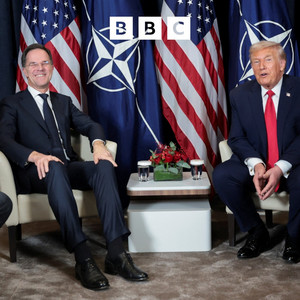
Donald Trump has rode back on threats to apply trade tariffs on countries opposing his ambitions to take over Greenland, after what he called a very productive meeting with the head of NATO.
Three activists who organized an annual Tiananmen Square vigil in Hong Kong before it was banned have gone on trial, facing national security charges.
Also in this podcast, which country do you think manufactures the most cars per capita?
Slovakia is really in the heart of Europe, quite well connected to the big markets.
Slovakia gives us access to a skilled local workforce.
Slovakia, the small country that's a major car manufacturer.
We're starting with the latest on what appears to be a major political U-turn.
For weeks, Donald Trump has been setting off warning bells in Europe saying the United States needs to acquire Greenland.
And he began his day at the World Economic Forum in Switzerland by repeating his strategic desire for what he described as a big, beautiful piece of ice.
But he was already softening his stance.
He ruled out using military force to seize Greenland.
Then, hours later, a big breakthrough.
Mr Trump wrote on social media that he'd formed the framework of a future deal with respect to Greenland and the entire Arctic region.
He added that he was dropping his planned extra tariffs on some European nations after what he described as a very productive meeting with NATO Secretary General Mark Rutte.
But the president offered few other details when speaking to journalists.
Here he is talking to the American network CNBC.
Well, we have a concept of a deal.
I think it's going to be a very good deal for the United States, also for them.
And we're going to work together on something having to do with the Arctic as a whole, but also Greenland.
And it has to do with the security, great security, strong security and other things.
The tariffs are off.
Nothing happens on February 1st.
No, we took that off because it looks like we have.
Pretty much the concept of a deal.
A deal of ownership?
Well, it's a little bit complex, but we'll explain it down the line.
But the Secretary General of NATO and I and some other people were talking, and it's the kind of a deal that I wanted to be able to make.
Where does Denmark, did they weigh in on what they want, what they would agree to?
Well, I assume they did because he very much represents, he's a strong leader.
Mark, you know Mark.
Yeah.
And I assume he's been speaking to them.
He's been speaking to all of them.
Are mineral rights involved?
Is ownership involved?
Did the Golden Dome sway people?
I don't want to say yet.
European leaders have welcomed President Trump's apparent climb down.
Denmark, which controls the semi-autonomous territory, said the day had ended better than it started.
Mr Trump mentioned Mark Rutte.
He was asked on Fox News whether Greenland would still be part of the Kingdom of Denmark under the proposals.
That issue did not come up anymore in my conversations tonight, Mr. President.
We very much focused on what do we need to do to make sure that that huge Arctic region, where change is taking place at the moment, where the Chinese and Russians are more and more active, how we can protect it.
I asked our correspondent in Washington, Helena Humphrey, what we know about this potential deal.
I think it's fair to say there was a sigh of relief, I'm sure, from European leaders in Davos.
But that will be replaced by so many question marks right now, because we just don't know exactly what Donald Trump is coming away with.
He hasn't put any more flesh on the bone when it comes to those details.
And so if you take a look at the language on Truth Social, he called this a framework for a deal.
This implies negotiations.
How long will they go on for?
What's in a framework?
Will this have to go through Congress for approval, depending on what is in this?
I think perhaps we could see greater Arctic cooperation.
That might be something that he might tout as a win to the American public, as some kind of perhaps off-ramp here.
But it is also worth remembering.
Denmark has long said, and has repeated in recent weeks, that The United States can also always upgrade the number of troops that it has on Greenland.
That has been in place under an agreement since 1951.
And so we are waiting to find out still what exactly is new here.
Helena, what's been the reaction to this whole episode from inside the United States?
You mentioned a sigh of relief coming from European leaders.
How are Americans reacting?
I think there is a sigh of relief all round.
I think some people were feeling quite bewildered by this.
I think, as you say, people's heads have been spinning.
They've been wondering what exactly has happened the past few hours.
But I think there's also a note of caution here in the He has said it would be a great deal if it's consummated.
This is conditional.
It suggests that this is less a final settlement, but perhaps more of a tactical pause here.
You know, Donald Trump is seeing this as a win.
He's keeping that leverage.
But I think, both in kind of Congress on Capitol Hill and among the US public, they know that Donald Trump is someone who can leave that door open to reapply pressure if he doesn't get the deal that he's looking for.
Interestingly, the Secretary General of NATO, Mark Rutte, appears to be the one who managed to bring some calm to the situation when, for so long, there were concerns that the president didn't value the role of NATO.
Where do you think that leaves us?
I think it's very interesting.
I think Mark Rutter has a warmer relationship with Donald Trump than some other European leaders.
Donald Trump recently has been leaking private messages and he seems to have warmer exchanges with Mark Rutter.
Was Mark Rutter trying to reassure Donald Trump that NATO would absolutely be there for the defence of America?
Were that the case?
Because remember, during that Davos speech from President Trump, he said I'm not even sure that NATO allies would be there for us.
And I think that was difficult for NATO allies to hear because, as we all know, the one time that Article 5 was triggered you know, an attack on one is an attack on all was in the wake of 9-11.
And we did, of course, see NATO troops deployed alongside US forces to Afghanistan.
And they were there.
But Mark Ritter, coming out in Davos today, seemingly being the person that could reassure Donald Trump and walk him back a little bit from the brink when it came to Denmark and Greenland.
I appreciate that we don't know all the details of what's been agreed.
But has this whole episode weakened Donald Trump?
That's a very good question.
I think essentially it just means that Europeans are in a position where they remain wary of where the transatlantic relationship stands right now.
That has reinforced perhaps some of their questions and doubts.
The fact that they are seeing very clearly that security and trade are linked, that tariffs are used as leverage, even against Europe allies.
And I think it reinforces the idea that, you know, Donald Trump can be a very unpredictable leader.
And I think actually that unpredictable nature is making him seem, and appear to be such a powerful negotiator on the world stage.
Well, some positive news for the U.S. president.
There have been some major developments in Donald Trump's efforts to build a new international organization that was first announced last September.
The Board of Peace was initially focused on establishing long-term peace in Gaza and the wider Middle East.
But later, Mr. Trump indicated it would also tackle other conflicts.
On Tuesday, he said it might even replace the United Nations.
In a joint statement released Tuesday, seven countries, including Saudi Arabia, Turkey and Egypt, say they'll join the organization.
There are reports that Russia is considering whether to sign up, too.
So what more do we know about this new grouping and who else has been invited to join?
Our Middle East analyst is Sebastian Ascher.
We still don't 100% know when Mr Trump first presented.
It did seem that it was already locked into Gaza.
Since then, we've seen several other boards splinter, and above them is the Board of Peace, which has now morphed into something which could be much wider.
It's being presented by the Trump administration as something that can oversee the conflicts across the world, moving away from Gaza.
And we've heard from a number of world leaders that they've received invitations.
President Putin, his spokesperson, saying that they're looking into it.
But if it's a potential replacement for the UN Security Council, that's not what we're interested in.
Hungary, Argentina, Morocco, Vietnam, Belarus have joined up.
Israel has joined up.
There was some speculation that Benjamin Netanyahu wouldn't want to because there would be people on the board of peace that he wouldn't want to be in the same room as.
Because it's quite a complicated structure, although Mr Trump does seem to have overarching powers over this whole body.
That's how it is.
It seems almost to be boiling down to one man will now have that veto for everything across the world, if this develops into a genuine powerful entity that has a role, that fulfills some of what the UN has been doing, which I think is certainly what President Trump and his administration would be looking at.
And they would essentially like the UN, in so many areas, to be replaced, Gaza being the first one of all.
There are wider questions about the credibility of this port, given that Russia, which invaded Ukraine, has been invited to be on it, and given that member countries are being asked to cough up a billion dollars each if they want permanent membership.
Of course, that's a huge issue.
You look at the UN, that is many countries obviously pulling in different directions.
Critics would say this is designed to undermine the UN, which is the big arbiter of global security since the Second World War.
Oh, absolutely.
There's no doubt.
However, this may have been stated publicly that this is being projected as a way of bypassing the UN and that role that it's played.
Sebastian Usher talking with Jannat Jalil.
And you can watch that full interview on the BBC's YouTube channel under the podcast section.
Select Global News Podcast. to the Chinese territory of Hong Kong now.
Years ago, before the Chinese authorities imposed strict security laws there, large crowds used to gather to remember what happened in Beijing in 1989, when the Chinese military killed pro-democracy demonstrators by Tiananmen Square.
Now, the organizers of those Hong Kong vigils are going on trial.
They're facing charges under the national security laws that have effectively shut down all political opposition to the ruling.
Communist Party.
Our correspondent in Hong Kong, Martin Yip, spoke to me from outside the Hong Kong courthouse and told me about the three activists involved.
We have in the dock today Albert Ho, a veteran solicitor and a pro-democracy lawmaker, alongside with his fellow Li Zijian, a veteran trade unionist, also a former legislator, and Xiao Hantong, a barrister, sitting in the counsel's bench because she's defending herself.
She's not hiring any lawyers and just this morning, as the trial began, albert hall have pleaded guilty to this charge of incitement of subversion.
That's prescribed under the beijing imposed national security law of hong kong and as an incitement charge it would carry a maximum jail time of 10 years if found guilty, and albert hall is facing exactly that.
But Martin, we have to remember how big these annual Tiananmen vigils were in Hong Kong.
I covered a few of them as a correspondent.
They were big public events at the time.
This trial shows just how much things have changed there.
Indeed, because in the past we would have been talking about tens of thousands or a hundred thousand or so people at Victoria Park in the heart of Hong Kong participating in this very candlelight vigil every year in the evening of the 4th of June to mark what happened in and around Tiananmen Square in 1989 the crackdown against pro-democracy movements mostly led by students.
And since the national security law was introduced in June 2020, there were no candlelight vigils, no more.
And it also happened at a time when COVID-19 struck the city.
So it's pretty convenient in one sense for the government to have both things introduced, so no more vigil of this kind could happen.
And today in the court, just as we speak, the prosecutors are arguing that by calling for an end to the one-party state in China,
They are committing subversion because the leadership by the Communist Party of China for this country, the People's Republic of China, is written in the foreword of the Chinese constitution.
So they are arguing that by calling for this end of one-party state, by spreading words about what happened in Tiananmen Square, the defendants were inciting hatred among Hong Kong people against the Chinese state.
Now, when we think of the big car manufacturing nations, countries like Japan, the US, Germany and other Western European nations usually spring to mind.
So you might be surprised to learn that across the world Slovakia, in Eastern Europe, makes the highest number of cars per capita almost a million vehicles a year for a population of just 5 million.
Some of the biggest car manufacturers now have factories there, with Volvo the latest to join the growing list.
John Lawrenson travelled to Slovakia to find out why this small nation has become a car-making powerhouse.
This is the European factory of the Korean car manufacturer Kia, just outside the Slovak city of Jilina.
When Slovakia was part of the Czechoslovak Socialist Republic.
The cars it made were, by Western standards shoddy noisy, thirsty and slow.
But after the Velvet Revolution, a non-violent transition of power in 1989 sent its communist rulers packing and the Czechs and Slovaks agreed to split into two independent countries.
Volkswagen bought and overhauled the old Czechoslovak carmaker.
Skoda and other foreign automobile manufacturers moved in too.
Peugeot Citroën, now Stellantis, Kia, Jaguar Land Rover and now Volvo.
Peter Prokop is the Czech-German head of GIV, a management consulting firm that advises clients in the automotive sector.
The labor cost was 20% of the labor cost in Germany.
On one hand, you have still lower wages.
I would say 60% of the Western wages in Eastern Europe still.
But you have also high productivity, so it's definitely competitive.
At the end of the assembly line I see a car driving around that is completely swathed in padded cloth.
It's their new all-electric vehicle, the EV2, which will go into production in February.
The president and CEO of Kia Europe is a Frenchman called Marc Andriche.
I asked him why Slovakia.
Slovakia is really in the heart of Europe, quite well connected to the big markets.
The quality of the manpower was also, let's say, very important.
So Slovakia gives us access to a skilled local workforce and high quality supplier.
Slovakia also offers inducements that cover a significant proportion of investment costs.
Robert Sermoncic is CEO of the Slovak Investment and Trade Development Agency.
It could go from like 20 to 40 or 50 percent potentially.
Now Slovakia prefers tax evocation more than cash grants because that's more palatable for the country.
Slovakia offers this because the benefits are enormous.
The mayor of Žilina is Pita Fiabane.
It has been a huge decline in unemployment and a significant increase in the economic strength of the region.
And today more than 20000 people are directly employed by Kia and other companies that are linked to Kia by production.
What is happening in Slovakia is also happening all over East Central Europe.
In this part of the EU.
Low wages, a tradition of industry and educating to provide manpower for industry, mixed with Western and Asian technology and management, is proving a winning combination.
John Lawrenson in Slovakia. still to come in this podcast.
It's fantastic.
This is really quite something because it's showing us how people are moving around the world.
A hand shape in an Indonesian cave, maybe the world's oldest known cave art.
If journalism is the first draft of history, what happens if that draft is flawed?
In 1999, four Russian apartment buildings were bombed, hundreds killed.
But even now, we still don't know for sure who did it.
It's a mystery that sparked chilling theories.
I'm Helena Merriman and in a new BBC series I'm talking to the reporters who first covered this story.
What did they miss the first time?
The History Bureau, Putin and the apartment bombs.
Listen on BBC.com or wherever you get your podcasts.
This is the Global News Podcast.
To the US now.
Ghislaine Maxwell is currently serving a 20 year prison sentence for her role in Jeffrey Epstein's illicit world, including the sex trafficking of underage girls.
She's reportedly indicated that she would be willing to testify before a US congressional committee about her knowledge of Epstein's activities.
Our U.S. correspondent Peter Bowes told me why the committee would want to hear from Ms.
Maxwell.
Ghislaine Maxwell is the British former socialite widely known for her association with Jeffrey Epstein.
She was convicted just over four years ago on charges including sex trafficking of minors and conspiracy.
She played a key role in recruiting and grooming young girls for Epstein and facilitating his crimes.
The committee wants to hear from her in the hope that she will shed light on the scope of what Epstein did, perhaps identify others who may have been complicit or aware of his crimes, and perhaps shed light on how he managed to evade scrutiny for such a long period of time.
So it seems though, that she's listed a string of demands attached to her, her appearance, her testimony.
Are they public knowledge?
Yes, they are.
Her legal team has previously said that she would decline to answer questions under her constitutional right to remain silent unless she is granted legal immunity.
Now, in July, the committee declined to agree to that.
Her lawyers have said that she will invoke her right against self-incrimination if forced to testify without protection.
So we'll see what happens.
Other demands reportedly are that she gets access to the committee's questions in advance.
Also, a suggestion reported that her demands could include a change of location for the deposition.
And she has reportedly offered full cooperation in exchange for clemency or a pardon from President Trump.
And how likely is that?
Could President Trump pardon her?
Would that be even politically possible for him?
Well, technically possible, but whether politically plausible or politically prudent on the part of President Trump, that is open to a big question.
Her only route to leave prison early would be a presidential pardon, unless she is able to persuade a judge to amend her sentence.
The White House has denied that Donald Trump is considering granting her clemency.
However, Mr. Trump himself has said that he has not ruled it out.
And just briefly Peter, what's the latest about the former President, Bill Clinton, and the former Secretary of State, Hillary Clinton, and their appearance in front of the committee?
Yes, well, they have offered to cooperate with this committee but have refused to testify in person.
Of course it's well known that Bill Clinton flew on Epstein's plane.
Several times has said that he knew nothing about his criminal activity.
The Clintons have said that they believe that the committee's investigation is a partisan exercise aimed at protecting President Trump.
For its part, the committee, which is Republican-led, has recommended contempt proceedings against Bill and Hillary Clinton.
The next stage of this is in the full House of Representatives, also majority Republican, which will now decide whether to refer the Clintons to the Justice Department for possible criminal prosecution.
To Ireland, where Michael O'Leary, the chief executive of the low-cost European airline Ryanair, has described his recent spat with the billionaire Elon Musk as great for bookings.
He's even offered the US tycoon a free ticket to thank him for what he said was a wonderful publicity boost.
More from our business correspondent, Theo Leggett.
Over the past week, Michael O'Leary has described Elon Musk as wealthy but an idiot and called his social media network ex a cesspit.
Mr Musk responded with offensive terms of his own and asked his online followers whether he should buy Ryanair and replace Mr O'Leary with someone called Ryan.
The row erupted after the airline said it wouldn't buy a satellite internet system from Mr Musk's Starlink company because it would be too expensive and passengers wouldn't pay for it.
Mr Musk disagreed.
Both businessmen are renowned for being publicity hungry, and Mr O'Leary made it apparent he at least wasn't taking matters entirely seriously.
Meanwhile, Mr Musk might struggle to take control of Ryanair, even if he wants to, because under EU law, European airlines have to be majority owned by Europeans.
Feel like it.
Well, staying with planes.
If you've ever watched Leonardo DiCaprio's 2002 film, Catch Me If You Can, based on the true-life tale of the prolific con artist Frank Abagnale Jr, this next story might sound familiar to you.
A Canadian man has been accused of posing as a pilot to get hundreds of free flights.
Our reporter Anna Aslam told us more.
Just like the movie.
Dallas Pokornik, a 33-year-old Canadian, is accused of using a fake employee card to get free flights on US airlines.
Now, he did work as a flight attendant between 2017 and 2019, but he left the job and wasn't employed by an airline at the time of the alleged fraud.
So you probably know a lot of commercial airlines offer discounted or free travel to pilots or other staff if there's space.
McCormick is accused of using a fake badge and insider knowledge from his old job to book these free tickets.
Prosecutors allege he's sometimes even asked to sit in the jump seat in the cockpit reserved for off-duty pilots.
The airline he worked for and the three he's accused of fooling haven't been named, but many industry experts are understandably concerned by how he could have potentially got through all the checks and security.
And he was eventually caught.
He was arrested in Panama last week and extradited to the U.S.
Prosecutors allege Pokornik was running the scheme for four years, but he's only been indicted for a 10-month period.
He pleaded not guilty to two counts of wire fraud on Tuesday.
If convicted, he faces up to 20 years in prison and a fine of a quarter of a million dollars.
Anna Haslam.
And some incredible news that could tell us about the birth of human creativity.
Researchers say they found the world's oldest known cave painting.
And it's on the Indonesian island of Sulawesi.
The artwork is a red outline of a hand that's been changed to resemble a claw.
Researchers say it dates back at least 67800 years, so up to 1100 years older than paintings in Spain that, until now, were the earliest ones on record.
Jill Cook is from the British Museum, and she's a specialist in Ice Age art and human evolution.
It's a terrific discovery made by the Griffiths University from Brisbane in Australia, who have been pursuing research on Sulawesi for a little while.
And a few years ago now, they made a wonderful discovery of an animal drawn on a cave wall, as well as hand stencils.
And now working on a different part of the island, they've made some more discoveries with scientific dating, taken the date of those discoveries back even further.
So what does this mean?
I mean had the presumption be that art started in Europe, and all those who sort of said well, you know, this is the origin story, the home of art is Europe.
I mean, that's all been blown out of the water, right?
Well, yeah.
I mean, when you've got no evidence from anywhere else, that's how it looked.
And because most of the work was going on in Europe, which is where the museums and universities were.
That was how it looked.
And then a few years ago we had huge discoveries in Southern Africa, not of cave art but of symbolic thought in painting and drawing on small objects and jewellery, so decorative arts.
And now the Australian universities have got involved.
The global south is coming into the picture.
People like me who don't know much about this may have thought that sort of the development of art was kind of done in a linear fashion.
But this suggests something else that the need to create art and human beings' ability to use their imagination can sort of spring up anywhere.
Yes, that's absolutely true.
I mean, there's a tendency to sort of think of this as evolutionary.
Well, of course, art isn't a biological organism.
It doesn't evolve.
And the surprising thing always with art is that when it appears, it's always so fully formed.
It doesn't go through the sort of developmental stages that you see, for example, as a child is learning to draw.
So it always appears fully formed.
And it does so because it comes when people need it.
What art does for us is part of our way of communicating and symbolising our world.
It may be about anxieties.
It may be about joy and happiness.
It may be about what we believe.
It can be about so many things, but we do it when we need it.
Jill Cook speaking to James Menendez.
And that's all from us for now.
But there will be a new edition of the Global News Podcast later.
If you want to comment on this podcast or the topics covered in it, you can send us an email.
The address is globalpodcast at bbc.co.uk.
You can also find us on X at BBC World Service.
Use the hashtag Global News Pod.
This edition was mixed by Derek Clark.
The editor is Karen Martin.
I'm Celia Hatton.
Until next time, goodbye.
If journalism is the first draft of history, what happens if that draft is flawed?
In 1999, four Russian apartment buildings were bombed, hundreds killed.
But even now, we still don't know for sure who did it.
It's a mystery that sparked chilling theories.
I'm Helena Merriman and in a new BBC series I'm talking to the reporters who first covered this story.
What did they miss the first time?
The History Bureau, Putin and the apartment bombs.
Listen on BBC.com or wherever you get your podcasts.