Hello, everyone.
Welcome or welcome back to my channel.
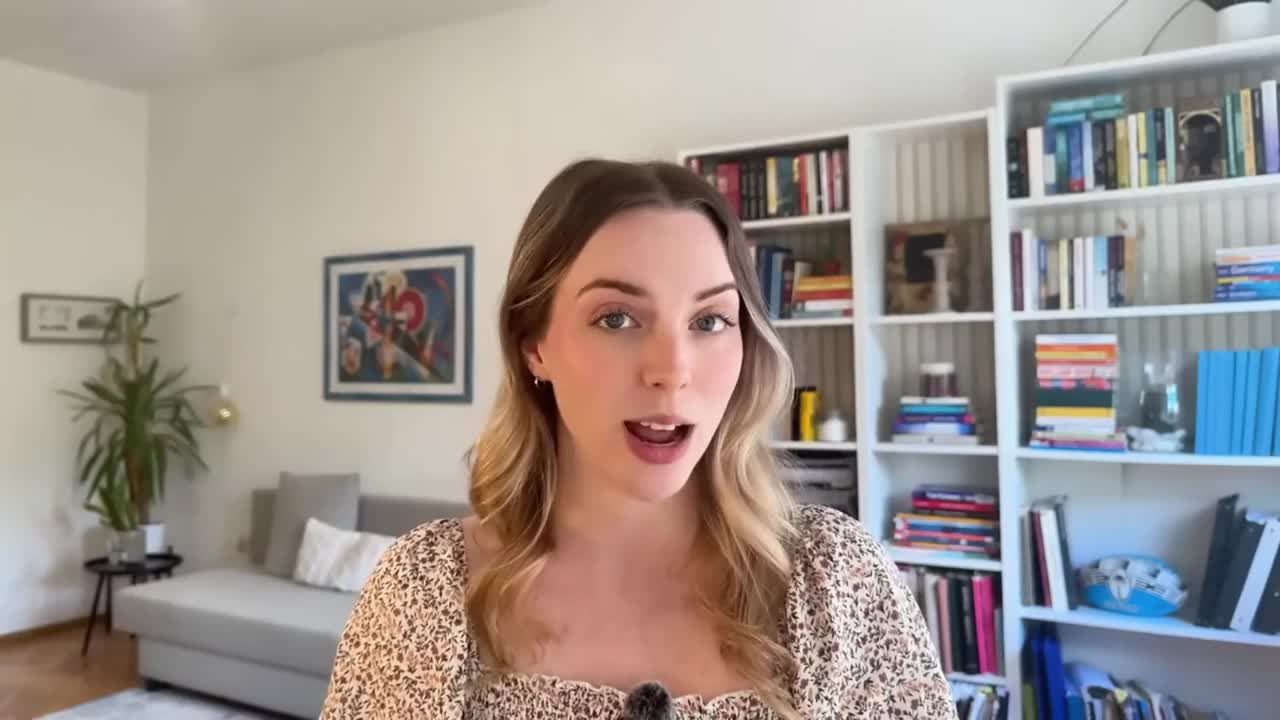
I'm English teacher Claire, a native speaker from the US and English teacher.
If you are practicing shadowing to sound more fluent in English, but you aren't really seeing results, you may be doing it wrong.
In this video I'm going to clarify how to shadow the right way so you don't just mindlessly repeat words, but you actually start to sound more natural, fluent or like a native speaker when speaking.
At the end, you will shadow a short English text with me.
So let's get started.
First of all, what is shadowing?
If you haven't tried it before, shadowing is when you listen to a native speaker and speak at the same time or slightly after, mimicking their tone, rhythm and pronunciation of the words.
Now, when shadowing is done correctly, It will train your brain, your ears and your mouth all at once.
But it only works if you do it right.
So let's go over my top five tips to improve fluency through shadowing.
So my first tip is to use audio that matches your level or is even slightly easier than your level.
You don't just want to parrot sounds without really understanding what you're saying.
If it's too hard, you'll burn out fast.
So make sure the speaker or the text or the clip from the TV show is at a level that is either easier than your current level or right at your current level, so you don't get overwhelmed if it's too difficult.
My next tip would be when you're first starting out practicing shadowing is to use a transcript.
This helps connect what you see written on the page with what you are saying in English.
And it's okay to read along with the text when you are shadowing at the beginning or for the first time.
Over time you can move away from the text and train your ears.
So for today's shadowing practice, at the end i have attached a transcript of it in the description of this video, so be sure to click the link.
All you have to do is put in your name and email to sign up and get your free transcript from today's lesson.
Okay, my third tip, and this is probably the most important one when it comes to shadowing, is to focus on the intonation.
Don't just copy the words, copy the melody of the speaker's speech.
So when the intonation goes up, make sure you go up.
And when it falls down, you want to follow that trend as well.
So we can think of the language kind of having a musical rhythm to it.
And so much about sounding natural isn't necessarily about getting rid of any accent you may have.
It's about getting the pitch and the stress of both the words and the full sentences correct.
So if you focus on the intonation and the stress over anything else, that is going to be your best tool for sounding natural in English.
Tip number four.
This one might seem a little bit weird, but it is a.
One of my tips would be to walk while you shadow.
Walking helps you focus and it gets the whole body involved.
Try it during your next shadowing session.
Practice walking as you shadow the speaker and see how that helps.
My final tip, tip number five, is to record yourself.
Now, for some of you, this one might feel a little uncomfortable to record yourself, But trust me, it's really helpful in getting feedback on how you're doing.
If you have a recording of yourself saying the text and the original recording of the speaker you shadowed, you can compare how your intonation matches theirs.
Now, if you're thinking it would be really great if I could get a native speaker to give me feedback on my shadowing recording instead of just myself, I offer that in my community to my community members.
So the link to join my community is also in the description of this video.
And that's where you'll find all of my course material, exclusive video lessons.
You can access live calls with me every week and also be a part of a community of English learners, so check that out below.
If you've enjoyed this video so far, be sure to click the like button and subscribe to my channel if you haven't already so you can see my future video lessons and, of course, share it with a fellow English learner.
Now, if you want to put these tips for shadowing into practice, Let's begin with the shadowing practice for today's video.
I'm going to read a short story about a Zoom call that has gone wrong.
So we will also learn some handy phrases for in the work environment, while also practicing our intonation and pronunciation of the language.
It was Monday morning and our weekly team meeting had just started on zoom.
It was Monday morning pause after the comma and our weekly team meeting had just started on zoom.
Intonation goes down at the end of a sentence.
I logged in a minute early, but of course, Half the team was still connecting.
I logged in a minute early.
Logged in means to begin the call or put in your details in order to join a website or a call.
But of course, half the team was still connecting.
The team being the people you work with.
Our manager, Lisa, was already speaking.
Our manager, Lisa, always pause when you see a comma.
So before and after Lisa, I did a small pause.
Our manager Lisa, was already speaking, but her audio kept cutting in and out.
But her audio kept cutting in and out and out and out.
We drop the ending of and and it allies with the next word when it starts with a vowel.
When someone's audio cuts in and out, it means that the audio is not consistent.
Sometimes we hear it, sometimes we don't.
You're on mute, someone typed in the chat.
You're on, you're on.
These words also allied together.
You're on becomes you're on.
You're on mute, someone typed in the chat.
A few awkward seconds later, she came back with, can everyone hear me now?
A few awkward seconds later.
Awkward means something that's uncomfortable, because it's not exactly what people usually expect or how you would want a social interaction to go.
If it's awkward, it's just a little uncomfortable.
She came back with, To come back with something means to give that response.
Can everyone hear me now?
Can everyone hear me now?
The intonation goes up because it's a question.
Can everyone, can everyone, can, can becomes can.
Can everyone hear me now?
We all nodded.
The one person's video was frozen on a weird face.
We all nodded.
Pause at the comma.
The one person's video was frozen on a weird face.
If your video is frozen, it means you stop moving.
And if you're making a weird face, that would be a weird face.
And another was clearly eating cereal off screen.
And another was clearly eating cereal off screen.
Off screen means we couldn't see them on the video, but clearly they were eating their breakfast at the meeting.
Maybe you could hear it, or it was obvious to everyone else.
They were doing this, but you couldn't see them on camera.
Then just as we started discussing the quarterly goals.
You'll notice here my intonation each time is floating up a bit, because I always have to take pauses after the comma.
And I want to indicate that I'm still continuing my sentence.
We don't want monotone.
Then just as we started discussing the quarterly goals, Alex microphone started.
It starts not to become understandable.
That's why intonation is so important.
Then, just as we started discussing the quarterly goals, Alex's microphone started making that awful robotic sound.
A robotic sound means a sound you might hear from technology, maybe when it's not functioning correctly or it sounds unnatural like a robot or like a computer.
Lisa tried to be polite.
Lisa tried to be polite, but eventually had to say, Alex, I think your connection's a bit unstable.
Alex, I think your connection's a bit unstable.
If someone has an unstable connection, it means their internet is not very good.
Alex dropped out of the call completely.
Alex dropped out of the call completely.
To drop out of a call online means to lose connection to that call, means to leave the call unexpectedly.
Then rejoined with a different background and said.
Then rejoined with a different background and said.
Again, we want to emphasize or stress the words that are most important in the sentence.
Here we're pointing out his background is different.
So we can stress that word.
Then rejoined with a different background and said, sorry, my cat stepped on the router.
Sorry, my cat stepped on the router.
A router is that device where you get wifi.
We all laughed and the tension eased a bit.
We all laughed and the tension eased a bit.
Tension eased a bit, eased a bit, eased a bit.
All of those sounds allied together eased, eased a bit a bit and the t is a stopped t sound.
So We often wouldn't speak like eased a bit and emphasize each or pronounce clearly each consonant.
But we allied through when there's a vowel between two consonant sounds.
And we often drop the T at the ends of words in the American accent.
And the tension eased a bit.
Tension is referring to that awkwardness we had earlier on in the story.
So if there's tension in a conversation, maybe it's because of awkwardness.
Maybe it's because someone's upset or angry.
And if the tension eased, that means the tension went away a little bit.
We somehow made it through the whole agenda.
We somehow made it through the whole agenda.
And as we wrapped up, there's a new idea being introduced, so my intonation goes up.
And as we wrapped up, Lisa smiled and said Lisa smiled and said all right, I'll follow up with the notes.
All right, I'll follow up with the notes.
To follow up with something means to contact someone again about something that was previously discussed.
So to follow up with a conversation or to follow up with notes on a meeting means to visit them again.
All right, I'll follow up with the notes.
Assuming the wifi gods are on my side today.
Assuming the wifi gods are on my side today.
To say the wifi gods are on my side is a kind of amusing or funny way to say that the wifi is working for me that day.
You could use this for different situations as well.
Maybe, if your shadowing practice is going really well, you could say the shadowing gods are on my side today.
Okay, now we're going to read the whole thing without stopping.
And this time you will practice shadowing along with me.
So of course that means to say it at the same time as me or just slightly behind me, to make sure you are matching my intonation, rhythm and pronunciation of the words.
It was Monday morning and our weekly team meeting had just started on Zoom.
I logged in a minute early, but of course, half the team was still connecting.
Our manager, Lisa, was already speaking, but her audio kept cutting in and out.
You're on mute, someone typed in the chat.
A few awkward seconds later, she came back with, can everyone hear me now?
We all nodded, though one person's video was frozen on a weird face and another was clearly eating cereal off screen.
Then, just as we started discussing the quarterly goals, Alex's microphone started making that awful robotic sound.
Lisa tried to be polite, but eventually had to say, Alex, I think your connection's a bit unstable.
Alex dropped out of the call completely, then rejoined with a different background and said Sorry, my cat stepped on the router.
We all laughed, and the tension eased a bit.
We somehow made it through the whole agenda and as we wrapped up, Lisa smiled and said All right, I'll follow up with the notes, assuming the Wi-Fi gods are on my side today.
Let me know how today's shadowing practice went for you in the comments below.
Don't forget to click the link to get your transcript of today's story so that you can practice reading along as well as shadowing me at the same time, if that would be helpful to you.
I also included the English words and phrases that we learned as we went along in today's shadowing practice, so that you can practice studying those terms as well and build your vocabulary.
If you want to see more shadowing videos for me, check out my shadowing playlist.
And again, there's lots more where that came from, also with personalized feedback that you can find in my online community, also linked below.
I'll see you guys next time.
Happy learning.
Bye.