Yes, I'm so excited to practice speaking English with you.
Are you ready?
Let's do this.
Now, if you're a basic English speaker, listen to me and then repeat after me.
If you're advanced, try to shadow me and match my pronunciation.
I know I'm going to go a little slow and exaggerate some parts, but that's good practice.
Good practice, all right?
First pattern.
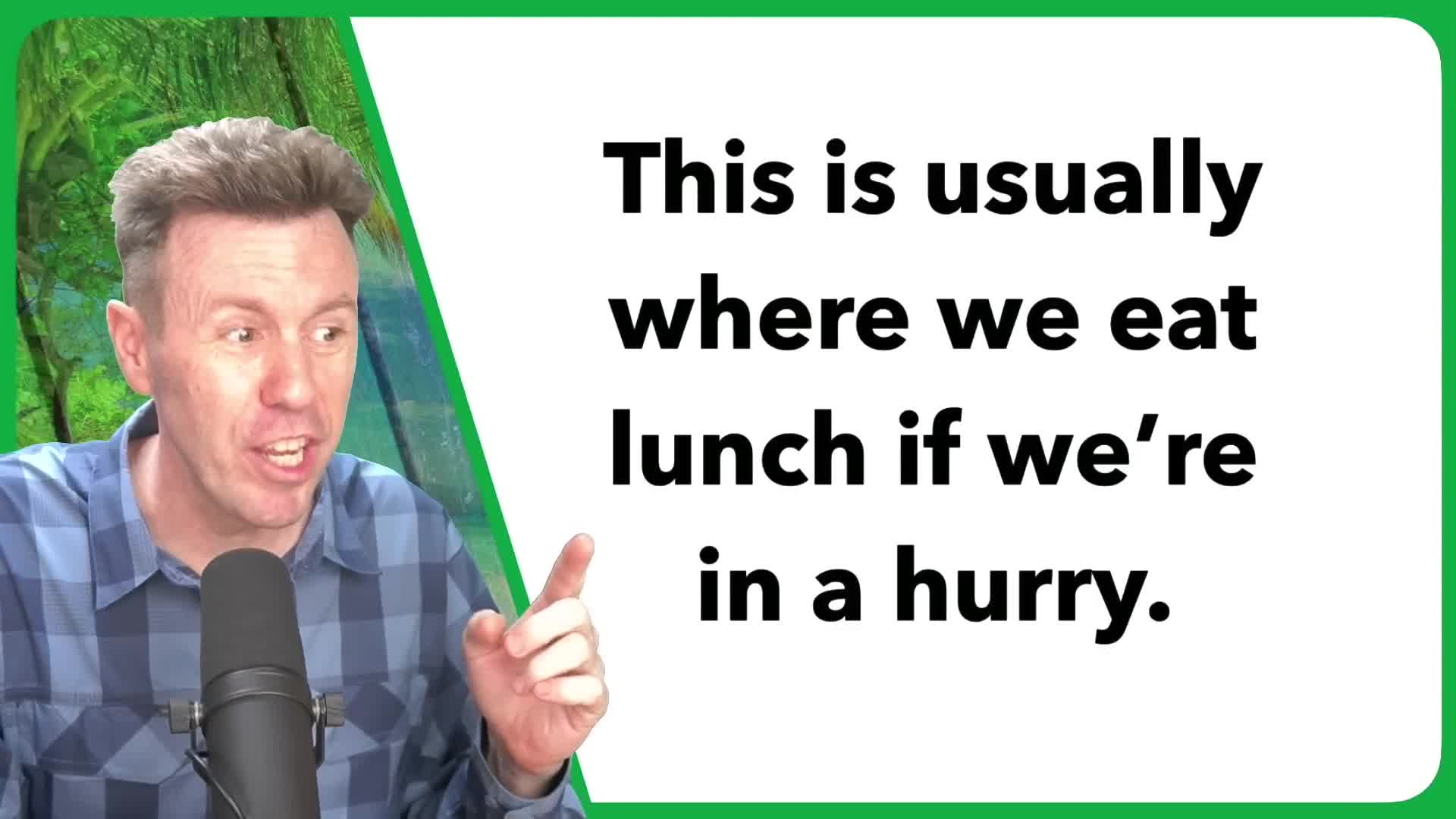
This is usually where we eat lunch if we're in a hurry.
If we're in a hurry, if we're in a hurry.
If we're in a hurry, if we're in a hurry, you can start your sentence there.
If we're in a hurry, this is usually where we eat lunch, period.
All right, next one.
This is usually where we catch a cab if we need one.
This is usually where we catch a cab if we need one.
A cab if we need one.
If we need a taxi, a cab, a taxi.
If we need a taxi, this is usually where we catch it.
We catch it here.
So you can say an Uber or you can just say a ride.
Let's try the next one.
This is usually where we take the kids to play when the weather is good.
This is usually where we take the kids to play when the weather is good.
Yeah, we take the kids to play here.
Maybe it's a park.
Maybe it's a beach.
Maybe it's just a nice place to play.
This is usually where we take the kids to play when the weather is good.
This is usually where we put them if a customer accidentally leaves one behind.
This is usually where we put them if a customer accidentally leaves one behind.
If a customer accidentally leaves one behind.
You don't even need the accidentally.
If a customer leaves one behind, if you forget, if you lost it, you forgot, you accidentally left it, then they will take that item and put it in a lost and found box.
So sometimes you can go say, excuse me, do you have a lost and found?
And if they have a place where they put it items that are accidentally left behind.
It's called a lost and found.
All right, bonus lesson.
Next pattern.
Are you sure you want to do that?
Are you sure you want to do that?
Are you sure you want to do that?
Are you sure?
Are you sure?
I know I kind of mix up my pronunciations on that sometimes, don't I?
I'm sorry.
Are you sure?
Are you sure?
It's regional in America.
Some people will say sure and sure, sure, sure.
So just say what's best for you.
Are you sure?
Are you sure about that?
Yeah, I'm sure.
Are you sure this was the last place you used it?
Are you sure this was the last place you used it?
Was this the last place that you used it?
Are you sure about that?
Are you sure he's telling you the truth?
Are you sure he's telling you the truth?
Are you sure he's telling you the truth?
He might be lying.
Are you sure there's no other way to solve the problem?
Are you sure there's no other way to solve the problem?
Are you sure there's no other way?
Are you sure there's no other way to solve the problem?
Alright, next pattern.
If I were you, I'd look for another job.
If I were you, I'd look for another job.
Yeah, that's what I would do if I were you.
I would look for another job.
If I were you, I'd want to be me too.
Do you know that song?
That's a popular song.
Well, it was.
If I were you, I would want to be me too.
Did you get it?
Anyways, let's go on.
Ready?
Ready?
If I were you, I'd take a day off and just relax.
If I were you, I'd take a day off and just relax.
That sounds good.
If I were you, I'd take a day off and just relax.
If I were you, I'd go see a doctor before you get worse.
If I were you, I'd go see a doctor before you get worse.
Before you get worse.
Or you could say before it gets.
You'd have to say gets before it gets worse, before the problem gets worse.
If I were you, I'd check with the manager, just in case.
If I were you, I'd check with the manager, just in case.
If I were you, I'd check with the manager.
Just in case.
Just in case.
You never know.
Just in case.
Just in case the manager says it's not okay.
Or the manager says you can't do that.
So if I were you, I'd check with the manager.
Just to make sure.
Just in case.
Alright, next pattern.
I just can't understand why he fired me.
I just can't understand why he fired me.
I just can't understand why.
Why did he fire me?
I just can't understand it.
I just can't understand it.
I don't understand why he fired me.
I'm such a good employee.
I just can't understand why I'm so tired.
I just can't understand it.
I just can't understand it.
Why am I so tired all the time?
Oh, this one rings true to me.
I just can't understand why this cold won't go away.
I just can't understand why this cold won't go away.
What's that cold right there?
What is that talking about?
Is that talking about cold weather?
It could, but I think it's talking about the flu.
If you're sick, an illness.
I just can't understand why this cold, this cold, this flu, it won't go away.
I just can't understand why this TV isn't working.
I just can't understand why this TV isn't working.
I just can't understand why this TV isn't working.
I just can't understand why.
I just can't understand why this TV isn't working.
All right, next pattern.
I've been meaning to buy a new suit.
I've been meaning to buy a new suit.
I've been meaning to do it.
I've been meaning to.
I intend to do it.
I've been thinking about it.
I want to do it.
I've been thinking I should do it.
I've been meaning to do it.
I've been meaning to buy a new suit.
I've been meaning to call you but I haven't had time.
I've been meaning to call you but I haven't had time.
I haven't had time.
I'm so sorry I haven't called you.
I've been meaning to do it.
I've been meaning to call you but I haven't had any time to do it.
I'm so sorry.
I've been meaning to ask you about that.
I've been meaning to ask you about that.
I've been meaning to ask you about that.
I was curious.
I wanted to ask you.
I've been meaning to ask you about that.
I've been meaning to get one of those for myself.
Yeah, I want one of those.
I've been meaning to buy one, get one of those things for myself.
All right, next one.
I can help you look for one if you like.
I can help you look for one if you like.
Oh, you've been meaning to get one for yourself?
Well, I can help you.
I can help you look for one if you like.
If you want me to help you look for one, I can help you look for one.
I can help you carry that luggage if you like.
I can help you carry that luggage if you like.
If you like, comma, I can help you carry that luggage, period.
If you like.
If you want me to.
I can help you wash the dishes if you like.
I can help you wash the dishes if you like.
If you like.
I can help you wash the dishes.
I can help you pick one out if you like.
I can help you pick one out if you like.
I can help you pick one out if you like.
Would you mind doing that for me?
Would you mind doing that for me?
Would you?
Would you?
Would you?
Would you?
Would you mind?
Would you mind doing?
Doing?
Doing?
Would you mind doing that for me?
You're so kind.
Thank you so much.
Would you mind doing that for me?
Would you mind stopping at the store for me?
Stopping, stop by the store.
Would you mind stopping at the store for me?
Would you mind stopping at the store for me?
Would you mind stopping by the store for me?
I say it that way.
Would you mind stopping by the store for me?
Would you mind stopping at the store for me?
Hmm.
I think they might be both fine, but I say bye.
Stop by.
Would you mind stopping by the store for me?
All right, moving on.
Would you mind holding that door open for me?
Would you mind holding that door open for me?
My fingers are going away.
Hold the door open.
Hold the door open for me.
Don't close it.
Would you mind?
Hold the door.
Hold the elevator.
Would you mind reserving a locker for me?
Would you mind reserving a locker for me?
Would you mind reserving a locker for me?
If you don't mind, I would appreciate it.
If you like.
Alright, next pattern.
I don't mind doing that at all.
I don't mind doing that at all.
I don't mind.
I don't mind.
I don't mind doing that.
I don't mind doing that at all.
Not at all.
I don't mind giving you a ride this weekend.
I don't mind giving you a ride this weekend.
I don't mind giving you a ride this weekend.
I don't mind it, No problem.
I don't mind loaning you my notes from the lecture.
I don't mind loaning you my notes from the lecture.
I don't mind loaning you my notes from the lecture.
No problem.
I don't mind driving if we can take your car.
I don't mind driving if we can take your car.
If we can take your car, I don't mind driving.
I just don't want to take my own car.
I don't know why.
Alright, last pattern, here we go.
Just make sure you put it back when you're done.
Just make sure you put it back when you're done.
Just make sure you put it back when you're done.
After you use it, put it back where it belongs.
So, when you're finished, when you're done, when you're finished, make sure you return it to its proper place.
Just make sure you return this to me when you're finished with it.
Just make sure you return this to me when you're finished with it.
When you're finished with it, just make sure you return it to me, okay?
Just make sure you're making the right decision.
Just make sure you're making the right decision.
Just make sure you're making the right decision.
It's important.
Just make sure you lock the house when you leave.
Just make sure you lock the house when you leave.
Make sure you lock the house when you leave.
And boom.
That's it.
We did it.
Way to go.
Good job.
Good workout.
One step at a time, right?
Keep moving forward.
If you are persistent and consistent, you are bound to succeed.
That's it.
That's all there is to it.
Get all the steps.
EnglishCoachChad.com.
I'll see you in the next step.