Practical and natural spoken English.
Let's do some English speaking practice, shall we?
Let's jump into it.
Now, when you're learning English at the intermediate level, one of the biggest challenges is what is it?
What is one of the biggest challenges?
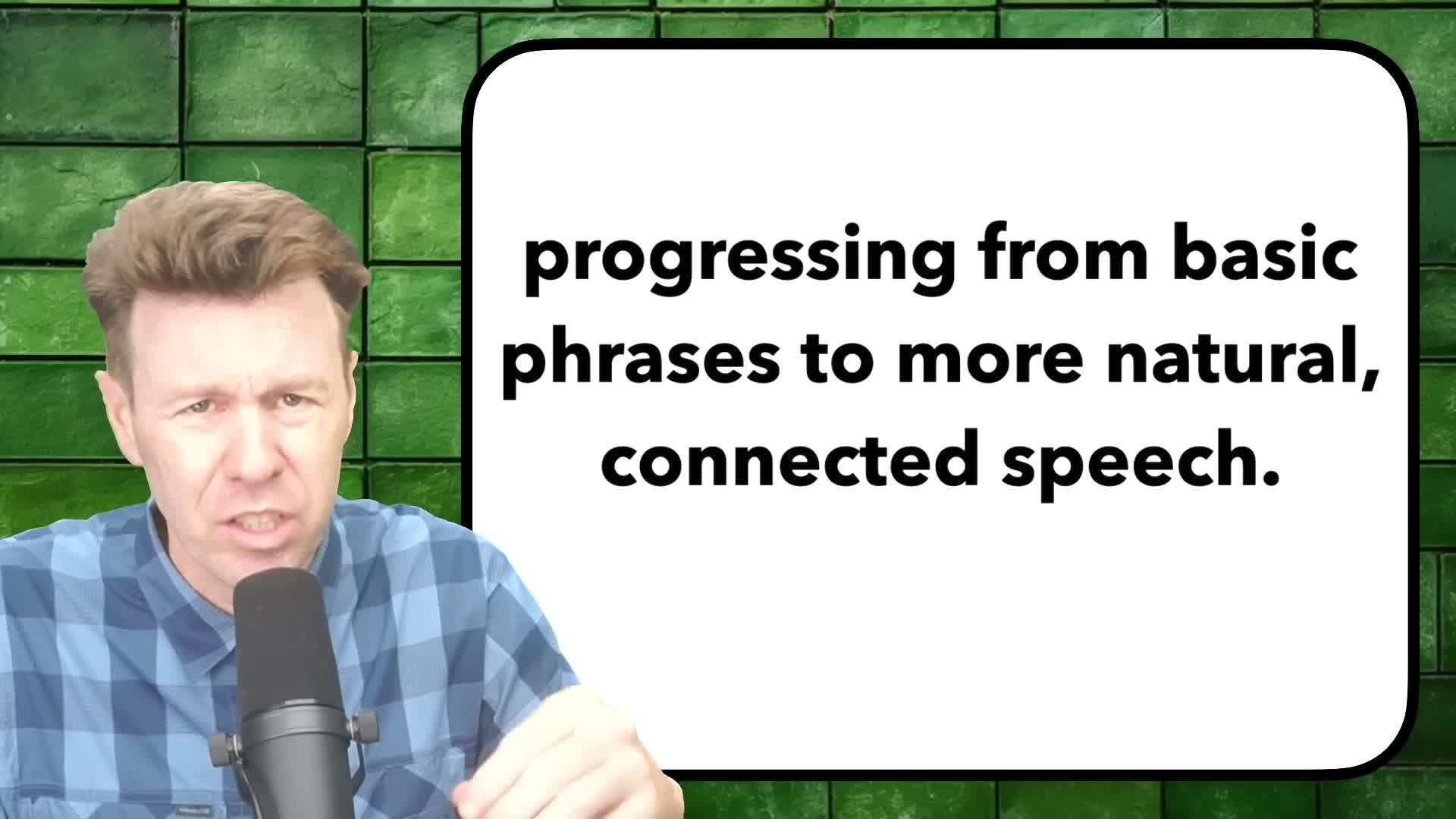
Progressing from basic phrases to more natural connected speech. to more natural connected speech.
You know, going to that next level, right?
It's not easy, I know.
You already know simple words and sentences and can probably introduce yourself.
Order food or ask for directions.
You can do that, right?
You probably already can do that using simple words and sentences.
Now you want to go further.
You want to go further.
You want to sound more confident and be able to express your thoughts smoothly, without hesitation, without hesitation.
I hesitated, so you want to do it without hesitation.
Let's say that one together.
Let's shadow this ready.
Now you want to go further.
You want to sound more confident and be able to express your thoughts smoothly without hesitation.
Good.
Let's start with something simple.
Imagine it's morning and you're meeting a friend.
They ask, how's your morning going?
How's your, how's your, how is your morning going?
How's your morning going?
Repeat, how's your morning going?
Is your morning going good?
You having a good morning?
Are you having a good morning?
You having a good morning?
Is your morning going good?
How's your morning going?
How's your morning going?
All right, we are practicing right now.
A beginner might simply reply, good, good.
My morning is good.
Fine.
But at the intermediate level, you should add more detail.
Because fluency comes from expanding your answers.
That's where the fluency comes from.
Expanding your answers.
Instead of just saying, good, you could say, what could you say?
Do you have any ideas?
How about this?
It's going well.
I woke up early today.
Had some coffee, so I feel awake.
All right, let's say this a few times together.
Ready?
It's going well.
I woke up early today.
Had some coffee, so I feel awake.
It's going well.
I woke up early today, had some coffee, so I feel awake.
All right, so did you notice that these are like chunks?
It's not like a perfect sentence.
You're just saying, my morning is going well.
I woke up early today.
I drank some coffee.
I now feel awake.
But you know, you don't add every word in there.
I woke up early today, had some coffee, so I feel awake.
I feel awake.
Feeling good.
All right, notice how this is still simple English, but it sounds more like a real conversation.
Here's another example.
If your morning wasn't great, Not every morning's great, huh?
What could you say?
What could you say if you are not having a wonderful morning?
How about this?
It's been a little busy.
I had to answer some emails and get ready quickly, so I feel a bit tired.
It's been a little busy.
It's been a little busy.
It's been a little busy.
I had to answer some emails and get ready quickly, so I feel a bit tired.
I had to answer some emails and get ready quickly, so I feel a bit tired.
I had to answer some emails and get ready quickly, so I feel a bit tired.
You try.
Oh, that's too bad.
Sorry to hear that.
This is still simple language, but it includes more detail and emotion.
All right, you don't need advanced grammar to sound fluent.
Key point, you don't need advanced grammar to sound fluent.
What you need is the ability to add details, feelings, and reasons when you speak.
Yeah, so when you're speaking, just add little details, add feelings, add reasons and you'll sound fluent.
It's that easy.
It's not that easy, is it?
No, it's not.
Of course not.
Let's practice with another question.
If someone asks, what did you do yesterday?
Repeat after me.
What did you do yesterday?
Did you feel those contractions?
What did you do?
What did you?
What did you do?
What did you do?
What did you?
I even contracted it more to what did you?
What did you do?
What did you?
What did you do?
What did you do?
What did you do yesterday?
What did you do yesterday?
All right, a short answer might be, I studied.
But to sound fluent, you should expand it, right?
Right?
I studied English for about an hour.
Then I went for a walk in the park to relax.
Later, I cooked dinner with my family.
Let's say it together.
Ready?
I studied English for about an hour.
Then I went for a walk in the park to relax.
Later, I cooked dinner with my family.
Let's move to another daily situation.
Imagine you're at a cafe.
The waiter asks, What would you like to drink?
What would you like to drink?
What would you like to drink?
Okay, you can answer.
At the beginner level, you might just say, tea, please.
But as an intermediate speaker, you can expand naturally.
I'd like a cup of black tea, please, with no sugar.
I'd like a cup of black tea, please, with no sugar.
Or you could say, I'll have a cappuccino, please, with extra milk if possible.
Ooh, throw in that one right there.
If possible.
Throw that in.
You sound fluent.
I'll have a cappuccino, please, with extra milk if possible.
You know it's possible.
Well, maybe you don't know.
You are making a request that might not be possible.
I'll have a cappuccino please with extra milk if possible.
The key here is politeness and detail.
Adding small details like with no sugar or with extra milk makes your English sound more natural and complete.
Now let's focus on expressing opinions.
You should be able to share your thoughts.
Not just answer questions.
Share your thoughts.
For example, if someone asks, what do you think about learning English every day?
What do you changes to?
What do you?
What do you think about?
What do you think about Learning English every day.
Did you notice that's every day, not one word, that's two words, every day.
That's a common mistake.
I sometimes make it when I'm writing.
What do you think about?
What do you think about learning English every day?
What do you think about it?
A simple answer might be, it's good.
Well, correct.
This isn't very fluent.
Instead, you could say, what could you say?
How about this?
I think learning English every day is very helpful because it keeps the language fresh in my mind and increases my confidence when I speak.
Let's say that a few times.
Ready?
I think learning English every day is very helpful because it keeps the language fresh in my mind and increases my confidence when I speak again.
I think learning English every day is very helpful because it keeps the language fresh in my mind and increases my confidence when I speak.
Here's another opinion question.
What do you think about learning English like this?
What do you mean like this?
In this method, in this style of learning, what do you think?
What do you think about learning English like this?
Is what we are doing right now good for you?
Is this a good method?
All right.
Oh, with English Coach Chad in this way.
I forgot I added that on there.
What do you think about learning English with English Coach Chad in this way?
Is it good?
All right.
Cheesy.
You could answer.
How could you answer?
I'm giving you time to answer.
Here's an answer.
I believe learning English this way is very effective because I can listen to natural speech, practice repeating and learn at my own pace.
All right.
Let's say that a few times.
Ready?
Here we go.
Again.
Now, try this exercise.
Think of something you enjoy in your daily life.
Do you enjoy reading, cooking, walking, or anything else?
Anything.
What do you enjoy in your daily life?
Make an opinion sentence about it.
About it.
Make an opinion sentence about it.
Okay, what's an example?
Here's an example.
I enjoy walking in the evenings because it helps me relax and clear my mind.
One more time.
I enjoy walking in the evenings because it helps me relax and clear my mind.
You could also say, and it clears, with an S, it clears my mind.
That's an option for you.
Expanding your sentences, adding details, and expressing opinions is key to moving up a level.
Let's move to another common topic, making plans.
Imagine a friend asks you, what are you doing this weekend?
What are you doing?
What are you doing?
What are you doing this weekend?
You got plans?
A beginner might say, nothing, nothing special, nothing interesting.
At the intermediate level, what could you say?
You could say this, my plans are pretty open, but I might do some shopping on Saturday.
That means I don't plan to do anything, but I might go shopping on Saturday.
My plans are pretty open, but I might do some shopping on Saturday.
My plans are pretty open, but I might do some shopping on Saturday.
This weekend I'm planning to meet some friends for dinner and I also need to finish some work, so I'll probably stay busy.
This person is busy.
They got lots going on.
This weekend, I'm planning to meet some friends for dinner and also need to finish some work.
So I'll probably stay busy.
All right.
Think about your weekend plans and say them in full sentences with details.
That's your challenge right there.
Think about it.
All right.
Try using phrases like, I might yada yada yada.
I might do something.
I might blank.
Or, I'm planning to yada yada yada.
Blank, blank, blank.
I'm planning to, I'm planning to.
I'd like to do blank.
I'd like to something something.
I'm planning to, I might, I'd like to.
Those expressions make your English sound more natural.
Let's practice expanding ideas into full sentences.
Breakfast time.
For breakfast, I usually have toast with butter and tea, but today I decided to eat some fruit instead.
For breakfast, I usually have toast with butter and tea, but today I decided to eat some fruit instead.
Okay, how about the weather?
Talking about the weather.
The weather is quite warm today.
So I'm planning to go outside for a walk after lunch.
It is quite warm today.
I like it.
I'm thinking about, I'm planning to go outside for a walk after lunch.
Did I say add too much?
Let me just read it as it's written.
The weather is quite warm today.
So I'm planning to go outside for a walk after lunch.
Boom.
There we go.
English practice.
Let's talk about English practice.
I try to practice English every evening for at least 20 minutes because it helps me stay consistent and improve bit by bit.
Little by little.
Step by step.
Bit by bit.
I try to practice English every evening for at least 20 minutes because it helps me stay consistent and improve bit by bit.
Say this with me.
Come on.
Ready?
Here we go.
I try to practice English every evening for at least 20 minutes because it helps me stay consistent and improve bit by bit.
One last time.
This is the last slide of this lesson, okay?
So let's nail it.
Here we go.
I try to practice English every evening for at least 20 minutes because it helps me stay consistent and improve bit by bit.
Boom.
Good workout.
Good workout.
Keep moving forward.
Keep practicing English one step at a time.
If you want to get all the steps, englishcoachchat.com.
All right.
I'll see you in the next practice session.