Okay, so does this sound like you?
You love NPR's podcasts, you wish you could get more of all your favorite shows, and you want to support NPR's mission to create a more informed public.
If all that sounds appealing, then it is time to sign up for the NPR Plus Bundle.
Learn more at plus .npr .org.
This is Planet Money from NPR.
Oh, we're going in.
A few weeks ago, we walked into this structure.
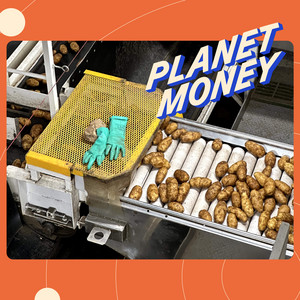
There we are. It was like three stories tall, the size of an airplane hangar, and it was filled with potatoes from end to end, piled 18 feet high, 15 million potatoes.
Oh my goodness. Oh, be careful.
It's a little muddy here.
Oh my goodness. This is literally a mountain.
It's a wall of potato.
We're at this wall of potato to learn about what happens after a trade deal is signed.
In this case, it's this wild saga that's been playing out over the past quarter century.
All these potatoes belong to Brian Wada.
He's a third generation potato farmer in Pingree, Idaho, and we were inside one of his giant climate controlled potato warehouses.
Can we climb this ladder?
Well, of course. Be careful.
How all three of us get on this ladder that's precariously propped up against the giant mountain of potatoes.
I don't normally climb ladders of potatoes, so I'm going a little slower.
I feel like we're climbing Mount Everest.
When we get to the top, we take a step out onto this vast plateau.
It's like bigger than a hockey rink, except the whole floor is made of potatoes.
Yeah, it felt like we were walking on loose cobblestones, except they were potatoes.
There were so many potatoes.
Wait, we're going to just stand on all these potatoes?
Yeah. Can we do that?
Yes. Oh my god. I'm not hurting them.
Oh my goodness. Oh, this is so cool.
Brian is not quite as excited as we are.
He's been clambering up hills of potatoes like this one his entire life.
Did you used to come play up here when you were a kid?
You know, when you were kids, the funnest thing was you just slide on your bottom down.
I would not suggest that because you will get very dirty, but it was cool.
That's fun. We should do it.
We should do it. Jeff sits at the top of the potato mountain.
You sit down on the potatoes?
Yeah. This is very light on technique.
And eases his way downhill.
Wait, I am sliding.
Well, the rate of descent is not extremely crazy.
Yeah, yeah, so. It's picking up.
Oh my god. It was amazing.
It was one of the best things I've ever seen.
It was like a mini potato avowainch.
I felt like I was surfing down an avalanche.
Here in the rich volcanic soils of southern Idaho is one of the best places in the world to grow potatoes.
And Brian Watt is potatoes.
These potatoes, Jeff is joyfully and maybe kind of fearfully sliding down.
I think a potato got up my shirt.
They go all over the place.
From the Florida Keys all the way to like the central California coast.
They end up at Walmart, McDonald's.
But for 26 years, there was a place that Brian's potatoes did not go.
A place that in fact, the entire American potato industry has been desperate to access.
It's a vast untapped market right on our doorstep.
Hello and welcome to Planet Money, America Barris.
And I'm Jeff Guo. Ever since free trade opened up between the US and Mexico in the 1990s, trillions of dollars of goods have been going back and forth between the two countries.
From cars to strawberries to MRI machines to fruit of the loom underwear.
But one major exception has been fresh American potatoes.
Today on the show, American farmers spent more than 25 years trying to get their potatoes over the southern border.
Standing in their way, a trade loophole, and the Mexican potato lobby, La Confederación Nacional de Produtores de Papa de la Repúlica Mexicana.
Better known as Con Papa.
Who were able to take advantage of an ingenious technicality in the way nearly all free trade agreements work.
Radio hour through line, the NPR politics podcast code switch embedded books we love, wildcard, are just some of the podcasts you can enjoy sponsor free with NPR plus.
Get all sorts of perks across more than 20 podcasts with the bundle option.
Learn more at plus dot NPR dot org.
There are celebrity interview shows and then there's wildcard.
It's a podcast from NPR that the New York Times just named as one of the 10 best of 2024.
It's hosted by me, Rachel Martin.
I ask guests like Issa Rae and Bo and Yang revealing questions like what's a place you consider sacred.
Has ambition ever led you astray?
And I'm telling you, it is such a good time.
Listen to wildcard wherever you get your podcasts.
When Brian Watt's grandparents first came to Idaho, they basically had nothing.
It was the middle of World War II.
And as Japanese Americans, they've been forced out of their home in California.
So they moved inland and ended up really where we're at now in Pingree, Idaho, and started over as 100 acre sharecropper.
Brian grew up on his family's farm.
A decade ago, he took it over.
His whole world revolves around this place.
I live here. I live on the farm.
I live in my grandparents house about 100 yards away from the warehouse and office.
So 100 yards away from where we're sitting right now.
Yeah. Over the course of three generations, the Wada family farm has grown from 100 acres to 32 ,000 acres.
It's one of the biggest growers and shippers of potatoes in America.
Brian himself is now an Idaho potato commissioner.
And he's like, here's the situation.
American farmers would love to sell their fresh potatoes outside the US.
But potatoes are heavy.
They're dense. They're like 80 % water.
So you really want to find customers that are close by.
Which is why they were so excited at the idea of sending potatoes to Mexico, where they don't eat quite as many potatoes as we do here in the US, but they could.
That's an untapped country.
And so how many times are you going to get a great marketplace that has a high population base that has never had US potatoes for the most part?
Like, sure, Mexico had its own potato industry, but they didn't grow that many potatoes.
And they certainly didn't grow the kind of potatoes that American farmers are famous for.
The classic Idaho Russet.
Like, you know, picture that perfect brown oblong baked potato.
It's sliced open. A pad of butter is melting into that soft, fluffy interior.
The past! Yes. Those are the potatoes that Brian thinks could go big in Mexico.
Now, the dream of selling American potatoes to Mexico really got started about three decades ago with the signing of the North American Free Trade Agreement.
NAFTA. NAFTA, of course, was this massive trade deal in the 1990s between the US, Mexico, and Canada.
It was kind of the beginning of the worldwide frenzy over globalization.
NAFTA opened the floodgates to goods moving across the US border.
It changed everything about the way Americans consume and buy and live.
It also seemed like NAFTA was going to change everything for the US potato industry.
Before NAFTA, American companies could basically only sell processed potatoes to Mexico, like frozen french fries or potato chips.
But as part of NAFTA, Mexico agreed to totally open up the market to fresh American potatoes.
Okay, but free trade?
It's never quite as simple as flipping a switch and now that two countries are trading.
In the case of plants and agricultural products, there's the problem of invasive species.
You know, like pests and diseases.
Stuff you really don't want crossing borders.
So after a big trade agreement is signed when one country actually wants to start shipping a new type of crop to another country, their agriculture departments have to figure out how to do it in a safe way.
Like, what kind of pests do these American potatoes have?
How are they going to inspect for those pests?
Governments have to come up with all these standards for how a potato is going to make it across the border.
And quite possibly, the person who knows the most about these complicated standards is Matt Lance.
Everyone calls him the potato guy.
I love potatoes. I like baked potatoes.
I like dehydrated potatoes.
I like hash browns.
You name it, I like it.
It was a perfect fit for the food I liked, yep.
Matt is not a potato farmer himself.
He's an international trade consultant.
Back in the 1990s, Matt was hired by American potato farmers to help lobby for their interests in these tricky negotiations.
I had been, believe it or not, at the Kennedy School of Government, training Russian politicians how to win elections.
You went from - Sorry, let me say that again.
You went from - That's right.
I went from trying to promote democracy and political party building in Russia to potatoes.
That's right. What was harder?
Maybe potatoes? I don't know.
Right. So right after NAFTA, as fresh US potatoes are going to Mexico, this problem starts to emerge.
Mexico is complaining that US potatoes have too many pests.
They're especially worried about something called the Columbia root knot nematode.
It's a little worm.
Yeah. Did we actually have that, though?
Yeah, we have that pest.
Okay. So it was like, it was a little founded.
Oh yeah, there's a strong basis for this.
Matt says, yeah, these were legitimate concerns.
This nematode, it's not harmful to humans, but if it spread to the potato crops in Mexico, it could devastate Mexican farms.
Mexico did not want to take that chance.
So just two years after NAFTA went into effect, the Mexican government basically put a halt to US potato shipments, said, any American potatoes, they are limited to this special 16 -mile region along the border.
There are border checkpoints outside of that border region, and they would stop the potatoes from going any further.
It was like a potato DMZ.
Yeah, that's exactly what it was.
It was a potato DMZ.
The American potato farmers were furious.
They were like, Mexico is way overreacting.
They're essentially closing the market to our potatoes.
Pretty soon, this becomes one of the major trade food fights between the two countries.
One of the other big food fights involved avocados, because while all this was happening, Mexican farmers were trying to get more of their avocados into the US, and they were running into kind of the same problem.
The United States said that the Mexican avocados had too many diseases.
So the two countries start negotiating, and eventually they agree on protocols for inspections and some other precautions.
That should help minimize the number of pests in these potatoes and avocados, but they also recognize that in order to open up trade, they're each going to have to take on a certain amount of risk.
And they agreed that Mexico would open the market for US potatoes, and the US would open the market for Mexican avocados.
Pretty soon, the US is buying millions more Mexican avocados.
All that avocado toast, bankrupting millennials.
But US potatoes are having a much harder time getting into Mexico.
They keep failing Mexico's inspections.
And from Matt's perspective, the problem is that Mexico is being way too picky.
And it turns out Mexico was looking for these nematodes a lot harder than we were.
They were peeling 400 tubers trying to find the...
The protocol said we had to just look at the potato, look at five potatoes, make sure it wasn't there.
Mexico, it turns out, was peeling all the potatoes, and you can see the nematodes a lot easier.
It's not just about the nematodes or the nematodes.
Nematode. Potato, potato, same difference.
Yeah, yeah. The Mexican inspectors, they claim they're finding all kinds of other viruses and funguses and insects.
They're turning back hundreds of American potato shipments.
And for this very reason, they say that this DMZ, it is staying in place.
Fresh American potatoes cannot go any further than that border zone.
For US potato farmers, it's almost like NAFTA had never even happened.
So this is getting silly.
It does sound like maybe it's not really about the pests in the first place.
Yes, we've come to that conclusion a long time ago, but yes.
Yeah, Matt and the rest of the US potato industry suspected that Mexico had an ulterior motive here.
Because remember, Mexico had its own potato industry, and the Mexican potato farmers were understandably upset at the prospect of all these American russets coming in and taking over their market.
Now, Mexican farmers couldn't stop NAFTA.
They couldn't undo this huge international free trade deal, but they could push the government to make a big fuss about pests as a scheme to stall for time to keep the American competition at bay.
Matt says, as free trade was taking off in the 1990s, more and more countries were using these kinds of pest concerns as a pretext to protect their own farmers from competition.
These pest regulations, which were supposed to be about science and plant health, were turning into a sneaky form of economic protectionism.
And it wasn't just Mexico.
This was happening all over the world.
Quarantine issues were becoming the new way, the non -tariff area, the new way of keeping any product you didn't want in your country.
You would just say, there's a quarantine issue and you wouldn't let it in.
And that would prevent market access.
Here was a huge loophole built into basically every free trade agreement.
Because every country has a right to keep all products that might carry invasive pests or diseases.
Yeah, because history is full of these horror stories.
Think of the Irish potato blight.
That was caused by a pest that came over from the Americas.
There's also the fungus that killed off like all of America's chestnut trees 100 years ago.
That came over from Asia.
Right now, Florida oranges are being devastated by a species of bacteria that showed up on our shores 20 years ago.
This is what makes pest regulations such a good loophole in our international system of free trade.
It's a totally legitimate reason to shut down trade entirely.
Or subject foreign crops to an endless process of bureaucratic inspections and risk assessments and pilot programs.
You know, just to be safe.
Which is why there have been hundreds of formal diplomatic complaints over the past couple decades.
Countries accusing each other of playing games with pest regulations.
Like Argentina was mad that the U .S.
wouldn't take its Argentine lemons.
The U .S. was mad that Japan was being picky about American apples.
In the case of American potatoes, Matt was fairly certain that Mexico was playing games.
Using these pest concerns as a pretext.
And maybe the best example of the absurdity of the situation has to do with that Columbia root knot nematode.
That little worm that Mexico kept making a big deal about in the U .S.
potato shipments. Then we found out, and this was a big discovery, Mexico has Columbia root knot nematode.
Yeah, Mexico had the same nematode.
It claimed that the nematode was under control, that it was only in a few places and those places were quarantined.
But, in 2009, Matt discovers that potatoes from those quarantined places could actually travel anywhere in Mexico.
It seemed pretty hypocritical.
Now, when the U .S. and Mexico were negotiating NAFTA, they kind of anticipated that pest concerns could become a point of contention.
So, as part of NAFTA, they designated an organization to help resolve these kinds of disputes.
In 2011, the two countries agreed it was time to call them in.
Why don't we have some objective potato experts listen to both of our arguments and then make a ruling on who's right?
You're gonna take this to potato court.
We're gonna take it to potato court.
It's actually just a panel of three scientists.
And the rules were they could not be from the United States or Mexico, so they had to be international.
They had to be potato pest experts.
And then both sides would make their case, and the three judges would then do the review.
The potato judges come back with their ruling.
Their scientific opinion was that most of Mexico's potato pest concerns were not really legitimate.
Like, yes, the U .S.
had a couple of serious pests, but there were simple ways to deal with that, and the risks they posed were fairly minimal.
In other words, the U .S.
had triumphed. By 2014, a full 20 years after NAFTA went into effect, Mexico finally agrees to get rid of the potato DMZ.
All of Mexico was now open to American potatoes.
At least, that is what the U .S.
potato farmers thought.
We shipped throughout the country for three weeks.
We have our first photos of potatoes in Mexico City.
We're thrilled. We're giving each other high fives.
And then the Mexican potato industry files injunctions to immediately stop all shipments to keep us out.
The Mexican potato industry had found one more way to stop American potatoes from getting into the country.
That's after the break.
Since the beginning of women's sports, there's been a struggle to define who qualifies for the women's category.
Tested from NPR's Embedded Podcast and CBC takes you inside that struggle.
Listen to Tested, the series that was named one of the 10 best podcasts of 2024 by Apple, Vulture, and The New York Times.
It's season 20 of NPR's Embedded Podcast.
Every January, millions of people take the pledge to cut down on alcohol in the new year.
If you're one of them, count on LifeKit, NPR's self -help podcast, for tips and tricks you can use to make the most out of your commitment.
We'll help you draw up plans and have experts weigh in on how to stay motivated and kind to yourself throughout the month.
Search LifeKit's dry January wherever you get your podcasts for the tools you need to pull it off.
From NPR. Every weekday, Up First gives you the news you need to start your day.
On the Sunday story from Up First, we slow down.
We bring you the best reporting from NPR journalists around the world, all in one major story, 30 minutes or less.
Join me every Sunday on the Up First podcast to sit down with the biggest stories from NPR.
In 2014, Jose Francisco Perez -Miel started a new appointed post as a federal judge in a potato growing region of Mexico, Los Mochis, Sinaloa, which was great for him, because he told me in Spanish that while he didn't know anything about this dispute, he does love potatoes.
He said, yeah, when he moved there, he started eating more potatoes.
That's why he stayed kind of chubby.
He used to be thinner.
A few months into Judge Jose's new job, a case came across his desk involving a group he'd never heard of before.
Conpapa is to Mexico what the National Potato Council is to us, a group that represents the interests of Mexican potato farmers.
It's short for la confederación national de productores de papa de la república mexicana.
And they call themselves conpapa.
The Spanish word for potato is papa, so the translation is with potato.
And conpapa's goal is to protect the Mexican potato industry.
Now, we reached out to conpapa, but they didn't want to do an interview with us.
So while US farmers had been lobbying to get their potatoes into Mexico, conpapa had been lobbying to keep them out.
Behind the scenes, conpapa had been urging the Mexican government to really take these potato pests seriously.
And in 2014, when they lost that battle, they threw a final Hail Mary.
They filed a lawsuit, not just any lawsuit, a constitutional lawsuit, that claimed that the Mexican government had violated their rights to a healthy environment and food sources when it agreed to let in American potatoes.
They go before Judge Jose and ask him to use his power to block the American potatoes from entering the country.
It was a weird argument.
It was kind of out there.
But Jose says he saw the desperation of all these farmers and business owners who were pleading with him.
And he says it was difficult for him.
He believes in free trade.
He didn't want to mess with the free market.
But he lived in potato country.
He could picture how letting in fresh American potatoes could harm his neighbors.
So he took action. Jose ruled in favor of the potato lobby.
He declared that the Mexican government, specifically the Mexican Department of Agriculture, did not have the power to let in the potatoes.
Once again, American potatoes were stuck in the border region, that potato DMZ.
And OK. Look at it this way.
This was classic interest group politics, right?
Free trade has this way of creating winners and losers.
The winners tend to be consumers who get access to cheaper goods.
Think of all the stuff that we import from China.
The losers tend to be the local industries who get crowded out, out competed.
Think of like US manufacturing.
Now, in the grand scheme of things, economists like to say that the benefits of trade outweigh the costs.
But for the losers, it doesn't always feel that way.
And when those groups are politically organized, like say, Con Papa, they can use their power to make things happen.
In this case, Con Papa's legal maneuvers bought them another seven years.
Eventually, in 2021, their case reaches the Mexican Supreme Court, which unanimously overturns Jose's decision.
Says that the Mexican government does indeed have the power to negotiate and set these past regulations.
Soon after that, the Americans and the Mexicans are back at the negotiating table.
And so much time had passed that NAFTA at this point had actually ended, gotten replaced in 2020 by a new trade deal, the USMCA, the United States -Mexico -Canada agreement.
One key person behind these new potato negotiations was a diplomat named Doug McCaleb, who has been thinking about the potato issue for a long time.
I began at USDA while I was still a college student.
Now, you know, I got kids in college.
I got a great beard.
So my career has sort of intertwined in the pathways, kind of gone along with the potato saga in one shape or form.
When the Mexican Supreme Court made its decision, Doug was senior advisor to the secretary of agriculture.
And he came up with a diplomatic strategy for this potato negotiation.
A big part of it, essentially, was that whenever Mexico and the US would talk about anything, like anything at all, they also had to talk about potatoes.
It meant ensuring that all agencies, if they were having discussions with the Mexican government, always put the potato at the front of every agenda.
So that was a conscious thing.
This wasn't like an afterthought.
The potato kind of got moved up to the forefront then.
Yeah, that's right.
Discussion after discussion, it was potato, potato, potato.
And in 2022, it actually happens.
Mexico agrees once and for all that American potatoes are welcome.
It's a process that took 26 years, decades of negotiations.
But starting in May that year, the first American potato shipments arrive all across Mexico.
No more potato DMZ.
This has been one of the longest running, most complex trade sagas in modern times.
But Doug says it gives you a window into how free trade actually works.
Yeah, you don't sign a free trade agreement and everybody goes home and the benefits kick in automatically.
Our system of free trade, it's never been entirely free.
It's subject to a complex system of rules and technicalities.
Rules about pests, rules about safety standards and labeling requirements.
And because free trade inevitably creates those winners and losers, technical rules have a way of becoming political.
But sometimes, sometimes it is possible for everyone to maybe come out a winner.
Like when the U .S. let in all those Mexican avocados, avocado farmers in California were livid.
But then a funny thing happened.
Americans became obsessed with avocados.
Avocado consumption tripled.
So American farmers have continued to sell their avocados alongside the Mexican farmers.
Now, Mexican consumers have not yet become obsessed with American potatoes.
But U .S. farmers hope that with more potatoes in the market, the market will grow.
Besides, Brian Wada, the third generation potato farmer, points out that we're sending those big brown russet bakers.
They're different than what Mexican farmers grow.
Those potatoes are smaller and thinner skinned, so they're complementary.
They can coexist. The potato varieties are different.
I don't think we're taking away market share from domestic growers.
I think we're growing the market in general by introducing just new products and new varieties that haven't been there before.
At the end of our tour, Brian took us to his shipping facility, where his potatoes are packed up for their journeys across the country.
And now some of those potatoes, at long last, are bound for Mexico.
So should we say goodbye to these potatoes?
Let's say goodbye. Adios.
Hasta luego. Goodbye potatoes.
Today's show was produced by Willa Rubin and edited by Meg Pramer.
It was fact checked by Sierra Juarez, who also contributed research.
Engineering by Sina Lofredo.
Alex Goldmark is our executive producer.
A special thanks to Cam Corals and David Lopez.
I'm Jeff Whoa. And I'm Erika Barras.
This is NPR. Thanks for listening.
Listen to Trump's terms from NPR.
Specifically, we make pop culture resolutions.
We also check in on what we resolved to do this last year.
Did we catch up on all those classic movies or finally write that novel?
Find out on the Pop Culture Happy Hour podcast from NPR.