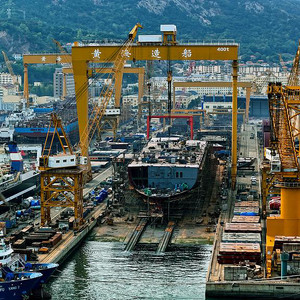
America lacks that industrial scale and infrastructure and skilled work force and all that to match China's shipbuilding output and capacity.
And if they have to be handed to the cost, all these decoders along the supply chains will suffer.
I'm optimistic that the Chinese shipbuilding industry will be able to navigate a potential crisis if a crisis is to be created.
The chat lounge unpacks views and opinions on hot issues in a more casual way.
The U .S. is attempting to revive its shipyards, not with innovation, but with tariffs.
A hefty US $1 .5 million fee on China -made bulk ships could shake global shipping.
Will it backfire on the U .S.?
Can America rebuild its shipbuilding industry?
And will business pressure sink the plan before it sets sail?
Welcome to the Chat Lounge.
I'm Cunh -Yen. Joining our discussion on America's China ship tax are Dr. Jane Heider, a reader in transport, logistics and operations management at Cardiff Business School, Cardiff University.
Dr. Zhou Mi, the deputy director of the Institute of American and Oceania Study, Chinese Academy of International Trade and Economic Cooperation.
And Dr. Georges Zugaklis, Senior Research Fellow of the European Institute, CIFE.
Thank you all for joining the chat.
Well, let's first take a look at the policy background.
What prompted the Trump Administration's China ship tax?
Dr. Heider, It's your first time on the show.
Shall we start with you, please?
Thank you for having me.
Well, it's for very obvious reasons.
President Trump wants to push back against the dominance of Chinese ship manufacturing.
And the specific aim is obviously to come to China's dominance in global shipbuilding and strengthen American national security by what they wanted to revitalize the US shipbuilding industry.
I'll probably just keep it simple as that.
And Dr. Zugap concludes from your perspective, do you have any different interpretation?
Well, I would say that it is quite significant to understand President Trump views China and draw lessons from his previous administration.
I would say that his China policies in general are placed in the very same context as much as possible to create obstacles to China's rise, and in so doing, to create obstacles to China's economic rise.
So in this case, it is the cheap building industry of China, which is in the interest of the American president.
But I would also like to offer an additional thought, which is relevant again to how President Trump is negotiating because we see that President Trump emphasizes a lot on tariffs.
But in the end, this is a tool for him to negotiate.
So perhaps this is another tactic that President Trump is employing in order as much as possible to speed up discussions with China and come up to an agreement as it has happened in the administration in 2020, just months before the pandemic.
The negotiation skill he is used to, right?
Yes, it's exactly this and we are monitoring the same tactic as far as general tariffs are concerned, which are about to take effect next week.
It is a methodology that the American president is quite frequently employing.
and I assume that the debate about the fees on Chinese vessels, talking in American ports, is placed in the same framework.
It does not mean that fees will not be applied, but I would say that the general debate is linked to his interest in negotiating with others, in this case, with the Chinese government.
To what extent is it associated with his domestic politics stance?
Some people just argue it's politically motivated.
Well, I would say that it is clearly politically motivated as all this is part of his pre -election agenda, his pre -election rhetoric.
What he's trying to say is that by imposing that type of tariffs, because even in this case, we are talking about a different type of a tariff, of a tax that is about to be imposed, additional jobs will return to the American market and additional investments will take place in the American market and in several of the messages also he's sending to the American public, President Trump is suggesting that because of his policy, he sees that different investments or announcement about different investments have already been made.
So again, you are right in saying this.
I would say that there is a combination of political and economic motivations from the of President Trump, in order to connect historic policy with the revitalization of the American economy, without of course suggesting that there is a direct linkage between the two.
But this is what President Trump is attempting to achieve.
And to Dr. Zhou, do you have a different perspective as a Chinese?
Well, we know that the 301 investigation is started by or initiated by the Biden administration, So it has some procedure requirements, about six months of investigation about the facts.
And since Biden has initiated that, and Donald Trump is accepting these results and trying to do something to counter Chinese government.
And I don't think that is really our good one, because 301 is one of the very bad behaviors of your militarism, especially for the United States, because they have made some commitments in WTO to not use this kind of measurement against the other members of WTO.
Well, they should try to use the dispute settlement if they fund, they are some kind of concern as experts has expressed, that they are trying to raise the concerns because of the so -called national security.
They saw that, you know, the linkage between the military use of ships and the civil use of the ships, combined to have a very big impact on the abilities of U .S. security.
But I don't think that is necessary to be the way—we want to just use a tariff as a one of the negotiation tools to affect China or trying to regain its abilities in this development.
Well, there may be another reason.
That reason is because that still, and Iran is one of its focus when Donald Trump came into the White House as a first term.
So he wants to provide for trying to make the United States steel and iron industry great again, by using the materials, but it's not that easy if they still want to do that.
I don't think that it's necessary to just target in another country.
Maybe now China is the number one, but we know that South Korea and Japan are also following the shares.
I mean, there are still very big shares of providing ships in the world.
We know that for the share building industry, there are so many interactions, intertwined relations among all the related stakeholders.
The actions may be not so effective, and it will have a much wider effect on international trade.
And we can find in the latter.
Right, and we'll talk about that a little bit later.
But Dr. Hayato, you just mentioned Trump may want to push back or push down China's dominance in global shipping, But it's not like China's topped the chart only recently, right?
If my memory serves me correctly, China has led the world in the three major shipbuilding indicators, namely shipbuilding completion volume and new orders and orders at hand for the past 15 consecutive years.
So why now? Yeah, you're absolutely right, and Yueng.
Maybe a bit of a shipbuilding history for everyone.
So as you correctly pointed out, the shift of shipbuilding from the West to the East didn't just happen yesterday.
So Japan was probably the first to rely on shipbuilding back in the 60s and 50s to rebuild this heavy industrial capacity and then became the largest shipbuilding country.
And then South Korea kind of followed that path, became the largest shipbuilding country back in 2003.
And then China very much followed very similar pattern of shipbuilding developments in Japan and South Korea.
And in terms of amount of contracts, it's passed South Korea before 2010.
So really, now, very much the dominance of shipbuilding that China has didn't just happen yesterday.
If we were thinking about whether and what the US claims to, I mean I really agree with the other two panelists, is perhaps used as a tool for negotiation rather than really trying to revitalize the US shipbuilding industry because the answer to that is, is very unlikely for the short term because it's just America lacks that industrial scale and infrastructure and skilled workforce and all of that to match China's shipbuilding output and capacity and one more thing I want to emphasise is if you look at shipyards in America, it very much focuses on military or naval vessels.
It lacks that, kind of, commercial shipping competitiveness because it's just the bulk and container shipbuilding.
These are all very much associated with oriental shipbuilding in China, South Korea, Japan.
Due to the higher costs, regulatory cost, These are not what U .S. shipbuilding is associated with.
Right, and actually the Ships for America Act, it's a bipartisan bill, actually mandates at least 10 percent of sea -going imports from China to the U .S. be transported on American built U .S. flagged ships staffed by American crews, with the requirement taking effect in 2029.
so from what you just said Dr. Heider it seems it's not so realistic for the US to reach that goal then?
No not at all I absolutely agree with you it doesn't really happen overnight you have to know that there are lots of time lags in shipbuilding in shipping markets in general and the demand and supply in terms of shipbuilding or shipping market what we call is there is an inertia in the demand and supply because for a ship it needs 18 to 24 months to build so once the ship is delivered back to the market, the whole supply and demand will be completely different so really that process, a very long -term process, is just impossible to change the current situation overnight, it's a long process.
Right, Dr. Zugoplis, what's your evaluation of the U .S. capacity or capability to do that or to replace actually imported ships?
Yeah, it's a very important question and the other respectable speaker nicely highlighted the situation.
It is right now too early and too premature to suggest that up to what extent the United States is ready in order to make a replacement of what is happening for years because China's dominance in the market that didn't happen overnight but it was the result of hard work which lasted for years.
And American companies relied on the Chinese shipbuilding industry for years.
And this cannot be replaced very easily, even if the United States have some time at its disposal in order to do so.
And more importantly, beyond the potential of the United States to support its own shipbuilding industry, is to look at the repercussions of such a measure in the interim because perhaps the effects of the instrumentation of such a measure will hurt the American economy to the extent that it will not be required in the end to look the extent to which the American seed building industry could be ready.
So it is a policy which is interesting to observe, obviously, but at the same time, I would say that there are so many factors that we need to take into account that it is quite hard right now to predict that the United States is really prepared to replace the Chinese shipbuilding industry the chat lounge The chat lounge unpack views and opinions on hot issues in a more casual way Susan Dr. Hyder and doctors the goblets have reached a consensus here, but dr. Joe Can you provide some like a specific figures that can?
support the conclusion that the US is incapable of doing what it wants right now.
Sorry. I don't have those numbers right now.
But I think that I agree with the experts that the United States market is not able to recover as before.
If we reviewed the history of the United States shipbuilding, I think that maybe there was some flourishing time because of the World War II when the Pacific War was started.
and the United States has put a lot of abilities on building the ships.
The warships in San Francisco, in those areas, the shipyards.
And it is because of the market driven for the United States to have the capabilities of building ships, but times change.
We know that when the time changes, we are seeing that transportation has different requirements.
In the past, maybe the ships do not have to be that big and they are taking care of just some ore, some not so many manufacturing products.
but now we are seeing more containers and also the LNGs and also a lot of requirements based on the environment protection or other standards.
So I went to several of Chinese largest shape -building factories and I talked with managers there and technicians there.
They told me that every year and maybe every month, they have to work out on what are the trends of the global market and they have to work out what kind of things they can do to improve the efficiency for the fuels and also to improve the capabilities to meet the demand from the customers.
So I think that the corporations are not just for the ship's building factories themselves, they are a lot of supply chain -based calculations, corporations and also a lot of supply chain support.
So if you are looking back to the United States, once we're looking at San Francisco and California as well as the main shape building sectors, and now there are more advantaged technologies over there.
The Silicon Valley has already become the driving forces for the development of economy.
So the people there, especially in California, they may not like to work that hard in the shape building factories.
They are not able to handle those machines.
They are not able to deal with that big, the giants of the ships.
So I would say that is not based on just the single factories themselves.
That is based on the supply chain, the industrial chains.
If you're looking at the data in my memory, China, for the new orders, for the shapes orders are building, and also for several other factors, China is almost taking half of this market in the recent years.
So this are based on the scale or economy, and it is not that easy to take over just by putting some money and see that everything will be magic to change to the United States recover of that so -called shipbuilding back sector.
Maybe it's like what you all mentioned, the United States is unable to revive or rebuild its shipbuilding industry in a very short period, but the White House obviously you think it's a quite smart move, right?
Up to 1 .5 million US dollars a levy on each commercial ship trying to enter US ports.
That could be a very good business, right, of raising money for the future use or to revive its shipbuilding industry.
Is it? It can at least kill two birds with one stone, maybe in their eyes.
Isn't that so, Dr. Heider?
Yeah, that's such a good question.
Before I answer that question, I am able to give some figures just to compare the UK rebuilding scale and Chinese rebuilding scale.
So currently China operates 5 ,500 or maybe over vessels worldwide whereas the US has under 100 vessels operated vessels worldwide so that's the scale we have and also Take Care Company for instance Maersk is the biggest container carrier so it currently has a current fleet that's 20 percent Chinese -made and the new build ships that they have currently ordered are 79 percent from China.
So I think these figures pretty much sums up the different scales of Chinese shipbuilding and American shipbuilding.
And then to answer your question, that's such a good question.
You know whether it's 1 .5 million for Chinese -made containers per ship, calling out U .S. ports, they can make a lot of money online, ship is that one, and then at the same time and put constraint on Chinese shipbuilding.
Is that one stone killing two birds, well, the answer is no because it has a massive impact on America itself.
Once the US exports industries such as coal, oil, agriculture, the proposal to limit Chinese shipbuilding dominance works impose restrictions on us exports very, very negatively because these industries rely heavily on cost effective Chinese meat bulk carriers.
Now they're imposing tariffs on Chinese -made container ship that's likely to increase shipping costs and reduce US exports global competitiveness.
So that's one thing, maybe a small aspect.
But even bigger aspect is the impact on the consumer spending.
Because, if that happens at 1 .5 million for each Chinese -made container ship that are caught on US ports, ultimately that cost will be added to the end customers meaning that the imported goods transported on Chinese used ships become more expensive, higher logistics costs can translate into pressure and reduce the consumer spending power.
So I think as Dr. Zhou correctly pointed out it starts rippling in fact the supply chain kind of it causes that the knock -on effect that what this might impose and all the supply chain disturbance that it might impose that's the bigger concern, not just that 1 .5 billion again per Chinese nation according to U .S. ports.
What can it get then?
Can it get what it wants, actually?
No, I really don't think so.
Currently for the time being it's very unlikely for America to gain what it wanted because if the goal is to push back against China's dominance in shipbuilding, the impact or effect is very minimum because the US is not the number one client to Chinese shipbuilding.
China can find alternative countries.
China can invest other aspects, like green ship technology and all that.
So really that impact on China, it's very minimum, I'd say, but it's more about the global supply disturbance and the U .S. exports relying heavily on Chinese - built ships.
That's more likely to be at risk.
Dr. Zugablos, do you have any additional ones that you want to mention, you know, potential impacts?
Yes. Another remark.
We are talking about an initiative which is currently in the form of a draft law or something like this.
So we can't be aware of all the terms that will be agreed in the end in order to talk about the fees and who will pay the fees because it's not clear to me to what extent several exceptions in the end will be applied or not.
We know very well that President Trump, as I said before, is very often granting exceptions.
So it's quite hard right now to anticipate or to calculate the impact of the fee about the vessels that will call on American ports.
Again, it is a policy which is in the making and that's why I'm also, as you said, quite sceptical concerning the calculation of the economic impact in terms of the fee.
We know from the policy of the tariffs, for example, and the response of President Trump in his previous administration, that he provided subsidies to the American farmers.
I don't know if he plans to do something like that with American companies in order to support their operation after the policies to be implemented, so there are so many unknown questions right now.
And at the same time, it's also interesting to see up to what extent the ship owners are already drafting plans in order to deal with the implementation of such a measure as far as their ships are concerned.
For example, are they prepared to use bigger ships and to keep some small ports in the United States?
There are so many open questions right now, so it's quite difficult to calculate.
and that's why I insist that there are so many factors that we don't know.
So it's quite difficult to suggest that in the medium and long term, the American sea -building industry will necessarily be revitalized as it is the initial objective of this policy measure.
Actually, Edward Gonzalez who's the CEO of the Seaboard Marine, which is the largest US -owned international ocean cargo carrier, has expressed a concern that national interests will not be served if the effort to boost American shipbuilding Unintentionally destroys American owned carriers.
So dr. Joe did he Exaggerate any extent could the consequence be so bad, you know American owned carriers being destroyed I don't think that is the kind of Very difficult to predict about the future of its own carriers, but we know that for the international trade, especially for the logistics, there are so many competitors.
So in the past, maybe they are some of the main carriers for, I mean, the agent or trying to clear the customs. Some of them are the main ones.
But now if you are looking at China's, for example, there are so many, thousands of, you know, maybe not millions, there are so many companies who are able to do that.
So the competition are very complete.
and I think that it is not that easy to have a very big price differences based on the same service and the same efficiency.
So I would say that it is also very not unknown for me.
So what is the nature of that fee?
Because that we know that in the United States tariffs are decided by the congress.
The congress has the power to decide and also to collect those tariffs But if they're going to look like to use the fee, I don't think it's a local one or a national one for the United States.
And how can they allocate those money and how can they distribute those money, or it just be collected by all the different ports?
So, we know that the dodge by Elon Musk is trying to reduce the persons employed in the government.
So, there will be a lot of more conflicts if they are going to put more complicated procedures and different kinds of fees or tariffs on the imported or other different stakeholders.
So I will say that, you know, there will be a lot of chaos if they are trying to put more, you know, interruptions from the governments to the market activities.
And the border carriers, I mean, some of these companies of the United States, they are not only operated in United States only.
If they have to operate in other countries, they may be afraid of just taking advantage of charging extra fees also.
So I would say that is a little bit uncertain for those carriers even for the United States.
I don't think that they will be very glad if they are protected in that way.
You've been listening to the Chat Lounge.
After the break, check out whether business pressure is able to sink the plant before it sets sail.
Stay with us. The strong wind was howling and whistling.
He was the first Chinese citizen to graduate from Yale University in the mid -19th century.
I was born on the 17th of November.
She had prominent features.
Three of us were old enough to lend a helping hand.
He navigated between two vastly different cultures and moved further to realize his dream and promote understanding between the people of china and the united states Jie Minxin was a native of Hanliang i realized no danger china is really awakening come and join us in discovering the incredible journey of Yong Wang in his autobiography my life in china and america check out the audible stories on radio dot cgtn dot com and all major podcast platforms. Just search for the podcast Books and Beyond, and find my life in China and America.
Welcome back to the Chat Lounge, we now continue our chat on America's China ship tax.
Dr. Zhou, what's your evaluation on the impact on China's ship building industry then?
Does the commerce ministry have any assessment over that?
I could not represent the history, but I have some observation by myself.
So actually, I went around in China last year, because they initiated the 301 investigation last year.
I visited several, the shipyards and the buildings, I talked with them.
They told me that maybe they still have some worries about that.
But they already are very busy, because they already have so many orders.
So I think that it's not a problem about whether there are too many China built ships.
The problem is that they are not enough because the trades are growing and recovering from the current and especially for the new routes are opened.
So they are going to buy more ships for them.
I think that they are still having some worries about possible impacts from the United States side.
But in my understanding that $1 million compared with the price, the value of the vessels is not that big, and if they have to be added to the cost. I think that all those decoders along the supply chains will suffer altogether.
It's just about the rebalance.
So the people when they're considering about the possibilities of doing business with U .S. market they may consider it again and try to find out whether it is possible to find some alternative.
And that makes the price even higher.
So I'm not quite sure that Chinese shape -building factories will be destroyed.
It's impossible, but they have to consider about some different ways.
So we're not just have some advantage in certain types of vessels.
There are so many new companies are trying to do more to meet the demands so diversified, some for the crews, some of the new fuels, i think that is possible that they were trying to think about how can they make more diversification of the supply chains and trying to be better fit for the new environments.
right Dr. Haidar, since you're specialized in transport logistics and operations management, do you have any estimation over possible maybe damage or losses that Chinese shipbuilding industry may suffer from this, short -term and long -term?
I think it's difficult to put it into any figure for the time being, but at the moment I can give you the latest figure about the Chinese -buied container vessels market share.
So in 2024 that's 81%, so that's the highest sector and higher than tanker or bulk carriers.
So that dominance is very obvious.
Well to answer your question, I think initially very, very minimum impact that can affect the China shipbuilding industry because the ship order that have already been placed will continue being built and the US is just not China's largest customer in shipbuilding.
So over time it may push China to diversify clients and push harder into global markets as Dr Zhou correctly pointed out earlier, but it just I think that's more of a long term saying but initially in the beginning the impact it's minimal.
But it's hard to do so right, to diversify its client.
You just said it's already taken like over 80 percent of the global market?
Yes, I mean, yeah, in the beginning, it's minimal, but I think it will force probably Chinese shipbuilding in the long term, if it does play an impact for that $1 .5 billion fee charge and all that.
One thing it might consider is to outsource to South Korea, Japan to kind of to ally with these other major shipbuilding countries.
You know, their top tier shipbuilders with strong US ties and can ensure that continuity of supply when rebuilding domestic capacity.
I don't know about this, I think for now it's pointless to discuss about this because we'll just have to wait and see to watch this space.
Indeed, actually the Chinese side isn't sitting there and waiting for their death sentence, right, and China's already continued.
Yeah, absolutely. Yeah, absolutely, Eun.
I feel at the moment I think, as the other two speakers correctly pointed out, is more of that logistic, that impact on the logistics efficiency and the port operations globally and in America as more of the worry.
I do wanted to probably elaborate about that port operations in America a bit, because for the time being, there are lots of just kind of a bit of a background picture.
Let's not talk about the biggest ports in America, there are lots of medium -sized ports, for example, ports of Oakland and some other ports, and they are operating not at 100 capacity, probably a much lower capacity, So with the tariff imposed on Chinese -built containers, a very likely shipping company will have to think about paring down port calls, divert containers to major ports.
And that's likely to have a huge impact on smaller ports.
So essentially they're going to operate on an even slow, even smaller capacity, and will face that inefficiency if the ship routes schedule is altered and there will be fewer ships at a higher cost. So whether these ports will survive or not is very much of a question mark.
Hmm. That's for the U .S. side.
But on the Chinese side, government has begun implementing a new anti -sanctions law.
So, Dr. Zygalplos, from your understanding of Chinese government.
What does this mean and how do you expect Beijing to respond then?
Yeah just a remark which is also complementing the thoughts of the other respectable speakers concerning the Chinese shipbuilding industry, in order to calculate all types of impact for the day after it's also quite significant to look at the finance and the banking sector so, you know I'm Greek and Greek owners are dominating the market one of the main reasons they are giving numerous orders to the Chinese shipbuilding industry is that they can get loans at favourable terms by Chinese banks.
So perhaps this is an opportunity also for our recalibration of this policy, you know, there are so many different aspects of the ship owners will have to take into account in the end.
And that's why I'm optimistic that the Chinese shipbuilding industry will be able to navigate a potential crisis if a crisis is to be created.
Again, because the finance and the banking sector are still favoring CIP owners to give orders to the Chinese CIP building industry because again, the loans can be provided a favorable terms and perhaps in the future, more favorable terms will be negotiated between the two.
Now concerning the other question, I would say that the general Chinese policy is placed in the context of the determination of the Chinese government to respond to what is happening.
What is quite interesting with the second administration of Donald Trump is that there is currently experience from his first administration and this means that different sides involved in the trade war and different sides affected by the trade and economic policies of President Trump can already set up plans and they had already the time in the past to set up plans in order to defend themselves and to protect their interests.
So, I would see that the Chinese new initiative is linked to that and more importantly, because China was directly involved in the trade war in the previous Trump administration, I would say that this experience will perhaps render the Chinese government quite well prepared in order to navigate the crisis and protect its interests as far as the shipbuilding industry is concerned.
Dr. Zhou, how can we expect the Chinese authorities to counteract in this regard then?
I think that it is very clear that 301 is always be again by the Chinese government.
We were never just trying to say that a 301 policy is a right thing because we want to deal with the problems, the framework of W2.
Actually, I think that if you can look back in the last eight years, China never see that we will agree that the 301 practices should be considered even in the form of the negotiation.
Well, if we are trying to look at the fact, I think that it is natural for us to try and also to raise our concerns in the W2 framework on the dispute settlement, trying to see that the practices, if they do, we will also file this kind of concerns in WTO.
But on the other hand, I think that for the market economy, we were trying to provide support for those enterprises were, in a separate allowed from this kind of unfair practices.
Well, if you're looking at the structure of the China sheet buildings, it's not just like the state owned enterprises, there are so many private enterprises, they are even stronger and more capable in building the ships of different types.
In Jiangsu province, in Guangzhou, and in Shanghai, there are several cities, that are centered by thousands of enterprises who are doing the similar businesses.
The support, we are also trying to give them some of this information on the way and suggestions, how can we deal with the situation.
Because we know that there are so many new possibilities for the development.
So many other countries want to better integrate it in the global market.
So, I hope we can provide the better support, not just from the monetary policy, but from the market side, and also encourage them to do better innovation.
And especially for the businesses with Europe, I think that the expert from Greece also know that the trade between these two parts of Europe and also East Asia is very huge.
We are seeing that there are a lot of geopolitical tensions in the Red Sea, in the Mediterranean.
So many ships are trying to move further through the Cape of Hope.
So they demand different shapes and I hope that will also provide some alternatives for the market space.
Well, we are seeing that some other countries in the Belt and Road regions, some of the developing countries in Central Africa and Western Africa, they are trying to export their products.
It's not only about the raw materials, also about some of the manufacturing products.
So the markets are emerging.
We cannot count everything on the U .S. market, and also even for the allies of the United States, Canada and even Mexico, are having some trouble with the United States.
So for these two countries, they do need to find some alternative or try to diversify their trade.
So the market is there.
I don't think that we are, you know, in a way of having less competitiveness, even based on that fate, we are trying to encourage those shipbuilding factories to be more focused on the innovation and trying to distribute or diversify their markets.
So you're saying that China, or Chinese shipbuilders or shipping industry might suffer in the short term, but we still got alternatives and it might be American consumers that turn out to be the biggest victim of the US policy, new policy, right?
I think that, yeah, they have prepared.
For Chinese shipbuilding companies, they have prepared that even one year before.
But for the consumers, I think that they have to depend on the import allowed. They cannot pay a lot of things.
I mean, they build a lot of things, or manufacturing a lot of things in the domestic market.
Even like the X, they have to find some alternative ways to import from other countries.
Zooming out to a broader perspective, you've already touched upon how this may affect the U .S. and China, Chinese shipbuilders or other related industries.
But from a global perspective, how would this policy, the U .S. policy, affect the global shipping industry and global trade dynamics in the short term and long run as well.
And maybe Dr. Hayter?
In the long term, I think we've already covered quite a few points about it, but in the long term, it's really, it will put, I mean, as Dr. Zhou correctly pointed out about the Red Sea crisis, it has already put strings on global shipping.
So with the Paris imposed on Chinese built containers, is really going to cause more tensions, and there's the risk of reciprocal tariffs or sanctions.
It's just going to reduce the cooperation on global trade and climate issues with higher shipping costs, and ultimately, as you just correctly pointed out, the consumers might suffer ultimately.
So all in all, I think the impact on global trade It is very, very negative.
The CHAT Lounge. The CHAT Lounge unpacks views and opinions on hot issues in a more casual way.
Indeed. Actually, it's a very lousy or negative outlook over there.
But obviously there are people trying to stop what the Trump administration tries to do.
A coalition of around 300 American business groups, including farmers, dock workers, and Ship owners, advocates against the proposed fees.
They argue that obviously what we've already discussed, that this could disrupt supply chains, increase costs, lead to job losses at ports.
But the question is, can they persuade the White House to adjust or withdraw this policy?
Dr. Zugoplis? Yeah, I think it's a very important question and once again, it's quite significant to try and understand how President Trump is thinking, although this is a tall order.
What President Trump seems to me he is trying to do is to negotiate with others.
And I would say that he takes into account complaints coming by both the domestic industry as well as by other countries.
And in the end, what he's attempting to do is to formulate his policies in order to combine to some extent, his pre -election rhetoric with the implementation of a policy that will serve the needs of him to deliver and at the same time will not hurt or damage the American economy.
This is what he's trying to do with the trade war.
That's why we are seeing so many exceptions in the last weeks, which were decided.
And I expect that this is what could happen with the case of the American shipbuilding industry.
There is much flexibility in the American approach as well.
And I would say that this is a world that perhaps can characterize what is to be expected concerning the shipbuilding industry and the tariffs on Chinese -built ships to call in American ports.
Do you think the chances are high or low for them to successfully persuade the government to stop the politics?
I would say it's possible to persuade the American government to some extent.
I wouldn't suggest that the American government will completely change its mind, but I would say that the American government will take the complaints into account and be flexible in recalibrating its final approach. That's why I'm preserving a wait -and -see approach because all this is happening right now, so it's quite difficult to anticipate how this could look like definitely in the medium term.
And what about Dr. Zhou, given your experiences in dealing with your American counterparts?
Actually, we know that USTR just held hearings to listen to the arguments, as you mentioned, some of these groups are trying to say that it is maybe not proper for doing that.
But I would think that if you're looking at this administration of United States, a lot of people believe that Trump can bring them a lot of success.
They believe that the United States can be recovered or revived by tariffs, by the policies.
So I don't think that they are really taking care of our economic effects of some policies.
They're just trying to follow the style or the signals of Donald Trump.
And I think that is really sad even for the people who voted for Trump in this election last year, and especially for some of the farmers.
we know that the United States has exported so many agricultural products of the soybeans and the beef and also a lot of other things to other countries.
They are not able to find enough safe carriers, I think it will be impossible.
It's not a problem about the money.
It's not about the cost. Sometimes it's about a security, because that US companies, when they are building the ships, I don't think that they can build enough good ships to fulfill their transportations or exports.
So sometimes I think that maybe just from the hearings, it is still very difficult for them to just hear from where the people really want.
But maybe in the future.
I don't think that it's good.
If there are some problems, some accidents happened through this transportation, they will have some alert.
So I think it's still a very a difficult time because the reaction line is very long from the people to the decision -makers.
There are so many stakeholders or so many factors that will have impacts on the decisions.
I'm not so optimistic about the result.
We should be prepared for that result.
When you say we, you mean China?
And not China, but also the people who are on the supply chain, the ship owners and the carriers, some of the companies, the logistic companies and the shipbuilding factories, and some of the engines or equipment suppliers, all of these stakeholders trying to think about how can we do to rebalance the margin of the economic performance.
Right, then if the US policy is in place then Dr. Haidar, how long do you expect the US may revive its shipyards?
Well that's a really good question, my answer to that is very long, it's going to be if it ever happens, we're talking about decades in terms of the timeframe, it very much because the two speakers both talked about the multiple stakeholders and the complexity of this whole problem.
Because shipbuilding very much depends on investment policies and core markets conditions and all the suppliers and all that so it's not going to happen overnight.
A ship takes 18 months to 24 months to be built, as we've talked about earlier, so um so the revitalisation will not happen overnight because it just includes rebuilding infrastructure, training workforce and developing competitive technologies and all that.
None of these will happen overnight.
And one thing I do want to emphasize is that shipbuilding very much depends on steel industry so around I would say 60 % if not more of the cost of the construction of a container ship is steel.
So a strong shipbuilding sector requires a very strong domestic supply chain for shipbuilding, including steel.
And the question is, does America have that infrastructure?
Can it support the shipbuilding industry with all the domestic supply chain for shipbuilding?
The answer to that is probably no or very, very questionable.
But maybe the American iron and steel industry is quite confident because the investigation was brought up by the steel union, right?
Yeah, but I don't think they have reached a conclusion about that.
I think with President Biden, there were some manoeuvres about that.
But at the moment, what I can see is still very much of a question mark whether they've that infrastructure and a strong kind of domestic supply chain for shipbuilding.
Right, and last but not least it seems the world is about to face a chaotic storm on the sea so I'd like each of you to, you know, maybe provide your advice to those directly affected like U .S. exporters, importers, or agriculture fossil fuel industry operators, or shipping companies and operators, or consumers, pick whatever you want to you know maybe come up with some advice for them.
Maybe shall we begin with Dr. Zugaplis this time, please.
Yes I would say two main things.
The first is to be prepared for the worst because I think this is the best advice in a changing world where protection is becoming the key lemur that is applied in today's changing world.
And the second thing is to be prepared also for negotiations with the other part because experience suggests that it is possible through negotiations to come up to agreements that can serve the interests of both.
So a twofold strategy, starting from the worst, but also being hopeful that a negotiation tactic could also lead to a mutually beneficial agreement.
Fair enough. And Dr. Zhou, please.
Okay, I think that when we're trying to look at the future, there are so many uncertainties.
So for the consumers of the United States, I think that it is very difficult for them to try to save some more money and trying to earn more money to prepare for the inflation.
Well, for some of the companies.
I think that it is possible for them to try to consider about the new a pattern of the global existence.
Maybe they can try to change the position of its domestic factories in other countries like in Latin America where there's no fee for the port logistics.
And it is also likely that we should be prepared for the financial impacts along the supply chain of the ships because we know that for the ships building, they do need a lot of money and this money are in the position of trying to be better used.
Well, for some of the Chinese companies, I would suggest them to trying to be prepared for this impact and trying to consider about the possibilities of doing some of the improvement.
Well, I don't think that it's a bad thing to invest in the United States.
Well, if Chinese companies, they do have the possibilities and they have the willingness, it is also not bad to invest in the United States for having a better profit.
but we have to consider all the factors – do we have enough human capital and supply chains?
And there really are very important problems we have to take care of.
So in the future, when we are trying to look at the technology side – artificial intelligence, new models of businesses – I encourage companies to be prepared for the uncertainties and trying to improve their abilities to be flexible, to adapt to the changing world.
Quite sensible. And Dr. Heider, please.
Thank you. I definitely agree with the other two speakers.
I think strategic alternatives and the stakeholder engagement.
These two aspects are key to speak for maybe shipping companies and the supply chain partners that are likely to be affected.
For them it's really to seek new markets, perhaps to shift focus to building that demand and then find new partners with the Belt and Road Initiative, Belt and Road Initiative partners and perhaps to invest in green shipbuilding, these green decarbonisation initiatives to stay competitive.
Thank you. Well said.
And that brings us to the end of this chat session.
Many thanks Thanks to Dr. Jane Hider, Reader in Transport, Logistics and Operations Management, Cardiff Business School, Cardiff University, Dr. Jomie, Deputy Director, Institute of American and Oceania Studies, Chinese Academy of International Trade and Economic Cooperation, and Dr. George Zugoplis, Senior Research Fellow of CIFE.
For your time and insight, the show is available on all major podcast platforms. Please email us your comments at radio at CG TN com.
Thank to you. Thank you for listening Join us again for more chat at the chat lounge next week I Cannot marry you while your mother regards stepping to the world of timeless elegance with mrs. Spring fragrance a A captivating audio book by Edith Eaton, read by Manling.
Experience the lively yet complex lives in Chinese -American communities at the turn of the 20th century, as Edith Eaton's delicate prose weaves together themes of tradition, change, love and identity.
forget all that belongs to the joy of life follow the journey of mrs. spring fragrance and witness the struggles and fights of those living on a rapidly changing exotic land while holding on to their cultural traditions or more importantly to their identities I'd hardly believe that his daughter was seriously opposed to becoming the wife of a such a good -looking prosperous young merchant as well.
Join Books and Beyond for Mrs. Spring Fragrance.
Let the stories come to life in your imagination.
Subscribe to Books and Beyond for free on your favorite podcast platforms or log on to Radio .cgtn .com for more.