
[The Cosmic Connection: Reflections on the Big Bang and Digital Loneliness]-[Poetry and music that reaches across the digital void | Elle Cordova]
📋 Summary
The Paradox of Origins: Meditating on the Big Bang
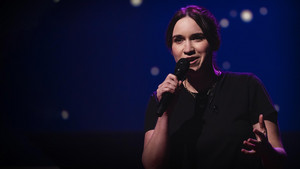
In her TED 2024 presentation, writer and performer El Cordova bridges the gap between scientific inquiry and artistic expression. A self-described "literature person" with a passion for science, Cordova opens her talk by addressing one of the most profound existential questions: "what happened before the Big Bang." Drawing inspiration from science communicator Hank Green, she crafts a poem that attempts to visualize the inconceivable state of pre-existence.
Cordova’s poem emphasizes the total absence of physical dimensions, noting that before the universe emerged, "there was no up, there was no down, there was no side to side." By stripping away the familiar markers of reality—light, dark, stars, and even space itself—she highlights the central paradox of creation: the transition from "nothing to infinitely dense" and from "immeasurably small to inconceivably immense." She concludes that while the human mind may struggle to grasp the physics of such a moment, we can still "marvel at when math becomes an art." This section of her performance serves as a reminder of the awe inherent in our origins, shifting the focus from technical comprehension to emotional appreciation.
The Digital Void: Seeking Connection in the Age of the Scroll
Transitioning from the cosmic scale to the intimacy of modern technology, Cordova introduces her original song, "Carl Sagan." She explores the irony of digital existence, where individuals spend vast amounts of time within the "endless scroll of social media," often feeling isolated despite being constantly connected. Cordova frames this behavior as a "conscious and unconscious desire" to reach out to other human beings while sitting alone on our devices.
She names the piece after astronomer Carl Sagan, who famously articulated the connection between human beings and the "billions and billions of stars in the night sky." Cordova utilizes this imagery to critique and empathize with our digital habits. She observes that we often lose ourselves in a "warm bath made of content," watching "brilliant bits of nonsense" because the act of consuming media "feels like making contact."
Beyond the Screen: Finding Solace in Shared Humanity
The lyrics of "Carl Sagan" act as a mirror for the audience, asking, "Are you scrolling alone again tonight?" Cordova captures the vulnerability of the modern user, acknowledging that whether our hearts are "good" or "breaking," we turn to apps to mitigate the feeling of being "cold and on our own." By referencing Sagan’s famous postulation—that if we are the only intelligent life in the universe, it would be an "awful waste"—she reframes our digital interactions as a collective search for meaning.
Ultimately, Cordova suggests that our obsession with social media is, at its core, a reach for human solidarity. We are "billions and billions of lights reaching out through a satellite just to know that feeling" that we are not alone. Through this performance, she successfully links the scientific vastness of the Big Bang to the intimate, sometimes lonely experience of the digital age, urging the audience to recognize that even in the vastness of space or the noise of the internet, the human impulse remains the same: to find contact and to know that we are not alone.
Deep Learning with ListenLeap


