Grownups, Wondery Plus subscribers can listen to Wow in the World early and ad-free right now.
Join Wondery Plus in the Wondery app or Wondery Kids Plus on Apple Podcasts.
Hey, Wowzer fans, Mindy here.
And before we start the show, I gotta let you know that this November, with a special new episode featuring our friends at Circle Round and Terrestrials on Radiolab for Kids,
And don't miss when Elmo from Sesame Street stops by Wow in the World to make us all belly laugh on November 24th.
Oh, but that's not all, Reg.
On December 1st, we are sharing our 250th episode of Wow in the World with all of you.
We think this one is going to be music to your ears.
Literally.
Did I mention it's a musical?
And if you're a member of the World Organization of Wowzers...
Oh boy, do I have a surprise for you.
You can listen to our 250th episode early with me and other members from around the world on Saturday, November 22nd, at 7 pm.
Eastern.
That's right, we are throwing another listening party.
Join us as we dance along to our new songs.
React to the episode with other members in the chat and more.
Grownups.
If you want your wowzer to join this members-only listening party, you can sign up to become a member today at Tinkercastcom.
Slash wow.
Already a member?
Well, you can find the link and password to join the event when you sign in at Tinkercastcom.
Slash wow.
That's it.
It's going to be a November to remember.
But for now, let's get on with the show.
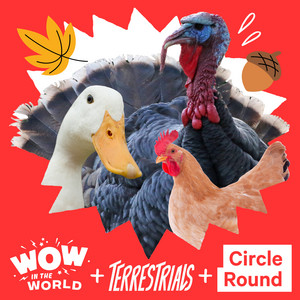
Woo! day of the whole year your birthday no the other one my birthday no the other one it's turducken day i'm sorry hey roz it's a day where we all sit around a big table with family and friends and give thanks for the turkeys and the ducks and the chickens in our lives you know tur day a day to give thanks wait mindy it's not turducken day i'm so excited gairaz we have been invited to a turducken feast with two of our podcast friends we have other friends besides dennis and reggie gairaz i'm talking about lulu from terrestrials and rebecca from circle round they want to spend turducken day with us ah that's so nice what can we bring oh i said we'd bring the duck The duck?
Where are we going to find a duck at this hour, Mindy?
Oh, I already got one.
What?
Where?
Reggie, go get the duck.
It's a live duck?
Well, yeah.
You don't want to be the guy who shows up for a turducken day feast with a dead duck, do you?
Well, no, that's not how.
His name's Freddy.
Say hi, Freddy.
Now, come hop on, Reggie.
He's going to give us a ride over there.
You're going to want to hold on tight for this one, little ducky.
Okay.
I'm on.
Good, because here we go!
Beautiful landing, Reg.
Right, Freddie?
Well, looks like we made it, Mindy.
Look, the sign on the door says, come on in.
Ah, well, don't mind if we do.
Happy Turducken Day, everybody!
Shh.
Lulu and Alan are giving their Turducken Day intro for the story feast.
Ooh.
Oh, sorry.
Happy Turducken Day, everybody!
Rebecca Sheer.
Hi, Mindy.
Hi, guys.
Come to the table and grab a mic.
A mic?
Ooh, fancy.
Here are your parts for the introduction.
Sure, thanks.
Thank you.
And for a very special Thanksgiving edition, we are teaming up with some of the biggest names in the kid podcast universe for a kids podcast crossover special.
That's right.
Terrestrials, Wow in the World and Circle Round have teamed up to bring you A story about a turkey, a story about a duck and a story about a chicken.
Each show has brought a story about one of these birds to assemble into this turducken.
And before we get going on these riveting tales, should we just all go around and introduce ourselves?
Yeah.
Let's do it.
You guys want to go first?
Okay.
Hi.
Hi.
I'm Mindy.
And I'm Guy Raz.
And together we bring you the Wow in the World podcast, where we search, find and share new scientific discoveries.
Discoveries that make us say, wow.
Wow.
Wow.
I'm so excited you're here.
And next up from Circle Round, we have Rebecca.
I'm Rebecca and I host Circle Round, a weekly podcast that adapts age-old folktales into fun audio plays for modern kids and families.
And I am Lulu and I host Terrestrials from Radiolab and we tell totally true stories about animals and sometimes break out into song.
All right, so let's get this story turducken started.
A turkey stuffed with a duck stuffed with a chicken.
Yeah.
So I guess we probably need to start with the littlest bird first.
Who's got the chicken?
Terrestrials does.
I am so excited to bring you this tale that will have you seeing the lowly chicken.
Completely anew.
Y'all ready?
I'm ready.
Oh, yeah, totally ready.
Let's do it.
Okay, so join me, if you will, on a very cold, wintry day a few years ago in Germany.
Run a little farm with a little flock of chickens and one normal-sized farmer named Gerald.
Guten Tag.
And in that flock is a very handsome rooster named Horst and a bunch of female chickens, including one lovely little red hen named Inga.
Inga, beautiful little Inga.
Who Horst had taken under his wing.
Literally, they spent a lot of time together, wing to wing.
Inga and Horst sitting in a tree, P-E-C-K-I-N-G.
But one day, farmer Gerald, well, he needed to earn some money.
So he looked into the flock.
Hmm, which bird shall I take?
And scooped up Inga.
Come here, little one, and put her in the car with him to drive over three miles away, past dark forests and snow and busy streets, to sell her to Which is German, for To become Or, according to our fact checker, possibly a fillet.
Anyway, it seemed like her fate was seared.
I mean, sealed.
Farewell, Inga.
Geralt drove home to his little farm with one less chicken.
The months went by.
The snow fell.
And then one morning, Girald woke up.
Imagine him trudging out through the snow to the chicken coop where... He saw... Inga!
He knew it was her because of the name tag still on her ankle.
And there she was, reunited with handsome Horst.
Mir stand in der Harseberg!
Which is German for... My hair stood up on end.
My hair stood on end too when I heard about this runaway chicken who made it miles and miles home through obstacles and darkness and who knows what else, because I figured she must have been the luckiest chicken in the world who accidentally made it all the way back home.
Because, you know, chickens not famous for their intelligence.
We do know that birds are fantastic with directions.
Well, birds, sure, but Exceptional.
Can you please introduce yourself, person suddenly correcting me?
Well, my name is Cy Montgomery, and I wrote What the Chicken Knows.
And Cy says the chicken knows a whole lot more than we give it credit for.
I have kept chickens for a couple of decades.
They have taught me so much.
The fact that we think that they're stupid seems awfully unfair to me.
I mean, really, though, Cy, like, I've seen chickens pecking at their own bum.
Well...
Chickens have different kinds of intelligences, but we sometimes don't know how to appreciate it.
Hmm.
Sai suspects Inga's journey was anything but dumb luck.
And to explain, she says we should all just imagine the story back at the beginning.
Right back at... Somehow, Inga got out of the stall, and then, most likely... She ran.
As fast as she could.
Out of the town center and toward the woods.
Can they go fast?
Actually, chickens can go nine miles an hour.
No.
Side note, I love running, and the best I can do is six miles an hour.
As soon as she felt she was out of sight, she probably then hid.
Maybe under a bush or a pile of leaves in the wintry forest.
This is what I would do if someone was trying to cook and eat me.
But all around her, new threats loomed in the darkness.
Raccoons, skunks, foxes, hawks.
And I might have even waited out the night to just get rested and think about what am I going to do next?
Chicken, chicken, chicken, chicken.
Sai thinks that Inga likely used her sharp listening skills to eavesdrop on the conversations around her.
Squirrels, chipmunks, and birds help warn each other of approaching predators.
They speak each other's language.
Oh, like she would have recognized that little chattering alarm sound from the squirrels on her farm.
She probably would have, yeah.
And then?
Maybe she hid under a bush until the coast was clear, until all the chattering stopped.
Wow.
But how would she know where to go?
How would she have found her way home?
Many birds have something called magnetite to detect the magnetism of the Earth the same way that a compass does.
What?
And they have excellent memories for things like directions.
Really?
So if she could see out of the car back when Girod drove her toward the chicken roaster, she may have been memorizing all those landmarks.
As she went.
Plus, they can see polarized light.
What does that look like?
It may look like stripes that indicate direction.
Almost like arrows.
Yes.
Wow.
All bird eyes are exceptional.
And she was highly motivated.
What?
What do you mean?
If she went home, she was going to see her boyfriend.
But does a little chicken brain experience something like a bond?
Oh, they absolutely do.
I've seen in my own chickens, at night, they want to sleep next to their best friends.
Huh.
And like that, I saw Inga's journey totally anew.
It wasn't dumb luck that let her get over three miles through the dark and cold forest, past hungry foxes and speeding cars.
Whew.
But her own instincts, her own memories, her own very special chicken intelligence that helped her find her way, I mean back to her flock.
I love this story.
And so too, it seems, did farmer Girald, because he has vowed to never take Inga back to the chicken roaster and instead let her live out her life peacefully with handsome Horst together raising their baby chicks.
We just make Wow in the World wow.
You totally did.
Yes.
And Circle Round, were you in fact circled round while listening?
Uh-huh.
Podcast dreams achieved.
All right.
So next is Duck.
Who's got the duck?
Oh, we've got a duck.
His name's Freddy.
I didn't expect that you were.
Oh, hi, Freddy.
He says hi back.
Oh, and Lulu, he says he likes your voice.
Thank you.
I'm quackered.
I'm flattered.
Okay, but wait.
When you said you were bringing the duck, I didn't know you were actually bringing an actual duck.
Well, I couldn't just leave him home.
Not on turducken day.
All right.
Oh, yeah.
That's a good point.
But what we brought is more than just a duck.
It is?
It is?
It is.
What we brought to this turducken feast is a whole quacken mystery.
A mystery?
A mystery?
I thought you were going to be bringing a duck-related story.
Oh, well, it is a duck story.
Sort of.
What do you mean, sort of?
It's a quack.
A quack?
A quack!
Stop saying quack!
You know, maybe we should just get into the story.
You ready, Guy Raz?
As I'll ever be.
Our story begins way back in 1964.
Two researchers on board a U.S.
Navy research vessel were listening for whale songs in the middle of the Arctic Ocean when suddenly they heard something a little strange.
Whoa!
Did you hear that, Captain?
Yeah, I did hear that.
There it is again!
What could it be?
I don't know, but it sure sounded like a duck.
A duck?
There it is again.
The researchers decided to call this strange sound the bio-duck signature because well, it sounded just like a duck.
A duck?
In the middle of the Arctic Ocean?
No way.
It couldn't be.
Nobody knew what this sound was.
Or where it was coming from.
It wasn't until 2013 when researchers from the Woods Hole Institution decided to lead an expedition out to the Arctic.
It was time to get to the bottom of this 50-year-old mystery once and for all.
Thank you, thank you everyone, for joining us on this expedition to find out what exactly is making those quacking sounds once and for all.
As of this moment, we have one prime suspect.
Oh yeah?
Who?
It's...
This guy.
A whale?
Not just any whale.
This is an Arctic minke whale.
Wait, wait, wait, wait, wait.
So what made the researchers think that this Arctic minke whale was the duck?
I mean, the quacking culprit.
Well, you see, whales make all sorts of noises to communicate over long distances.
They're called whale songs, and sometimes they can sound pretty strange.
As strange as a duck's quack?
Sometimes.
So to find out if these whales were making the quacking sound, they did something that all of us are very familiar with.
What did they do?
They miked them up.
They gave the whales microphones?
Yeah, just like us here at this turducken feast.
Is this thing on?
Mindy, how did they get these whales in front of a microphone?
I mean, the last time I checked, whales don't know how to use a podcast studio.
They did it with a very special piece of scientific equipment.
Okay, everyone stand back.
What I hold here in my hands is a very special piece of scientific equipment.
What is that thing?
This. my fellow scientist, is a digital recording acoustic tag.
A what?
Otherwise known as a D-tag.
It's like a waterproof microphone, GPS tracking system, and motion sensor all rolled into one.
And we're going to use it to spy on these whales underwater.
We can do that?
Yeah.
Here, take a closer look.
Let's see here.
This part must be the hydrophone.
The only kind of microphone you can use underwater.
But how are minke whales supposed to use underwater microphones?
Oh, that's easy.
We're going to stick them right onto the whales.
Okay.
And then we're going to go away.
Let them do their thing and then listen back to the recordings to hear what sounds they've been making while we've been gone.
Wait, wait, wait, wait, wait.
These scientists are going to stick the device to the whale?
How are they going to do that?
Two words for you, Lulu.
Suction cups.
Suction cups?
Uh-huh.
It's sort of like those phone holders for your car that stick to the windshield.
So you don't have to fiddle with your phone to play music or podcasts or whatnot?
Exactly.
So each of these suction cups has a hydrophone attached.
And after a couple of days, they just fall off.
The whales don't even realize they were there in the first place.
And then how do they find the hydrophones again after they fall off?
Three more words for you.
Global Positioning Systems.
Ah, GPS.
That's right.
The hydrophone floats to the surface and then the scientists find it by tracking its GPS location.
Genius.
So, can we get back to the story now?
Yeah, yeah, yeah.
Totally, sure.
Yeah, of course.
It took a few months, but eventually our researchers found two perfect quacking candidates for this very special recording session.
Okay, now that we have them in our sights, let's hop in our dinghies and head out to the whales.
Got everything we need?
Let's see here.
Hydrophone recording devices, check.
Suction cups for sticking, check.
And a couple of very long poles.
Check, check, and check.
Uh...
Very long poles?
Surely not fishing poles, right?
Oh, no.
These are just poles to help the researchers put the microphones on the whales.
Yeah, in order to not disturb the whales, they can't get too close.
So these poles help them attach the microphones from a distance.
And all they have to do is wait for the whales to pop up to the surface.
I see one.
Look, it's a minke whale pole. reaching to the surface.
Quick, get the pool ready.
Got it.
Pool is ready.
Mike is attached.
Okay, here it comes.
Ready?
Ready?
Now!
Here we go.
Ha-ha!
Got it!
Now keep swimming, little buddy, and quack till your heart's content.
Woo-hoo!
So, what happened next?
Well, they waited.
And waited.
And waited.
I can't take this anymore.
I'm so bored from waiting.
Is that what I think it is?
A signal from the D-tag?
Quick, let's get out all those Ds.
The researchers then went out to retrieve their recordings from the ocean's surface.
And when they got them back, they found a very Familiar sound waiting for them.
So it was the minke whale.
I knew it.
But wait, couldn't it just have been another marine animal that made that quacking sound?
Well, that is a possibility.
But when the scientists lined up the times for when all of the quacks occurred, There were no other marine animals anywhere.
Anywhere near the whales.
So the scientists concluded that it had to be the minke whales making that quacking sound.
Huh.
So mystery solved, I guess?
Well, half solved.
You see, scientists still don't know why these animals are making those noises.
But there are a few theories.
Think, think, think, think, think.
Why would these whales be making these noises?
Maybe they're talking to each other.
Some whale songs can be heard hundreds, sometimes even thousands of miles away.
But what would they even be talking about?
I have some theories.
Chalkboard's all yours, buddy.
OK.
Theory number one, mating calls.
Ah, trying to serenade the other minke whales, huh?
Maybe showing off, looking for love?
It's possible.
Okay, theory number two.
Theory number two, navigation.
Ah, yeah, it is pretty dark down there in those icy waters.
Probably hard for these whales to keep track of each other when they can hardly see what's in front of them.
Yeah, maybe these quacks are a way for these whales to let other whales know they're still close.
Like a whale version of that Marco Polo game we play at the pool.
Exactly.
And theory number three, migration.
Migration.
Explain.
Well, research shows that these sounds become more common in the winter.
Which is also when these whales head up north to warmer waters.
That could be it, Guy Raz.
Could be.
We'll have to do some more investigating to know for sure.
Well, I guess it's true what they say.
A marine biologist's work is never done.
But for now, let's close the chapter on the mysterious case of the ocean quacking.
Another scientific mystery solved.
The end.
And that's our duck, not really a duck, but actually a whale story.
Do you think it's going to fit inside your chicken, Lulu?
What?
Quick, give me that chicken you shared earlier.
Well, it was actually just more of a concept than... Come here, little chicken story.
Oh, boy.
Let me just... There we go.
All right.
We got the duck in.
Now we just need the turr.
Who's got the turr?
Turkey, anyone?
I guess that's where I come in.
Ooh, I can't wait.
The final course in our story feast.
The grand finale.
The centerpiece.
The turkey.
Yes, Circle Round has a fascinating indigenous folktale about how the turkey got its gobble.
Which you will hear right after this short break.
Gobble gobble gobble gobble gobble gobble, gobble.
Be right back grown-ups, this message is for you.
Hey grown-ups, mindy here from wow in the world, the number one podcast for curious kids and their grown-ups, that's you, and we are so excited to bring the wows of the world to your home with our brand new wow in the world stem toys from wondery kids and themes and cosmos.
Channel your inner astronomer with our Wow in the World telescope kit.
Or zoom in on the tiny wows of nature with our Wow in the World microscope and biology kit.
You can even tinker like real scientists with our 100 experiments that wow kit.
And with every Wow in the World stem toy, you unlock access to exclusive audio content from me and my buddy, Guy Raz.
There are so many ways to wow, so whether you're shopping for a kid who loves science or one who doesn't, just yet our Wow in the World stem toys are the perfect gift for your curious kids.
Grownups, visit Tinkercast.com slash toys to shop the wow now.
That's it.
Back to the show.
We are back with our Turducken episode podcast.
Crossover special between terrestrials wow in the world.
And circle round.
That's right.
A three-part kid podcast extravaganza, bringing you a three-part meal, a three-part story to a duck and a story about a turkey, a duck and a chicken.
We heard the chicken story.
We heard the duck story.
It is time, at long last, for the turkey story, which will be brought to you by our friends at circle round who tell folk tales over to you.
Host of circle round, the lovely rebecca.
Everybody knows that turkeys gobble
But have you ever wondered how that gobble came about?
According to legend, it all began long, long ago, back in the earliest of times, when animals ruled the world.
In those long-ago days, the turkey with its large, plump body tiny, bald head and wide rounded tail didn't make any sound.
Like the other animals in those days, Turkey could talk, but he couldn't hoot like Owl.
Or trill like Red-Winged Blackbird.
Or sing like Wood Thrush.
So naturally, he envied them all.
But the bird he envied most... was Grouse.
Because Grouse, that reddish, grayish, chicken-like bird, could drum.
Not with an actual drum, of course.
Those had yet to be invented.
Instead, Grouse would climb up onto a fallen log and beat his wings in the air, flapping faster and faster and faster, until he produced this amazing buzzing thumping, drumming sound.
Turkey loved hearing Grouse drum, so one day he made a decision.
I shall have Grouse teach me how to drum.
My wings are way bigger than his, so I could do some serious thumping and bumping.
Then I shall make the coolest, grooviest, most special sound of all.
The next morning, Turkey found Grouse in a clearing, pecking tender young shoots for breakfast.
Hiya, Grouse.
I need you to do me a favor.
Grouse swallowed a mouthful and smiled.
What kind of favor do you need, turkey?
I'm always happy to help out a fellow bird.
Great!
Because I need you to teach me how to drum.
Teach you how to drum?
Grouse cocked his crested head.
Why would you want me to teach you how to drum?
Because it's a cool sound.
A groovy sound.
And in case you haven't noticed, I don't make any sound at all.
Just like the narrator said, owl can hoot, and red-winged blackbird can trill, and... I'm sorry.
What was the other one again?
Wood thrush can sing.
Right.
Wood thrush can sing.
But me?
I can't do anything.
I want my own sound.
I want to be special.
But you are special, Turkey.
You may not make your own sound, but look at your feathers.
They're gorgeous.
Rich brown, jet black, gleaming bronze, copper, and green.
My feathers are just reddish grayish.
Talk about blah.
Turkey looked at Grouse's plumage.
It was kind of blah.
And now that Grouse mentioned it, Turkey's feathers were pretty spectacular.
I tell you what, Grouse.
If you teach me how to drum, I'll give you some of my feathers.
It's a deal.
Turkey plucked out a bunch of jet black feathers.
Grouse excitedly took the plumage and arranged it around his neck in a collar-like ruff.
And, fun fact, he's been known as Ruffed Grouse ever since.
Wow!
Thank you, Turkey!
Now, let's get started.
Watch and learn.
Ruffed Grouse nimbly hopped onto a fallen log.
Then he lifted his head, stretched his body tall, and began to beat his wings.
He beat them faster and faster until a buzzing, thumping drumming filled the forest.
Then he stopped.
See what I did there?
The upstroke and the downstroke.
Now hop on up here and let it rip.
Turkey scrambled onto the log and tried to beat his wings.
But he was far bulkier and plumper than Ruffed Grouse was.
And the bright red waddle on his neck wiggled back and forth as he wobbled to and fro.
How do you flap your wings without falling?
It's easy for me.
Maybe because I'm smaller?
Try spreading your legs more and flap harder.
Turkey tried following Grouse's instructions, but balancing his big, bulky body was a challenge.
I don't know, Turkey.
Maybe you just weren't meant to drum.
Maybe you should appreciate your natural gifts, what you've already got.
No way!
Struggling and scrambling to stay perched on the log, Turkey teetered and let out a gurgle.
Then he tottered and let out a gurgle.
Then, just before he tumbled to the ground, he threw back his head, opened his beak and let out a gobble, then another, and another, and another.
And all this time later, Turkey is gobbling still.
He had always wanted to make his own sound, after all.
And though it isn't quite as pleasant as Owl's Hoot, or Red-Winged Blackbird's Trill, or Wood Thrush's song, roughed grouse's drumming that gurgling gargling gobble definitely sets turkey apart and makes him nothing short of special let's go what a great tale wow thanks rebecca hey i we should we should cheers oh oh yeah cheers we hope wherever you are whoever you are that you have a wonderful holiday season and thank you for joining us for our turdecken day story feast we are all so grateful for your support which allows us to make these shows for you we hope you'll subscribe to our friends podcasts you've heard from wow in the world circle around and terrestrials thank you guys so much for joining.
This was so much fun.
Wow, that was a blast.
Yay, we did it.
We made a turducken.
Woo, pass the potatoes.
I'm starving.
Happy turducken day.
Grownups, if you like Wow in the World, you can listen early and ad-free right now on Wondery Plus.
Join Wondery Plus in the Wondery app, or on Wondery Kids Plus on Apple Podcasts.
Prime members can listen ad-free on Amazon Music.
And before you go, tell us about yourself by filling out a short survey at wondery.com slash survey.
Hey, Wowsers.
Just want to throw a special thanks to our podcast friends Lulu Miller, Rebecca Shear and their teams for joining together with us to create the first ever Podcaster Duckin' Feast.
And if you're still hungry for more, you can find lots more terrestrials from Radio Lab for Kids and Circle Round, wherever you get your podcasts.
Thanks for listening to this episode of Wow in the World.
If you're a kid with a big wow to share with us, call our wow hotline at 1-888-7-WOW-WOW for a chance to be featured at the end of the show or an upcoming episode of Two.
What's in a Wow?
And while you're at it, Why don't you head over to Apple Podcasts and tell us what wows you about our show by leaving a review?
You just might hear your reviews read by Dennis on WeWow on the weekend.
Oh, and don't forget to visit us at Tinkercastcom and become a member of the World Organization of Wowsers.
With that, you'll get year-round mailings, weekly activities, birthday cards, and more.
On Tinkercastcom.
You can also shop our Wow Shop, get tickets for upcoming live events, find our books and learn about all the other amazing podcasts from Tinkercast.
Once again, that's Tinkercast.com.
Wow in the World is written by Mindy Thomas and Tom Van Kelken with contributions from me, Guy Raz.
Original sound design and music editing is done by our senior production director, Jed Anderson.
You can also hear Jed Anderson in the voices of Dennis Thomas Fingerling, Reggie and many of the other silly characters you hear on our show.
Jessica Bode keeps our facts straight as our fact checker and Meredith Halpern-Ranzer powers the wow at Tinkercast.
Our theme song was composed and performed by three-time Grammy nominees, the Pop-Ups.
Find them at thepopups.com.
Special thanks to our team, including Kit Ballinger, Rebecca Caban, Dr Natasha Crandall, Kenny Curtis, Kristen Yang, Thuy Mac, Erica Medina, Henry Moskal, Jodi Nussbaum, Ali Paksima, Linda Rothenberg, Steph Sosa, Tyler Thull, Anna Zagorski and all of the other tinkerers at Tinkercast HQ.
Grownups.
You can follow Wow in the World on Facebook, Instagram and Twitter at Wow in the World and our email address is hello at Tinkercastcom.
Thanks for listening.
Find episodes of Wow in the World every Monday, Two What's in a Wow every Friday, and We Wow on the Weekends with Dennis every Saturday and Sunday, right here in the Wow in the World podcast feed.
Until then, keep on wowing!
Wow in the World was made by Tinkercast and sent to you by Wondery.