This is Planet Money from NPR.
Every year, as winter starts to turn to spring, this very weird thing starts to happen in the NBA.
Diehard fans begin rooting against their favorite teams.
This is the only time in recorded human history where I'm not even the slightest bit mad that we're losing to the Brooklyn Nets.
You can bet every loss means so much more for these teams, and they're not hiding it at all.
That's right.
It is tanking season.
Somebody going to see this score and wonder if we even tried.
No, good sir.
No, we did not.
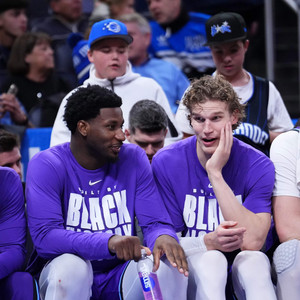
Right now, some of the greatest athletes in the history of the world are being paid millions of dollars to lose.
So the Utah Jazz are not even trying to hide the fact that that they're tanking.
They were up by as much as 17 points last night against the Magic.
Will Hardy, then in the fourth quarter pulls the entire rotation out and throws in a bunch of G League dudes to completely give that game away back to the Magic.
Now this is so normal in the NBA that if you're a sports fan you're like yeah, of course they're losing games on purpose.
The league gives the teams with the worst records the best chance of getting one of the top picks in the next NBA draft.
So teams have this real incentive to be as bad as possible.
So, yeah, tanking is rational.
But if you are a fan of one of these tanking teams...
It can be rough.
And I watched that Pacers game last night and it was the most disgusting thing I've ever seen.
Like I said, something smells fishy here.
What about teams like the Kings who are flat out benching everybody?
No Levine, no Sabonis, no Westbrook, no no one!
If you're curious, we will share the social media handles for all the voices of fans we used in our credits.
And it's not just fans who feel this way.
Here is the most powerful man in the NBA, Commissioner Adam Silver.
Are we seeing behavior that is worse this year than we've seen in recent memory?
Yes, is my view.
Adam Silver also said the league is considering every possible remedy to fix tanking.
There have been lots of different ideas out there over the years looking at whether there's a better system here to try to align incentives.
So, Adam Silver, you are saying you have an incentives problem and you need some creative solutions?
I mean, you might as well shine a giant Planet Money sign up into the sky.
Yeah, yeah, we got you, Adam Silver.
Hello, and welcome to Planet Money.
I'm Keith Romer.
And I'm Erika Barris.
Every system of rules creates incentives.
This is true whether you're talking about CEO stock options or regulating greenhouse gases or yes, the NBA draft.
So if you want to change the behavior of the people operating within a system, change the rules that govern that system.
Today on the show, Planet Money fixes the NBA's tanking problem by fixing the NBA draft.
We will look at three radical proposals for changing the draft and talk to an Olympic gold medalist and a World Cup champion.
This message comes from Ameriprise Financial.
Vice President Dena Healy shares why she believes many clients recommend Ameriprise to their family and friends.
It's because they've had an experience with an advisor that was positive for them, that helped them understand their most important financial decision.
And we see that clients routinely want to extend that sense of security and confidence to the people that matter most to them.
For more information and important disclosures, visit Ameriprise.com slash advice.
Securities offered by Ameriprise Financial Services LLC, member FINRA and SIPC.
This message comes from Capital One.
Capital One offers checking accounts with no fees or minimums.
What's in your wallet?
Terms apply.
See CapitalOne.com slash bank for details.
Capital One N.A., member FDIC.
Let us just consider for a moment the majesty of sports.
The very best athletes, competing as hard as they know how, putting all their effort and training and natural ability to the test against their opponents.
Yeah, this time of year.
That's not what you see when you turn on a random NBA game.
No, it's not.
Because of tanking, a lot of NBA games are basically not even worth watching right now.
It's bad for fans and it's bad for the league.
So to help us think through what to do about this pox on the game of basketball, we reached out to someone who lives and breathes this stuff.
How much time in your life do you think you have spent watching basketball games?
Can I just pass?
I don't I don't I don't want to actually sit down and do the math.
So my religion is two games a night at a minimum.
It's it's I don't know.
I don't even want to venture.
I guess it's too much.
I mean, I think it's it must be years right at this point.
That's a depressing.
That's a depressing.
I mean, it's fun.
I love watching basketball, but it years is we only have so many years.
That's a lot of time.
That is Zach Lowe, host of the podcast The Zach Lowe Show, longtime NBA reporter and commentator for Sports Illustrated and ESPN, and now The Ringer.
Yep, important member of my household.
My husband listens to Zach Lowe just about every single day.
Shout out to Andy and his fandom.
Okay, so Zach says the whole tanking problem basically boils down to incentives.
Teams are trying to lose to get a higher slot in the NBA draft.
So we are going to start with kind of a history of the different incentives the league has offered teams in the draft over the years.
Back in the 1960s and 70s, the NBA draft system was pretty simple.
Teams got to pick which young players coming out of college would come and play for them.
And to try to keep the league as competitive as possible, those picks were distributed in a very intentional way.
The league decided, as many leagues do, that the draft should more or less go in reverse order, with the worst teams picking high and the best teams picking low.
And so that's what the draft is designed to do.
Every year, the worst team from the Western Conference and the worst team in the Eastern Conference would flip a coin to see who got the number one pick.
And from there draft picks were assigned to the next worst team, and then the next worst team, and so on.
And you can see the logic of a reverse order draft.
Let's give hope to the bad teams.
Maybe they won't stay bad forever because they can get the next great star coming out of college.
But as long as that general incentive structure exists, teams are going to exploit it in whatever ways are advantageous for them.
This famously came to a head. back in 1984.
That year the draft featured a couple of players that were so good that teams had a big incentive to exploit the rules a little.
Yeah, Hakeem Olajuwon, and another guy you might have heard of, Michael Jordan.
They were going to be in the draft that year.
And the Houston Rockets were like, if we got one of those players, this could change everything.
So maybe you know, we lose this year so that we can win next year and the year after that, and the year after that, and the year after that.
So to make sure they got a shot at a top pick, the Rockets started sitting their best players, giving worse washed-up players big minutes.
They managed to lose 14 of their last 17 games.
And it worked.
They ended up with the first overall pick.
The Houston Rockets, who are represented here by owner Charlie Thomas and his daughter Tracy select Akeem Olajuwon of the University of Houston.
The Rockets got their star and they ended up winning two NBA championships with Olajuwon.
1984.
It was an important year in the history of tanking because it launched this decades-long game of cat and mouse between NBA teams tanking and the league trying to stop them from tanking.
For the league, teams intentionally losing games was a terrible look.
So to try to avoid a repeat of the whole Rockets tanking fiasco, the league remade the rules for the draft.
Now there was going to be a lottery.
Every team that missed the playoffs would get their name thrown into a big drum.
As soon as the drum is closed, it will be turned to mix the envelopes.
Then they would draw to see who got the top picks.
The envelopes will now be selected from the drum by the representatives of the participating teams.
It stopped mattering whether you finished dead last or just missed the playoffs.
The league added some randomness to their draft that is still there today.
What's the randomization trying to maximize?
It's trying to discourage abject, obvious, horrible tanking.
It's trying to remove the incentives or decrease the incentives for being a 15-win team, just a terrible team that's intentionally bottoming out.
And the change worked, at least as far as making tanking less attractive.
But every new set of rules contains new trade-offs.
And while the lottery lowered the incentives for teams to full-on tank, it also made it way harder for some not-at-all-tanking just genuinely bad teams to ever get better.
Now, instead of getting a top pick, that could have made them relevant again.
The worst teams sometimes ended up picking fourth or fifth or seventh.
And so, some bad teams just stayed bad.
Over the years, the league has tried all these different tweaks.
In 1987, they made it so only the first three picks were determined by a lottery.
Then in 1990 they weighted the lottery so that the worse your team was, the better chance you had of getting a top pick.
You know, giving bad teams more hope.
Then in 1994, they increased the odds for the worst teams even more.
So even more hope.
In 1996, they went the other way and decreased the odds a little for some of the worst teams.
And the league stuck with that version of things for a few decades, until in 2019.
They went back in the direction of randomness.
They increased the number of picks in the lottery from three to four and they flattened the odds again by kind of a lot.
You used to have a 25 chance of getting the number one pick if you were the worst team in the league.
Now it was going to be just 14%.
The whole point of it was to discourage teams from being the absolute worst teams in the league.
But this year, there are a few players coming out of college that people think could be really good.
So even with those lower odds, a lot of teams have decided that it's still worth it to throw away the rest of the season to tank for a shot at a better draft pick.
Yeah, Zach says teams are maybe more motivated to tank in the NBA than in other sports because of just how valuable a single great player can be.
There are only five players on the court at a time for a team.
The best players can have the ball on every single possession.
And so a superstar is uniquely valuable in basketball.
Now, Zach has heard all sorts of ideas about how to fix this tanking problem.
Everyone has their favorite solution.
I mean the number of emails and tweets and suggestions.
Everyone has a fix that they think is the silver bullet.
He's heard the one about making it so that no team can have a top four draft pick two years in a row.
And the one that says if you make it deep enough into the playoffs, you can't get a top pick the following year.
But Zach says if your only goal is to stop teams from losing games to get a better draft pick, there is a pretty straightforward solution.
I think you can eradicate tanking.
It just requires none of these band-aids, none of these like mini fixes on top of mini fixes that might open holes everywhere else.
It requires you have to snap the connection between a team's record and where it picks in the draft.
Yeah, if your draft pick had nothing to do with how bad your record was, there would be no reason to intentionally lose games.
One of the more elegant proposals for how to snap that connection between losing and draft picks is something called the draft wheel.
I think I first learned about it in the summer of 2013.
I learned about it at a bar in Las Vegas, as many people learn things at bars in Las Vegas.
I feel like NBA draft reforms is low on the list of things that people learn in bars in Las Vegas.
Not during NBA Summer League.
NBA Summer League, the NBA takes over Las Vegas.
The season's over.
Free agency is over.
The draft is over.
This is when people have these kind of conversations because there's nothing else going on.
So at that bar there in Vegas, Zach finds himself talking to someone he knows from the front office of the Boston Celtics, an executive named Mike Zarin.
And Mike starts explaining to Zach his elaborate draft wheel idea.
The wheel... has 30 spokes, one for each first round selection.
So there's a spoke for pick one, pick six, pick 10, pick 20, whatever.
And then over 30 years you just cycle like you're ticking around a clock kind of, through all 30 picks in a predetermined order.
And Mike Zarin's draft wheel is going to be the first of our proposals for how to fix tanking in the NBA.
So imagine a wheel.
All 30 teams in the NBA get assigned to one of the 30 spokes of the wheel.
And then each year they advance.
One spoke around the The spokes don't go.
First pick, second pick, third pick.
Instead, the order looks kind of random.
There were a few versions of the wheel over the years, but in the first version, after pick number one, the next spoke was the 30th pick, then the 19th, the 18th, the 7th, the 6th.
The idea was very simple.
Like, it doesn't matter what your record is in this particular year.
You pick where the wheel says you pick.
And so there's no benefit to you being bad in this particular year or good in this particular year, because the wheel sets the order for you.
And mathematically, the design of the wheel is a thing of beauty.
Every five years, you're guaranteed one top six pick and one pick seven through 12.
Hope was always at least somewhere on the horizon.
So it's not like you'd ever go through a series of five picks that were like 27, 22, 29, 30.
After 30 years, every team will have moved through all 30 picks and then they start moving.
Another trip around the wheel.
Zach says the league did talk about the draft wheel.
Some and a lot of teams were really resistant for a couple of pretty fundamental reasons.
Number one is just the general principle of are bad teams going to get trapped into badness for longer?
Like if my team just stinks and the next three picks on the wheel are 11, 29 and 16 picks, And I'm a fan of that team.
I might just like checking out for three years until the wheel spits me out somewhere else.
Under the current system, if you're bad, you get help right away in the draft.
But with the draft wheel, no matter how crappy your team is, you are still just going to get whatever pick the draft wheel says is on the next book.
And connected to that, there is always some contingent of small market owners saying front office executives who will say hey, wait a second.
We lose to the glamorous markets in free agency.
No player is going to pick us in Midwest City X over Los Angeles or New York or Miami.
And so our best and most secure vehicle to getting a superstar player is being bad in the right draft and getting lucky in the lottery.
And if you take that away from us, is it going to increase the disparity between big market teams and small market teams?
But those are the two main sort of quibbles that come up.
Too many of these smaller market teams were worried that the draft wheel would take too much hope away from bad teams.
And that's partly why the wheel never really got serious traction.
Yeah, big changes like this, they are not done top down by the league.
It would take a vote of all 30 teams and would require three-fourths of the teams to say yes.
So a lot of teams would need to change their minds for this to become a reality.
So for our next option for fixing the NBA's tanking problem, we went looking for a plan that could limit tanking without completely doing away with the whole hope element of things.
And we found it in women's hockey.
I don't always get to start interviews this way.
And so I'm going to take the opportunity today because I have it.
How many Olympic medals do you have?
I have five Olympic medals, four Olympic gold medals, and one Olympic silver medal.
That is Hockey Hall of Famer Jaina Hefford, arguably the greatest athlete we've ever had on the show.
Second greatest.
Thank you very much.
Second greatest to you.
Jaina won her five medals across five different Olympics as one of the stars of the Canadian women's hockey team.
These days, Jaina is in charge of hockey operations for the PWHL, the Professional Women's Hockey League.
The PWHL, first of all, was established in 2024.
Well, established in 2023, but dropped the puck in 2024.
So still a fairly young league.
Jaina helped launch the league.
And she says one of the benefits of being a young league was that they had the ability to experiment, to not just do things the way they've always been done.
As we were setting up the entire league, really, we had...
I guess, a culture, a mindset that said, you know, we want to think outside the box.
We want to be creative.
We want to do things differently.
One of the things they did differently was their draft.
Yeah.
Jaina and her colleagues.
They could see how just giving the best draft picks to the teams that lost the most games was hurting other leagues.
How bad tanking was, especially for fans.
There's many people that maybe only get to one draft.
NHL or NBA or NFL game a year.
And if you get to bring your child there once a year and then see a team that isn't putting their best team on the ice, on the court, on the field, you know, I think that's a really tough place to be as a fan.
So to try to limit tanking but still give bad teams some hope, the PWHL adopted this idea that had been floating around for over a decade.
Something called the gold plan.
So the gold plan was developed by a gentleman by the name of Adam Gold.
And what it does is it ensures that there is no tanking with teams, that they don't just play lesser players to try to earn or get their way to the first draft pick by losing.
Once you're eliminated from playoffs, you actually have to be the highest performing team to get the first overall pick.
Yeah, the gold plan takes the standard reverse order draft and adds this twist.
So to take the PWHL right now as an example, currently the two teams with the worst records in the league are the Seattle Torrent and the Vancouver Golden Eyes.
Let's say Vancouver gets mathematically eliminated from the playoffs first.
From that day forward, every game they win works for them instead of against them.
Then, say a couple weeks later, Seattle gets eliminated.
Now Seattle is also incentivized to try as hard as they can to win games to compete with Vancouver and whoever else might get eliminated from playoff contention.
Whichever team ends up racking up the most points after they're eliminated from the playoffs, that team gets the highest pick.
For the fans of a team that gets eliminated early...
They have reason to continue to show up and to continue to cheer for their team to win games and earn points so that they can earn the top draft pick.
Like imagine that it comes down to the very last game of the season and Vancouver and Seattle are playing head to head.
Both teams have had this rough year.
They've lost a lot of games.
But now their fans are going wild because they know if their team wins they will get the better pick in the next year's draft.
Like that would be amazing sports theater.
But every new system comes with new tradeoffs.
Sure, the goal plan increases a bad team's incentives to keep trying hard, but Jane acknowledges it could also limit their chances to get better.
You know, if I had to see one downside, I think it would be that, you know, if you did have a team that got eliminated very early and they still didn't get the number one draft pick, it would be challenging for them, you know, to continue to get better without top young talent.
Right.
If a team is just perpetually really, really bad and they're so bad that they can't even win with this new incentive, then yeah.
It's still early days for the PWHL.
The league is in the process of adding teams.
So this is the first year that the goal plan might really shake up the draft order in a dramatic way.
But Jaina is pretty confident that the pros of the goal plan are going to outweigh any possible cons.
So would it work in the NBA?
No.
Well, it's obviously not apples to apples.
For one thing, there's a lot more money at stake in the NBA.
It can be worth potentially as much as a billion dollars for a team to be able to draft the next LeBron James.
And the same bottom line cynicism that leads NBA teams to tank now, that would still be there.
Yeah, if teams wanted to tank under the goal plan, they still could.
They just have to tank at the beginning of the season, then turn it on once they're eliminated from the playoffs.
For me, though, I still kind of like the gold plan because it's like a dare, right?
Would NBA teams actually be willing to be that cynical and just intentionally lose their first 20 or 30 games of a season?
No.
No.
I kind of think mostly no, but it's hard to say.
No.
So, in the event that NBA front offices really might sink that low, we're going to consider one final plan for how to get rid of tanking.
Let's call it the Milton Friedman approach.
And this plan is already being used right now in a different U.S. sports league.
That's after the break.
Wix Harmony makes it unbelievably easy to create a fancy new website that's built to sell.
Get the perfect blend of AI and drag-and-drop tools that puts you in control of every detail, plus an AI agent to help you every step of the way.
Try it for free at wix.com slash harmony.
This message comes from Odoo.
If you are currently overpaying on software to run your business, remember this number, 10,000.
That's the number of new businesses that join Odoo per month.
Join Odoo today at odoo.com.
That's odoo.com.
OK, how to fix the NBA's tanking problem?
Well, you could do something like the draft wheel and just completely break the connection between losing and getting a high draft pick.
But then you're risking bad teams just staying bad for years and years and years.
Or you could use the gold plan incentivize teams to keep winning games even after they've been eliminated from the playoffs.
But like we said, teams might still be willing to game the system.
So for our third and final proposal, we wanted to go a little bigger, a little more radical.
And we brought in another big shot.
Let's start this way.
How do you like to be introduced?
World Cup champion, Sam Mewis?
Editor-in-chief of the women's game, Sam Mewis?
Wow.
Both, ideally.
In case your household is a less religious follower of the US women's national team than mine, is Sam Mewis, legendary midfielder, former professional soccer player and now host of a kajillion podcasts about women's soccer for the women's game.
For most of her professional career, Sam played in the NWSL, the National Women's Soccer League.
And in the NWSL, there is no tanking at all.
Because in 2024, they decided to get rid of their draft entirely.
Players who want to enter the league can just enter into conversations with teams that they're interested in, that are interested in them back.
And they can negotiate a contract just as individuals kind of on their own accord.
Now, if every team wants to sign the same young phenom, they have to compete for her on the open market.
Try to outbid each other on salary or who can provide the best place to develop as a player.
Now the clubs are competing to have the best facilities, the best coach, the best environment, the best culture, the best fans.
They have to make sure that their team situation is an appealing place for these young players to go play.
There is a salary cap in the NWSL, so it's not just full-on free market anarchy.
But without a draft.
Teams have to decide way more precisely how much a young player is worth to them and then pay them.
Interestingly, Sam says she thinks the primary motivation for eliminating the draft was not actually trying to fight tanking.
Instead, she says the NWSL was trying to deal with two pretty idiosyncratic problems.
The first problem was that at a certain point, the NWSL got some competition.
In the UK, the WSL the Women's Super League started bringing together really strong teams who were willing to pay top dollar for elite players.
You could play for a team like Chelsea, Manchester City, Manchester United, Arsenal.
Top players who didn't like where they were drafted could just go play overseas.
The second problem.
The NWSL, like a lot of soccer leagues, allowed teams to sign some pretty young players.
But the league didn't want a situation where a 16-year-old had to move thousands of miles because she got drafted by a team across the country.
So players under the age of 18 were exempted from the draft.
And that created another problem.
The really great youngest talent was skipping the draft and they were choosing teams that have great environments, probably a good amount of money and were really good places for a teenager to go play instead of going to college.
So the NWSL got rid of their draft for a bunch of reasons that had nothing at all to do with tanking.
But it's not hard to see how not having a draft changes the incentives for teams.
Yeah, without a draft, there is precisely zero reward for a team losing more games.
We're a year into this experiment.
How do you think it's working out?
Super interesting.
Obviously, one year is not a ton of data.
I definitely don't think it was a problem.
I think that, you know, just anecdotally and feelings wise, the rookies did great.
And Sam says, even without a draft, small market franchises could still build strong teams.
There is still this opportunity for smaller market teams to carve out an environment for their players that is appealing, even if they aren't paying top dollar.
Having other things as a part of your club environment that are really, really important to you could still allow these smaller market teams to be successful.
But she also recognizes that with no draft, owners with deeper pockets might be able to build powerhouse teams year after year after year.
I think, generally the wealthiest owners, who are the most dedicated and the most committed, are going to win.
And the top four teams are probably going to keep getting better.
This whole time though, we've been approaching this problem of drafts and tanking from basically two perspectives.
On the one hand, the leagues and the fans.
And on the other hand, the teams themselves.
But Sam says it's also worth thinking about how all of these systems work from a third perspective the players.
There are several reasons why it was specifically important in this league to have players have more of a say where they get to go.
Part of that is like a history of abuse in the league, or you know, different states have different laws about women's rights and different levels of friendliness towards LGBTQ plus people.
I also like to think that player autonomy and seeing these players as like human beings who have a say in where they're going, leads to better performance, better engagement with fans, better relationship with the club.
That I think is the lesson to take from the NWSL eliminating the draft.
So it's complicated.
Like how do you craft a system that perfectly balances the needs of the league, the teams, the players, the fans?
It's trade-offs all the way down.
We reached out to the NBA.
They didn't want to do a recorded interview, but they told us that fixing the incentives around tanking was very much on the league's radar and that the NBA Board of Governors was set to meet later this month and would be discussing a bunch of different possible solutions.
Okay, Erica, I want you to imagine... that you are the NBA commissioner for a day.
Finally.
What's your move?
Are you going to keep things the same, do the draft wheel, the gold plan, get rid of the draft?
I am getting rid of the draft.
I'm done with it.
It's over.
Whoa.
I personally, I'm team gold plan, but this stuff is super hard.
It is.
It's hard to figure out what's going to end up working in the long run.
Our NBA expert, Zach Lowe.
He also doesn't know what the league is going to do, but he's very confident they're going to do something.
I think change is 100 percent coming.
I mean, like the outcry.
Planet Money is doing a podcast about it.
Well, Planet Money is doing a podcast, the public shaming.
I mean, Adam Silver just more or less came out and said, we're looking at everything.
And they are looking at everything.
And I don't know how sweeping and dramatic.
I don't think the draft is going to be abolished in two years.
I don't think we're going to a 30-team lottery in two years or something like that.
But I do think changes are definitely coming.
Zach told us he has always been pretty opposed to just getting rid of the reverse order draft.
He wants bad teams to have hope.
But after all the tanking this year, he's at least opening his mind to other possible systems.
I've come to just sort of think more about.
What does the world look like when everyone has to try every year?
And that's all we want from NBA teams.
Just try.
Give a little.
Play the game.
Just play the game.
Planet Money is going on tour and I'm sitting here looking at this brand new tote bag.
It's amazing.
It's like those shirts that fans make for their tours with a list of all the cities they visit.
And these bags were made for people who come see us live.
Our tour starts in April.
We're celebrating the release of the Planet Money book.
If you buy a ticket at planetmoneybook.com, You can also get this bag while supplies last.
Each stop on the tour will have a Planet Money host and a special guest.
And all of the stops will have the book's main author, Alex Mayasi.
That's planetmoneybook.com or click the link in the show notes.
This episode was produced by James Sneed with an assist from Sam Yellow Horse Kessler.
It was edited by Jess Jang.
It was fact-checked by Ciara Juarez.
Alex Goldmark is our executive producer.
Special thanks to Ryan Nantell, Abdullah Ayubi, and Evan Johnson.
The fans we heard from at the top of the show go by the handles.
The Voice of Evan Full Court Blitz.
Ashley Neville, I Got Next Pod FinesseWest Basketball, Savant and Mike Dodino.
We'll add links to their videos in our show notes.
I'm Keith Romer.
And I'm Erika Barris.
This is NPR.
Thanks for listening.