This message comes from Discover, accepted at 99 % of places that take credit cards nationwide.
If you don't think so, maybe it's time to face facts.
You're stuck in the past. Based on the February 2024 Nielsen report, find out more at discover .com credit card. This is Planet Money, from NPR.
So, alright. I was out on maternity leave for a while and, I dunno, something about that time just made me view things in the world differently, I was questioning why everything is the way that it even is contemplating the big questions, like, like, why in the world do stores send me so many emails, an email a day from every story I've ever bought anything from ever why things like that, you know, so, okay, yeah, no, not the most important issues of our time.
But like that little pet peeve that just like, oh, gets you every single time you open your email.
I actually really need to know how bombarding us with email like this doesn't backfire on them.
Like, let's get to the bottom of this.
And I was certain that other people at Planet Money also had little petty annoyances that once we understand them could maybe make us less bitter about it all.
So, I told everyone come to me with your complaints, vent to me what is annoying you in the world that I can help make sense of.
And I'm just gonna say, some of us really needed the catharsis.
James Snead, you have a list?
Sure yeah, okay, like driving is terrible, there's like traffic everywhere, nobody knows how to drive.
Everything's expensive, nothing's cheap, nothing's cheap.
Mary Childs? Oh you know, I wish that we had peace on earth.
and we're not interested in the big ones.
We want petty complaints.
Okay, sorry sorry sorry, Lexy Horowitz -Gazi, what's your beef?
You got some beef? Okay, my beef is, oh, I'm so sorry, sir.
We don't do free refills.
And then you have to buy an entire another like three to $6 cup of coffee, outrageous.
Alex Goldmark, Planet Money's boss boss.
Yeah, it was about my microwave. Okay.
Okay. The short version is my microwave broke.
I'm now mad at like all appliance designers.
I am I am sad for skilled labor in the u .s. Like this took me on a journey I think I haven't gotten a single thing fixed since like 1999 like I think I just go like buy a new product Okay.
Well, here's what I'm thinking.
I don't want to live in that world.
I want to live in a world where we can like fix Yes Hello and welcome to planet money complaining I'm Sarah Gonzalez and we are complaining for the sake of learning We can't tackle World Peace, but there was a theme to some of our complaints.
We are annoyed consumers.
So we are gonna try to understand the other side, the annoyers.
Today on the show, why appliance companies maybe don't want us to repair things.
The very sad thing about satisfaction, like customer satisfaction, that could keep cafes from giving you that little top off and the bane of my existence 70 % off sale email.
Why do stores keep sending them?
This message comes from NPR sponsor State Farm.
In the market for small business insurance State Farm agents can help you create a personalized plan that fits your business needs and budget.
Like a good neighbor State Farm is there.
Talk to your local agent today.
Support for this podcast and the following message come from eTrade from Morgan Stanley.
With eTrade, you can dive into the market with easy -to -use tools, zero dollar commissions, and a wide range of investments.
And now there's even more to love.
Get access to industry -leading research and insights from Morgan Stanley to help guide your decisions.
Open an account and get up to $1 ,000 or more with a qualifying deposit.
Get started today at etrade .com.
Terms and other fees apply.
Hi, investing involves risks Morgan Stanley Smith Barney LLC member SIPC E -Trade is a business of Morgan Stanley.
So um, can I just, can I like vent to you for a little bit?
Yes, I know I just met you.
I called up Cynthia Price to give her my genius idea that stores should send less emails because Cynthia works with stores that send these emails.
Okay, so I get an email a day from, it seems like every store I have ever interacted with, ever in any way, shape or form.
And I feel like - Like something's not working.
Like, what could these brands be thinking?
Like they are conditioning me to not open their emails ever because it's too many emails.
They're conditioning me to just click, click, click, click, click, click, delete.
And also they are kind of making me I hate them a little bit.
Can I ask you some questions?
I'm just curious. Cynthia is an email marketing expert at an email marketing company called Litmus, and for some reason, Cynthia loves getting store emails.
It's a browsing opportunity for me.
It's a break from my day.
I will say I do enjoy clicking and deleting.
I'm an inbox zero girl.
Oh my god. I was just about to ask you if you were an Unbox Zero person.
I mean, that is part of the difference between me and you.
If you, like me, think that email has gotten out of control, we are right.
Cynthia says stores send more emails than ever.
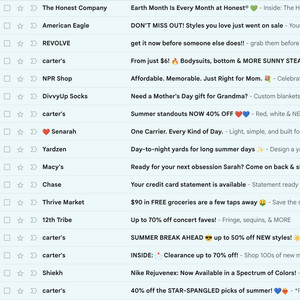
Okay, if I open my Gmail right now, it's like Chase, Massage Envy, Thrive Market, Chase, Carter's, Carter's, Carter's, Carter's.
Why is Carter's emailing you so much?
Carter's emails me four times a day, every single day.
Cynthia. What is that?
Carter's is a kids clothing store?
Oh, wow. Yeah, that's a lot.
Like who buys things from an email that they get?
A lot of people. Yeah, of course they're sending emails because it works.
But how, how could this possibly work?
It's like a great form of marketing?
It is. There are very few tactics that you can use as effectively, as immediately as email.
We're out of luck, guys.
Of all the forms of marketing, email has one of the highest returns on investment.
We know this because stores can usually see when we open their emails, so there's data.
And here's how it all plays out.
Let's say you're a store with a hundred thousand people on your email list, and you send out an email that's like spring deals are in bloom, or 70 % off your winter faves now, something like 20 to 40 % of people will open that email, like see it.
That doesn't mean they're actually clicking through to your store's website though to see any of your spring deals.
On a good day, 3 % of those people total are gonna click on your email.
That's not to mention the people that are gonna buy from it.
Yeah, just like 3 ,000 of the 100 ,000 people you emailed are gonna click through to your store and even fewer are actually gonna buy something.
So not that many people bite, but some do, and that's worth it.
For every $1 spent on email marketing, there is a 42 to $48 return on investment for the store, that's the average.
Yep. And that's a real stat?
It's a real stat. A 4 ,000 % return on investment?
Yeah. I mean, it's it's it is incredibly effective.
Part of that is just that email is cheap, right?
You're paying for someone to write an email, maybe make it pretty?
But the bigger part is that email has such a high return on investment because you invited these stores into your inbox.
You have actually raised your hand and said, yeah send me promotional emails in some way, shape or form.
You at some point liked what they were selling or even bought something.
That's how you ended up on their email list. So it's just more likely that you will buy something again.
Which just is like an entirely different world to play in as a marketer than it would be if I was putting up a billboard on the highway or just trying to target everyone on Instagram who is between the ages of 20 and 25.
I mean, those are way different scenarios.
It's expensive to get your ad in front of people online who might not even like what you're selling.
And sure, Instagram marketing is also relentless and it feels like all social media just knows everything about our wants and likes and our buying patterns.
But Cynthia says email marketing is still usually more effective because they just know that we want their content.
But do we though? No, I just signed up because when you buy something online you have to put your email if you want the receipt.
You just wanted the transactional emails that say like, where's my shipping.
That's all I want for every store.
All right, Cynthia says some brands, some stores, they do do email marketing very well.
Like, they have cult followings.
There's a snowboarding gear company that sends out emails when there's fresh snow on the mountains targeted to your location, like, the closest mountain to you with fresh snow.
That seems useful. Innondating you with emails?
Cynthia says, I was right, it is risky.
What they're training you to do is block them out and you're gonna unsubscribe because you're so annoyed by it or you will completely learn to just completely tune them out and you won't even look at what the subject line says at all you probably are already there.
Oh, I'm there. And every couple of months I will do like a mass unsubscribe purge which Cynthia says is kind of like the biggest F in marketing land.
Like, you had me, and you blew it.
You lost me. But it doesn't really matter, because someone else will like it.
So, some stores don't really care if they lose me and maybe even damage their reputation with me.
I have to wake up every single morning to 30 marketing emails just because someone else out there is gonna buy something.
Alright, who else has to get something off their chest?
I know I have things to complain about, but… Mary Charles.
We should all be on the same time zone.
Which would mean, like, nighttime is daytime for some people.
That would mean that, perhaps, you and I wake up at… what is called 10 p .m. and we go to work, and the sun is out, and it's shining.
It's fine. I'm just gonna squash this one right away.
You don't wanna go to work at 10 p .m. and it's daylight outside?
It's just called 10 p .m. What do you care what it's called?
A -M -P -M? That's just made up.
You were a baby when you learned that.
It doesn't matter. I don't know.
Countries of the world consider it.
And cafes of the world consider Alexi Horowitz -Gazy's next gripe.
Basically, Alexi hates it when coffee shops charge him for refills.
It just like, taints the whole cozy coffee shop experience for him, makes him not want to even go back.
Like, at least give him a discounted refill.
he's a reasonable guy.
Some places they'll say, give me a buck.
How about an extra dollar?
That's pretty chill.
And then it makes you wanna be like, here's an extra dollar as in the tip jar.
You know what I mean?
We are on the same team.
I feel like we're the opposite team when they're charging me for the refill.
This is just like regular coffee.
Not like the fancy, that's not like a mocha chuk or something.
It's just like straight up.
Straight up. Like coffee.
Black cup of coffee.
No adulterants. Oh, no sugar, no cream, no sugar, no nothing.
the gesture of a free little top off when he's setting up shop at a cafe, ordering snacks, spending money would go a long way for Alexi.
He says it would make him so loyal.
He'd be like the best repeat customer, he thinks.
So he wants to know why so many coffee shops don't see the benefits of offering customers a free refill on like a small 12 ounce cup.
Can I ask you, do they make a 16 ounce cup?
Yeah, I could buy the larger cup.
Isn't that just like the free refill?
No, look, there's a problem with that.
It gets cold way too fast. It gets cold.
You're totally right.
It's just a mood thing.
It's just a mood thing.
It's just the tiniest signal I get about what kind of business this is.
For Alexei, it's less about the money, or even what's practical.
It's more about how all of this makes him feel in a coffee shop.
so I called up a sort of expert in how we experience things.
I study both experiences that cost something as well as experiences that don't cost something.
So I'm really interested in how paying attention to certain things gives us more or less enjoyment.
So yes, enjoyment. Kristin Deel studies joy, technically satisfaction at the University of Southern California, like the joy we get out of experiences.
She teaches consumer behavior among other things and I'm just gonna say it Kristin is very joyful.
I'm generally a happy person I think.
And my advisor told me that people either study what they're good at or what they're bad at.
Okay, I think this is the perfect match. I think I have some insights there, it's much more complicated question than you would think it is.
I agree. First of all, Kristin says, we can blame diners for the expectation of free drinks.
Right, because they're the ones who kind of suggested to us that that's something normative, like the norm for a diner maybe still, like I walk around with this like coffee pot that has the coffee burned on the bottom, right?
Yeah, diner coffee.
But you know, like they also tend not to be the ones who are profit maximization entities.
Sorry. But a coffee shop is not a diner.
They don't particularly want you to linger taking up seats maybe for hours with just your $5 coffee.
So even if a free refill would make Alexi happy.
The incremental benefit of him being a little bit happier with this is probably not worth that cause so.
Even for like a little top off.
Yeah, it's just a little top up to you but times 24 seven, it's still an expense.
Coffee shops are just gonna do what makes them the most profit, right?
That's why they don't do this.
Our extra happiness isn't worth it.
Ah, the man. So if Alexi is gonna be happy in a coffee shop, he's gonna need to charm the workers.
Get the rogue employee that's like, I'm supposed to charge you for this, but like, I'm not gonna charge you.
And then you're like, yes, we're in this together.
Yeah, okay, so there is actually research and then something like that.
There's research on how satisfying good surprises actually make us.
That works the first time.
But then the next time, he was like, okay, where's the rogue employee here?
Turns out customer happiness is not as valuable as you might think it is.
The problem for companies is that when they give things out for free as a surprise, we come to expect it the next time, and we are not happy if we don't get it.
Yeah, and then you're like, is Jack working today?
Is Jack here? Cause he's normally the guy who gives me my tea.
Kristin says, there's actually a sad ending to anything that brings us satisfaction.
We adapt to that and we get accustomed to that.
Even if the rogue employee always reliably gave us the rogue free refill, Or even if it wasn't rogue at all, if it was company policy like Alexei wants it to be, they could do the exact same thing that made us happy last time.
But we're just not as happy.
That is sad. Yeah. I think that's sad, but it's called hedonic adaptation.
Hedonic adaptation or the hedonic treadmill.
The theory behind this is basically that you don't just go up, up, up in happiness forever.
For instance, as you make money and you can buy more and more things, your expectations also rise.
This seems like a good reason for a coffee shop to not give free refill because they're like, whatever, you're just gonna get mad at us about something later on anyways.
It definitely will give your colleague a bigger bump the first time than the fifth time.
No question asked. Yeah, yeah.
Okay, I'm gonna tell him just suck it up because we're just gonna be dissatisfied eventually anyway because we're terrible people, because people are terrible.
On the upside that got us out of the caves right?
If we had been happier in the caves we wouldn't have ventured out.
Yes she did just say on the upside dissatisfaction is why we came out of the caves.
By the way, Alexi might be onto something here because Starbucks, of all coffee shops, is bringing back some free refills, which might sound very exciting now.
But we know the excitement will fade.
After the break, why it's so hard to fix things these days.
Hint, it's all by design.
But first... Yes! Umbrellas are the worst!
A quick complaint from Kenny Malone.
The umbrella is an inherently selfish thing.
You build a little bubble up around yourself that you're gonna poke other people, take up too much room, pour water on other people, and umbrella has negative consumption externalities, is how we would put this in the econ world.
You use it. You benefit.
I'm happy for you, but you are making my life worse When you use the umbrella so can we just stop?
This message comes from Capella University Imagine an education that teaches you the skills you need to succeed.
At Capella University You'll get a competency based education where you can take what you learn from your courses right to the workplace They'll teach professional skills that'll help you pursue the goals you hope to achieve.
And you can apply those skills right away.
A different future is closer than you think with Capella University.
Learn more at capella .edu.
This message comes from NPR sponsor Informatica.
Everybody's ready for AI except your data.
Informatica offers the only end -to -end AI -powered platform that connects, manages and unifies your data across virtually any multi -cloud hybrid environment.
Informatica accelerates your AI readiness and scale at a pace that allows you to pay for only what you use without compromise.
Get your data ready for AI at Informatica .com.
Informatica where data and AI come to life!
This message comes from Capital One with the Capital One Saver card. Earn unlimited 3 % cash back on dining and entertainment.
One Capital One. What's in your wallet?
Terms apply. Details at CapitalOne .com.
Alright. Alex Goldmark, Planet Money's executive producer, his microwave broke and he got ranty and just like the perfect amount of concerned about the future of fixing things.
I go to use the microwave and it just doesn't work.
It doesn't turn on, the little digital clock doesn't tell you the time.
I've got one of the ones that goes over the stove, the light underneath it doesn't work, nothing.
And it seems pretty, pretty obvious to me that like, a fuse blew.
Like that's just the way it broke, right?
Alex wants to fix the fuse himself, even though you apparently definitely should not try to do this.
It can be very very dangerous, but there's no like...
fuse panel on the microwave. No little door to open where he can swap it out.
And he's like, oh, come on.
Why would you bury the fuse?
So I'm being a little dramatic with my fuse panel, but it's a stand -in for why don't we design things for repair?
Like, an appliance that is in your house, made out of lots of metals and like toxic parts.
He doesn't want to throw it out.
I want to try to fix it.
It's just a thing I believe in.
And I'm so sure it's a fuse.
But with no fuse panel, it's more complicated than Alex can handle and he calls up repair people.
And most of them are like, we don't repair microwaves.
Like, they're too small.
Like, it's too little.
It's not even worth it.
But the manufacturer, they have their official repair people, right?
So he calls them up.
And they're like, cool, we will send somebody, it will be $179 for them to show up, then it will be $200 an hour, billed every six minutes in increments as they do the repair plus the parts.
It was going to cost Alex $981 to fix his broken microwave and just $793 to buy a new one, have someone deliver it and install it.
Where is the incentive to fix things?
Sara, there's a saying in our business, our number one competitor is the price of a new appliance.
Oh, this is Stuart Cowder with the repair company, Mr. Appliance.
Wait, are you, are you Mr. Appliance?
I'm Mr. Appliance, New York city.
I own the New York city franchises.
Stuart has repair people driving to people's homes all over the city.
And he has his own complaints about that, like expensive parking tolls.
Congestion pricing.
I mean, ridiculous things.
Stuart, Mr. Appliance, is very proudly non -woke, as he says.
Yes, very good. Very proud of his Queen's New York accent.
Oh, of course. It was my nickname in college.
What was your nickname in college?
Queens? Queens. Oh, that is such a great nickname.
And Stuart is based in Manhattan, where Alex's broken microwave was and where Alex got his decently expensive repair quote.
Yeah, $200 an hour, I think, is the going rate.
Does that seem right?
It seems cheap to me.
Oh, Stuart asks me a bunch of questions about Alex's microwave, which I'm going to let Alex take.
First of all, how old is the microwave?
Five years. How much did you pay for the microwave?
Four hundred dollars.
Okay. And what brand is it?
Bosch. Bosch. All right.
Knowing the brand is very important.
And the reason for that is some brands make their units easier to repair than others.
Yeah, Stewart says several manufacturers make products that are not meant to be repaired at all.
They make the repair difficult, they put the replacement parts in difficult spots, they make it time consuming, hard to get to, hard to take apart.
They just, they make it difficult as opposed to other companies that make repairs very easy.
This is what I'm talking about, it's like some appliances, even if you're like the handiest handy person.
The manufacturer doesn't want it.
Alright, some manufacturers put parts in difficult to reach places because they want you to rely on them for repairs.
There's actually a whole right to repair movement of people saying, we shouldn't have to rely on the manufacturer, we should have access to the tools and information we need to repair the things that we have bought.
Some states have laws that give people the right to repair.
But then other brands just actually make it impossible for anyone to repair.
Like if the part breaks, they do not make the replacement part, it doesn't exist, so you have no option.
You have to throw the appliance out and buy a new one.
If you ask Stewart, manufacturers do this because they don't really make any money when you repair things.
They make money when you buy a new appliance.
But it's not just that, sometimes brands are just making things in the cheapest way possible.
Like, one brand makes a part out of 100 % steel when another one makes it out of 100 % plastic.
So it's just not meant to last that long.
Which, on the bright side, means that there are cheap appliances available.
Everyone can have them.
Alex's Microwave is apparently not one of those brands.
No. It's no bunch, actually.
Their products are meant to be repaired, and that doesn't mean it's cost -effective to repair them.
but they're meant to be repaired, and that means Bosch will make parts for them for many years.
Yeah, just because it's designed to be repaired does not mean that it will make sense financially to repair it.
A repair person has to come to you, right?
It's a very high skill trait.
It takes a long time to learn it, and you're not just learning how to fix one appliance, you're learning how to fix all appliances.
If you have to know how to fix a microwave, you have to also know how to fix a dishwasher and a washing machine, stoves, which mean you need to know plumbing, electrical.
There could be gas leaks, pretty heavy lifting, a refrigerator, right?
And this was Alex's point at the very beginning of the show, that the high cost of repair makes him sad for the future of this skilled labor in the US.
He wants to be able to use that labor.
but when it becomes so expensive, it's like, well, yeah, just buy the other one.
That's just the way of the industry, so...
And you guys try to like, oh, let's bring down our prices.
But like, you're just, you're stuck.
You can't bring them down.
For us, it costs what it costs.
And sometimes, this is nothing you can do.
The repair is more expensive than the appliance.
But a lot of times, the customer still repairs it because it matches the kitchen.
It has custom cabinetry.
The new one is different, it's a different size.
They'd have to call it carpenter.
So your bread and butter is kind of like people with like a fancy modern kitchen.
High end. We go with a high -end appliances.
If it was a $500 microwave, we wouldn't even come out.
We'd tell you go buy a new one.
The repair market, it's the higher end market.
By the way, Alex did not buy a new microwave, a repair person came to him and actually told him exactly what the problem was and where he could go on YouTube to fix it himself.
Which again, you should not do.
Never. What about like, if your own microwave breaks?
Would you know how to fix your own microwave?
I wouldn't even try.
I'm going to tell my boss that.
So those are our gripes.
And didn't it feel good?
complaining, catharsis.
Well, apparently, recent research has shown that venting and letting it all out can actually make you more riled up, more stressed out.
Venting may not actually be good.
Unless the person you're venting to can help broaden your perspective, see the other side.
Which, we did, right?
This is a very, okay, this is, I'm gonna sound ridiculous.
Erica Barris. I cannot stand little free libraries.
We have free libraries.
They are actual libraries.
They are called libraries.
Erica, this is a genius grievance.
This episode of Planet Money was produced by the one and only James Need and edited by Maryann McKeown.
It was fact -checked by the amazing Sierra Juarez and engineered by James Willets with help from Jimmy Kealey.
Alex Goldmark is Planet Money's Executive Producer.
Special thanks to Jamal Miller at Intuit Mailchimp.
I'm Sarah Gonzalez.
This is NPR. Thanks for listening to Us Bent.
This message comes from LinkedIn ads.
One of the hardest parts about B2B marketing is reaching the right audience.
That's why you need LinkedIn ads.
You can target your buyers by job title, company, role, seniority, and skills.
All the professionals you need to reach in one place.
To get a $100 credit on your next campaign so you can try it yourself, just go to LinkedIn .com slash results.
That's LinkedIn .com slash results.
Terms and conditions apply only on LinkedIn ads.
This message comes from Mint Mobile.
If you're tired of spending hundreds on big wireless bills, bogus fees, and free perks, Mint Mobile might be right for you with plans starting from $15 a month.
Shop plans today at mintmobile .com slash switch. Upfront payment of $45 for a 3 -month 5GB plan required.
New customer offer for first 3 months only.
Then full price plan options available.
Taxes and fees extra.
See Mint Mobile for details.
This message comes from Capella University.
At Capella, you'll learn relevant in -demand skills you can apply in the workplace right away.
A different future is closer than you think.
with Capella University.
Learn more at capella .edu.