Support comes from our 2025 lead sponsor of Planet Money Amazon Business.
Free your team from time -consuming office tasks with smart business buying tools.
Enable buyers to find and purchase items fast. Learn more about the technology, insights, and support available at amazonbusiness .com.
This is Planet Money from NPR.
A little while back, I bought something online that frankly seemed too good to be true, and after seeing this thing with my own eyes, I knew I had to share it with somebody.
My Planet Money colleague, Sarah Gonzalez.
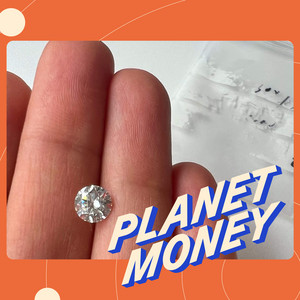
It's like, uh, white envelope.
I had mailed this thing to her as a kind of proposal to, you know, co -host this episode about this very strange economic mystery.
This package had come from the Chinese e -commerce website Alibaba.
Alibaba is the kind of place where you can buy like two dozen lawnmowers straight from the factory.
You gotta pop the bubbles.
But what I had bought is a lot smaller.
Oh, so satisfying. And a lot shinier.
Jeff, what is this?
Is it a fake diamond or a real diamond?
Sarah. This is not a real diamond.
According to the website that I bought it off of, that is a real diamond.
it is a one carat, colorless ideal cut diamond.
It's basically an engagement ring quality diamond.
That's what they told me.
Wait, this is like creme de la creme top of the top.
Like perfect cut, perfect clarity, dude it's sparkly.
Now the retail price for a diamond like this, it depends.
If it's a natural diamond, we're five thousand dollars.
If it's a lab -grown diamond, we're still talking about a thousand dollars.
But that was not what Alibaba was charging.
So how much did you pay?
I paid $137. I mean it's not a real diamond right?
There's no way. Or is Is there a way?
Hello and welcome to The Planet Money Diamond.
I'm Jeff Guo. I'm Sarah Gonzalez and Jeff, this is the start of a real mystery here.
Or a scam. Is it a diamond?
Is it real? How is it $137?
Well, today on the show we're gonna answer all of those questions and dive into the economics of sparkly, sparkly things.
My favorite things.
Because the market for diamonds, let me tell you, it started to get very, very weird. Yeah, no, I think it's just going to be a fake diamond.
This message comes from Charles Schwab.
Financial decisions can be tricky.
Your cognitive and emotional biases can lead you astray.
Financial Decoder, an original podcast from Charles Schwab, can help.
Listen today at Schwab .com financial decoder.
This message comes from ServiceNow.
People should do the creative work they actually want to do.
Not boring busy work.
Now, with AI agents built into the ServiceNow platform, you can automate millions of repetitive tasks in every corner of your business, IT, HR, and more, so your people can focus on the work that they want to do.
That's putting AI agents to work for people.
It's your turn. Get started at Servicenow .com -AIDashAgents.
So Jeff, when you sent me this diamond that you apparently bought, sight -unseen off of this website in China it for $137, my first thought was, obviously it's not real, right?
Which is why we tried some experiments.
So, there are tests you can do at home to see if something's a diamond or not.
Do you wanna try those?
Oh yes. They're not definitive or anything.
Oh, like bite it? Like, you can get clues, no not bite it.
No, don't bite the diamond.
Like, smash it. The first actual test that you had me try I was to try to scratch something really hard with this diamond of ours.
Right, because diamonds, which are made of carbon, they are the hardest naturally -occurring substance on Earth.
Jeff? What? It literally created like a gash in my glass kombucha jar.
Oh my God. Test number one, kind of promising.
It's feeling real. Test number two, put a diamond in a glass of water.
Diamonds are super dense so they sink but fake stones a lot of them will float.
All right I'm dropping in the diamond let's see if it makes a clink.
Okay. Oh. It sank straight down to the bottom.
All the way to the bottom.
Wow, it looks even sparklier in water.
Test number three. You had me hold the diamond up against my cheek.
Right, so diamonds are incredible conductors of heat so they're supposed to feel weirdly cool against your skin.
Does it feel hot or cold?
No. You feel nothing?
It doesn't feel hot.
It may be warm. Okay.
So, the last test, I'm going to say not looking good for you, Jeff, but yes, the other two experiments were leaning diamond.
Obviously, these tests are not, like, super scientific.
No, no, no, no. So, do you want to know the real answer, Sarah?
Oh, already? So, soon?
Well, no, no, no. First, I gotta tell you a story about how I figured it out.
Of course, all right.
Let me get settled in here.
Okay, so before I ever mailed you the Planet Money Mystery Diamond, I actually took it on a couple adventures.
We started out at the GIA, the Gemological Institute of America.
They're like the diamond experts.
So a couple of weeks ago, they're walking into the GIA.
I went to one of their labs in Midtown Manhattan.
Wow, this lobby is really pretty.
For the diamond industry, the GIA is like the temple of truth.
It's where people take their diamonds to get poked and prodded, and given a grade by expert gemologists.
I met their executive vice president, Tom Moses, who was going to take me behind the scenes, which they don't usually do, because the GIA inspects millions and millions of diamonds a year.
So let's just say we were in the presence of a lot of dollar signs And I've noticed we have a security guard following us Is that just for me?
Yeah just for you. No, no I'm kidding.
Um, Tom kind of was not kidding the whole time.
I was there. I had to have a security escort Anyway, Tom introduced me to the scientist who was going to be taking a look at the planet money mystery diamond Ulrica, Dan and CEO of Hanson, senior manager of diamond research here.
Dr. Ulrica Danens Janensen has a PhD in physics, specifically in diamonds and how to identify them.
So if anybody in the world could tell us what we had whether it was a real diamond or a cubic zirconia or some newfangled futuristic kind of fake diamond, it was going to be Dr. Ulrica.
Should we talk about this mystery diamond that I bought?
Please, let's. I've been showing it off, so it might be a little smudged.
That's okay. On the table in front of us was a large microscope hooked up to a television.
So now taking your mystery diamond, and looking at it under the microscope.
Sorry, I think that's some cat hair.
Yeah, there was a little bit of cat hair there.
A little bit of fluff, but that's, that's not a problem.
Wouldn't it be a Jeff Guo story if some cat hair wasn't involved?
My life is covered in cat hair.
So, after getting the cat hair off and the fingerprints of basically all my friends and family, Orica got her first good look at the planet money mystery diamond.
What I'm seeing here at least is that it's very high clarity.
Oh, that's good, right?
That's good. Alrica said, yeah, if this is a diamond, it is a very nice diamond, and to figure out if it is a diamond, she was gonna pull out all the stops for us, run all of these fancy scientific tests.
So she takes me to where the GIA keeps all of its most advanced equipment.
It kinda looks like a room where NASA might assemble satellites – like, the walls are white, the ceilings are white, there's this HVAC system that's filtering out every stray pinpoint of dust. test, and in one corner there was this big beige cabinet.
It was called a spectrophotometer.
This machine was going to tell us what kinds of atoms the planet -money mystery diamond was made of.
A real diamond, of course, is made of pure carbon.
Now, to get our diamond ready for the big test, apparently we had to make it really, really cold?
We need to give it a little bath.
It's going to go in liquid nitrogen.
So liquid nitrogen...
I'm sorry. What? No one told me about this.
Your... your diamond is gonna take a bath now.
Ulrika has this bubbling thermos of liquid nitrogen.
She pours it over our mystery diamond, which is sitting in a little dish, and she loads it into the machine.
Inside, a bunch of lasers turn on, and they're just, like, blasting our sample.
Like - pew pew pew pew!
Meanwhile, Ulrika is watching a monitor nearby.
Thinking about it, and then the squiggles come up.
So the screen was showing this squiggly graph.
It looked like a bunch of mountain peaks and somewhere in those peaks was the answer.
Ulrica points to one of them.
This one here? She says that specific peak in that specific place, it tells us we have carbon atoms. Carbon atoms arranged in a very special way.
It tells us this is diamond.
100%, this is a diamond, so we're not looking at a simulant.
Okay, confirmed, we have a diamond.
We have a diamond here.
No! Yes! This is a real diamond?
Yes! Sarah, it is official.
The planet money diamond is a real diamond!
This is, this is a twist. I wasn't expecting this.
Uh, but hold, okay, hold on.
There are diamonds, right?
And then there are diamonds.
You know? There's, there's natural diamonds, and then there's like the lab grown diamond.
So, is this is this where we're headed?
Okay. Okay. So it is true that for the last 10, 15 years, people have been growing these beautiful diamonds in the lab, but I just want to be clear.
Natural diamonds and lab -grown diamonds, they're both real diamonds.
They're chemically the exact same thing.
I mean, tell that to the real diamond crowd, but okay, I will say the big difference between natural and lab grown is still price.
Right, so a natural diamond like this could sell for maybe $5 ,000 but if it's lab grown, the price it's more like a thousand dollars and Allerca's machines, they could actually tell us exactly what we had cuz every diamond it turns out is unique.
It doesn't matter if they look flawless to the naked eye, Allerca says they all have these little defects.
These little impurities, little imperfections.
It's that imprint of how it grew, how it it survived in the earth, or how it was produced in a laboratory.
Like a fingerprint, or freckles?
Yes, exactly. The placement of freckles on anyone who has freckles is slightly different.
So these imperfections can tell you how a diamond came to be.
And when Orrick had examined our diamond, she saw three really telling imperfections.
Number one, she saw when she looked at it under the microscope.
They're teeny tiny little black specks.
Oh, I see them, they're so small.
So these specks, most diamonds have them, are bits of stuff from the environment that get trapped inside the diamond when it's born, whether that's deep underground or in a lab.
Now, the second imperfection she saw was when our diamond was in that fancy liquid nitrogen laser machine, because no diamond is like 100 % carbon.
Most natural diamonds, they have a little bit of nitrogen in them.
But our diamond, it had something else.
It had tiny traces of silicon in it.
You can see it on the chart.
That feature creates this spectral signature.
And both of these clues, they were pointing in the same direction.
It's lab grown, not natural.
That's right. So the Planet Money diamond is a real diamond just grown in a lab, and Orica is like 100 % sure about this.
She's 100, 1000 % sure.
She said, the shape of those little black specks and the fact that they were silicon, those are really only things you see in lab -grown diamonds.
Okay, but now here is the coolest part.
There's one more imperfection that Orca noticed and the moment she saw it, she was like, oh, not only can I tell you this is a lab -grown diamond, I can tell you exactly how they grew it.
How do you even grow a diamond?
Isn't it amazing? There are actually two different ways that people create large diamonds in the lab.
So, one, you try to mimic how a diamond is made in nature, so you get this giant press, some of them are 20 feet tall, and you just squish some carbon at really high temperatures.
But there's also a newer method that's becoming really popular.
it involves growing diamonds layer by layer and what Orca says is basically a fancy microwave oven.
So when orca put our diamond under this special black light and zoomed way in she could actually see traces of that process.
One of the things that you'll notice is that there's a line going through it, a layer.
Under the black light you could see a very faint line going through the middle of our diamond.
So as they were growing, probably they were struggling a little bit with their conditions.
They weren't able to maintain it.
They had to stop, they take it out, get a little clean, polish it up and then they grew a second layer.
So you're telling me that the top half and the bottom half of the diamond grew at different stages?
Yes different stages.
We have a kit -kat diamond.
It's like It's got layers to it.
Yes. So it's not the perfect perfectly imperfect lab -grown diamond.
I just want to be clear.
I just want to be clear here, OK?
The layers are invisible.
You cannot see it with the naked eye.
This is a high -quality diamond.
That happens to be lab -grown.
OK, but here's the thing that still doesn't make sense.
If you were to walk into a diamond store today and tried to buy a lab -grown diamond like this one, like our planet money lab -grown diamond, that would cost you like a thousand whole dollars and yet you bought this lab -grown diamond for $137.
Yeah, so that, that is the final mystery we're gonna try to figure out.
After the break, we're talking about the bizarre economics of the diamond market.
it. So, before we talk about how we were able to get a diamond for $137, let's just take a step back to talk about where diamond prices in general even come from.
Why do we even pay whatever amount of money for a rock, basically?
Yeah. Exactly, like the diamond industry is built around this kind of circular idea that people want diamonds because they're valuable, which makes diamonds valuable because people want them.
Because they're valuable.
And the deeper you get into the economics of diamonds, the weirder it gets.
So to understand how our Planet Money diamond fits into all of this, we should start with natural diamonds.
Like, why are natural diamonds so expensive?
The modern version of that story begins with De Beers.
De Beers, the diamond company, they got us all to think diamonds are special.
Yeah, so for many many decades, the De Beers company, they controlled almost all the world's diamond mines.
So they were able to keep the supply of diamonds really low.
But more importantly, like you said, in the 1930s and 40s, De Beers launched maybe the most genius marketing campaign in history.
They convinced all of us that.
If you love someone, you get them a diamond.
You better have that diamond ring if you want to get engaged.
The diamond is forever.
That's them. It's forever, yeah.
So that marketing campaign really, really juiced diamond demand.
Yeah, and of course when you have high demand and you have a company that's like keeping the supply of diamonds low, that is obviously going to make the price of diamonds go up.
Exactly. But now the story gets weirder.
Because by the 1990s De Beers had started to lose its diamond monopoly.
A bunch of competing diamond mines had opened up.
De Beers later had to settle an antitrust lawsuit.
So they didn't control the supply of diamonds anymore.
But diamond prices still stayed high for decades.
Yeah, why is that? I'm so glad you asked because I called up the expert.
Can you just say your name for us and what you do?
Yeah, so my name's Paul Zynniski and I'm an independent diamond industry analyst. Paul Zimniski is like THE Diamond Market guy.
He travels the world visiting mines and factories, collecting data on supply and demand.
Paul says, right around the time that Tabiers was losing control over the supply of diamonds, they found a big new way to juice demand.
They took the same classic playbook, you know, a diamond is something you give to someone because you love them, all that stuff, and they deployed that playbook in a huge untapped market.
A country with more consumers than anywhere else in the world.
You know, culturally, Chinese consumers really didn't buy diamonds prior to, say, the 2000s.
So they were kind of marketing that as a new area to drive diamond demand.
And, you know, it started to really catch on. So in large part, thanks to these new Chinese customers, buying into the story of diamonds and also buying a lot of diamonds, Paul says diamond prices actually hit a new peak in the 2010s.
OK, so now lab -grown diamonds, though, they enter the mix.
Yeah. Does that not bring the price of natural diamonds down?
Yes. But here's where the diamond story gets even weirder.
So these high -quality lab -grown diamonds, they started hitting the market in a big way about a decade ago.
And people did worry at the time, are these going to crash the price of diamonds?
But because scientists like Oerka can actually tell a lab -grown diamond from a natural diamond, instead what happened is the diamond market split into two different markets.
So if you look at the market for natural diamonds over the past ten years the prices come down maybe 20%.
Because people who would have bought natural diamonds started buying the lab -grown ones.
Yeah that is a big big part of it.
But then, you look at the market for lab -grown diamonds.
And that has been just on a wild ride.
So, at first, lab -grown diamonds were pretty expensive.
Paul says, if you went to the jewelry store, the lab -growns, they were only 10 % cheaper than natural diamonds.
Essentially, they were selling a lab diamond, having the same, maybe meaning, if you will, of a natural diamond.
And so they were piggybacking off the sort of a diamond is forever and super expensive marketing stuff from the beards.
That's the way I see it.
They're essentially riding on their coattails.
Like you remember the marketing for the Sara, right?
It was like, be ethical.
Yeah. This is not a blood diamond.
This came from a lab.
Yeah. But the more and more people that started to buy lab grown diamonds, the more companies invested in perfecting the technology to make them—to grow them bigger and cheaper.
A lot of those breakthroughs were happening in China since China was already the world leader in making diamonds for industrial purposes.
So Sarah, let me show you something that blew my mind.
Remember Alibaba, the Chinese website where I bought the planet money diamond?
Well, they don't just sell diamonds there take a look at this page okay I see a machine I see like a big machine with like knobs all over it kind of looks like a big giant like ice machine oh it's a different kind of ice Sarah this is a chemical vapor deposition machine this is basically one of those fancy microwaves or it was talking about oh so you can buy the thing to make your own diamond for just a hundred and fifty eight thousand dollars yeah yeah steel you wanna buy one?
No, I rather just buy $158 ,000 worth of diamonds.
I mean, a lot of people did think this was a steal.
Paul says over the past couple years companies in India and China have been buying tons of these kinds of machines, building big new factories.
Paul's actually visited some of them.
There's really not anybody there.
It's basically machines that are growing diamond.
There will just be rows and rows of them.
All these automated factories with their rows and rows of diamond -making machines led to a huge upswing in the supply of lab grown diamonds.
Since then, the wholesale price for lab -grown diamonds has absolutely crashed.
In just three years, it's fallen like 90%.
It's been this cataclysm for the diamond industry.
Paul it all says some lab grown companies are going bankrupt.
Also, you know how diamonds are also used a lot for industrial purposes.
Some companies are actually pivoting back to that, just making diamonds for like saw blades and drill bits.
Diamonds are a construction worker's best friend, you know?
They are. Okay so this is how you got our diamond for so cheap.
You got it wholesale, direct from the supplier.
Yeah, exactly. And the normal wholesale price for a diamond is something like a hundred and thirty seven dollars, I guess Well, you know, I did ask Paul about that So how much do you think I paid for it?
I would say the wholesale on that diamond is under $100 $100, oh gosh You said under $100 So you overpaid for extra sparkly lab run?
I know, I know. That we made in a microwave diamond.
I know. Apparently, this is an open secret in the industry.
Literally, nobody that I talked to was surprised at all that I'd somehow managed to buy this diamond for $137.
Apparently, it was not even that good of a deal.
OK, but there is this disconnect for me.
Because Paul is saying that the wholesale price for a lab -grown diamond like this one is $100ish.
dollars but if you walk into like any diamond store right now this exact kind of diamond is not going to cost you $100 at a store it'll cost you like $1 ,000 yeah exactly that is the biggest mystery in the diamond market right now the markup yes I think we should buy one of these diamond making machine yeah I know that's what I'm saying so this is the big puzzle right now because for natural diamonds, the typical markup like in a retail shop, it's maybe 30%.
But for lab grown diamonds, the markup right now is like 600%.
Okay. Logically, this should not happen, right?
Someone else should just open a store next door, sell the lab grown diamond for a lot less than $1 ,000 like $500, $300, they would still make a huge profit.
And then everyone else would cut their prices, and all the prices would go down.
Right. But that isn't happening.
And there are a couple theories why.
So theory number one is maybe there's collusion, right?
Maybe there's some conspiracy among Diamond stores to not lower their prices.
But there are so many Diamond stores, you know, in person.
You can also buy them online.
So it's kind of hard to imagine that they would all agree to this.
Yeah, that doesn't seem like the likely scenario here.
So theory number two.
This is about something maybe going on with customers.
Think about when you buy a diamond, right?
For most people, it's maybe once or twice in your life.
So the price of diamonds is not like the price of gas.
You're not paying attention to it all the time.
Right. People don't really know what the price of diamonds are until they're at the store buying in.
And when you say, oh, this one is $3 ,000 less than a natural diamond, you think like, wow, what a steal, you don't know that it should actually be even cheaper than that.
You don't know that it's actually $100.
Yeah. So part of this is that the price of these lab -grown diamonds has been changing so quickly, the wholesale price.
But eventually you would expect consumers to catch on and for the prices to come down.
PSA, news you can use.
You're paying too much for your lab -grown diamonds.
Well, unless you believe in the final theory, theory number three.
And this goes back to why diamonds are so expensive in the first place.
You know, the whole story that de Beers sold us decades ago.
How diamonds are supposed to be this expensive symbol of love and affection.
So there's a big difference between buying someone an engagement ring that costs $5 ,000 versus $99.
Yeah, you don't want to seem cheap.
Yeah, you know I think it's just psychologically hard to let go of the idea that a diamond should be expensive Like on some level it just doesn't seem right that you can just order a diamond like this for one hundred thirty seven dollars I mean just look at it.
It's a diamond. I'm just gonna say This would not matter to me personally if it's as sparkly as the diamond I'm looking at right now like I don't care if it's natural lab -made, don't you just want something sparkly at the end of the day?
Isn't that the only thing that really matters?
Okay so Sarah you know I did try to embody that mindset.
I did try to imagine this diamond as you know just a commodity in the cold hard marketplace.
Wait what are we doing with our diamond?
Did you try to sell our diamond?
Well, okay okay. Let me tell you one last story.
So when I was in New York, I took our little diamond out for a walk in the Diamond District.
See it's family. Great.
Street lamps are shaped like diamonds.
It's pretty cool. The Diamond District is this one block in midtown Manhattan where like 90 % of the diamonds that come to the US pass through.
It's like the Ellis Island of diamonds.
I was walking down the street and I saw so many shops selling diamonds, but also buying diamonds.
You guys buy diamonds.
Yeah diamonds. Yeah where can I I followed this guy wearing a sandwich board and said we buy diamonds we buy gold.
And he led me to this dark kind of dirty stairwell.
Just go up the stairs.
Yeah. Oh here? Push, push, push, push, push, push.
I walk in and the door actually walks behind me and they have me go into this small backroom.
The shades were down and there were these three kind of big looking guys just sitting around.
What's this old thing you got bro.
This? That's my microphone.
You recording? Yes.
Is that okay? I don't know, I mean I'd prefer not but it feels recording.
The guy behind the desk said his name was George Mooks.
How do you spell that?
I thought you were gonna ask me for a spelling on my last name, bro?
What are you? I have a report I gotta ask.
I'm gonna talk to him.
Show him what you got.
All right, all right, hold on.
I handed over the planet money diamond.
Fold him what kind of diamond it was, how many carrots.
So this is a lab grown diamond.
Yes. It's not a natural diamond.
I got you. So you need to go to somebody that buys lab -grown diamonds?
You don't even buy lab -grown diamonds?
Yes, I do. But honestly speaking, I really don't because I don't have a customer for our labs.
Oh, he didn't want our diamond, okay.
No, he didn't even want it.
Okay, so you wouldn't, so you wouldn't even buy this.
Not for me my friend.
Not for you. I cannot offer you anything that's not for me.
But just then, one of the other guys who's watching our conversation gets up from the couch and comes over.
The old smart don't worry about okay No this second guy he said his name was Solomon. No last name.
Are you are you the owner of this No?
C -ceo You like a KGB digging I'm a reporter some rules.
All right I'll come to do business here.
I have no time for it.
Okay and you know what, Sarah?
As I was standing there in that little room, seeing our diamond in the hands of some stranger, I realized something.
I realized maybe I didn't want to sell this diamond.
I don't know. I don't know if you didn't want to, so much as they were not going to let you.
Fair enough. Fair enough.
Anyway, I got our diamond back from Solomon. Alright, thank you so much, appreciate it.
And I got out of there.
Thank you. I'm glad they didn't let you sell it because I have actually grown kind of fond of our little planet money diamond, Jeff.
How dare you try to sell it?
I mean, I kind of feel the same way.
You know, that's what I was thinking in that room like me and this little diamond, we've been through things from the lasers and the liquid nitrogen to our romantic tour of the Diamond District, no matter what anyone else says, this diamond is valuable.
To me. There is a new perk for Planet Money Plus supporters.
You can now listen to some of our classic series from the Planet Money Archive.
Like when we bought some gold to understand why it's been used as money for thousands of years.
You can find all five episodes in one playlist, with more playlists coming.
If you're already a Planet Money Plus supporter, check them out.
Also, thank you. If you're not, sign up at plus dot NPR dot org.
You also get bonus episodes, sponsor free listening, and you know you're supporting the work of Planet Money.
This episode was produced beautifully by one of the sparkliest producers in the business, James Snead, Planet Money's true diamond.
It was edited by Keith Romer with help from Jess Jing.
backtracked by Emma Peasley and engineered by Gracie Lee.
Alex Goldmark is our executive producer.
A special thanks also to Martin Rapaporte.
I'm Jeff Guo. I'm Sarah Gonzalez.
Yeah, go for it. You say it, right?
I don't know... You should say it.
It doesn't matter. I know you take it.
This is NPR. Thanks for listening.
This message comes from Capital One.
With the Spark Cash Plus card. You earn unlimited 2 % cash back on every purchase for your business.
Find out more at CapitalOne .com slash Spark Cash Plus.
Terms apply.