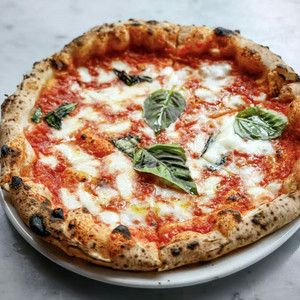
If I put an egg on a grandma pizza, it's still a pizza.
I mean, it's not one of my traditional toppings, but... Cheddar.
Is that a pizza cheese?
No.
This is a pizza.
Confirmed.
100%.
Why are you in such shock?
I'm in shock because... It has sauce.
It has cheese.
It has dough.
Not a pizza, but close enough.
French bread pizza, not a pizza.
We agree.
This is really good.
This is crazy good.
Is this like any other pizza you've ever had?
No, I've never had a pizza donut before.
But to me, it doesn't taste like pizza crust.
To me, it tastes like a donut.
It's a pizza donut.
Yeah, but is it a donut or is it a pizza?
Donut pizza?
I don't know.
Oh, I do.
And it's a yes.
I mean, I don't know know it.
I don't know donut pizza in the biblical sense.
Haven't actually had one, but conceptually, yes.
These are clips from the Thrillist video series Really Dough, where two guys go around and debate whether something is or isn't a pizza.
And so the question is, is a donut pizza pizza?
I'm so glad you asked Cynthia, because this is Gastropod, the show that looks at food through the lens of science and history.
And we are here today to get to the bottom of this pizza question.
I'm Nicola Twilley.
And I'm Cynthia Graber.
And while pizza seems like it's incredibly straightforward crust tomato sauce cheese it's actually surprisingly mysterious.
Where does it come from?
You may have just involuntarily shouted.
Italy, you dummies!
But A, that's mean, and B, just you wait.
We're gonna blow your minds.
As it turns out, most of the people living on the Italian peninsula thought pizza was weird and gross until just a few decades ago.
Which, why?
I mean, I think pizza is one of the world's perfect foods.
I can't imagine anyone thinking it's gross.
But that said, there are some serious battles for the best pizza.
The best type of pizza, that is.
Is it from Detroit, New York, Naples, Brazil?
Is there such a thing as bad pizza?
I'm thinking about one I ate in China with sliced apple on top, and feeling like I might already know the answer to that question.
We've got the answers to all those questions in this Encore episode of Gastropod.
Gastropod is part of the Vox Media Podcast Network in partnership with Eater.
Support for this show comes from Nature Sunshine All New Marine Glow Collagen.
It's that time of year when the summer heat is fading, the air is getting crisper, the leaves are turning red, everything starts tasting like cinnamon and pumpkins.
As the sun sets earlier, we spend less time with beams of sunshine and more time with the glow of blue light.
That's why Nature Sunshine New Marine Glow contains the blue light blocking power of lutein and other antioxidants to combat the damage to skin and eye health from blue light exposure.
Experience more radiant skin and proven eye protection with Nature Sunshine New Marine Glow, the only collagen product clinically proven to support eye and skin health and defend against blue light.
Try Nature Sunshine New Marine Glow now at NatureSunshine.com.
I'm really pleased that the Jane Goodall collection with Brilliant Earth connects to my vision of how we can live in harmony with nature.
Every choice we make ripples outward and you can choose what sort of impact you make.
I know that the things I've worked for all my life will carry on.
Discover the Jane Goodall Collection, exclusively at Brilliant Earth.
We eat a seriously astounding amount of pizza.
Americans collectively eat 350 slices a second and 100 acres a day.
More than 5 billion pizzas are sold around the world each year.
It's a lot.
So we all eat it, but are we all eating the same thing?
To get back to where we started with the donut pizza that is going to be haunting my dreams.
Is there actually a standard definition of pizza?
Oh, no.
OK.
The reason I'm laughing about that is because any time I'm asked.
I've become somewhat of an expert or authority on the history of pizza.
And anytime I'm asked, there's always someone who disagrees with my definition.
Carol Halstoski is a history professor at the University of Denver and author of Pizza A Global History.
So I want to be really careful about what I say here, that this is my opinion as a food historian, that I believe pizza is a yeasted flatbread that has ingredients baked onto the crust.
That is sort of the most basic definition of pizza.
I don't get that specific where I say okay, it has to be round, or it has to be square, or it has to, you know, be thin or thick, or it has to have tomatoes and cheese on it.
But here's the thing.
You ask two pizza experts for a definition of pizza, you get two different definitions.
I think that we need to kind of establish the fact that pizza is pizza until you put tomato sauce on it.
Because before that, it's a flatbread.
I mean, if not, then you could argue that the Egyptians had pizza because they had flatbreads, right?
And that would be absurd to say.
Francisco Magoya is the head chef at Modernist Cuisine.
They've already put out a five-tome series called Bread, and now they're working on an equally exhaustive pizza book, or books for which they have been doing a lot of research, which sounds delicious, although Francisco says it's actually very exhausting too.
The tally as of december, it's been 200 pizzerias, and it's just a number that boggles the mind because i mean, if we've been to 200 pizzerias you have to picture there's at least five pizzas per pizzeria And I don't want you to think that we eat the entire pizza.
You have to pace yourself.
It is a marathon of eating pizza.
And by the end of the day, you just want, like a carrot or something, a vegetable, something that feels a little bit better to your body to eat.
Because there is such a thing as too much pizza.
I'm unconvinced, but I agree with Francisco that the definition of pizza is kind of a slippery thing.
I wouldn't call just any flatbread a pizza.
I mean, is a tortilla a pizza?
I'm from Mexico.
I would say no, but I've thought about it because...
It has sauce and it has cheese and it's a flatbread.
And, you know, it's cooked at, you know, in a command, which is very high heat.
So strictly defining it, you can see how some of these lines cross over each other.
I think we can all agree that a tortilla is not a pizza.
For starters, a tortilla is flat, but it's not really a flatbread.
It doesn't have yeast.
But there are a lot of delicious yeasted flatbreads around the world.
There's laffa and pita and lavash and naan, and those are just off the top of my head.
Carol says there's archaeological evidence going back 10,000 years for little ancient pizza things.
They were cakes of mashed grains baked on a hot stone and then topped with whatever was handy. oil, honey, herbs, or even more complex sauces.
So if flatbreads go back to the Neolithic, the dawn of agriculture, and if there are yeasted flatbreads in so many different cultures, then pizza can't possibly be an Italian invention, right.
These are the kind of fighting words that will land you in court, Cynthia.
Specifically the Court of Historical Review in San Francisco, which is a fake court staffed by real judges.
They've made some landmark rulings in their time on where the martini was invented and whether or not chicken soup is the Jewish penicillin.
And in 1991, the court gathered to debate a serious question.
Is pizza originally Italian or Chinese?
The Chinese case was surprisingly strong.
The prosecutor claimed that pizza is descended from bing ce, which are rice flour cakes filled with sausage and spices that were brought to Italy by our old friend Marco Polo back in the 1200s and then transformed with the use of local ingredients.
But the judge wasn't buying it.
Even before Marco Polo made his way to the east and back, the Etruscans in what is now Italy, around about 1000 BCE, were making little cakes that looked much more like pizza.
The Italians won their day in court.
So I guess we can say that pizza is not Chinese.
But that's pretty much all we can say for sure.
While the exact origins of ancient pizza are somewhat murky, modern pizza definitely has a birthplace.
Where you begin to see pizza develop and being called pizza is around the 17th and 18th century in Naples.
And what people ate.
Back then that they called pizza was essentially kind of a bread with toppings baked onto it.
It didn't look anything like what we might visualize now as pizza.
For starters, the first things that Neapolitans called pizza had no tomato.
In fact, it was yeasted flatbread with anything that was on hand.
You kind of threw whatever you had. usually because you didn't have a lot of ingredients.
So it wasn't unusual for people to consume pizza, which was just, you know, crust or bread, with maybe bits of fish baked on it or maybe herbs that you gathered from the fields.
And that would look really different from what we think about is pizza today.
By the late 1700s, Italian dictionaries defined pizza as the word that people in Naples used for what pretty much everyone else called focaccia, a yeasted flatbread topped with oil and herbs, and sometimes olives and other salty good things like cheese and cured meats.
But what about the tomato?
At least according to Francisco.
A yeasted flatbread isn't really a pizza until it meets one of the most delicious vegetables ever.
Oh, God, it's actually a fruit, but never mind.
The tomato first had to get to Naples from Central and South America.
It arrived at the very end of the 1500s, but it took another century before people regularly ate it.
Europeans were initially a little wary of tomatoes, but tomatoes planted in the rich volcanic soil in sunny southern Italy were particularly sweet and delicious.
And someone in Naples had the brilliant idea to take these delicious tomatoes and toss them on their flatbread.
I have no idea you know who was the first person to do it, but I think it was very much the case, like I just mentioned, that people kind of threw whatever ingredients were on hand and someone got this great idea of like yeah, let's slap a few tomatoes on top of this pizza.
And it caught on, at least in Naples.
And that's actually the thing you have to understand to understand where the modern pizza came from is that Naples in the 1700s was the third largest city in Europe and also by far and away the most densely packed city.
Lots of those people in Naples at the time were really poor.
They lived tightly packed in tiny rooms in multi-story buildings, and they didn't have running water or kitchens, and so they had to buy and eat their food on the street.
They were eating a lot of things you could buy hot and hold in your hand.
This is how Naples developed a very particular food culture.
Naples was famous for its street vendors, who walked the city and cried out their wares.
Octopus balls, cones of fried anchovy, smelt from the bay, boiled chestnuts, chunks of zucchini marinated in vinegar, this fun new food called macaroni which, of course, you can hear about both in our macaroni and cheese episode and also in our pasta episode.
Although actually macaroni was comparatively speaking expensive and the very poorest Neapolitans could only have that on Sundays.
Pizza was half the price, and so people ate slices of it for breakfast, lunch, and dinner.
Remember, Naples is a port town, and there were a lot of fishermen there.
Many of them ate plain tomato pizza for breakfast before going out to sea.
Carol says that's why it's called marinara.
And a mobile vendor would sell them a chunk of pizza, or they would go into a pizzeria and eat standing up.
The history of these very first pizzas is actually not super well documented.
Like Carol says, pizza was food for really poor people.
And that's not the kind of thing that tends to make the official histories.
So we don't have a lot of evidence left behind by the very poorest citizens of Naples about what they eat and when they ate their first tomato pizza.
We do have evidence from foreigners who visit Naples and see that wow, all these people are eating pizza.
And let me be really clear on this that when foreigners come to Naples and witness pizza, They do not think this is a very enticing or interesting food.
International visitors had some choice words.
Samuel Morse, he's the guy who invented the telegraph.
He visited Naples in the 1800s and said pizza was a quote Species of most nauseating cake covered over with slices of pomodoro or tomatoes, sprinkled with little fish and black pepper and I know not what other ingredients.
It altogether looks like a piece of bread that had been taken reeking out of the sewer.
Even other Italians, if they weren't from Naples, they were usually not pizza fans.
In the late 1800s, a Pioneering woman journalist called Mathilde Serrao described these vendors walking around with slices of pizza made from quote dense dough that burns but doesn't cook, and covered with almost raw tomatoes.
She wrote that the slices would freeze in the cold and turn yellow in the sun, eaten by the flies.
But also, honestly, most Italians hadn't even heard of pizza.
It's such a rich, varied cuisine.
And people in the north are eating something very different from people in the south and people in the center.
And I think that certainly was the case where you had most Italians who were living in Italy.
If they weren't living in the immediate environs of Naples, they were not that aware of this dish called pizza.
Even a visit from the queen of a newly unified Italy, who traveled south to Naples in 1889.
That didn't help pizza's popularity.
But it did give one pizza a famous new name.
The legend of the pizza margherita is that the wife of the Italian king, on their visit to Naples, really wants to try some local street food.
And she's not going to go out in the streets and the alleys and walk into a pizzeria or buy pizza from a mobile vendor, which is how most Neapolitans consumed their pizza then.
Instead, her staff found one of the city's best-known pizza makers, and the story goes that he came up from his cramped little pizzeria to the palace she was staying at and made her three pizzas.
One just with oil, one topped with tiny silvery fish fry and one with tomato mozzarella and some torn basil leaves.
Queen Margarita was enjoying a bit of culinary tourism.
She was in Naples and she wanted a taste of what the locals ate.
The local poor people. which meant pizza, and she quite enjoyed it.
Her staff wrote the pizza maker a lovely thank you note saying that the three pizzas were found to be delicious.
And in return, the pizza maker named one of those three pizzas Pizza Margherita, the one with tomato, mozzarella and basil.
So everyone assumed, oh, they were the inventors of the Pizza Margherita.
Now, It's highly likely, and I think it would be the case, that many other pizzerias also made this type of pizza or some variation thereof.
So I don't think they were the only pizzeria that made it.
I don't use the story.
I don't think about the story as illustrative of an authentic first pizza margarita but rather I think it's an important story that tells us something about food and Italian nationalism.
I mean tomato sauce, mozzarella and basil is red, white and green the colors of the relatively new Italian flag.
But even though a local guy got excited about the new national colors, pizza margarita wasn't a national dish because pizza was still super regional.
It took decades more for other Italians to fall in love with pizza.
As late as 1900, all the pizzerias in Italy were in Naples.
There had been one attempt by a Neapolitan to open a pizzeria in Rome, and it had apparently failed miserably.
Strangely, the next place pizza takes hold isn't somewhere close to Naples.
It's across the ocean.
Pizza definitely catches on next in the United States.
Remember, Naples was really poor, even for Italy, which was a really poor country.
So in the early 1900s a lot of Neapolitans emigrated to find work and a lot of them ended up in New York City.
And they wanted food from home, so some started making pizza for their fellow Neapolitans.
No one knows who opened the true first pizzeria in the US, but you can still get a slice at the place that calls itself the first in the US Lombardi's, which opened in 1905.
They wind up being the first ones to get a commercial license to sell pizza.
And again, it doesn't mean that no one else is producing pizza.
It just means that there's some physical record.
Lombardi and all the other guys making pizza wanted to make it taste like home.
So they had super hot ovens, but they could only get hold of coal instead of the wood they'd use back in Naples.
So the pizzas became coal fired rather than wood fired.
Back home, they would have used fresh tomatoes in season.
So they wind up initially asking for tomatoes back in Italy.
And what we see is the growth of a canned tomato or tinned tomato industry back in Southern Italy, which is really interesting because the market for What becomes a hallmark of Italian cuisine really develops outside of Italy.
So the tomato sauce on a New York slice was already different.
Canned tomatoes taste cooked and more jammy and umami-ish than raw tomatoes.
And the cheese changed, too.
Back home, these pizza makers would have used fresh buffalo mozzarella, which is just like those creamy, soft balls of fresh cow's milk mozzarella you can find in lots of stores today, but it has even more delicious fat.
And that doesn't get exported as readily and easily as the tinned tomatoes, which keep for a long period of time.
So they experiment with other forms of cheese and other forms of mozzarella cheese specifically.
And so you wind up seeing these sort of mozzarella cheese, American-style mozzarella, that low-fat, more dried and aged kind that you buy shredded in bags or in blocks in the supermarket today.
Carol says an entire industry developed around this cheese to support these early pizza makers.
It's completely different different from fresh mozzarella and it forms a stretchy, stringy yellow layer on top of your New York slice.
And this is why a New York slice is so different from pizza in Naples.
The cheese, the sauce.
It's not Neapolitan pizza anymore.
And it wasn't just Neapolitans eating it anymore either.
You do have some people who are not Italian at all, who are just in New York, who are, like you know, bohemians.
And they're more adventuresome in terms of their palates.
And so they're going to try this pizza. wild Italian thing called pizza.
They're going to drink a little bit of Italian red wine with that.
And that to them was very exotic.
New York, New Jersey, Connecticut all three states had a lot of Southern Italians and some people willing to try this exotic Southern Italian food.
This is the birthplace of pizza in the U.S. and the first region it really caught on outside Naples.
But pizza didn't start to catch on anywhere else, even in Italy, outside of Naples, until quite a bit later.
Half a century later, actually, after the Second World War.
So what happened?
That's shrouded in myth.
We have the story of how pizza actually got big in the U.S. coming up after the break.
This is advertiser content brought to you by Vitamix.
Throughout human history, in homes and restaurants in every corner of the planet, kitchens have always been full of noises.
Okay, so long before the buzz of the fridge and the whir of the Vitamix, the story of kitchen noise started with the sound of fire.
Its crackle has been part of the essential kitchen soundtrack for over 1.5 million years.
With the Stone Age came essential kitchen tools like the mortar and pestle, rolling pin, the knife and even the humble spoon.
Skip ahead a bit, and we have the modern kitchen.
Following the Industrial Revolution of the 1850s, electricity brought a whole concert of beeps and buzzes.
First there was a dishwasher in the late 1800s, the garbage disposal in the 1920s, the electric blender in the 1930s and the microwave shortly after that.
But all these sounds from across kitchen history the clank of the mortar and pestle, the buzz of the Vitamix, the click of the stove form the course of experimentation, nourishment and love that fill the kitchen up.
Kitchen noise is nothing short of the sound of joy.
Dinner is served.
Vitamix knows your blender is one of your kitchen's essential noisemakers.
Its whirring is the sound of making your family's famous hummus the creamiest strawberry smoothie, or that perfect summer pesto to enjoy around a crowded, noisy table.
Add a little more joy to your kitchen and shop only the essential.
Like the new Vitamix Ascent X5 at Vitamix.com.
Most AI coding tools generate sloppy code that doesn't understand your setup.
Warp is different.
Warp understands your machine, stack, and code base.
It's built for the entire software lifecycle, from prompt to production.
With the powers of a terminal and the interactivity of an IDE Warp gives you a tight feedback loop with agents so you can prompt review, edit and ship production-ready code.
Trusted by over 600,000 developers, including 56% of the Fortune 500.
Try Warp free or unlock Pro for just $5 at warp.dev slash topcode.
Support for this show comes from Notion.
There's only one of you, only so many hours, only so much focus.
What if you had a teammate who could work just like you do with all the contacts you have, but faster?
That's what Notion AI feels like.
Notion is the connected workspace where teams create, plan, track, and ship together.
Now with Notion Agent, you can get an AI teammate that finishes the job.
Notion Agent can do anything you can do in Notion, completing multi-step actions end-to-end to move, work forward while you focus on hard decisions.
You assign the task, your Notion agent does the work.
Try Notion and Notion agent for free at notion.com slash box.
The myth that supposedly explains how pizza spread around the US in the 50s.
It's that as American servicemen passed through Naples during World War II, they tried this strange flatbread with tomatoes and cheese and they really liked it.
On reaching the center of the city, thousands of shouting, hysterical people started to swarm around the lorries, tanks and cars.
It was the start of an amazing scene.
Here's a press car snowed up under an avalanche of wildly excited Neapolitans.
This was Italy's second most important city in the year of good gracious me, 1943.
And when they came back stateside they, you know, looked around and said hey, you know, I had this great thing called pizza.
I'd really like to have some.
And so servicemen were running into, I guess, pizzerias and asking for pizza.
And that fed the growth of.
But although you can read this story in a lot of pizza books and articles, Carol doesn't think it's true.
And she has a very good reason.
By the time that the Americans get to places like Sicily and Naples and then have to sort of march up the peninsula fighting the Germans the whole way.
Italians are really struggling in terms of food and how much food they're eating.
Now, if we think about that scenario, I don't think that's a scenario that's conducive to a lot of American soldiers eating this great thing called pizza.
There probably wasn't a lot of pizza available.
And if it was, it probably tasted pretty horrible.
Pizza did start to catch on in the 1950s, but it seems like it was more the whole post-war period we've talked about frequently on the show.
People had And Carol says as part of that, there was a whole pizza craze in the 1950s.
We begin to see the promotion of pizza through newspapers, through women's magazines, like here's a great Italian thing for you to try.
You could basically make it out of any ingredient you could find at home.
So they're suggesting the English muffin pizza.
They're suggesting making pizza out of whatever toast or whatever kind of bread stuff you could find.
You just need to slap some ingredients on it and bake it somehow.
So I found all these really unique recipes for various kind of homemade pizzas where you would put liverwurst and chopped onions on the pizza, which doesn't resemble anything I don't think that people in Italy were consuming.
This kind of thing was happening to a lot of, quote, foreign foods at the time.
Magazines were printing recipes for egg noodles and ketchup and calling it Italian.
It was the 50s and there was a lot of bad food being made in the U.S.
So pizza was starting to spread around America, but it still hadn't really caught on outside of the tri-state area.
What I do think made pizza break out of this, what you call the ethnic enclave of taste was were the fast food restaurants, specifically Domino's and Pizza Hut.
What makes a Pizza Hut pan pizza so good?
And it's really interesting to me how they get their start.
They're started in the Midwest where there aren't a lot of Italian-American communities.
So they're not appealing directly to Italian-Americans, right?
They don't care as much about them as consumers.
What they do care about is they set up these pizzerias and they specialize in food delivery.
Later, you can eat inside a pizza hut, but they're really just interested.
So they add this new twist to it. where they will deliver this pizza to you.
One call does it all.
And that's because these are the other big stories of the 1950s.