Grownups, Wondery Plus subscribers can listen to Wow in the World early and ad-free right now.
Join Wondery Plus in the Wondery app or Wondery Kids Plus on Apple Podcasts.
Hey, Wowzer fans, Mindy here.
And before we start the show, I gotta let you know that this November, with a special new episode featuring our friends at Circle Round and Terrestrials on Radiolab for Kids,
And don't miss when Elmo from Sesame Street stops by Wow in the World to make us all belly laugh on November 24th.
Oh, but that's not all, Reg.
On December 1st, we are sharing our 250th episode of Wow in the World with all of you.
We think this one is going to be music to your ears.
Literally.
Did I mention it's a musical?
And if you're a member of the World Organization of Wowzers...
Oh boy, do I have a surprise for you.
You can listen to our 250th episode early with me and other members from around the world on Saturday, November 22nd, at 7 pm.
Eastern.
That's right, we are throwing another listening party.
Join us as we dance along to our new songs.
React to the episode with other members in the chat and more.
Grownups.
If you want your wowzer to join this members-only listening party, you can sign up to become a member today at Tinkercastcom.
Slash wow.
Already a member?
Well, you can find the link and password to join the event when you sign in at Tinkercastcom.
Slash wow.
That's it.
It's going to be a November to remember.
But for now, let's get on with the show.
Woo!
Wait a minute.
What's that smell?
Is that coming from here?
It smells like mushrooms and garlic and herbs?
And butter?
Oh, mushroom duxelles?
My favorite, but where is it coming from?
It's not down here.
Is it coming from outside?
Oh wow, it is.
It smells like it's coming from Mindy's house?
Oh, I can practically taste it now.
The butter, the garlic, that mushroomy paste.
I'm having an umami overload.
Okay, Parage should be here any minute, Reg.
Everything is going according Mindy, Mindy.
Huh, I wonder who that could be.
Mindy?
Guy Razzy!
Mindy, are you cooking mushroom duxelles?
Maybe.
You know that's my favorite mushroom-based French dish, don't you, Mindy?
Yes, of course I don't know that, Guy Raz.
But I do know that you've tried to feed me that mushroom garlic paste every time I come over to your house.
Well...
That's because it's my favorite.
Yeah, I can't stand it.
Well, then why are you making it?
I can clearly smell it coming from the other room.
Well, I'm making it for science, Guy Raz.
For science?
Yeah.
Here, check it out.
Follow me to the kitchen.
We got him, Reg!
High five!
Mindy!
What in the world is going on in here?
What does it look like?
Well, it looks like you have a giant pot of mushrooms boiling under a giant fan.
Uh, correction, two giant fans.
That way I can direct them in the direction that I want the smell to flow.
And in this case, toward your micro house.
Uh-huh.
And what does this have to do with science, Mindy?
Well, I'm trying to replicate or copy this experiment that was conducted by a group of researchers at France's Montpellier University.
They...
Boiled up a cauldron of mushrooms and pointed a couple of fans at it?
Well, not exactly.
See, the experiment that they performed had to do with botany.
Botany?
You mean the study of plants?
Exactly.
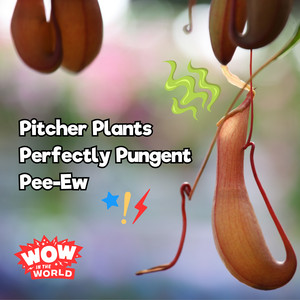
They were doing experiments on this plant called the pitcher plant.
Oh, I know the pitcher plant, Mindy.
I tried to grow some a few years ago.
Oh, yeah?
Yeah, they're a carnivorous plant.
I know, and that means that they eat meat.
Like small people.
Which actually means that, instead of just getting their energy from the sun and soil, they get it from other animals like bugs or insects too.
But not people.
Never people.
That we know of.
And their leaves are the shape of, well, vases or pitchers.
Exactly.
And if you really wanted to, you could fill them up with soup.
But I would not recommend that.
Okay.
So let's talk about how these pitcher plants lure in their victims.
Well, okay, sure, Mindy.
So how do pitcher plants lure in their victims?
Well, I could tell you.
Or?
Or we could do a story time.
Oh, let's do that.
I love these.
Ahem.
Once upon a time, there was an innocent and curious little fly who loved the sweet smell of nectar.
One day, the fly spotted a beautiful plant.
The pitcher plant.
Oh, I think I know where this is going.
It smelled so good to the fly that the fly just had to go in for a closer look.
Ah, don't fly.
Don't get too close.
It perched itself on the edge of the pitcher plant to soak in that sweet, sweet scent.
Ah, be careful, fly.
You might fall in.
The fly fell into the pitcher plant, falling deep, deep down until it reached its liquidy center.
Ah, Gross!
The fly struggled in the watery liquid, trying to escape.
But the walls of the pitcher plant were just too slippery for the fly to get out.
Oh, no!
And then the fly was done.
Ooh.
Slowly dissolved in the water and digested by the plant.
Ugh, that's a pretty gruesome story, Mindy.
Yeah, I know, huh?
Wait a minute.
I think I see what's going on in here, Mindy.
You're trying to see if you can lure your friends over to your house in the same way that a pitcher plant uses its smells to lure insects over to them.
You know it.
I call it...
A smell-vitation.
A smell-vitation?
Yeah, inviting your friends over to your house with smells.
Right, but surely it would just be easier to email or send a text message to the person, right?
Yeah, but emails and texts don't smell like anything and they're not nearly as fun.
That's true.
Which brings me to the second part of this experiment.
Reggie, prepare the pork knuckle.
Okay.
Pork knuckle?
Yeah.
Fingerling can't get enough of them.
So now I just need to adjust these fans here so they're pointing at Fingerling's house.
OK.
There we go.
And now I just got to turn them up a little bit.
Huh.
And now we wait.
Okay.
So, Mindy, what were these researchers from Montpellier University studying anyway?
I mean, we've known that pitcher plants use smells to lure in insects for years already.
Yeah, but these researchers wanted to find out if different kinds of pitcher plants were able to lure in different kinds of insects, depending on their smell.
Ah, so different...
Different smelling plants might attract different types of insects.
Sort of like how you're customizing each of your smells to lure in each of your friends.
Exactorinos.
Mandy, you having a barbecue in here?
Speaking of which, I think that might be Thomas Fingerling.
Whoa, that smells delicious.
Coming!
Run, run, run, run.
Oh, uh, pardon me, Cindy, but, uh, what in the world wide web are you cooking in there?
Pork knuckle.
Pork knuckle, huh?
Well you uh wouldn't happen to have enough pork knuckle for poor old, hungry Thomas Fingerling, would you?
You know it.
Where is it?
Oh, it's in the kitchen.
And thank you for being part of my scientific research.
Oh, no problem at all, Mandy.
I love pork knuckle.
I mean...
Scientific whatchacallits.
No, I said scientific research.
Right, right.
Oh, boy, would you look at that food.
But, uh, what's with all the fans?
It's for an experiment that Mindy's running.
Oh, okay.
Let's just turn these off here, and then we can get to eating, right?
That's right.
Okay.
Everyone stand back.
Uh... Wow, I don't think I've ever seen anybody pork knuckle that big.
Quickly before.
Oh, that's good.
I don't think I've ever seen anyone eat pork knuckle.
Yeah.
Okay, Reg, time for smell-vitation number three.
Load up the five-alarm chili.
I'm guessing that's for G-Force?
Here, you might want to put on these swimming goggles, Sky Ross.
The chili peppers in here really pack a punch.
Huh, yeah, thanks, Mindy.
Uh, Reggie, the cauldron, please.
Brr, brr, brr, brr.
Alright, everyone ready?
Yep.
Goggles are on.
Oh, goggles.
That's a good idea.
I'm a bit of a messy eater.
Okay, let me just adjust my fans here to point them towards Grandma G-Force's house.
There we go.
Alright, all set.
Now, you think we're going to go three for three, Guy Raz?
Well, I'm not sure, Mindy.
What do they find in the pitcher plant experiment?
Well, The researchers set up 16 pitcher plants and then sampled the air above each pitcher.
Presumably to find out what kind of smell they were giving off.
Right.
And they also measured the size of the pitchers too, like how wide they were and how deep each one was.
Huh.
And then they waited to see what kinds of insects each of them caught.
And what did they find?
Well... and tricks on me, or does someone got that five-alarm chili on the boil?
Three for three!
Grandma G-Force!
Hugs!
No.
Oh, okay.
I'm here for the chili.
Oh, well, it's over in the kitchen.
Just go and help yourself.
Don't mind if I do.
Fingerling, pass me that straw.
Talk to you later.
So Mindy, what did these researchers find after they waited to see what kind of insects the plants were able to catch?
Well, it's actually super interesting.
See, they found that the pitcher plants that used a lot of something called monoterpenes in their smells, those plants attracted more bees and moths.
And a monoterpene is a kind of molecule that can sort of smell like fruits and flowers, right?
That's right.
And so what about the other plants?
Well...
The researchers found that some of the other plants that used more fatty acids in their smells attracted more ants.
Huh.
So it seems like these pitcher plants are able to create a smell that attracts the certain kind of insect that they're hungry for.
Well, we'll need some more research to know for sure if they're doing it on purpose.
But for now, that's certainly what it looks like.
Kind of like how you personalize each of your smellvitations for each of the people that you want to lure to your house.
You're picking up what I'm putting down, Guy Raz.
And speaking of which, hey, Reg, let's load up the last smellvitation.
Okay.
Well, who's left, Mindy?
Almost everyone is here.
Guy Raz, how can we forget about Dennis?
Oh, of course.
Now, what does Dennis like to eat?
I have no idea.
I've never actually seen him eat anything.
So what smell are you going to use to get him over to your house, Mindy?
Guy Raz, I'm going to use the smell of secrets.
Huh?
It's Dennis.
Well, how do you smell a secret, Mindy?
I have no idea, but it works every time.
Now, I'm going to need everyone's help.
Grandma G-Force?
Thomas Fingerling?
I'm going to need your help for a second.
Okay, now first, let's just point this fan towards Dennis' house.
And let me just up the power a little.
All right, Kairazi, you go first.
What?
Whisper a secret into the fan.
Mindy.
This is absurd.
I'm not going to whisper a secret into the fan.
That doesn't even make any sense.
Come on, Guy Raz.
We've almost finished our experiment, and we're three for three.
Yeah.
Anything for science?
There are limits to this, but in this case, anything for science.
And make sure it's a good secret, too.
Okay, fine.
Let's think.
Okay, I got it.
Here we go.
Ahem.
I don't actually like dark chocolate.
Nobody does.
Okay.
All done.
Yay!
I knew you could do it, Guy Raz.
Okay, Thomas Fingerling, you're up.
Huh?
I'm up where?
I mean, it's your turn to whisper a secret into the fan.
All right.
Let's see.
I once had a kitty cat named Spikey.
That's it?
Yep.
Okay, well, that's a terrible secret, but fine.
Uh, Grandma G-Force, you ready with your secret?
Well, I guess.
Okay, go right ahead.
I was involved in a series of high-value hot dog heists across the Midwest in the 1990s and I am still wanted to this day.
Wow.
Now that's a secret.
Can I get back to my chili now?
Yes, of course you can.
Oh, yeah.
Well, Mindy, looks like you're the last one up.
Right.
Okay.
My name, Mindy, is short for... Mindy Annapolis.
This is so embarrassing.
Okay, I'm done.
I'm done.
That was hard.
Good job, Mindy.
Thanks, Guy Raz.
Okay, well, what do we do now?
Now?
We wait.
Mindy!
Mindy!
Yes!
That's four for four.
Write that down, Reggie.
Mindy, are you guys cooking up secrets in here?
I love secrets.
Yep, just a little scientific experiment.
Scientific secrets?
Like laboratory gossip?
Oh, boy.
Well, there isn't any gossip here, Dennis.
Oh, well, whatever.
I'll just have some chili.
Well, you still... away from my chili, boy.
What?
Grandma J-Force, you can't eat this whole cauldron.
Just give me a little spoonful.
No.
So Mindy, what else did they find with this experiment?
You were saying before that they also measured the size of the pitcher plants before the experiment.
They did.
And the researchers found that, on average, the longer pitchers caught more bees and moths, whereas the shorter pitchers caught more ants.
Interesting.
Yeah.
Maybe I should do a follow-up experiment where I change the size of the front door of my gingerbread mansion and see if that has any effect on the kinds of people that come over.
That's not a bad idea, Mindy.
Well, I guess that's an experiment for another day, huh, Reg?
But for now, I have a new invention to patent.
The Smelvitation.
Another classic Mindy invention.
You know it.
I can smell the success already ready.
Wow in the world.
We'll be right back.
Grown-ups, this message is for you.
Hey grown-ups, it's mindy and guy ross here from wow in the world.
Mindy and i have some brand new wow in the world toys out in the world just in time for the holidays, made for the kids who love science and for the ones who don't yet.
From our 100 experiments, that wow kit to the telescope and astronomy kit.
Our Wow in the World toys help your wowzer learn about their world through play.
Plus, you can hear exclusive audio content from me and Guy Raz to help your wowzer discover even more wows.
Grownups.
Give the gift of wow and wonder this holiday season with our latest Wow in the World toys designed with your curious wowzer in mind.
You can shop our Wow in the World toys at Tinkercast.com slash toys.
That's Tinkercast.com slash toys.
Hi, thanks for calling Wow in the World.
After the beep, get ready to record.
Hi, Mindy and Guy Raz.
My name's Pearson from Miami, Florida.
My Wow in the World is bats sleep upside down.
They hang from their feet, which have special tendons that lock them in place.
Allowing them to rest without falling.
Say hi to Reggie, Dennis, Grandma G-Force, and the other guy.
Rude.
Hi, I'm Asher and I'm from Cleveland, Ohio.
My wow in the world is the cordyceps mushroom can take over insects' brains and spread the fungus to other insects.
Bye, love you so.
My name is Izzy, and I'm seven years old.
I live in California.
My wow in the world is ring-tailed lemurs have stink in their tails and use it for stink fights.
Say hi to Reggie, Twinkle, Bucky, the annoying Dennis, and the sleigh cats for me.
Bye.
Love your show.
Hi, Mindy and Guy Raz.
I'm Aurelia, and I live in Naperville, Illinois.
My wow in the world is that in Scots, a language in Scotland, there are 421 words for different types of snow, like slidrican and feeble.
Say hi to Reggie for me.
Hi, Minnie and Guy Raz.
My name is Mimey, and I'm from Silver Spring, Maryland.
My wow in the world is that avocados are berries.
Say hi to Reggie, Dennis, and the snake cats for me.
Bye.
Hi, Mindy and Guy Ross.
My name is Benji, and I live in Chicago, Illinois.
My wow is that owls can turn their heads 270 degrees.
Say hi to Reggie, Dennis, Grandma G, Forrest, and Thomas Fingerling.
Dennis, I know you're static there.
Oh, snap.
What?
No!
Hi, Mindy and Guy Ross.
Cole from Plymouth Michigan, and my wow is that there are more than 43 quintillion combinations on a Rubik's Cube and only one is the solved state.
The world record time to solve one is 3.13 seconds.
Bye.
Hi, Mindy and Guy Raz.
My name is Romanza and I'm from Alabama and my wow in the world is that did you know that cacti store large amounts of water in their thick stem?
When rain is crazy In the desert, cacti absorb them, store water and help them survive through long drops.
Say hi to Reggie.
Dennis.
Howdy.
Stay out of trouble, please.
Well, I mean, that goes without saying.
And Grandma G-Force.
Say what?
I love your show.
Please mention this in your podcast.
End of messages.
Wow in the World is written by Mindy Thomas and Tom Van Kalken with help from me.
Original sound design and music editing is done by our supervising producer, Jed Anderson and Tyler Tholtz.
You can also hear Jed Anderson in the voices of Dennis Thomas Fingerling, Reggie and many of the other silly characters you hear on our show.
Jessica Bode keeps our facts straight as our fact checker and Meredith Halpern-Ranzer powers the wow at Tinkercast.
Our theme song was composed and performed by three-time Grammy nominees, The Pop-Ups.
Find them at thepopups.com.
Special thanks to Steph Sosa, Henry Moskal, Anna Daniker, Rebecca Caban, Kit Ballinger, Sana Ali-Mohamed, Anna Zagorski and all of the other tinkerers at Tinkercast HQ.
To keep the wows rolling, visit us at tinkercast.com.
There you can learn more about becoming an official member of the World Organization of Wowsers.
Learn about upcoming events, shop our wow shop, Find our best-selling books and learn about all of our other amazing podcasts from Tinkercast.
Grown-ups, you can follow Wow in the World on Facebook, Instagram, and Twitter at Wow in the World.
And our email address is hello at Tinkercast.com.
And if you're a kid with a big wow to share with us...
Call us at 1-888-7-WOW-WOW for a chance to be featured at the end of our show or an upcoming episode of Two What's and a Wow.
Thanks again for listening.
And until next time, be fun wowing.
Wow in the World was made by Tinkercast and sent to you by Wondery.