Imagine you're a student in China and the single most important test of your life has just been canceled.
That's the reality for some families in Chengdu right now, where a new pilot program is ditching the high-stakes zhongkao.
That's the high school entrance exam.
It's a radical experiment to ease academic pressure, but is removing the ultimate benchmark a relief for students or a risk to their future?
We're live from our studios in Beijing.
This is Roundtable.
I'm Steve.
Thank you so much for sharing your time with us today.
And for the show, I'm with Yushun and Xinyu.
First up...
In a significant pilot program, the city of Chengdu is exempting students at eight local schools from the daunting national high school entrance exam.
While initial media reports overstated the case by suggesting a full cancellation of the Zhongkou, the move nonetheless provides a tangible break for select families from the relentless pressure of standardized testing.
The initiative replaces the high-stakes exam with school-based assessments, aiming to foster a more holistic educational environment.
The experiment raises some important questions about China's education system, though.
Can this alternative model really reduce student burnout without compromising academic rigor?
And ultimately does trading a uniform national standard for individualized evaluation?
Does it really better prepare students for It's a big topic.
We're going to talk about the Zhongkou the test itself in a little while, but we'll start.
Yushan and Jingyu, good afternoon with the program.
It's a small one, but it's still a significant one.
Yeah, actually in September, which is the time that the new semester starts, several schools in Chengdu, southwestern China, launched this education reforms to improve student development and ease educational anxiety.
That's according to some paperwork that is launching or releasing this reform.
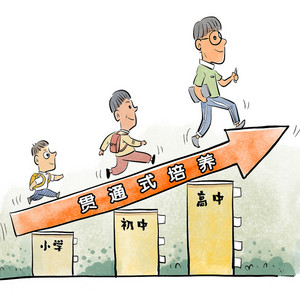
The city will pilot a 12-year integrated education program from primary to high school, starting in 2025, with eight schools, as you said, joining this first batch.
And parents can apply voluntarily.
If applications exceed available spots, then admissions will be decided by a computer lottery, which means it starts totally random.
Schools cannot hold entrance exams for these programs.
Part of efforts to reduce competition and also and selective admissions because, as i said in the beginning, it's the program itself is supposed to ease the pressure for students.
How many, how many schools did you say?
Eight schools, eight public schools and and private schools, two classes within each school and no more than 45 students in each class.
And then you mentioned, sorry, I'm repeating what you said.
I just want to make sure I get it right.
So there's two different programs here.
One is the six year path or track from grade seven to grade 12, if you will.
And then from grade one to grade 12, pardon me, that's the 12 year path.
Yes.
Okay.
So this would be very, very competitive to get into, I would think.
Yes.
Yeah, especially when it comes to today's education, we can feel the pressure from not just parents but also children.
Starting from primary school, they have this competition going on to get enrolled to a better middle school and also better high school.
And when it comes to this pilot program, I've seen that the curriculum, content and structure of these so-called integrated education classes, they remain consistent with the national curriculum.
And students, when they are enrolled in this type of program, at any time, they can quit.
They feel they don't like this type of class.
They can go to other normal, ordinary classes.
And because it follows the national standardized program, if they did choose to leave the program...
Still, they can keep up with the progress.
Yeah, right.
They wouldn't fall behind because the material is similar.
Yeah, because of the structure.
Maybe the content or the way that they learn is a little bit different because they will have different and specialized programs for them.
And one example is that I'm thinking it will make it clearer.
This Peng Hao principal of one.
This first batch of these eight schools is called Lie Wu High School in Sichuan.
Mentioned before said, the pilot integrated program will no longer train students solely for that high school entrance exam, but will focus more on holistic education.
And one example is when they teach functions in math.
This topic appears both in junior and also senior high school.
So in this integrated program teachers can introduce some related high school knowledge during the junior high stage.
So you can learn.
Maybe both and all of the teachers will be qualified as a both junior high school teacher and senior high school teacher.
Okay, understood.
Let's talk about the test itself.
So I didn't know about this, by the way.
I knew about the Gaokao, the university entrance exam, but I did not know that in China there was an entrance exam to get into high school itself.
So tell us, tell me about this exam in general.
Yeah, in addition to the famous Gaokao Zhongkao, the high school entrance examination is also a critical juncture exam that can determine a student's future or academic and career trajectory.
So it's a nationwide academic examination that determines which type or tier of senior high school a student can enter after completing junior high school.
And of course, the admission is merit-based.
So the higher scores you get, the higher tier or better schools you can enroll to.
And for Beijing, for instance, Haidian District.
So it's a district known for top high schools in Beijing.
And for this district, particularly if you're from another district other than Haidian, then you might need to score higher for an enrollment at a high school in Haidian.
But it is possible.
It is possible, but it's harder.
Your school is not determined by the location of your house.
So if you score very well on the Zhongkao, then you, as a student, you have a choice where to go to high school.
It can be anywhere in the city.
And also it is a big thing.
And I mean the pilot program is a big thing is because it can be quite um, challenging and difficult for a lot of students to prepare for this.
Uh, when students get into grade 10, let's say, or senior high school, there is this entrance exam, that letting you to do because you'll think okay, this is that exam that is going to decide where i'm going for the future, for the next three years.
So inevitably, parents and students will get nervous or anxious about the result, because this is going to be your lifetime choice.
The test itself, tell me about that.
Is it as difficult as the gaokao?
Is it seen as difficult?
Is the pressure the same?
Is the preparation similar?
The gaokao, you'll study and prepare for that for years.
Is it the same for the zhongkao?
I think it's...
I mean, the pressure is getting closer to Gaokao.
But over the years we have seen some reforms in terms of what content or what type of tests we're taking in terms of for these junior high school students.
In Beijing, for instance, we used to have like 10 subjects for these junior high school, junior school students.
But nowadays we have reduced that number of tests to six.
So we don't have this, I mean, the scored tests for history or chemistry or physics.
Now we have very basic like math, Chinese, English tests. and morality and rule of law and physics and also physical health and education.
Those are the topics that are on the Zhongkao.
Yes.
So we have reduced that to six.
So in some way, it can reduce some of the stress.
But also, on the other hand, we are looking for a holistic, a more holistic way of evaluating that, and that's the idea behind this pilot program.
Uh, you shouldn't, you took.
You took the test yourself.
Yeah i, i did, and i wouldn't say that is that hard, because when you are that under that kind of circumstances, all of the students around you are taking that test because um i, i didn't take the uh gaokao, so i cannot compare with the like difficulty with these two exams, But what I can feel is that everybody's like working hard for that test.
And it's just combining and using all of the knowledge during the whole year of your study.
And then I wouldn't say that it is quite hard.
I would say because at that situation the nerve you get, also the things that teachers and parents will say to you, is that okay now Zhongkao, it is the most important exam that you need to take in your life now.
Of course, after you take the Zhongkao, when you get into high school.
Now, teachers and parents, gaokao is the most important thing that you need to work on.
So always people around you will motivate you with all of these words and make you feel, I would say, a little bit nervous.
Yeah, motivates an interesting choice of word there.
Well, you mentioned that this is important because it determines the next three years of your life.
And that's because of the tiered high school system that exists here in China.
So tell us about that now.
Yeah.
First of all, we have mentioned for those who have taken Zhongkao if your scores are good, you can be admitted to ordinary.
And if your scores are better, you can be admitted to better schools or the so-called model schools.
And what's the difference behind these two types of schools is that, First of all, these model schools, or demonstrative high schools they have top performing students who scored higher at the tests.
And also they have more funding, resources, better facilities backed by the government.
They also have more experienced teacher and better environment for your students.
So these high schools, they are more competitive when it comes to the future gaokao that you're about to take.
Those are the coveted schools, the ones that students want to go to.
What's the other one?
What's the other path?
And the other path is if you didn't score very well and you have not been admitted by these high schools, then you have to go to these vocational schools that focus more on the skills so many of those students.
They graduate early, at the age of like 18, and then they go directly to find a job in the job markets like a blue collar workers.
So that's the other path.
It's not the absolute predetermined path of your life, but that is a common path for students who enter into those vocational schools starting from the first year of high school.
A highly percentage, I would say.
But I don't want to paint a picture that okay people students, when they did not score very high and they forced to go to that kind of vocational school.
Because when you, first of all, when you take the exam, you know what kind of level you are at right and then you need to choose.
You have, you have some, like several options that you can choose before you take the test, maybe after the test, but anyway, at the period of time that you need to choose uh, what kind of school you're getting in.
So you have that period of time to choose And you have several options.
You can choose the academic high school.
You can also choose the vocational schools.
But that's also tiered options.
Maybe you will, first of all, get evaluated with your first option.
If you failed I mean not like achieve or reach that score that school requires you then you will go to the second tier.
And which means if you go to that vocational school, you chose that and this, the option that you picked by yourself.
And i would say, of course, nowadays we are speak or talking about a lot about the you know, the integration of some vocational knowledge and some academic knowledge, because they are all integrated and maybe overlap some in in the way that we are training more um like technicians, in the way that we need more technicians, and then a lot of these vocational schools.
They also offer you a academic um path.
When you get into that vocational school, you can also apply for some universities and then, when you get into universities, there's also a chance that you can get into some top university for a graduate.
So, regardless of which path you go to, you're still going to take the gaokao and you still have the opportunity to get into a top-tier university, should that be the path that you want to follow.
It's just that through the vocational path, the path to a top-tier university is going to be a more difficult path to achieve that goal.
Is that fair to say?
Not necessarily you have to take Gaokao, because this is like two different paths of going to universities.
Some of them you need to take Gaokao, some of them you don't.
And it is also your choice.
Okay, last question.
Sorry, I have so many questions about this because I just want to make it clear for everyone how this system works.
So for students who don't perform well on the Zhongkao, then what they get, put in the vocational path.
But for some students, do they choose to take the Zhongkao again?
Can you take the Zhongkao again?
If you can, do you have to wait a year?
And my final question, sorry, I'll put them all together.
Do some students?
Instead of going the vocational path, will they take a break and just spend some time preparing for the Zhongkao again?
Definitely, you can take the Zhongkao again if you don't perform well this time.
And then you have to repeat the third year of your junior high school with the students together and then take another year's test later.
Only once a year.
Yeah, because the Zhongkao only happens once a year.
Like Gaokao, yeah.
The reason I wanted to get the answer to all of those questions is because I wanted to get an idea of the pressure that the students might feel, or that the families might feel, when they're preparing for this high school entrance exams.
So what does this mean then for the country, or at least for Chengdu?
Does this mean that the exam is going to be cancelled?
I mentioned it in the beginning that I didn't think, or the media initially reported, that that's what they thought was going to happen, but that's not what this is about, correct?
Right.
The pilot program on integrated education classes has no direct connection to canceling the exam.
And the information released by the Chengdu Municipal Education Bureau is showing that the pilot program currently involves only eight schools, as we said, making it a small scale and also localized experiment focused on personalized education for participating students and schools and not a citywide cancellation of the Zhongkao system.
And this is also a, I think, test for an experiment as a showcase for schools all around the country to see that, if it is like applicable,
And the purpose is not to cancel the entrance exam but to explore a more scientific and a coherent talent cultivation model.
Yeah, definitely.
Zhongkao will still be there.
At least in the near future.
But if we look at some of the statistics here, nationwide the passing rate of this Zhongkao stands at around 60, even though we have seen the percentage has been growing over the years, because Back in 2001 there were over 17 million junior high school students.
They are graduating in China.
And the academic high school only enrolled nearly 5 million students.
So that enrollment rate was only one-third.
Five out of 17.
Yes.
So from one-third, now the rate has surpassed 60% last year.
And in some regions, they have been expanding the enrollment rate. to 70% even.
So that's why we are seeing why these parents, they are anxious about their children is that they don't want their children to be blue collar workers in the future.
They want their children to take high school education and then go to a good college and then change the fate of their life.
So that's why I mean Parents.
They are pressured, and then they extend the pressure to their children.
So the competition is going on.
But then now we have this pilot program going on in Chengdu.
And I have seen many reports say that some of the parents they're very interested in this type of uh program.
They don't want to see that that their children they are.
They suffer from these kind of competition, uh and intense study environment going on in at schools so they also want to get enrolled.
But um, this program is still just like one of its kind in china and we don't know, and it's still experimenting, So they have very limited number of spots for students, right?
So some parents, they regret that they are not picked by the computer selection.
Like winning a lottery.
I'm sure those kids who won that lottery if that's how it worked out must have thought this is the single greatest day of my life, right?
They would have probably felt like that.
I get it.
I mean, I get the reasons behind a national standardized test, but I also get the reasons why it's anxiety-inducing, for sure.
And what I always say when we talk about the Gaokao or any college entrance test, any standardized test, is that if you have a bad day that day, If you have a really bad day that day, you're sick, you're depressed, something's going on in your family or in your life where you can't focus, you didn't prepare well enough or what have you.
You have a bad day on that particular day.
That can determine the course of your life for at least the next little while.
You know what?
I saw a post on social media once saying that she likes raining.
That's all.
And and after like these whole years, she suddenly understand why she loves raining.
Oh, the weather.
The weather, because her father made her like tell her wow, such a wonderful day that it is raining.
And we love raining days.
And then she realized that the reason is because during these no matter it's high school entrance examination or college entrance examination it's during June and July, which means it's raining season.
And then, in order to don't make her feel bad or that kind of a blue mood, her father started making her like rainy days.
From childhood.
Oh, my goodness.
Yeah, well, there's proof, right?
You know, we've been talking about Chengdu so far, but also there's a pilot program happening in Shanghai too.
And there were some online rumors saying that Shanghai pilots perhaps are in preparation for the cancellation of the Zhongkou after similar moves were announced.
The Shanghai Municipal Education Commission.
They responded to that, saying that the nature of long-term integrated education lies in the unified design of curriculum and the shared use of educational resources, and it does not mean the cancellation of the high school entrance exam.
So I guess there's a lot of rumors or there were a lot of rumors going around that oh, the Zhongkou is going to be canceled and this major major, major reform is coming.
Important to say that this is a pilot program.
So, I mean, what's the response?
What are people saying?
Is this good?
Is it bad?
Is it neutral?
What do you think?
For me, I totally support this type of program.
And even though we still need to wait and see I mean, this has just started we have to wait for another six years to see the results, to see if they can, these students, without the pressure of Zhongkao, and they can still work hard and get good scores at the Gaokao.
Six and 12 years, because one of the programs is for six and one's for 12 years.
Yes, but I have seen also cities like you mentioned Shanghai.
It's also planning to launch such a program.
So I think this is the trend for the whole Chinese high schools or education system to have this reform to reduce the exam pressure and anxiety for these students.
So the education is not just exam-oriented.
They want it to be a more holistic education system for students to develop more profoundly.
I mean, it's not just about getting high scores at the exams.
It's just about being a good person and cultivate your critical thinking, problem-solving skills and other interests.
Maybe
So that's a good trend.
That's the holistic side of it.
Yeah, for that comprehensive learning kind of aspect and also holistic learning.
I would say of course it is easing students' anxiety and also pressure on studying.
But I wouldn't say that it's going to be that nationwide trend, because if all of the schools have this kind of program and all the students are going to this kind of program, which means no students will go to that vocational school because every student can get into high school.
And then let's not from a perspective of outsider, from a perspective of students.
Not all of the students want to go to the path of academic study.
I mean, of course there is still a stereotype and prejudice on students.
Maybe blue collar are the students in vocational school but maybe they are good at doing that, such kind of things, and there are a lot of national competitions on students doing very, very skillful things and some of the students can do very, very well and can win some championship like globalized.
So this is, of course, students now having more options.
It is good, but when students having that kind of idea or interest in another direction, I wouldn't say we should have a one-size-fits-all, that kind of thing.
Yeah, and also, when you have a system that has standardized testing, you have merit based advancement meaning, if you perform well, you go this path.
If you don't, you go that way, and there is something to be said for that, because i think it just makes things quite clear now, whether that's a fair evaluation of what becomes clear or not is the other side of that coin.
It's the other side of the argument.
But still, and also China has had this system for such a long time that it might be hard to convince people otherwise, meaning parents who have grown up with these testing systems in their own lives for the whole time, and now they've got their kids doing the same.
But wait, oh, here's another option.
They don't have to go this path.
All right, wait a minute.
What happens if they don't go that path?
Because if the high schools aren't participating in these programs, what happens to these kids?
Do they just become guinea pigs to figure out if this is a good idea or not?
So I can see the argument against this as well, which is perhaps, perhaps why they're starting quite small.
Anything else that we need to know about the kids these days?
How are they trying to make them feel better about the pressures of going to school?
Just quickly, anything in the news there?
Mm-hmm.
Actually, we've made several attempts in the educational area.
At a press conference held by State Council Information Office in September 2025,
Minister of Education stated that during the recent five years the field of basic education, efforts are being made to revitalize education, county level, middle schools and change the resource allocation model that is overly maybe focused on exam oriented advancements.
And, alongside the reform of the high school entrance examination, we're exploring ways to reduce competition and alleviate anxiety of maybe both students and parents.
Yeah.
And also we have seen some places, like I mentioned before, they have been expanding enrollment for these junior high school students.
For instance, like a county in East China's Anhui province.
They said academic high schools in the county increased its enrollment rate to 60 this year.
And that figure would reach over 70% in 2027.
So that's two years later and 80% in 2030.
And also the capital city of this province, Hefei City, would increase its academic high school enrollment rate to 82 in 2026.
So we have also seen not only the efforts in expanding the enrollment, but also reducing the subjects, so that students can feel less stressed about the amount of tests they're about to take.
Expanding the enrollment on the academic school side of things, because that is the as we mentioned before, the coveted path.
So that helps to... relieve some of the anxiety for parents and students.
But also, I would think if we can get rid of the stigma, if there is a stigma attached to the vocational path or improved resources, improved quality of education, improved programs on that particular path, then that would also help to alleviate some of the anxiety.
We're in the pilot stage right now.
It's big news here, educationally speaking, in China.
But yeah, it's the pilot stage.
So we'll see.
We'll check in six years from now and 12 years from now and see how it goes.