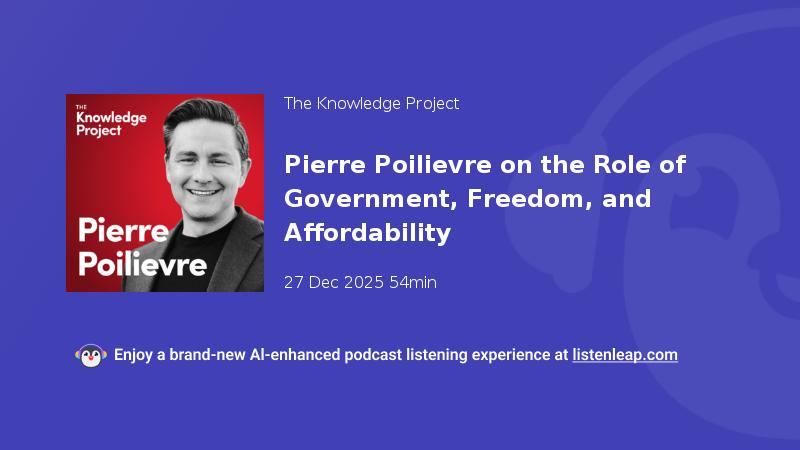
This is a special episode of The Knowledge Project, featuring our guest Pierre Polyev, leader of the Conservative Party in Canada.
After my last interview with Pierre, I heard from thousands of you thanking me for allowing political leaders to skip the slogans and loaded questions and speak with nuance and depth.
I reached out to both Mr. Polyev and Prime Minister Carney directly with the same invite.
No questions were provided in advance and no editorial control was given.
It's time to listen and learn.
What do you think the role of government in society should be?
You have to start by asking, what is government?
This is generation screwed.
I'm not surprised that they feel detached and frustrated with the system and the government that screwed them over.
Let's walk through the rap sheet.
My purpose is to provide people with hope.
And that's not just a touchy feely word.
It's actually a political strategy for me, because if people can be convinced that there's hope, then they'll vote for it in election.
It's a very exciting things we can do, like get rid of capital gains tax.
The media is dependent on the government.
Can something that is dependent be independent?
If you think that the average reader, viewer or listener is incapable of determining what is true and what is not, well then, how will a government official be able to make that same determination?
Pierre, welcome back.
Great to be back.
What do you think the role of government in society should be?
Well, you have to start by asking what is government?
And The only thing that's unique about government is that it has the legal power to apply force.
That's it.
There are plenty of other decision-making bodies associations, governance structures around society, but they're not governments because they cannot apply force legally.
So you start with the first principle that government is the legal use of force.
So The only thing that government should do is the thing that people can't do for themselves, that we, as people, need to be forced to contribute to or be part of, without which it would not exist.
So, for example, a military border control, policing some basic infrastructure and supplying necessities to those who would otherwise not be able to provide for themselves.
Those are all things that would not happen. if the government was not requiring it.
And therefore those are the things that government should do.
It should not do things that people can do for themselves.
So I think of the world of business.
We don't need government subsidies to prop up businesses because there are sources of funding for businesses.
It's called credit and capital.
We have very developed capital markets and credit markets where you can raise money.
So there's no need for government to do that.
There's no need for government to be the provider of media.
This is a media outlet right now.
Why is it that you need the government to do what people, free citizens, can do for themselves?
And the answer is that you don't.
So my view is that government should only do what the people can't do for themselves and then leave the rest to free people to decide how to live.
How do you define Canadian national identity and how would a government under your leadership strengthen or reshape that?
I always ask myself what what is the thing we all have in common?
And in Canada it's never been ethnicity, even when Wilfrid Laurier was asked what is Canada's nationality?
He couldn't define it as an ethnic nationality, a religious nationality or any other kind of bloodline, because by that time and this is 100 years ago we were all mixed up already.
We had Scots and Irish and first peoples and french and english, and so he said canada is free and freedom is its nationality.
People come here for freedom.
They don't come here for the weather.
I mean, look out the window um, they come here because, when you know the place they came from, they weren't free to build a life, start a, a family, build uh, you know, afford uh food and housing.
They weren't free to speak their mind or practice their faith.
So they said let's go to this place where you can, you're free to do all those things.
And whether it was the pioneers of the 1800s who settled the West, or the Catholics who settled Quebec hundreds of years before that, or it's the person who gets off the boat in 2025, figuratively speaking, it's almost always for that same freedom.
And so we share that in common.
But how do you preserve that freedom?
Everybody has to be Canada first.
They have to put this country first.
And what we've allowed to happen over the last decade is that the government has said that Canada has no national identity.
We're a postmodern, post-nationalist state.
And there's nothing that binds us together.
And as a result of that and mass migration on levels that are not absorbable, people are increasingly divided along for along demarcation lines that were in their country of origin.
Rather than coming here and leaving that all behind, these protestants and catholics tore each other's eyeballs out for centuries in europe, but they got along in canada because they said we're canadian here and i don't care if my neighbor's a protestant or a catholic.
They're my neighbor and they're a fellow Canadian.
And that is that we have to get back to.
We're all Canadian.
We're all here to enjoy freedom together.
And to do that, we have to be Canada first.
What's our role in the global world then?
If we're Canada first, what's our responsibility to the rest of the world?
Well, the first responsibility is to put our own country above all else.
So that means...
We need to unlock our resources, fund a strong military that preserves our sovereignty without being overly dependent on any other country for our defense.
Those are the first things that we have to ask.
What makes us safe?
What makes us secure?
What makes us an affordable country?
Those things must be the top of the decision-making matrix for a prime minister.
After that, we can ask how we can help.
And I believe that our general posture should be to favor freedom and democracy over tyranny and dictatorship, because it's generally in our interest to have more democracy and freedom in the world than it is to have less.
So that is how I would prioritize it.
So it's sort of like putting on your own mask first, like when you're on the airline when they make the safety announcement.
It's like you have to put your own mask on first because you can't take care of other people if you're can't take care of yourself.
Well exactly, and you know, i i've said i'm very clearly i will be cutting foreign aid.
I find it appalling that we had 22 million people lined up at food banks, that we got a return of scurvy in canada, our one in four kids are going to school hungry and yet we're putting, we're giving money to the un and other international bodies supposedly for foreign aid, And I think we should bring our money home and put our own country and its national interest first and foremost.
I think everyone agrees we have an immigration problem, But not everybody agrees on what that problem is or what the solution looks like.
Talk to me about that.
The first thing is too much, too fast.
You know, we we have been the Liberals have been bringing in a million people a year and growing our population almost 3, while our housing stock grows by 1.
Our job market grows by about the same, and our availability of doctors and nurses grows by about that one or 2.
So when your population is growing faster than healthcare, housing and jobs, then eventually you're going to have shortages.
It also makes it hard for people to integrate.
We used to bring people in very large numbers, but in numbers that you could integrate into Canadian life.
So people would arrive here and they'd be encouraged to sure keep their foods and their customs and traditions, but also they'd be told about Canada, our war history, Terry Fox, our proud past, all of the millions of people we've saved by allowing them to come and take refuge here.
And people were genuinely proud.
But the woke liberal ideology imposed over the last decade has been to say that Canada is nothing but a racist country with nothing but shame, and we should denigrate the history, knock down our statues.
And so people come here into a vacuum, and it's not hard to figure out why they don't feel as much of a commonality as they did 10 years ago, when they arrived and they were proud.
My wife came here. you know, roughly three decades ago, she was extremely proud to be Canadian.
Like she loved Canada and she thought and her whole family thought this is the best place in the world.
And they learned that in school.
They learned that this was a great country and they, they should be very, we should all feel privileged to live here.
And I think that is part of the missing piece.
We have to get back to telling people Canada is amazing and it's a privilege.
So when you come here to our country, you're Canadian first and you're proud of it.
Speaking of amazing, it's really easy to get trapped in what's wrong with Canada.
But what do you think is going right and how can we build on that?
Well, I think our people are fantastic.
I meet the people across this country and they're astonishingly brilliant.
I go to factory floors and I see people programming a CNC machine and I say, my God, the brainpower that goes into running this kind of machinery.
It's mind-blowing.
Um you um, you see how hard people work.
I'm actually.
The thing i love right now is our young people.
Actually, this is the hardest the.
The youth of today are the hardest working generation of youth since the second world war.
Everywhere i go i meet, you know, a waitress who's got like she's working 60 hours a week and she's taking university classes.
It's like wow, that's work ethic.
Now it saddens me that she has to work that long.
But On the flip side, what does it say about the potential of this country when you see a generation of youth who are willing to put in that much time and effort to get ahead?
And if we could unlock their potential with a government that's worthy of them then man, we could be easily the most affordable and richest country in the world.
I was reading an article the other day about how youth are feeling checked out, too.
Is that because there's no rung?
If you think of capitalism as a ladder, that first rung seems to have gone higher now.
And it's harder to get a job.
You go to school, you get an education, you come out and you're applying with 700 other people for one job.
Right.
And that's changed.
Yes, this is generation screwed.
Uh, and frankly, I am not surprised that they feel detached and frustrated with the system and the government that screwed them over.
Let's walk through the rap sheet of the government of the last 10 years.
When it comes to youth, the doubled housing costs.
So young people can't even come close to making a down payment.
Uh, you know it takes till you're late in your late thirties to to afford a down payment.
Then they have driven up the cost of rent, so even just surviving in a rental situation, treading water, is more and more difficult.
Food prices are up, so young people have had to downgrade their diet and then, as you say, jobs are missing, partly because the we haven't unblocked our resources and partly because the government is bringing in so many temporary foreign workers and international students who, through no fault of their own, are filling jobs.
And of course, some in the corporate elite love it because they get to pay lower wages.
But it means that our young people can't get those jobs.
Even in places with double-digit youth unemployment, there are temporary foreign workers who are making in reality less than the prevailing wage and driving wages down and jobs out.
So The young people today have had it harder, as I say, than any generation since the Second World War.
And what I'm trying to offer them is hope, jobs, and homes.
Those are the three things.
Hope is important.
I'll come to hope last, though.
Jobs, we know what to do.
Stop bringing in temporary foreign workers.
Get rid of that program altogether.
Unblock our resources so that our young trades workers can make you know 200 grand 250 as pipe fitters welders, industrial carpenters etc.
Cut taxes on job creation.
And then homes.
We need to unblock home building by speeding up permits, getting taxes off houses, off home building, and let people afford to have a house again and start a family.
But I'll close off with hope, because what I worry about more than just the ad policies of the government, is that the liberals will convince young people to permanently lower their expectations just to say yeah, it sucks.
It'll never get better no matter who's in power, but it could be worse.
And I had.
I was on another podcast about four months ago and this lady asked me well, Shouldn't we just accept that home ownership is a thing of the past and we're all going to be renters?
And I said, no, you shouldn't accept that.
That's ridiculous.
Everybody should be able to afford a home if they get a job and work hard.
We should be the cheapest place in the world to afford a house.
We have the most land to build on.
And I don't want liberals to gaslight people into thinking that things cannot get better.
My purpose is to provide people with hope.
And that's not just a touchy-feely word.
It's actually a political strategy for me.
Because if people can be convinced that there's hope, then they'll vote for it in an election.
If they can be convinced that things are hopeless and they'll never get better, then liberals will win by default.
So my strategy is one of reinstilling hope.
It seems like the second, third order consequences of that, too, are also impactful.
So people, when you can't find a job, you delay marriage, you delay having kids.
Talk to me about that.
Well, I met an airline attendant who said that him and his wife are making that.
We're in the process at that moment, of making the decision to never have kids.
Because they can't afford it.
And it was a simple economic decision.
He said, like we can't afford a house and we don't want to raise a kid in a six or 700 square foot apartment.
And even if we tried, we were already, you know, up to our eyeballs in grocery bills and rent and other expenses.
So adding a child, which is obviously thousands of dollars of costs every year.
I argue worth it, but if you don't have that money, then how do you do it?
And so him and his wife or wife to be.
How do they?
Why is it they're having to give up on a major life decision because of numbers?
It doesn't make sense.
We've always been able to afford to have kids in Canada.
How is it that with all the advances in society that that's not possible?
It And the good news is that we know how to fix it.
We need to get back to sound money, to free enterprise, to open up the opportunity so that young couple can actually build a home, build a family, build a life.
One of the things I don't see people talk about a lot when it comes to having kids is sort of the third order.
If that was the second order, consequence the third order is you just tend to be more selfish, right in a way, in how you vote.
And it's really hard.
Like we think about, you think about voting for your kids.
You think about you want Canada to prosper long term.
That's a lot harder, I would imagine, if you don't have kids.
I would talk about the inverse of that.
And I understand some people don't, for them, it's not the right decision to have kids.
But But they are an incredible blessing.
I know for me, it's been a great blessing to have kids.
Even though I was a very late bloomer I think I was 39 when we had Valentina and in my 40s when we had Cruz.
But it's been a great blessing.
It's taught me a lot of lessons.
And I even read a study a while back about people who had been laid off and had been long-term unemployed.
And the happiness level of those with kids was actually higher because, even though they didn't have a job, they had children bringing them joy in their lives.
And we want people to have the option.
I mean, people decide not to have kids.
I totally respect that.
It's going to be a great decision for some people.
But I don't want them to be forced into the decision by economic decisions imposed by government.
What do you see as the major factors facing Canada's lagging economic prospects and what are sort of the concrete steps, aside from pipelines, that we can take?
The problem is that we're spending too much on government and not enough on productive private sector jobs.
You know um every time we had a new government agency department bureaucracy.
That's a cost without a productive outcome.
And that sucks money out of the private sector into government consumption.
And so you think about these deficits we're running.
$78 billion has to be borrowed from somewhere.
Everything comes from something.
Nothing comes from nothing.
So there's two ways you can fund a deficit.
You can borrow it or print it.
If you borrow it, you're taking capital out of the private sector and putting it into the productive private sector and putting it into the unproductive government bureaucracy.
And if you print it, you cause inflation.
So it's lose-lose.
When Israel reduced its deficit in the 90s, it actually unlocked a lot of capital that then went into the tech sector and made it into the startup nation.
So I think by reducing the deficit we not only reduce inflation and the cost of living, but also we reduce the drain on the productive part of our economy.
There's also, I think, some very exciting things we can do, like get rid of capital gains tax when you reinvest in Canada.
The government's going to get its pound of salt one day anyway.
Eventually, you'll fully cash out and you'll want to enjoy everything you built up through the series of investments you made.
And then you'll pay your capital gains tax.
But if you want to keep rolling it over building factories mines pipelines, IT infrastructure, inventing new products, then why wouldn't we encourage that?
I mean, we should be taxing people.
We shouldn't be taxing people for what they put into the economy.
And I think it would be economic rocket fuel if we did that.
What should Canada's strategy be concerning our relationship with the United States, not just in the next few years, but say, the next 50 years?
How should we position ourselves?
So the first thing we have to acknowledge is that American capitalism is the most powerful economic force in the history of the world.
And the American military is the most powerful defense force in the history of the world.
And both of them are right next door to us.
We can't ignore that or pretend that it's just going to vanish.
We have to think long-term about how we use that proximity to our advantage.
So the first thing I would do is create leverage.
And that means unblocking the production and transportation of our resources to ourselves and to overseas markets.
Whether we like it or not and I like it oil and gas is the single biggest net export in this country period.
And there's nothing that is even close.
And there's nothing that any government strategy or subsidy program can ever do to change that.
So we have to unblock pipelines and LNG plants to our coasts.
You got one pipeline to Northwest British Columbia that the Liberals blocked and that I'm pushing for.
That would move a million barrels a day and 30 billion a year overseas.
That would be the single biggest boost to overseas exports in the history of Canada.
$30 billion works out to about $1,400 per every family every year, one pipeline.
And to put that into perspective, You know the trade agreement with Indonesia is supposed to give us 400 million.
So one pipeline will give you 75 times more export overseas than a trade deal with a relatively big country.
Then there's the LNG side.
We've got 1,300 trillion cubic feet of natural gas.
We just have to get it to coast, liquefy it, put it on ships, send it over to Asia and Europe, where it goes for four times the price that we pay for it here.
And you're talking like tens of billions.
Then you go to the Americans and say, okay, we've got options.
We have other markets now.
Deal with us fairly.
Take off the tariffs and let's trade.
And I think you'd have more leverage in that negotiation if you had done if we do unblock the other world markets that await us.
At the same time, I think we can offer the Americans a lot of mutual benefit.
We can supply more oil to America.
That will reduce their gas price at the pump.
They have an affordability crisis too.
We can sell.
We can be a reliable supplier of critical minerals, which we have as long as we get paid the market price for it, and we can ensure that our continent is secure from chinese russian, north korean and iranian threat.
By doing our part in the arctic and i think we put that all into a single package combined with more leverage i think we can get back to tariff free access to the most lucrative market in the world, which will make us and them safer, richer and stronger.
How do you feel when people compare you and your approach to Donald Trump?
And what do you see as the key differences between your approach and his?
Well, I think that's just a liberal tactic, because I've been winning the debate on inflation, carbon taxes affordability crime drugs, natural resources.
So they engage in in that distraction.
I find it ironic.
Here's Mark Carney, the guy who moved his corporate headquarters to the US, who has 90 of his assets in the US.
Carney dodges his taxes in Canada by putting them in the Caribbean.
And then he has the audacity to try and complete compare me to a foreign leader.
I find that very ironic.
You know by now.
I think people need to know.
People should know where I stand, because I've been extremely consistent.
I don't know if there's a political leader in modern memory in Canada that has been so consistent in what he stands for.
And I would just encourage people to judge me on what I've said for my entire political career.
It's been the same free enterprise, low tax, sound money affordable, safe country that I've been advocating for.
And I'm happy to stand on my own record.
I think you saw the Nokia deal that we recently did.
So I'm going to give a bit of a preamble for this question.
But We basically bribe foreign companies to come into Canada by paying hundreds of thousands of dollars from taxpayer money per job.
And this puts Canadian companies at a massive disadvantage.
In a sense, it's worse to actually be a Canadian company in Canada than to be a company headquartered elsewhere.
We are effectively taking our taxpayer money and sending it elsewhere, if you think about it that way.
And so why are we doing this?
And does that ever make sense?
No, it doesn't.
Giving money, taxpayer money, to foreign multinationals never ends up producing the promised jobs.
They find a way to lawyer and lobby the money into their pockets with few conditions.
And as soon as they get the cash, they dash.
And we've seen it with the Stellantis deal, where we're in for 15 billion and Stellantis is cutting jobs in Canada.
15 billion for one company that works out to almost 1000 for every Canadian family in taxes.
For a company that has, since it got the subsidy, reduced its Canadian workforce and increased its workforce in the States and going to the Oval Office to announce a 13 billion plan to invest in the US.
So my approach is guaranteed to benefit our country, because what I propose is let's cut taxes on investment income and energy in Canada.
So let's take my capital gains tax idea.
You get rid of capital gains tax on reinvestments in Canada.
You only get the money if you invest in Canada.
You cut taxes on Energy, for example, you only benefit from that tax cut if your company is using energy in Canada.
So we're better off to create a free enterprise, low tax environment for business to compete and to raise money through private investment.
In the way that I approach it then, to take money from workers and all businesses and give it to a favored few.
Do you think that optimizing for winning a reelection prevents our elected officials from making extremely difficult choices that might cause them to not be reelected, but are in the best interest of Canada long term?
Yes.
I mean, I can speak from experience.
I was running for in the last election for an Ottawa seat and I was very open about my plan to reduce the size of the federal bureaucracy and I paid the electoral price for that.
So some people say I should have done what Mark Carney did and just lie and say that the bureaucracy can keep growing when people are lined up at food banks and can't afford homes because of the cost of government.
But if I had done that, then I would be a liar.
I might have won my Ottawa seat, but I would be a liar.
And so I'd rather tell the truth, which is that in this case, the bureaucracy is too big.
And it's one of the reasons why people can't afford their lives rather than to make up stories and then betray people after the election.
Speaking of hard choices, recent court decisions in BC, including the Cowichan ruling and the implementation of UN DRIP, have raised concerns among Canadians about property rights, democratic accountability and economic certainty.
Pair this with increasing frustration that, despite the federal government spending over 240 billion on indigenous priorities since 2014, many indigenous communities still face poor outcomes.
In your view, what's the end state of reconciliation?
Well, I think the end state is going forward.
We have to create a country where everybody has opportunity.
I think the end state is the Enoch Reserve near Edmonton where Chief Billy Morin took 20 unemployment, brought it down to 3, took a huge deficit, turned it into a balanced budget and opened up his reserve to business so that his community became self-reliant and very proud that he's now a member of our caucus.
Or It looks like Kitimat, where Alice Ross, who's also one of my MPs now, was the chief counselor of the Haisla and signed a deal to bring the 40 billion LNG Canada project, the single biggest project in Canadian history of any kind, public or private.
This is going to be like tens of billions of dollars of benefit for all Canadians, and his people will now live in prosperity forever.
That is the end state of reconciliation.
It's not through court cases or government bureaucracies in Ottawa that only make us all poorer.
It is through the model that I just described of unleashing the power of enterprise opportunity and allowing First Nations to use their God-given talents in building our economy with other Canadians.
Has empathy been weaponized?
I would say complexity has been weaponized, because the whole bureaucratic apparatus in both the First Nations government departments now there's two
There used to be one, now there's two.
And in all aspects of government The average person, including indigenous Canadians, would look at and say that these programs aren't working.
They're making everybody except a small group in Ottawa Poor and they benefit only the people in power.
And The reason that that they get away with it is because it's so damn complicated how all these government programs in Ottawa.
They have good names and flashy PR programs but no one in the real world has time to figure out even what they do.
And so you know people are.
We're dumping tens of billions of dollars into all kinds of programs that have nice names you know, like build Canada homes, and which doesn't build any homes, or yet another defense procurement agency which can't figure out how to buy anything for our military.
But because the average welder or small businessman is too busy feeding his kids, building a business, paying his taxes, and he can't decipher it all, he ends up paying for it and getting nothing in return.
And that's not just the case when it comes to First Nations programming, it's the case with all the programming, And I don't blame the people, the grassroots people, either in First Nations or other communities.
I blame this bureaucratic and political industrial complex in Ottawa.
What role does media play in that?
Well, it should be to hold the government accountable.
You know unfortunately, our media seems to think that their job is to hold the people accountable to the government, rather than the government accountable to the people.
But, you know, every day there's a scandal that comes out in the form, like read Blacklocks.
They're actually a real media outlet.
They expose governmental wrongdoing and waste every day and it gets no coverage in mainstream media.
And so I think that's why people are looking for alternative media that will get them the facts that the government funded and corporate controlled outlets don't report.
I want to make sure I get this right, so I'm going to read it here.
The government of Canada has provided over 34 billion in subsidies, tax breaks and grants to support the operations of the Canadian media industry since 2017.
This figure doesn't include the amount spent on CBC or the amounts the government spends on federal advertising subscriptions with mainstream media company, and it does not include the numerous laws that they've used to protect the media from competition.
With such enormous amounts flowing from government, some Canadians are starting to question the independence of mainstream media organizations.
Can government subsidies to media organizations coexist with a free and open press?
Let's go back to language.
Language is important.
You've just made the case that the media is dependent on the government.
Can something that is dependent be independent?
After our last interview, to go on the media train here a little bit, several former political staffers reached out to me and told me that there is an unspoken quid pro quo in this town where backroom negotiations with journalists secure favorable coverage and avoid negative coverage in exchange for exclusive interviews.
What's your reaction to that?
I guess it's possible.
Media have to negotiate to get information, I suppose.
But I really don't.
I think the main problem is that too much of it is controlled by government and Too much of it is concentrated, and I think what we need to have is more independent voices like yours, so that Canadians have choice and freedom, and We've seen this government has been trying to concentrate more and more media power, whether it's through c11, which allows the CRTC to manipulate social media algorithms to favor certain types of media, and whether it's the proposed I think it was C-68, which was designed to promote, to get rid of what are called online harms, an ill-defined idea that could include things that the government considers to be politically incorrect, or whether it's the enormous subsidies that there's no question media outlets have to consider when they do their jobs.
So I think we need is more decentralization, more competition, more freedom, more choice.
And, you know, that's the the idea of having a free and independent media.
It's not perfect, but it's better than all the alternatives.
If we can't, if we don't trust the people to decipher what is the truth, then how can we trust people who are in government to decide for them?
It seems like Western countries, not just Canada, but they're cracking down more and more and trying to regulate what can and can't be said on particular platforms.
It's guised in the language of disinformation, misinformation, and fake news.
What are the consequences of free speech being curtailed?
Let's go back to first principles again.
If you think that the average reader, viewer or listener is incapable of determining what is true and what is not.
Well, then how will a government official be able to make that same determination?
If man is not capable of deciding for himself what is true and what is not, then how is he capable of deciding for others?
Put differently.
Some say what we need is a watchman to come in and He's going to say oh, this is true and this is not true.
So this can be broadcast and that can't be.
Who watches the watchman?
What if he's a liar?
What if he spreads disinformation?
If you think that a media, an independent media outlet, is going to spread disinformation, what's to stop the same disinformation agent from getting into the government bureaucracy that decides what's true and what's not?
There is no perfect answer to disinformation.
But the single greatest antibody to bad information is good information.
To have an overabundance of information so that the truth clashes with the falsehood.
And in the long run, human beings judge for themselves.
Now, you might say, well, that's naive.
How can you expect human beings to be able to make that discernment?
Well, that's exactly what the censors are claiming they're going to do.
They're going to hire human beings, presumably, to tell us what's true and what's false.
But if humans can't do that, then how can they do it for other people?
And the other answer is they can't.
The least bad option is to allow unbridled free speech, so that good ideas clash with bad, true information with false.
And in the end, the right side will win.
I always frame this to my kids, as you would never want to give power to your friends that you wouldn't want your enemies to have.
Exactly.
All right.
Let's step outside politics for a minute and do some get to know PR questions.
Growing up your wife may have tipped me off on this one, but growing up, who was your favorite wrestler when you were a teenager?
What did you love about him?
I loved Hulk Hogan at the time.
Why?
Well, you know, he was just like such a classic hero.
You know he was like a big lion heart and he would overcome hardship and he fought against Andre the Giant in that famous fight with that incredible body slam.
And, you know, he was it was outmatched in size and he was battered and bruised but he fought on and overcame and won and I I loved that that moment was like epic and But I used to go to Stampede Wrestling in Calgary, which was like the Hart brothers.
I don't know if you know the Hart brothers.
Well, they're all from Calgary.
Brett and what was the other guy's name?
Well, there's Brett, Owen, and then Bruce.
Bruce wasn't very well known.
But we go to that.
And when I was a kid, I loved it.
And my mother was a substitute teacher.
So was Bruce Hart.
He was one of the lesser known, but a great guy.
So she convinced him to come to my birthday party.
My dad actually built a wrestling ring out of PVC pipe, some bed padding, like some bedding, uh camping, uh beds and he put some ropes around it and we had a ring in my front yard and bruce hart came and taught us how to wrestle.
And then my my buddy's dad owned a funeral home and so he showed up with the limousine that they carry the remains in, remove the coffin and so we could actually go to the stampede wrestling in a limousine And we sat and watched the match and it was probably one of my best ever birthdays.
So I still thank my parents for putting that on for me.
I was about 10 or 11 at the time.
Who's your favorite MMA fighter?
Right now, the guy I enjoy watching is Ilya Topuria.
I think he's... I'm just saying in terms of the pure enjoyment of watching him.
I think the guy is so fascinating.
He's a grappler.
He comes in through... He came in through wrestling and jiu-jitsu.
But he learned how to strike.
And he's a really good puncher.
You feel like you're watching a world-class boxer when he strikes and his head movement, his dodging, his knockout punches have been just something to behold.
And I think he's going to be kind of the big name in MMA for the next, the biggest name for the next little while.
I know he's going through a few challenges right now, but I think he's the funnest guy to watch these days.
What's your favorite thing to do with Cruz these days?
I would say building things.
He loves to build and assemble, so mostly Lego.
We put together a little gingerbread house for Christmas the other day, and he likes to meticulously assemble projects.
I would say the second thing is reading.
Depending on the week.
Sometimes he really loves books, sometimes not so much, but I love reading with him.
So that's what I would say are the two favorite things.
Explain the Let's Go to Home Depot song to me.
Well, there's this Spanish song my wife listens to.
I obviously can't figure out what they're saying.
So I just insert English words all the time and start singing them along.
And her and her family always laugh at me.
And so one of the songs sounded to me like they're saying we're going to go to Home Depot.
We go to Home Depot.
So they're all listening to music, enjoying themselves.
And I walk in and start singing like a gringo and brings lots of laughter to them.
You've been underestimated over and over again in life.
Did that start early?
Yeah, I think so.
I mean uh, when I, when I was first elected, I was running against a minister of national defense and I was 24 years old and he'd been elected, I think, six times federally and municipally and no one thought I had a hope and I won that.
And then, um, most people thought I would never get into cabinet.
I did that.
And then I don't think people expected that I would win the leadership of the conservative party with such a strong victory.
But I like being underestimated.
What's your guilty fast food pleasure?
You know, I don't have a lot of guilty fast food pleasures anymore.
I've become much more disciplined in my diet.
So I always had a weakness for ice cream, but I'm pretty hardcore disciplined now.
I'm mostly a carnivore diet now.
What's your workout regimen?
Kettlebells.
Every day?
No, I wouldn't say every day as often as I can.
The great thing about kettlebells, you can do a full body workout in 15, 20 minutes and you're set.
You don't need to work out the next day.
And I just do some body weight.
Usually in my hotel room, I bring some bungee cords along just for like some fine tuning.
It's nothing impressive, but if I'm on the road for long periods of time and I don't have my kettlebells around, Then I just use some bungee cords, push up squats, that kind of thing.
And I can usually I can bang out a workout in 15 minutes.
You got to be efficient.
Tim Hortons or Starbucks?
I don't love either of them, to be honest.
I like independent.
I like independent coffee shops that are stronger.
I like strong coffee, really strong.
I don't like it watered down.
I like, you know, a really punchy, like Turkish coffee or espresso.
I don't like anything with too much water in it or milk.
Boxing or MMA?
I'd say MMA, but I love both.
Hockey or baseball?
Hockey.
Desert or ocean?
Desert.
Why?
I find the desert incredibly beautiful and peaceful.
I like the dry air.
I've been to a lot of deserts.
Like my wife and I had our honeymoon in Morocco and we went to the desert and slept there.
And I just find the desert to be incredibly beautiful.
I love the hot, dry air.
It's very peaceful.
I love it.
What's your least favorite household chore?
Matching socks.
I hate when you pull a big pile of socks on and you have to sit there and try to match the.
It's the most frustrating thing in household living.
If your wife had to describe you in one word, what word would she use?
I think she would say determined.
And how would you say the kids would describe you in one word?
Ridiculous.
Because I love to horse around with them.
I love to tease them.
I love to wrestle with them.
I love to make funny faces.
And half the time it makes them laugh.
And the other half the time it makes them want to give dad a little hit across the face.
What's your favorite memory with your family from the past year?
I can't think of one particular moment, but i would just say watching valentina make progress.
She's really progressed.
She has obviously some, some challenges, but she's very communicative.
Now she's not quite speaking yet and she uh, she knows how to communicate through her own form of sign language, her own.
She understands words.
So she and you know that because she responds to what you're saying And she actually can project into the future so we can tell her what she's going to be doing throughout a morning.
And as the morning progresses, she will walk through that day.
She was just at the shopping center with Anna I think it was yesterday and she picked out a little pair of dress shoes.
She was very proud when she got back to our residence for lunch a Hanukkah party that she could put her her her fancy new dress shoes on.
And she had a little bit of makeup and she was pointing at her lips saying, you know, to indicate she wanted makeup on and she's become very advanced.
And I think she's much happier little girl.
She's calmer now.
She's sleeping a lot better.
So I can't pinpoint like one instance.
I could just tell you that that progression for us has been really great.
Do you ever get stressed?
Less and less, you know.
The more stress I face, the less stress I become.
Because you learn that not only in theory but in practice that worrying has no point.
There's no purpose to it.
And I focus on what I can control.
And that is the most liberating thing you can do.
And whether it's the serenity prayer or I saw this Hindu priest online and he said he had a magic formula to end all worry.
He said, you ask yourself these questions.
Do you have a problem?
No.
Why worry?
Yes.
Do you have a solution?
Yes.
Then why worry?
You don't have a solution?
Well, then why worry?
At the end of the day, no matter what the circumstances, worrying won't make it better.
So I have found, as I've grown, I used to be a lot more.
I used to have much more anticipatory anxiety in my youth.
Like what's going to happen?
Oh, we got to control events.
But now you realize there are certain events out of your control and you focus on the things that are in your control.
And it's an incredibly liberating feeling.
How do you maintain hope in politics?
And I'll sort of, I'll give you a bit of context to this.
I find the more I pay attention to politics, the more it affects me as a person.
It affects me positively and a lot of optimism, and it affects me negatively and sort of I wouldn't say cynicism, but despair, almost like things aren't getting better and how do we make things better?
And I feel for all the millions of people who are lined up at a food bank and I feel for our policies and the consequences of those policies.
How do you maintain hope?
What other choice do we have but then to have hope?
And, you know, I meet so many people that tell me that they see me as their hope.
And what strikes me about them is they don't give up.
You know, like I meet people who are fighting every day just to get by, just to feed their kids.
I meet the middle-aged couple that wants to have kids and they can't afford a home.
I meet the mother who lost her kid to an overdose, but she's still advocating for drug treatment to save other people's sons and daughters.
And these people don't give up, so I don't give up.
That's what keeps me going.
That's what keeps me having hope.
Speaking of drug treatment, we give drugs to people.
That doesn't seem to be working.
Why do we keep doing that?
That's a very good question.
The answer is that there's a whole apparatus that profits off of keeping the drug crisis going.
Is that federal or provincial?
It's a combination.
It's federal in the sense that there are federal transfers to local governments that give out these drugs.
And there are federal exemptions to the Controlled Drugs and Substances Act that make it legal to consume otherwise banned substances in, But there is a an entire apparatus that is profiting off of the drug crisis.
And they have enormous political power the pharmaceutical companies, the bureaucracy, the consultants, the agencies.
And if the drug crisis were to vanish, they would all stop profiting from it.
So they keep it going.
And I'm sorry that people don't want to hear it, but that is exactly why this problem has gotten bigger and worse over time.
Governments, pharmaceutical companies and a whole group of parasitical interest groups have created this crisis and perpetuated it.
You know, the irony of this is this.
How did we get into this drug crisis?
Where did it start?
A bunch of corrupt pharmaceutical companies, like Purdue, came up with Oxycontin.
Claims that it was harmless and non-addictive, pushed and bribed the medical community to over-prescribe it, particularly in hope communities that were deprived of hope due to economic conditions.
They got literally millions of people hooked on it.
They killed half a million Americans and 50,000 Canadians.
And now we're told that the solution to pharmaceutical addictions to pharmaceutically prescribed drugs is to give out more pharmaceutically prescribed drugs, profiting the same industry that caused the crisis.
This is insane.
We need to do exactly the opposite with treatment and recovery.
And there are incredible treatment centers and almost all of them are based on getting off drugs completely.
Not like trying to give people more in different types of drugs.
They get them off drugs and they give them treatment counseling, physical exercise, group therapy, job placement, housing.
I met with a group in Windsor.
They have a 70% success rate on the first treatment. to get guys off drugs.
And one of the guys young guys there.
He actually got out started a home renovation company that only hires graduates from the treatment facility.
So he's got like five employees and they're all recovered drug addicts.
And so there are ways to do it.
We can do it.
We can get people off drugs.
So my message to people is if you're addicted to drugs, there is hope.
And not only that, we need you.
We need you to get better so you can be an inspiration.
You can go onto the street and grab the next guy, pull him off the ground, bring him in for treatment and then he's going to go on the street and pull in the next guy.
And we're going to create that virtuous circle until we've saved every one of our brothers and sisters.
It seems like we don't think of second, third, fourth order consequences to that.
And so one of those is, you know, when you go, I was in a merge a few weeks ago.
And I'm surrounded by a lot of people who are OD'd on drugs.
So when we think about wait times at hospitals, when we think that the leading domino to this problem in some cases is that we're giving people drugs for their addiction instead of solving the addiction and then cutting off supply,
Yes.
And we should lock up fentanyl dealers.
It takes two milligrams of fentanyl to stop your lungs.
So my view is anyone who's caught marketing or producing more than 40 milligrams enough to kill 20 people should be given a murder sentence.
It should be considered murder to give out, to remove those numbers.
Because if you spray bullets into a crowd, you might not know who you're killing.
There might even be a miraculous chance that you don't kill somebody.
But you know you're probably going to kill someone.
If you're spraying 40 milligrams of fentanyl around, you're going to kill somebody.
So you should be charged with murder and never come out of jail.
That's my view.
I'd like to return to locking people up.
Bad people.
Well, yes.
The good news is there's not a lot of them.
There's not a lot of them.
There's actually not a lot of criminals in Canada.
Crime will go down.
Crime is a tiny group of criminals that rampage through our streets literally all day, every day.
You take them off the street and you automatically return to safety.
And we can do that.
I want to end with an optimistic question.
What are you most hopeful for in the next year?
I am hopeful that we're going to get back to the promise of the country, that We restore the idea that anybody who works hard gets to have a great life, own a nice house, live on a safe, safe street.
That's why I'm in this.
If I didn't think that was possible, I wouldn't be doing it.
But I do have hope that we're going to restore that country.
And I'm going to fight every day to make that happen.
Thank you, Pierre.
And thank you for taking the time today.
Privilege.
Thanks for having me.
Thank you.