Hello hello, hello and welcome to English Learning for Curious Minds by Leonardo English, the show where you can listen to fascinating stories and learn weird and wonderful things about the world at the same time as improving your English.
I'm Alastair Budge and today we are kicking off another three-part mini-series, our last for 2025.
The theme for this month will be Liani di Piombo, the Years of Let, the almost 20-year period of post-war Italian history that was marred by violence, terrorism and murder.
In part one today's episode, we'll be talking about the early years, focusing on the bombing at Milan's Piazza Fontana, the search for the culprits and its political fallout.
In part two we'll talk about the Red Brigades and the kidnapping and people's trial of the former Prime Minister, Aldo Moro.
And in part three it'll be the final years the bombing of the Bologna train station, the state crackdown in its aftermath and the legacy this period has on modern Italy.
As with all our miniseries, parts two and three will be member-only episodes, so now is my time to briefly remind you that you can listen to those, as well as our hundreds of other bonus episodes, with a membership of Leonardo English.
This gives you access to more than double the number of episodes, plus all of our learning materials, including instant translations in 12 languages, study packs and much, much more.
So if you are ready to take the next step on your English learning journey, the place to go is leonardoenglishcom.
Okay then, let's not waste a minute and get right into it.
It's easy to romanticize the Italy of the 1960s.
Handsome young men with jet black hair, beautiful women with bright red lipstick.
The hustle and bustle of a cafe in the morning, the smell of coffee from the espresso machine, the beeping horns of mopeds from the streets outside.
And in the afternoon of December, the 12th 1969, some version of this scene was no doubt being played out up and down the country, a nation that had only recently celebrated its 100th anniversary as one unified state.
In Milan, Italy's second largest city and industrial centre.
It might have seemed like it would be an afternoon like any other.
In the headquarters of the Banca Nazionale dell'Agricoltura, the National Agricultural Bank, just a stone's throw away from Milan's central cathedral.
The business day was drawing to a close.
It was 430 in the afternoon, but the bank at Piazza Fontana was still full of customers, with people from the countryside who had travelled into the city to do their business before the weekend.
Many would never make it home.
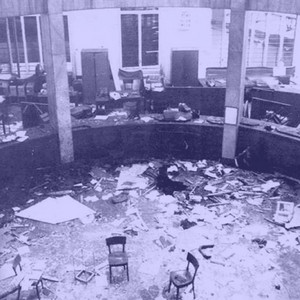
At 16.37 there was a huge explosion in the central atrium of the bank.
14 people were killed instantly, while three more would die from their wounds.
88 people were injured.
Nobody knew it at the time, but it would mark the beginning of a nearly two-decade-long period that would come to be known as gli anni di piombo, the years of lead.
Two decades of modern Italian history, that would see an astonishing 14591 acts of political violence, an average of two every single day.
Now, before we get into the details, let me add one little disclaimer.
This period is full of mystery and intrigue.
The lines between left and right are blurred.
The Italian state is not one single entity.
And this is one of the most controversial and emotive periods in recent Italian history.
So if there are generalizations, I hope you will excuse them.
I actually listened to an Italian podcast about this period and the narrator spent the first 20 minutes giving a very long disclaimer.
This one is shorter and I won't stop every two minutes to say this is a generalisation or to explain the difference between two slightly different right-wing groups, as that would firstly be tedious and it would also mean we'd be here for hours.
So, phew, we've got that out of the way.
But before we get right into the years of lead themselves and to better understand why Italy lived through such a tumultuous period and, for the purposes of today's episode, what all started it, we must remind ourselves of what was happening before.
Italy, let's remember, was still a very young country, little more than 100 years old.
For centuries, it had been a patchwork of kingdoms and city-states.
Someone from Turin in the north would most probably have felt more in common with someone across the border in Geneva or Nice than with their fellow Italian from Naples or Palermo in the south.
And when the Kingdom of Italy was created in 1861 and this collection of different regions was stitched together and given the name of Italy well, these divides didn't go away overnight the richer, more industrialized north and the poorer, agrarian south, the city and the countryside and, of course, between regions with centuries of rivalry between them.
Italy was united on a national level, but significant differences and divisions remained.
Little more than 50 years into the creation of Italy came World War I and shortly afterwards, Mussolini and 20 years of fascism.
For these two decades, the fascist party controlled every aspect of life.
And when Mussolini fell in 1943, his political ideology did not disappear with him.
Fascism might have been discredited, but it certainly did not go away.
It remained like a ghost hanging over Italian politics.
And the other important factor when it comes to understanding the Years of Lead is what was happening in Italy at the end of the Second World War.
Italy was initially allied with Nazi Germany, but switched sides in 1943, surrendering to the Allies.
What this meant was that, for the last two years of the war, the country was effectively split in two.
In the north, German troops and the remnants of Mussolini's fascist regime fought bitterly against partisan resistance fighters.
In the south, mostly American and British allied soldiers occupied the country and pushed northwards.
By 1945, peace had returned to Europe, but Italy was exhausted and deeply divided.
And almost immediately, it found itself on the frontline of a new conflict, the Cold War.
Italy had the largest communist party in Western Europe, which was directly supported by Moscow.
But it was also home to powerful Catholic and conservative forces that looked in the other direction, to Washington, for protection.
So for the CIA and the KGB alike, Italy was not just another European country.
It was an ideological battleground.
And while all of this was playing out, Italy was changing fast.
In the 1950s and 1960s, the country experienced what was called the Miracolo Economico, the economic miracle.
Millions of Italians left the poor countryside of the south to work in the booming industrial north, in cities like Milan, Turin and Genoa.
This was the era of fiat, of the spaghetti western of Sophia Loren and Federico Fellini, of Italy becoming a rich modern state.
Perhaps it's hard to imagine it as anything other, but let me give you some statistics to illustrate quite how fast and steep this transition was.
In 1955, only 3% of Italians had a fridge at home and 1% had a washing machine.
By 1975, the figures were 94% and 76%.
And in a similar period, average incomes tripled.
It was a huge transformation, a veritable miracle.
But this miracle was uneven.
While some Italians grew rich, many were left behind.
The South remained poor.
The new urban workers were crammed into overcrowded neighbourhoods.
They were overworked and underpaid.
Strikes and protests became part of daily life.
Students occupied universities.
Workers occupied factories.
The autumn of 1969 became known as Hot Autumn and was marked by protests and strikes for better pay and working conditions.
Meanwhile, the ghost of fascism was emerging from the shadows.
The sense of crisis was everywhere.
By the end of the 1960s, Italy was a country of contradictions modern and prosperous on the surface, but fragile and unstable underneath.
And it was in this Italy, divided, restless and full of tension, that the bombs began to explode.
Indeed, the explosion at the bank in Milan was not the only bomb that day.
In Rome, three bombs exploded at almost exactly the same time, with injuries but fortunately no casualties.
Another was discovered before it went off.
Clearly, this was a coordinated effort.
But, perhaps surprisingly, nobody claimed responsibility for the attack.
Within hours, investigators announced that far-left anarchists were to blame.
Leaflets and manifestos from radical anarchist groups had been circulating, and the police quickly rounded up dozens of suspects.
One of them was a 41-year-old railway worker called Giuseppe Pinelli, who was a well-known anarchist in Milan.
Pinelli was taken to the police station for questioning.
But after three days of interrogation, onlookers would see him crashing out of the fourth floor window of the police headquarters, falling to his death.
The official verdict was initially that he had committed suicide.
Few bought this, and his death would become one of the most infamous episodes of the period, a symbol of police brutality and the deep mistrust between the Italian state and the left.
Now we will return to Pinelli and what might really have happened in a few moments, but we must first move on with this fast-moving story.
The day after Pinelli's death, the police announced they had arrested another man.
His name was Pietro Valpreda and he was a member of a small anarchist group.
Valpreda protested his innocence and pointed out that the only evidence against him was the testimony of a taxi driver who said he had dropped him off at the bank.
The evidence seemed shaky at best, but Valpreda was quickly cast as the monster of Piazza Fontana and thrown into jail.
He had to wait three years for a trial.
Then, by the time the trial took place, the only witness against him, the taxi driver, had died of a heart attack.
Valbreda would spend the best part of the next two decades in the Italian judicial system, and it wouldn't be until 1985, 16 years after the attack, that he was eventually acquitted of all charges.
As you'll see throughout this mini-series, the wheels of the Italian judicial system move very slowly and aren't always very just at all.
So, if Pinelli and Valpreda didn't plant the bomb, who did?
And why?
Well, it has now been attributed to a far-right neo-fascist group called Ordine Nuova .
The possible involvement of this group and the fact that it was an attack by the far-right rather than the far-left was something that the authorities were aware of relatively soon after the attack.
But there are accusations that actors within the police might have covered this up.
Why?
Why might it have been advantageous for the bombings to be pinned on the far left?
Well, one theory is that this was not just a cover-up, but part of a broader pattern, a way of using fear to manipulate politics.
By carrying out acts of terrorism against civilians and then blaming them on the left far-right extremists, sometimes with the knowledge or protection of parts of the state, they could frighten ordinary Italians into demanding stronger security measures and a tougher, more authoritarian government.
In the years that followed, this pattern would appear again and again.
Bombings that targeted innocent people, rushed accusations against the far left and investigations that mysteriously fell apart.
Journalists and magistrates would later call this la strategia dell'attenzione, the strategy of tension, a campaign of fear intended to keep Italy from drifting towards communism and bolstering support for a stronger, more authoritarian state.
And there is also a broader international dimension linking back to Italy's status as a frontline of the Cold War.
At the end of World War II, there were secret stay-behind NATO operations set up across Europe where operatives were tasked with resisting in the event of a Soviet invasion.
In Italy this was called Gladio, So its remit was to stay underground, only emerging if the Red Army ever crossed the Iron Curtain.
But there are suspicions that Gladio operatives were a little more active than they were supposed to be.
In Italy, some of these networks are suspected of overlapping with the far right.
As to the extent of these overlaps.
Well, some accuse Gladior operatives of direct collaboration, of helping far-right terrorists source bombs and plant attacks, while others accuse them of simply turning a blind eye.
For what it's worth.
The Americans say that they never collaborated with terrorists and that this is Soviet disinformation.
What does seem clear is that quite a few members of far-right groups had pretty intimate knowledge of the operations of Gladio and have suggested Gladio operatives tolerated or even encouraged these acts of violence.
It is speculation, and it's highly unlikely that the full extent of these connections will ever come to light.
And on the subject of things never coming to light and the murky connections between the police, the state and the far right, we must return to Giuseppe Pinelli, the railway worker who came crashing out of the police station window to his death.
As you'll remember, the police initially said it was suicide, but soon there were conflicting witness reports with other officers saying he had fainted from exhaustion, that he was near the window and was so tired after extensive questioning that he simply fell over out of the window.
Now, even if this were true, clearly the police have a responsibility to anyone in custody to make sure they don't die, so they must bear the responsibility for Pinelli's death.
And of course, many didn't buy this official accidental verdict, suggesting instead that Pinelli was either beaten to death by the police and then thrown out of the window to make it look like suicide, or the police were dangling him out of the window to try to get him to confess and somehow they lost their grip and he fell.
And it wasn't just general police mistrust.
Later, autopsies were full of inconsistencies, suggesting that Pinelli was likely dead before he hit the ground and suggesting he suffered a serious blow to the neck before he fell.
In other words, he was killed by the police and then they threw him out of the window to try to cover their tracks.
Terrible in any case, and made even worse when you think about the fact that Giuseppe Pinelli shouldn't have been there.
For starters, there is no evidence he had anything to do with the bombing.
He was innocent.
And secondly, Italian law says that the police can hold a suspect for 48 hours without charge.
After that, they have to be either charged with a crime or released.
Pinelli had been held for three days, way past the legal maximum, which indicates that police might have taken to even more extreme measures to force a confession.
And this case gets even murkier still when you hear that the police officer who was responsible for Pinelli's arrest and interrogation, a man called Luigi Calabresi, was himself murdered in 1972, two and a half years after Piazza Fontana.
His murder would be claimed by far-left activists as revenge for Pinelli's, but there are theories that he was actually murdered by the far-right or even state elements, as he was one person who knew the truth.
Now, when talking about much of the years have led, it's hard not to get too pulled in to these webs of conspiracies and theories.
After all, there is an abundance of evidence that elements of the Italian secret services had obstructed investigations, hidden evidence and even protected suspects.
Files went missing.
Witnesses gave contradictory testimony.
Judges complained of being misled by the very police and intelligence services meant to help them.
Not just after Piazza Fontana, but throughout the years of lead.
Some officers were later convicted not for planting bombs themselves, but for covering up who really had.
As to their motivations, the links they may or may not have had to politicians, foreign powers, even organized criminals.
That is a subject that is still debated today.
What is clear is that the Piazza Fontana bombing and the subsequent years of carnage that it unleashed would be deeply destabilising for Italy.
This strategy of tension, as it would later be called worked, or at least it created a hostile, frightening environment.
The images of the destroyed bank atrium shocked Italians.
Shattered glass, broken marble, bloodstains on the floor where customers had been waiting only moments before.
And the victims were not politicians or police officers.
They weren't even political activists or protesters.
They were ordinary men and women.
Farmers who had come in from the countryside to deposit their savings.
Workers finishing up their business on a Friday afternoon.
In a country that was already on edge, the message was terrifying.
If you could be killed simply by walking into a bank in the centre of Milan, then nowhere was safe.
And Piazza Fontana was only the beginning.
Over the next decade, bombs would go off in trains in public squares at police headquarters.
Some were carried out by the far left, but an overwhelming majority by the far right.
Hundreds of Italians would die, thousands would be injured and entire generations would grow up in a country where violence was part of daily life.
But perhaps the most famous and most shocking episode of all was still to come.
The kidnapping and murder of the former Prime Minister Aldo Moro.
And that, my friends, is where we will go in part two.
Okay then, that is it for today's episode on the Piazza Fontana bombing.
As a quick reminder, this is part one of a three-part miniseries on the Years of Lead Liani di Piombo.
Next up will be the Red Brigades and the kidnapping of Aldo Moro, and in part three it'll be the bombing of the Bologna train station and the legacy this dark period has left on the country.
As with all of our mini-series now, parts two and three will be member-only episodes, so let me quickly remind you that you can listen to those, as well as hundreds of other bonus member-only episodes over at leonardoenglishcom.
You've been listening to English Learning for Curious Minds by Leonardo English.
I'm Alistair Budge.
You stay safe and I'll catch you in the next episode.