
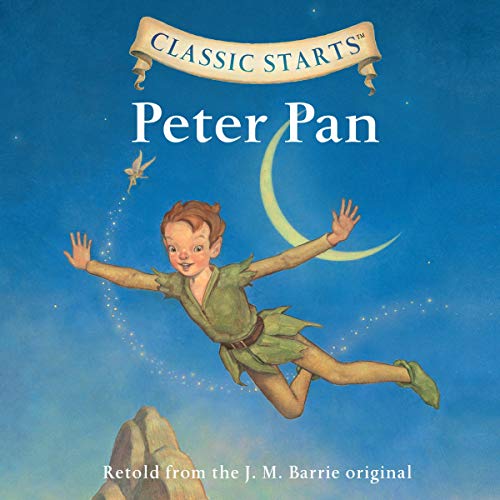
[The First Encounter: Peter Pan, Wendy, and the Jealous Fairy]-[Peter Pan - Part 04]
📋 Summary
A Midnight Meeting: The Arrival of Peter Pan
The narrative unfolds in the Darling household, where the departure of Mr. and Mrs. Darling leaves the nursery in a state of quiet transition. As the nightlights flicker out, the room is illuminated by a "strange, blinking glow" emanating from a water jug. This light reveals the presence of Tinkerbell, a fairy described as "no bigger than your hand," who is frantically searching for Peter Pan’s lost shadow. Peter’s arrival marks the beginning of a profound encounter between the boy who refuses to grow up and Wendy Darling.
The Mending of the Shadow
Peter’s initial state is one of distress; he is discovered crying on the floor because he cannot reattach his shadow. When he attempts to affix it like a "pair of pants" or a "hat," the shadow resists, highlighting the whimsical yet disconnected nature of Peter’s existence. Wendy, acting as a maternal figure, intervenes with her sewing kit. Despite her observation that Peter’s lack of a mother and his "funny address"—"second to the right, and then straight on until morning"—are tragic, Peter remains largely indifferent to these social conventions. He views mothers as "overrated" and is primarily concerned with his functional needs, such as getting his shadow "sewn on."
The Nature of Kisses and Growth
A pivotal moment occurs when Wendy attempts to navigate the complexities of affection. After Peter is reunited with his shadow, Wendy suggests that "a thank you might be nice." When Peter fails to grasp the social expectation, Wendy demands a kiss. Peter’s response—dropping an "acorn button" into her hand—perfectly illustrates his developmental stagnation. He is a boy who "ran away on the very day [he was] born" to avoid the prospect of growing up. Wendy, displaying a gentle wisdom, accepts the acorn, deciding to "wear his kiss on a string around her neck," thereby shielding Peter from the embarrassment of his own innocence.
The Jealousy of Tinkerbell
As the dialogue shifts to the origin of fairies—Peter explains that "when the very first baby laughed for the very first time, its laugh broke into a million pieces," with each piece becoming a fairy—the tension in the room rises. Tinkerbell, having been accidentally locked in a drawer by Peter, emerges in a "flurry." Her reaction to Wendy is immediate and hostile. When Peter asks if Tink can be Wendy’s fairy, the fairy responds in her bell-like language, calling Wendy a "huge, ugly girl" and asserting her exclusive claim over Peter.
The Lost Boys and the Dynamics of the Nursery
The interaction concludes with Peter sharing tales of the "lost boys" who fell out of their strollers and were never claimed. Peter’s assertion that "girls are too smart to fall out of their strollers" serves as a charming, if backhanded, compliment that briefly delights Wendy. However, the scene ends on a note of discord. Tinkerbell’s persistent "naughty" behavior—manifesting as pulling Wendy’s hair—reveals a core theme of the chapter: the "enormous case of jealousy" that the tiny fairy harbors. Much like the adults in the Darling household, Tinkerbell is subject to complex emotional triggers, proving that even in the magical realm of Peter Pan, the dynamics of affection and possessiveness remain a powerful force.

Deep Learning with ListenLeap


