It's the Book Club for Kids.
It's the Book Club for Kids.
It's the Book Club for Kids.
It's the Book Club for Kids podcast. It's a bonus edition of the Book Club for Kids.
Hi, I'm Kitty Felde.
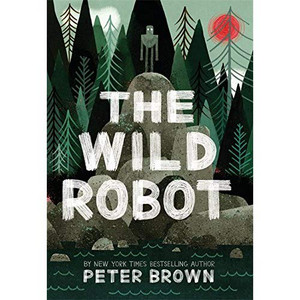
Last week we talked about Peter Brown's novel about a robot stuck in the woods.
It's called The Wild Robot.
This week we asked Peter about both writing and illustrating, beginning with, how do you plan out your stories?
So, I do this thing I call story mapping, which is, basically it's just figuring out the plot of the story, but in kind of a visual way.
I'm a visual guy as an illustrator, and it can be hard to organize my thoughts, especially in something like The Wild Robot, a big story with lots of different moving parts.
So to kind of make it more manageable to me, I start writing down my little ideas on a sheet of paper and I'll circle each little idea, each little moment that I think should happen in my story.
And I'll draw an arrow from one little moment to the next to the next.
And sometimes I'll cross out a little moment in the story because I realize it's not that important after all or I'll kind of rethink it and adjust it and write another one next to it and then I'll use that moment instead of the original one.
I end up with this sort of web of circles and arrows and words on a piece of paper.
But if you look carefully, you'll see a series of little ideas leading from one to the next to the next to the next that start telling the plot of my story.
And for me, that really helps me make sense of all the different ideas I have for a story.
I started doing that with picture books.
And when I started writing The Wild Robot, my first novel ever, I thought, well, it worked pretty well with picture books.
Maybe it can apply this to a novel as well.
And so I did just that.
that, I story mapped the whole story, and then I would kind of story map each individual chapter, and whenever I'd get stuck, I'd just start doing the story mapping thing, and that would help me kind of work through any little problems I bumped into along the way.
It sounds a lot like when you watch detective movies or television shows, and they have the evidence board where they're drawing all these lines and things.
It sounds very similar.
Yeah, well, it kind of looks like that, actually, yeah.
I could probably do something like that actually on a wall.
Most of my story maps are or just on a big sheet of paper.
But I moved into an art studio recently where I'll be working from now on, and there's a big chalkboard on the wall.
So it could be that in the future I'll do my story maps on a big chalkboard, and it'll kind of look like one of those scenes from like a thriller movie or whatever.
So tell us about this teacher you met at an early age.
You didn't hit it off particularly well, but she was really the one who discovered or recognized the fact that you had an artistic bent.
Yeah, it's funny. She inspired a whole picture book called My Teacher is a Monster.
her because we didn't get along particularly well she was the toughest person I'd ever met in my life and I had her for a whole school year and so I was pretty nervous and not very happy but you know she she at one point had us drawing pictures in class for some sort of project and I was drawing and she saw my drawing and she really liked it and she complimented it which felt pretty good and so she shared it with an art teacher and actually ended up asking this art art teacher if there was any kind of extra art classes available around town somewhere you know and turns out there was and the art
teacher knew about it and they got my parents on the phone and before long I was taking extra art classes every Tuesday and Thursday afternoon and feeling like a little I was a real artist you know I was taking classes with other kids who really love drawing or painting or whatever and you know that that goes a long way towards developing a kid's sense sense of confidence, and we all were going to be good at something, and here I was.
I thought I was good at something, and so I took it seriously, and I took these classes, and I took it more and more classes as the years went by, and here I am a professional illustrator now.
So who knows if I would have gotten here anyway, but certainly that teacher who was pretty tough and was not my favorite person ended up having a huge effect on my life for the better.
When you're writing a book that either has illustrations or it's a picture book.
Which comes first, the words or the pictures?
Every book is different.
Sometimes I'll work on a picture book and it'll begin with a little doodle in my sketchbook or it might begin with a sentence or a word. I wrote and illustrated a picture book called Children Make Terrible Pets which began as I just for some reason was just messing around in my sketchbook and I wrote a sentence that said something like like, a wild animal brings a boy home to be her pet.
Because I was thinking about how when I was a kid, I would go into the woods and sometimes bring home turtles and stuff, and, you know, my mom would say something like, you know, wild animals make terrible pets.
And so there was a sentence that really got the ball rolling.
And from there, I wrote more, and I started figuring out what kind of animal would bring home a pet boy and kind of trying to actually use sort of logic to work out how the story would unfold.
Other times, like, I made a picture book called The Curious Garden that just began when I discovered a real place in New York City called what's now called the High Line Park.
At the time it was just this sort of abandoned railway that was all covered with weeds and grasses and trees and wildflowers and I just began drawing pictures of nature in a city, like wild nature growing up in city places and I probably was drawing those scenes for a year before I started piecing together some sort of a story.
So every book is different and has its own kind of journey I'm sure I'll have some other story in the future that will begin in some other way that I can't even imagine right now.
You cross genres, so talk a little bit about the difference between, I mean there's the obvious, a picture book's shorter, it has pictures in it, fewer words, but other than that, as you move through genre, middle grade, you're thinking about YA, what's different?
I spend a lot more time with my characters in a middle grade novel, for starters.
I have to know them a lot better, I have to flesh out their personalities more and I end up getting more attached to the characters as a result of that.
Personally, it's a very different experience to spend two years on the Wild Robot and then maybe almost another, more than two years actually, but two years focused on the Wild Robot and then maybe another two years focused on the sequel, The Wild Robot Escapes.
That's four years plus that I spent with this character Raaz the Robot and so the kind of of attachment that I develop with this character is so different.
I love my picture book characters, but I don't live with them for very long.
I was kind of surprised at how kind of deeply I cared about my own invented characters.
And I get that to an extent with the picture books.
They all reflect kind of a little slice of my personality or my history or my life experience in some way.
But nothing has been as much me as what I did in the Wild Robot books.
So yeah, that was a big difference between the two and best piece of writing advice particularly for a young writer who is trying to figure it all out the best piece of writing advice I think I can probably give is to read your writing out loud to yourself because oftentimes we write and then we think we're done we hand it in to a teacher or whatever an editor maybe without really even knowing well what we we just wrote.
We kind of rush ourselves sometimes in our eagerness to get this thing wrapped up.
But when you read it out loud, suddenly you trip over clumsy words.
Syllables might be a little clunky.
You might want to rethink a character's name even, because it's hard to pronounce when you say it out loud.
And so I find that readers and writers of all ages from little kids to professionals I think can benefit hugely from just getting in the habit of reading their writing out loud to themselves seeing hearing how it sounds and adjusting their writing until it sounds uh kind of rhythmical and if the words flow together nicely and then maybe you're almost done maybe we have interviews with lots of writers about writing at our website at websitebookclubforkids .org.
And before we let you go, we wanted to let you know about another wonderful podcast. It's called The Fina Mendoza Mysteries, the tale of the daughter of a congressman who solves the mystery of the demon cat of Capitol Hill.
Be sure to subscribe The Fina Mendoza Mysteries.
I'm Kitty Felde. Thanks again for listening.