All right.
So I truly think it's super important for every single business owner to have a personal brand, every entrepreneur to be in the social media space somewhat.
If you're not, you're missing out on a lot.
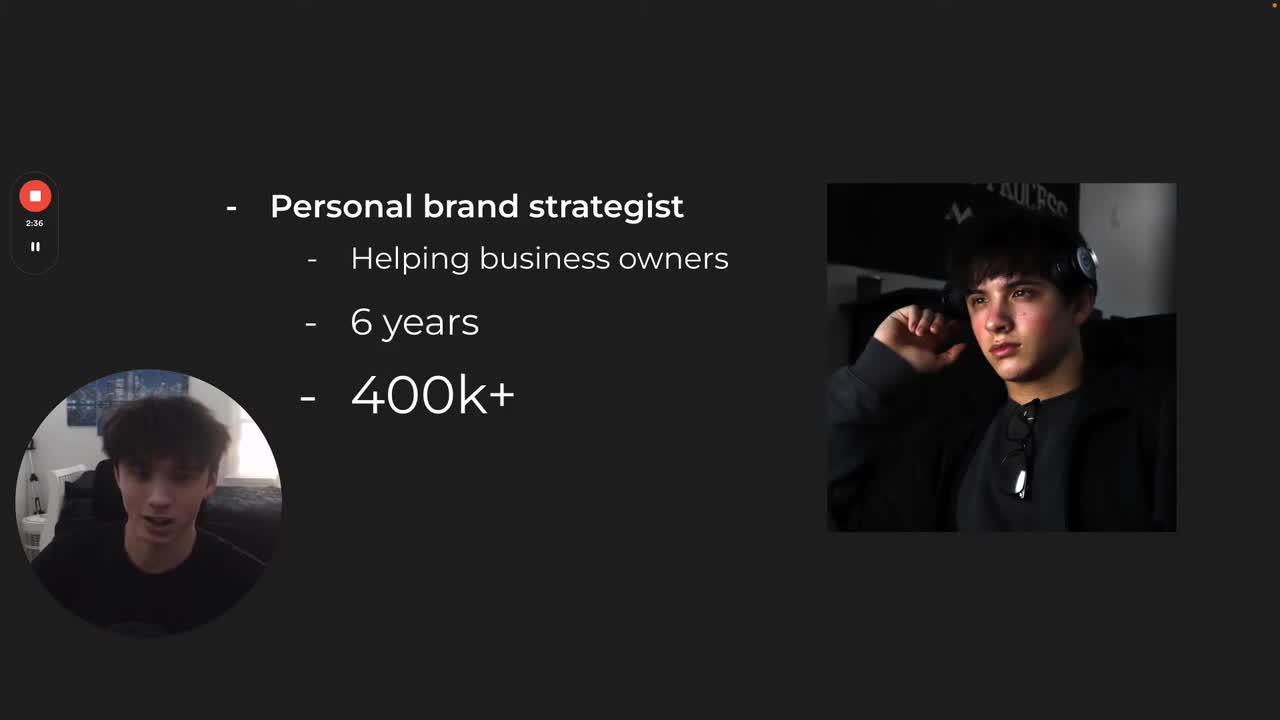
So I'm going to walk you through my strategy to get over 400000 followers with my personal brand in about a year.
I'm Trey Gustafson.
I'm a personal brand strategist.
I'm helping business owners start and grow their own personal brands to really build that trust and authority with potential customers.
I've been working in this space for the past six years.
In the past year of being in the content space, I've been able to get over 400000 followers with my fresh personal brand, which I said started about a year ago.
Here's proof.
Here's the Instagram, 225K followers, TikTok, YouTube, there.
Sorry to flex on you, but there's my follower counts just so you know that I've actually done it.
So how did I do this?
I did this by creating Andrew Tate subway surfer split screen videos.
No, I'm just kidding.
So that's not actually what happened.
I created these super cinematic, super helpful videos for essentially young men to level up their life and to get motivation, to get the inspiration at the start to actually go and make a change with their lives.
So I was in like that motivational gym niche for a while.
And as you can see here, 17 million views.
The views were just going crazy.
5 million views here.
These are all consistent also.
So like 1.5 million, 600,000, 2.4 million, 5.5 million.
These are consistent views coming right after the other.
Like this is a lineup of videos on Instagram reels.
Did the same thing on YouTube.
Same thing on this video here, which is a completely raw iPhone video.
160,000 views.
And like that reach is just crazy.
If you ever wanted to drop a product or anything, having reach like this, these numbers on YouTube, which is long form videos where you get to show off personality and really explain like, how good you are at a certain scale super, super helpful to have.
And just to build that personal brand, which is a long-term thing.
So here's YouTube, you know, 90 days, 600,000, 675,000 views, pretty crazy.
And the way I did this is pretty simple.
I just created good videos.
So the hardest part is defining the subjective definition of good.
What is a good video?
You know, it's hard to determine what a good video is, but that's the secret.
You just have to create good videos over and over again to get those types of views, those types of numbers, and then pull the followers that I've been able to gain over the past year.
So here's lesson one.
Use these exact hooks, songs, and hashtags to go viral.
Use carnival, use for you page, hashtag for you.
So don't don't actually do these things.
A lot of people say, you know, use these hashtags, use this sound, use this trend post at these times to get high view counts.
It's like, no, that's not how it works.
It works by creating good videos.
And that's why I say the secret to virality is to just create good videos.
And it's almost that simple, but you have to break down what a good video is.
So we create good videos by creating for people.
Why?
Because it's not robots watching our videos.
It's not the algorithm watching our videos.
There's no AIs watching our videos.
It's real people.
Real people are watching our videos.
So that's who we create for.
The algorithm's purpose is to find those good videos and push them to more people who enjoy them.
So the algorithm is trying to get the videos to this person.
And let me show you here.
A lot of us.
What we want is we want our video to go straight to the viewer, right.
We want our video to just reach 17 million views, like i've been able to do just at the start, right?
But that's not how it works.
It has to go through the algorithm first.
So let me explain why you shouldn't go too algorithmic, because you could go down the route of you know only hashtags and sounds and trends, because you want the algorithm to pick it up.
The algorithm here is optimizing for this part.
You can't just go straight from video to viewer.
You have to go through the algorithm, but the algorithm wants you to be able to get to the view, So it's just a little roadblock there.
It's a little something in the way.
But if you understand how the algorithm works and how the algorithm wants us to create for people, then you can easily bypass this whole roadblock here and make it an advantage.
So how does the algorithm determine if a video is good?
Because again, we're optimizing for good videos.
That's what we want to create.
How does the algorithm know if a video is good?
The first thing is retention rate.
It tracks if the video is interesting enough to keep watching.
If the viewer is interested enough to keep watching the video, then that means essentially the retention rates high because the viewer watched more of it.
The second metric it uses is interactions.
It uses interactions to know if the video is fulfilling enough for the viewer to take action.
Two very important things.
They want people to stay on the app and they want people to like the app retention.
Stay on the video.
Stay on the app.
The longer they stay on the video, the longer they stay on the app.
You know how it works.
The interactions is fulfilling them constantly.
So they want to stay on the app.
Let's touch on retention rate real quick first.
So the definition of retention rate is average percentage viewed.
It's just the average that people stayed throughout the video.
If the average person stayed for 75% of the video, you'd have a 75% retention rate, essentially.
If they watch the whole video and watch it again, you could have a 200% retention rate.
You know, it's possible.
I've had a 140% retention rate, I'm pretty sure.
That stuff's possible in short form.
So the logic here is the longer someone watches the video, the more interesting the video is.
Because remember, the algorithm wants the viewer to enjoy their experience on the platform.
So they want to stay because that's how the app gets more money by people staying on the app.
The longer someone watches the video, the more interesting the video is.
That's how it works.
The techniques that we can use to actually make the video so good that people want to stay on it.
First thing is the hook.
There's two hooks.
Actually, the first hook is stopping them from scrolling.
That's the whole point of the first hook.
What do I mean by that?
I mean the actual first thing you do in the video, the first second, the first frame of the video is the first hook.
And that's just what you say.
What you show, whatever it is, it has to satisfy the viewer that you're trying to reach.
And then they will stop scrolling because they're, they're waiting for a reason to scroll, right?
They're sitting there waiting for a reason to scroll.
If you don't start it off on a good note, they're out of there.
They're going to the next for the next dopamine hit right away.
So you want it to be interesting in the first second.
You want to catch their attention.
It's like no one's going to want to watch a boring video when there's just another option right below it.
So make that first second very interesting with the first hook.
And there's the second hook.
This is something that not many people think about, but it's the most important part of your video, because everyone knows the first hook, but they neglect the second one.
The second hook gives the viewer a reason to keep watching.
So essentially you can do this with anticipation tactics.
And that is with music rises and compare and contrast concepts.
The music rises is like the viewers waiting for the beat drop because, if you guys don't know, a lot of people watch a video and they don't scroll until they hear that beat drop of the song.
So they like the song in the video, so they keep watching for the beat drop.
It's kind of crazy that like stuff like this is possible.
But if you pick up on patterns like this, you get the biggest advantage ever in the social media space.
So a lot of people watch videos for the beat drop of the music.
So you can use rises to kind of emphasize your point.
Like the hook can have a rise in it and the viewer is going to listen to the hook and listen to the second hook, like get into the second hook, waiting for the beat drop and the.
The second hook would be the, the music rise, and maybe something you say in the video.
So you want the second hook to give the viewer a reason to keep watching.
An example of this would be like you stop them.
First you say something interesting, like eating mcdonald's is killing your health, like whoa, i didn't know that.
And the second hook would be here are three ways to avoid it.
The third one's what changed my life.
They're going to stay for that third reason because that's the one that changed your life.
So that's an anticipation tactic.
It's giving them a reason to keep watching.
That's the second hook.
So compare contrast concepts.
Let me give you an example of that real quick.
So the whole point is to build anticipation the whole time to lead up to a worthy payoff essentially,
So let me put one, I'll throw it on the screen right now, but.
Let me listen to it.
In this world, you are one of two things.
The first is the consumer, the person who avoids difficulty, who seeks short term pleasure and lets their goals slip away as they watch others achieve theirs.
They are often found sitting on the sidelines, too distracted to focus on themselves.
And the sad part is that's probably who you are right now.
But what if I told you there was another option?
The creator.
The person who thrives on taking action.
They create for the consumers and have a burning desire to do something great in this world.
To make an impact.
To create something worth listening to.
The creator is always in the lead.
Sweet.
So you saw the video.
You can even hear the music rise there.
So I'd use the music rise when I was talking about the consumer.
And then, by the time we got to the creator, most people have already stayed because they're waiting for the good part.
You know, they listen to the bad part.
They're waiting for the good part.
Plus they have the music rise.
They're waiting for the beat drop.
So all those things together create that fulfillment.
They create that anticipation leading to the beat drop, which is the fulfillment.
There's a reason to keep watching.
And then I reward them for continuing to watch, loading the anticipation the whole time leading towards the worthy payoff.
The second thing is interactions.
So, like I said, interactions are a way for the algorithm to determine if the video is fulfilling enough for the viewer to take action.
I want you to think of it like this.
One like equals one point, a comment equals a hundred points.
That's how the algorithm kind of thinks of it.
I don't know if these numbers aren't ratioed correctly, but it's just a good way to think about it.
Everyone who comments usually likes.
So you want the most likes possible, but comments also matter.
So I'm just kind of putting into perspective, like they both matter a lot.
Comments are more effective for boosting the post in the algorithm though.
Because if someone comments that they went out of their way to click on the comments, click on add a comment and then type out a comment.
Think about what they're going to type, post it into the world for everyone to see.
Versus a like, they just click one button, so the comment is a lot more effort from the viewer.
Therefore, it shows the algorithm that the video was truly worth watching because they went through all that effort to post a comment.
A really good metric that i want all of you guys to understand likes over views.
This is the proportion that is going to determine if a video performs well.
Let me show you exactly what i mean.
So when you divided likes by views, you get a number.
This will determine, kind of, if the video is performing well, and it's a good way for you to track what videos performed the best for you.
Because you know, the ratio matters more than just the straight up numbers.
So this video had a 0.052 ratio of likes to views.
This one had a 0.066.
This one had a 0.096.
This one had a 0.115.
This one had a 0.119.
So you can see the views correspond almost directly to the ratio.
You can see that they're like the higher the ratio gets, the higher the views get.
Let me show you exactly on a graph here.
Higher ratio equals higher views.
You see that the ratio of likes to views increases, meaning for every view, for every 1000 views.
In this one, there were 52 likes.
And every 1000 views in this one, there were 66 likes.
You see the deal?
And every 1000 views in this one, there were 119 likes.
That means nearly one out of every 10 person who saw this video liked it.
And that's super important for the algorithm to pick up because it's like a lot of people who are watching are liking.
And the way I think about it, the rate at which the video is pushed is determined by this ratio.
If the video starts off with a super high ratio of likes to views, then it's going to be pushed out to more people at first.
And it's going to be continually pushed out until that ratio starts to drastically decrease.
So once the algorithm picks up oh, this ratio is going down.
You know it's hard to hit the target audience.
Not many people are actually liking the video that are watching it.
Then it's going to start not pushing the video out as much, because it's like this is wasting people's time.
We want to keep their feet clean and interesting so we can keep sparking dopamine.
So why would we push out videos that aren't interesting?
So then as the ratio decreases, so does your views and everything else.
Let's start with our video.
So our video here we must think of it from our videos perspective is the longer they watch, plus the more people that like and comment equals the higher the views.
Those two things there.
This is the equation for virality.
If I could put it in one equation.
This is it.
Retention and interactions equal views.
The algorithm thinks of it like this.
This is how the algorithm sees it because it's not a real being with emotions.
So it has to think of it through analytics and such things.
That's just how it does it.
The higher the retention rate is.
It's going to think oh, more people are watching the rest of this video, meaning it's more interesting.
And the higher the interaction rate is, they're like oh, people are actually liking the video after watching most of it, so then it's a good video.
They found the good video.
Like i said, you want to create good videos, the algorithm will find the good video, therefore pushing it out to more people.
As long as the video has a good ratio of likes to views and the viewer sees it as the more interesting the video is.
Plus, the more people fulfilled after watching equals the more views.
So this is going from like the very analytical perspective to the actual traits of the the viewer watching the video and how they feel.
It's just a cool way to think about it, because you don't want to be all algorithmic.
Oh, I need a high retention rate, high interaction rate.
So I'm going to use this color of font to get it.
And like, bro, like that's just, that's some crazy stuff.
You know, you want to create for the viewer.
So, like I said, we're trying to get from our video to the viewer that we got to go through the algorithm though.
So we have to play into retention rate and interactions a bit.
We should understand what makes those work.
So the, the underlying belief behind those is the more interesting the video is.
Plus, the more people that feel fulfilled after watching the video equals the more views the video is going.
So if you narrow it down to those two things there, then you're going to get more views, essentially.
Lesson two is to steal styles.
So I know you're thinking, whoa, don't do that.
Stealing is bad.
You're a fraud.
You're probably thinking stealing is horrible.
You know, don't be stealing styles.
But the truth is there's this meaning, steal like an artist.
This is like a thing from Reddit.
So it's not going to be the best definition of all time, but it's honestly a really good one, I found, because I know like, the true meaning behind it.
Here's what the person said.
When you say steal like an artist, it means getting inspiration from multiple sources, not by copying it, but by getting inspired.
Every single creator steals like an artist.
Every single artist steals like an artist.
Every single person in the creative industry or any industry, in fact, steals like an artist.
You're stealing like an artist every single day just by living and doing things.
The reason why every creator does this is because of proof of concept.
They steal like an artist because someone else succeeded with something, with their method.
So then, the creator, whatever it is, of art, of content, whatever they're creating, they steal that concept because there's proof that it works.
And that's the smartest thing you can do because you know it works already.
So you're going to do it again because you're like, oh, it works.
And I can replicate the success.
And it works sometimes.
There's ways to do it properly.
So let me just explain how to do this properly.
Because if you do it wrong you're going to get trapped in that whole chasing virality and views and money route that's going to put you into the short term game.
And in the long run you're going to end up losing.
So you do this properly by first stealing from multiple sources.
So here's how i did i stole from interstellar and blade runner for my cinematics.
Those are two styles that i kind of combined and like, took inspiration from in terms of how they do lighting, how they do angles and all those things like how they set the mood and stuff in their shots.
I stole those ideas and put them into my content on YouTube, Instagram, on TikTok.
I stole them and put them there.
For video ideas, I stole from Alex Ramosi and Sam Ovens.
I'll be honest, that's how I steal from because they have really good concepts they preach about.
So I listen to them, I learn from them and then I'm able to replicate their ideas and reword them in my own ways and figure out other ways to express them.
Because you know, everyone has to learn from someone and they just spit their ideas out in a new way of thinking of it.
So i listen to these guys's messages and then i improve them.
That's just how it works.
That's what everyone does.
It also with my square format.
So with all my videos they're in this square format.
If you've noticed, on instagram and tiktok i took this from some other creator, i don't even know who.
It was someone who created like super cinematic videos on tiktok.
I saw it and i was like oh, that's sick, no one's doing it in the gym motivation niche and it would certainly work in that niche.
So then I brought it over and once I brought it over to the niche, more people started doing it.
It's just, it's my style now.
So like after doing it for so long, it's just my thing.
So I continually do it in every single one of my videos.
And I don't think I've had one video where I didn't do it since that's the style that stuck with me.
And it shows that I'm like unique.
It makes me stand out.
So here's how to do this properly again with step two, steal from your sources source.
So one of my biggest inspirations for was nick peterson when i started off.
This guy creates like gym cinematic videos, so i took these ideas and replicated them into my own content.
Just the whole idea of having the super cinematic stuff.
I was like i want to be able to do this.
But you know, i tried replicating it.
I just couldn't get it right because it felt like i was copying him too much And that was because I was stealing from the secondary source technically, not from the primary source.
So you have to take it back a couple of steps and be like, where did my inspiration get inspiration?
So his main inspiration for his shots was Blade Runner.
And like I said, I use that for my cinematics now.
It also shows that like, if you're taking all your inspiration from content creators, then you're just going to look like a copycat, versus if you take inspiration from their inspiration, which is usually books movies, TV shows or whatever it is.
If you take inspiration from that, then you're not going to seem like a copycat on in terms of content.
But again, it's the proof of concept. thing because the movie was interesting to people.
They liked the shots in the movie.
So if you can replicate that into your videos without taking away the algorithmic perspective of interactions and retention rate, then all those things together are going to create a new style that will make you stand out plus really push your videos through the algorithm.
So tracking it back to the source of everything, like the primary source, that's the most important thing.
Number three is to include your own personality.
So it's really important to include your own personality in your content.
And this is just going to happen naturally.
So you don't even have to worry about it.
Honestly, as you create content, your own style, your own way of talking, your own way of expressing ideas is going to come out naturally.
Like the more you do it, the more your personality would kind of rise to the surface.
You may be a little uncomfortable at first with your personal brand.
But over time, you're going to just naturally be yourself on camera and naturally be yourself through your content, through your shooting style, through the music you choose.
So just let it come out naturally.
Don't try to hold it back and try to be someone you're not.
And the third lesson is going to be to systemize everything.
And this is one of the biggest things when it comes down to consistent posting and making sure that you're going to actually grow in the long run, because you know you can have one viral hit, but if you can't do it again, then you're screwed.
So here's how to do it over and over.
Here's the content system i use, like the literal.
This is a screenshot of the system i use in order to get my first million view video, my first 10 million view video, first 15 million view video and then eventually go up to the 400 000 followers on all platforms, like together was using the system here.
I don't use this one exactly now, but I use something very similar.
I'm just, I'm more focused on YouTube now.
So it's a bit different than this, but you can see, I start with the output.
So, everyone who does this, they should start with the outputs of what they're going to put out every single week.
Every week I wanted to post one YouTube, three short forms.
And that was it.
I was just pretty stuck on that.
Once you start with the output, so it's like, this is where I want to get to.
You have to track it back to what you should do, like in terms of micro actions.
So we have the major results.
We want the micro actions now.
So the input every week would be one YouTube planning session, one YouTube recording session, one short form scripting session, one short form recording session and three short form editing sessions.
So you can see there there's a lot.
But these two YouTube things like I need to plan the YouTube and I need to record the YouTube, that's for everything.
This was like for the raw format I was filming.
So there was no editing necessary for this.
So you can see those things go into the output of one YouTube every week.
And then I wanted to do three short forms every week so I could script them all in one go.
Then I would do one short form recording session here.
So I'd record them all in one go.
Like I had to switch outfits or something like on the go and I'd be able to get out three videos in one go.
I would edit the three videos in three different sessions.
So that's why I have three times there, but that would result in three short forms every single week.
And it was just that simple.
I found ways to systemize it into the actions I actually needed to take to get the output that I wanted.
Here's the content system, like the board that you would put everything in.
So I don't have any texts in here, but you would put one time YouTube planning session, like on Sunday, let's say you'd be like plan YouTube, split the outputs into inputs and you take the inputs and you spread them out throughout your calendar.
So you can consistently do the actions that drive results for your personal brand every single week.
And it's just a very easy way to stay on track and to visualize everything in one one.
Look, if you repeat that over and over, your content's going to improve like crazy because you're doing it a ton of times, and that's what happened with me.
Super beneficial because it reduces decisions, like i said, and also it allows you to prepare in advance so you know what's going to happen.
And lesson four is to trust the process.
It's not going to be easy.
It's going to take time and you have to understand that building your personal brand, just like anything good in this world, is a long-term game and it's going to take time.
Just be super patient with it.
Don't expect your first video to blow up.
Don't expect your first 100 videos to blow up.
Maybe don't even expect your first 500 videos to blow up, but eventually something's going to stick and you have to just keep putting those videos out.
Keep sticking to your schedule.
Eventually something's going to work out.
Stay patient, trust the process.
I promise you, with enough time of innovating, trying new styles and everything, something's going to pop.
If you want to learn more about everything I taught in this video, like more in-depth stuff and work directly with me.
I have a private community.
So I help online entrepreneurs, learning exactly what I just taught in this video, but on a much higher level.
So we have weekly calls.
We have the whole community where everyone's like close together.
Everyone who joins gets invited to it.
They join the inner circle and we all just work together to grow our personal brands.
It's much more advanced information than what you saw in here.
It's for entrepreneurs who are serious. about it.
So if you're an entrepreneur who's serious about growing your personal brand top link in the description you can join it.
You'll be able to hop in a call with me.
We'll talk about if you're fit for the program and fit for the private community.
Go check it out.
I don't really care if you do though, because you know I have plenty of people booking calls anyways.
Hope you enjoyed this and I'll see you in the next video.