Squiz Kids acknowledges the traditional owners of the lands on which we podcast the Turrbal and Combermeri people.
Squiz Kids!
It's your daily news fix.
Fun.
Free.
Fresh.
Hello and welcome to Squiz Kids today.
Your fresh take on what's happening in the world around you.
I'm Christy Kidgerina.
It's Wednesday, February 25th.
In Squiz Kids today a pay rise for kids robots, master kung fu, the koala Cupid strikes and a big record for tiny things.
That's what's making news kids style.
How far does your pocket money go these days?
If you're following the old 1 for every year of your age rule, you might be discovering that 10 doesn't buy what it used to.
With the price of snacks at the servo or corner shop creeping higher and higher, kids are getting a real life lesson in something called inflation when prices rise over time.
You might have even heard adults mention the cost of living crisis, which is just a way of saying everyday life has become more expensive.
New data from the UK shows that kids there got an 8 rise in pocket money last year, taking the average weekly amount to £1073.
That's about 21 Aussie dollars.
Tidying bedrooms was the most commonly paid chore, but watering and caring for plants earned the most per job.
And the biggest saving goal?
Well, that was holidays, followed closely by electronics.
That checks.
Here in Australia, Westpac Bank found that last year 55 of kids, so just over half aged between 8 and 17, earned pocket money, with the average weekly amount sitting at around about 25.
But whether it's $5 or $25, chores really aren't about the cash, are they?
They're about being part of a team, because families, just like footy clubs, work best when everyone chips in.
Spin the globe.
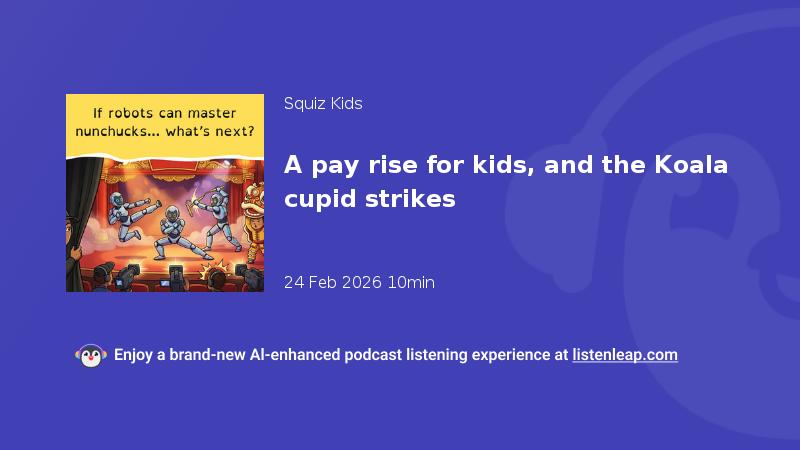
Each day, we give the world globe a spin and find a news story from wherever it stops, and today we've landed in china, where ai powered robots have been showing off their kung fu skills during china's hugely popular spring festival gala.
That's a tv event it's a little bit like the super bowl halftime show and it's watched by hundreds of millions of people.
More than a dozen humanoid robots performed an intricate martial arts routine for Chinese New Year.
We're talking perfectly coordinated fight sequences, sword flourishes, flips and balance so steady it'd make your legs wobble just watching.
The tech came from Chinese start-up companies like Unitru Robotics, and it's a big step up from last year, when more basic robots danced with handkerchiefs.
Experts say that the big leap forward is in the robot, in inverted commas, brains.
They have AI software that helps them balance and control small, precise movements.
Some people online were amazed and others like me, well, we were slightly unnerved.
So much so that news agencies around the world had to make sure that the footage hadn't been generated by AI.
There's a link for you to take a look in the episode notes.
China already produces the vast majority of the world's humanoid robots, and experts predict that these numbers will double again next year, which raises a question.
If robots can master Kung Fu today, what might they be learning tomorrow?
Animal Kingdom.
If your family's hooked on reality dating shows from rose ceremonies to farm romances here's one that you haven't seen yet.
Koala Cupid.
In the forests of New South Wales' mid-north coast, scientists at Goolabah are playing matchmaker for koalas, carefully pairing them up to help boost the wild populations.
But instead of judging personalities, they're studying DNA.
That's the genetic instructions for making every living thing.
The goal is genetic diversity, making sure koalas aren't related and a healthy biological match.
Size and age matter too.
Koalas are slow breeders.
They take years to mature, usually have just one joey a year and that joey sticks with the mum for at least 12 months, which means every match really matters.
The program has already produced seven joeys in a year, all preparing for life back in the wild.
Turns out, when it comes to finding love, koalas might be a little bit better behaved than reality TV contestants.
We haven't had a biggest furthest, longest for a while, and maybe keep this one away from any parent who's ever stepped on a tiny plastic toy in bare feet.
Shopkins!
If you've never seen one, imagine your fridge, pantry and wardrobe shrunk down to a thumbnail size.
Then, given googly eyes and glitter.
These tiny, colorful collectibles shaped like cupcakes, cereal boxes, sneakers and handbags became playground gold when they launched back in 2014.
Now one woman from Queensland holds the Guinness World Record for the largest collection of Shopkins.
She has more than 2,656 unique items.
She started collecting at just seven years old and now owns more than 4000 individual pieces, including duplicates.
Just oh my!
Q&A call out.
Attention all curious humans.
If you've ever had a science question that made your brain fizz, this is your moment.
Dr. Carl is coming to the Squiz Kids Q&A hot seat and he's ready for your questions.
Yes, that Dr. Carl.
Science explainer, myth buster, bright shirt enthusiast.
And you can ask him anything scientific, like how black holes form, why we get goosebumps or whether time travel is even slightly possible.
You can even ask him about how he knows so much stuff, what his favourite discovery is, or even maybe what it's like answering questions on the radio for like 40 years.
But don't dawdle, the Cut-Off is next Tuesday, March 3.
And remember Bryce told you on Monday to keep your ears open for a competition?
I'm not allowed to spill the beans just yet, but I am absolutely bursting to tell you.
Keep listening.
Trust me, it's definitely worth it.
Time for the quiz.
This is the part of the podcast where you get to test how well you've been listening.
Question number one.
What's the word we use when prices rise over time and money doesn't stretch as far as it used to?
Do you need a hint?
It starts with an I. Well done if you knew that it is inflation.
Question number two how much was the average weekly pocket money for kids aged 18 to 17 in Australia last year?
Was it A, about $5, B, about $21 or C, about $25?
Some lucky kids out there.
It is C, about $25.
Question number three.
What kind of performance did humanoid robots give at China's Spring Festival Gala?
Amazingly, they did kung fu.
Shout out.
It's Wednesday, February 25.
And on this day, way back in 1606, Dutch navigator Willem Janszoon became the first recorded European to land on the Australian mainland, stepping ashore on the western side of Cape York Peninsula.
That's the sticky addy tip at the very top of Queensland.
He was sailing a ship called the Dijfken when he encountered local Aboriginal people from the Wick language group.
The meeting didn't go smoothly and Jan soon mapped the coastline before sailing on.
At the time, the Dutch named the land New Holland, a name that would stick around on European maps for more than a century.
It's also a special day for these quiz kids celebrating a birthday today.
Kaelin from Epping, George from Hawthorne East and Mason from Kilseth.
Belated birthday shoutouts go to Zoe from Frankston South, Amanda listening all the way over there in Singapore and Benjamin listening all the way over there in Lucerne, Switzerland.
Classroom shoutouts today go to Class 456A with Mrs Murphy at Albury North Public Schools.
Class 45M with Mrs McNabb at Albury West Public School.
Class 5K1 with Mrs Carter at Springfield Central State School.
Class 34A with Mr Andrews at Tenelbar Bay Public School.
And lastly, but definitely not leastly, Class 6B with Miss Barton at Griffith Public School.
And don't forget people.
If you have a birthday coming up and you want a shout-out, or if your class is after a classroom shout-out, you can drop us a line at squizkids at thesquizcomau, or just fill out the form on our website.
Well, that's all we have time for.
Thanks for listening to Squiz Kids today.
We'll be back again tomorrow.
In the meantime, get out there and have a most excellent day.
Over and out.
Thank you.